

|
시장보고서
상품코드
2125426
영국의 초음파 기기 시장 : 시장 점유율 분석, 업계 동향 및 통계, 성장 예측(2026-2031년)United Kingdom Ultrasound Devices - Market Share Analysis, Industry Trends & Statistics, Growth Forecasts (2026 - 2031) |
||||||
 Mordor Intelligence
Mordor Intelligence에 의하면, 영국의 초음파 기기 시장 규모는 2025년 4억 3,441만 달러로 평가되었고, 2026년에는 4억 5,087만 달러로 추정되고, 2026-2031년 CAGR 3.79%로 성장을 지속할 전망이며, 2031년에는 5억 4,302만 달러에 이를 것으로 예측됩니다.
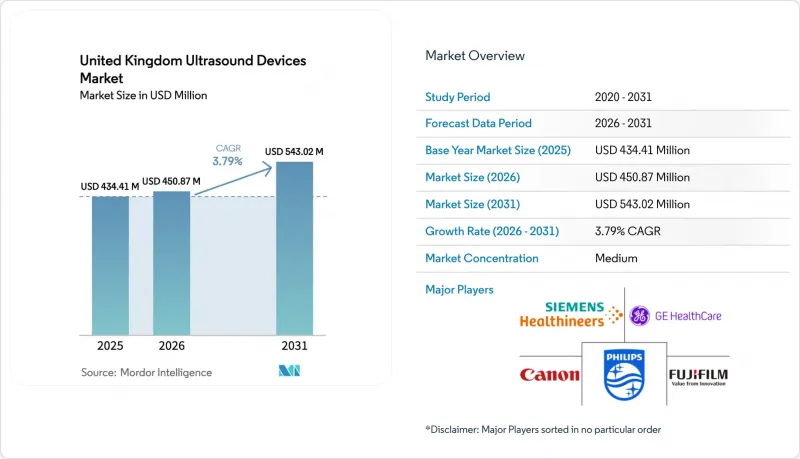
본 보고서는 용도별(마취과, 순환기과, 산부인과, 방사선과 등), 기술별(2D 초음파 영상 진단, 3D 및 4D 초음파 영상 진단, 도플러 영상 진단, 고밀도 집속 초음파, 기타 기술), 형식별(고정형 시스템 등), 최종 사용자별(NHS 병원 등)로 분류되어 있습니다. 시장 예측은 금액(달러) 기준으로 제시되어 있습니다.
영국의 초음파 기기 시장 동향 및 인사이트
만성 질환 부담 증가
2040년까지 잉글랜드에서는 930만 명의 주민이 중대한 질환을 앓게 될 것으로 예측되며, 그 추가 부담의 80%는 경제적으로 취약한 지역사회가 떠안게 될 것입니다. 심혈관 질환만 해도 약 230만 명이 앓고 있으며, 이로 인해 심초음파 검사 및 혈관 검사에 대한 의존도가 높아지고 있습니다. 암 신규 발병 건수는 2025년 42만 건에서 2040년에는 50만 6,000건으로 증가할 것으로 예상되며, 비침습적 종양 병기 분류 및 치료 경과 모니터링에서 초음파 검사의 중요성이 더욱 높아지고 있습니다. 이러한 요인들이 복합적으로 작용하여, 2차 의료 및 1차 의료 현장에서 고성능 트랜스듀서, 조영 검사, AI를 활용한 영상 획득 루틴에 대한 수요가 지속적으로 증가하고 있습니다.
지방 및 재택 진단 분야에서 휴대용 초음파 기기의 급속한 보급
소형화와 실시간 AI 피드백의 결합으로 인해 구급대, 요양 시설, 환자 자택에서의 원격 스캔이 촉진되고 있습니다. 영국 임상의의 20%는 이미 진단에 AI를 활용하고 있으며, NHS(국민건강서비스) 내 AI 도입의 35%는 현재 영상 진단 워크플로우에 통합되어 있습니다. Caption Health사의 재택 심장 스캔 시범 사업은 통합된 알고리즘이 조작자에 대한 의존도를 낮추고 인력 부족을 보완하는 동시에 병원 방문자 수를 줄이는 방법을 보여주고 있습니다.
엄격한 규제로 인한 제품 승인 지연
2025년 여름부터 시행될 MHRA(영국 의약품 및 의료제품 규제청)의 새로운 의료기기 프레임워크에서는 위험에 따른 감시가 의무화되었으며, 국제적인 승인 절차가 공식적으로 정해져 있습니다. 호주, 캐나다, 미국, EU의 인증과의 일관성으로 인해 중복 평가가 단축될 가능성은 있으나, 시판 후 추가 보고 의무로 인해 새로운 프로브나 소프트웨어 시장 출시까지 소요되는 총 기간이 길어질 수 있습니다. 규제 대응에 풍부한 노하우를 보유한 기업은 스타트업보다 이러한 복잡성을 더 쉽게 처리할 수 있으므로, 혁신 속도가 둔화될 가능성이 있습니다.
부문 분석
2025년, 방사선과/일반 영상 진단 분야는 NHS(영국 국민건강서비스) 병원의 복부 및 소부위 검사를 주축으로 초음파 진단 기기 시장 점유율 32.42%를 유지했습니다. 한편, 순환기과는 미세혈관 영상 기술의 비약적인 발전과 1차 진료에서의 심부전 선별 검사 증가에 힘입어 연평균 성장률(CAGR) 6.73%로 다른 모든 전문 분야를 능가하는 성장이 예상됩니다. 초음파 국소화 현미경법을 통해 과거에는 MRI로만 가능했던 벽 운동 및 관류 분석이 가능해지면서, 심초음파 검사의 임상적 유용성이 확대되고 있습니다. 예측 기간 동안 심장학이 초음파 진단 기기 시장 규모에서 차지하는 비중은 1,800만 달러 가까이 증가할 것으로 예상되며, 고급 심장용 프로브를 둘러싼 공급업체 간의 경쟁이 격화될 것으로 전망됩니다.
산부인과는 성숙한 분야이긴 하지만 여전히 수익성이 높은 분야입니다. 재택 태아 발달 모니터링에 관한 임상시험은 AI 통합이 널리 보급됨에 따라 소비자 대상의 새로운 수익원이 개척될 가능성을 부각시키고 있습니다. 중환자 치료 및 마취과 부문에서는 신속한 처치 지침을 위해 포인트 오브 케어 시스템에 대한 의존도가 높아지고 있으며, 견고한 휴대용 콘솔에 대한 기본적인 수요가 유지되고 있습니다.
3D 및 4D 모달리티는 산부인과 및 구조적 심장 영상 진단의 워크플로우에 힘입어 2025년에는 초음파 장비 시장 규모의 47.85%를 차지했습니다. 그러나 교체 주기가 장기화됨에 따라 그 성장세는 둔화되고 있습니다. 대조적으로, HIFU는 연평균 성장률(CAGR) 8.09%로 확대되며, 수술 대신 장기 보존 치료를 추구하는 종양 센터 시장을 점차 흡수해 나갈 전망입니다. ‘Ablatherm’ 및 ‘Sonablate 500’ 플랫폼은 임상적으로 유의미한 전립선암 재발률이 95% 미만임을 입증하여, 민간 의료기관과 NHS(영국 국민건강보험) 모두에서 도입이 가속화되고 있습니다.
도플러 및 조영제를 이용한 영상 진단은 간 병변 및 혈관 평가에서 여전히 중요한 역할을 하고 있는 반면, AI 기반 후처리 패키지는 자동 혈관 추적 및 플라크 정량화를 통해 2D 시스템의 성능을 향상시키고 있습니다. 예산 압박이 지속되는 가운데, 각 벤더들은 중급 콘솔로 전환하는 고객을 유지하기 위해 고급 소프트웨어를 번들로 제공합니다.
기타 혜택 :
- 엑셀 형식 시장 예측(ME) 시트
- 3개월간의 애널리스트 지원
자주 묻는 질문
목차
제1장 서론
제2장 조사 방법
제3장 주요 요약
제4장 시장 구도
제5장 시장 규모 및 성장 예측
제6장 경쟁 구도
제7장 시장 기회 및 향후 전망
AJY 26.09.15According to Mordor Intelligence, the United Kingdom ultrasound devices market size is expected to grow from USD 434.41 million in 2025 to USD 450.87 million in 2026 and is forecast to reach USD 543.02 million by 2031 at 3.79% CAGR over 2026-2031.
This report is Segmented by Application (Anesthesiology, Cardiology, Gynecology/Obstetrics, Radiology, and More), Technology (2D Ultrasound Imaging, 3D and 4D Ultrasound Imaging, Doppler Imaging, High-Intensity Focused Ultrasound, Other Technologies), Portability (Stationary Systems, and More), End User (NHS Hospitals, and More). The Market Forecasts are Provided in Terms of Value (USD).
United Kingdom Ultrasound Devices Market Trends and Insights
Increasing Burden of Chronic Diseases
England is projected to have 9.3 million residents living with major illness by 2040, with deprived communities bearing 80% of the additional burden. Cardiovascular conditions alone affect about 2.3 million people, prompting greater reliance on echocardiography and vascular studies. Cancer incidence is expected to climb from 420,000 new cases in 2025 to 506,000 by 2040, reinforcing the centrality of ultrasound in non-invasive tumour staging and therapy monitoring. The cumulative effect is sustained demand for advanced transducers, contrast-enhanced studies, and AI-guided acquisition routines across secondary and primary care.
Rapid Adoption of Hand-Held Ultrasound for Rural & Home Diagnostics
Miniaturisation combined with real-time AI feedback is encouraging remote scanning in paramedic units, care homes, and patient residences. Twenty percent of UK clinicians already use AI in diagnostics, and 35% of NHS AI implementations now sit in imaging workflows. Caption Health's home-based heart scan pilot illustrates how integrated algorithms reduce operator dependency, bridging workforce shortages while cutting hospital footfall.
Stringent Regulations Prolonging Product Approvals
The MHRA's new device framework, effective from Summer 2025, mandates risk-proportionate surveillance and formalises international recognition pathways. While alignment with Australian, Canadian, US, and EU certificates may shorten duplicate assessments, additional post-market reporting can extend total time-to-market for novel probes and software. Firms with deep regulatory benches will absorb the complexity more easily than start-ups, potentially tempering innovation velocity.
Other drivers and restraints analyzed in the detailed report include:
- Technological Advancements in Ultrasound Devices & Rising Diagnostic Usage
- Growing Private Fertility Clinic Segment Driving OB/GYN Ultrasound Upgrades
- Shortage of Sonographers Causing Under-utilisation of Installed Base
For complete list of drivers and restraints, kindly check the Table Of Contents.
Segment Analysis
Radiology/general imaging retained 32.42% ultrasound devices market share in 2025, anchored by abdominal and small-parts examinations across NHS hospitals. Cardiology, however, is projected to outpace all other specialties at a 6.73% CAGR, propelled by microvascular imaging breakthroughs and increasing heart-failure screening in primary care. Ultrasound localisation microscopy enables wall-motion and perfusion analysis once reserved for MRI, broadening echocardiography's clinical utility. Over the forecast, cardiology's contribution to ultrasound devices market size is expected to add nearly USD 18 million, intensifying competition among vendors for premium cardiac probes.
Obstetrics & gynecology remains a mature but lucrative field. Home-based fetal growth monitoring trials underline how widespread AI integration may unlock new consumer-direct revenue streams. Critical care and anesthesiology segments increasingly rely on point-of-care systems for fast-track procedural guidance, sustaining baseline demand for robust portable consoles.
3D & 4D modalities commanded 47.85% share of ultrasound devices market size in 2025, supported by obstetric and structural-heart imaging workflows. Yet their growth is moderating as replacement cycles lengthen. By contrast, HIFU will expand at 8.09% CAGR, capturing oncology centres seeking organ-sparing alternatives to surgery. Ablatherm and Sonablate 500 platforms demonstrate 95% freedom from clinically significant prostate cancer, accelerating adoption in both private and NHS settings.
Doppler and contrast-enhanced imaging maintain relevance for hepatic lesions and vascular assessments, while AI post-processing packages elevate 2-D systems through automated vessel tracking and plaque quantification. Vendors are bundling advanced software to retain customers transitioning to mid-range consoles as budget pressures persist.
Complete Report Scope:
- By Application
- Anesthesiology
- Cardiology
- Gynecology/Obstetrics
- Radiology
- Critical Care & Emergency Medicine
- Other Applications
- By Technology
- 2-D Ultrasound Imaging
- 3-D & 4-D Ultrasound Imaging
- Doppler Imaging
- High-Intensity Focused Ultrasound (HIFU)
- Other Technologies
- By Portability
- Stationary Systems
- Portable Laptop-Based Systems
- Handheld/Pocket Ultrasound Devices
- By End User
- NHS Hospitals
- Private Hospitals & Clinics
- Diagnostic Imaging Centres
- Ambulatory Surgical Centres
- Other End Users
List of Companies Covered in this Report:
- GE Healthcare
- Siemens Healthineers
- Koninklijke Philips
- Canon
- Mindray
- FUJIFILM
- Samsung Medison (Samsung Electronics)
- Esaote
- Hologic
- Butterfly Network Inc.
- Clarius Mobile Health Corp.
- Hitachi
- Analogic Corp.
- Sonosite Inc.
- Supersonic Imagine SA
- Terason (Teratech Corp.)
- Alpinion Medical Systems
- Carestream Health
- Beckton Dickinson
- Shenzhen SonoScape Medical Corp.
Additional Benefits:
- The market estimate (ME) sheet in Excel format
- 3 months of analyst support
TABLE OF CONTENTS
1 Introduction
- 1.1 Study Assumptions & Market Definition
- 1.2 Scope of the Study
2 Research Methodology
3 Executive Summary
4 Market Landscape
- 4.1 Market Overview
- 4.2 Market Drivers
- 4.2.1 Increasing Burden of Chronic Diseases
- 4.2.2 Rapid Adoption of Handheld Ultrasound for Rural & Home Diagnostics
- 4.2.3 Technological Advancements in Ultrasound Devices and Rising Usage of Ultrasound Devices in Disease Diagnosis
- 4.2.4 Growing Private Fertility Clinic Segment Driving OB/GYN Ultrasound Upgrades
- 4.2.5 Expansion of NHS Diagnostic Imaging Modernization Programs
- 4.2.6 Rising Focus on Women's Health & Fertility Monitoring
- 4.3 Market Restraints
- 4.3.1 Stringent Regulations Prolonging Product Approvals
- 4.3.2 Shortage of Sonographers Causing Under-utilisation of Installed Base
- 4.3.3 Budget Constraints in Community & Rural Healthcare Settings
- 4.3.4 Competition from Lower-Cost Imaging Alternatives
- 4.4 Technological Outlook
- 4.5 Porter's Five Forces Analysis
- 4.5.1 Threat of New Entrants
- 4.5.2 Bargaining Power of Buyers
- 4.5.3 Bargaining Power of Suppliers
- 4.5.4 Threat of Substitutes
- 4.5.5 Intensity of Competitive Rivalry
5 Market Size & Growth Forecasts (Value in USD)
- 5.1 By Application
- 5.1.1 Anesthesiology
- 5.1.2 Cardiology
- 5.1.3 Gynecology/Obstetrics
- 5.1.4 Radiology
- 5.1.5 Critical Care & Emergency Medicine
- 5.1.6 Other Applications
- 5.2 By Technology
- 5.2.1 2-D Ultrasound Imaging
- 5.2.2 3-D & 4-D Ultrasound Imaging
- 5.2.3 Doppler Imaging
- 5.2.4 High-Intensity Focused Ultrasound (HIFU)
- 5.2.5 Other Technologies
- 5.3 By Portability
- 5.3.1 Stationary Systems
- 5.3.2 Portable Laptop-Based Systems
- 5.3.3 Handheld/Pocket Ultrasound Devices
- 5.4 By End User
- 5.4.1 NHS Hospitals
- 5.4.2 Private Hospitals & Clinics
- 5.4.3 Diagnostic Imaging Centres
- 5.4.4 Ambulatory Surgical Centres
- 5.4.5 Other End Users
6 Competitive Landscape
- 6.1 Market Concentration
- 6.2 Market Share Analysis
- 6.3 Company Profiles (includes Global level Overview, Market level overview, Core Segments, Financials as available, Strategic Information, Market Rank/Share for key companies, Products & Services, and Recent Developments)
- 6.3.1 GE HealthCare
- 6.3.2 Siemens Healthineers AG
- 6.3.3 Koninklijke Philips N.V.
- 6.3.4 Canon Medical Systems Corporation
- 6.3.5 Mindray Medical International Ltd.
- 6.3.6 Fujifilm Holdings Corporation
- 6.3.7 Samsung Medison (Samsung Electronics)
- 6.3.8 Esaote SpA
- 6.3.9 Hologic Inc.
- 6.3.10 Butterfly Network Inc.
- 6.3.11 Clarius Mobile Health Corp.
- 6.3.12 Hitachi Ltd.
- 6.3.13 Analogic Corp.
- 6.3.14 Sonosite Inc.
- 6.3.15 Supersonic Imagine SA
- 6.3.16 Terason (Teratech Corp.)
- 6.3.17 Alpinion Medical Systems
- 6.3.18 Carestream Health
- 6.3.19 Becton, Dickinson & Company
- 6.3.20 Shenzhen SonoScape Medical Corp.
7 Market Opportunities & Future Outlook
- 7.1 White-Space & Unmet-Need Assessment


