

|
시장보고서
상품코드
2125424
독일의 초음파 기기 시장 : 시장 점유율 분석, 업계 동향 및 통계, 성장 예측(2026-2031년)Germany Ultrasound Devices - Market Share Analysis, Industry Trends & Statistics, Growth Forecasts (2026 - 2031) |
||||||
 Mordor Intelligence
Mordor Intelligence에 의하면, 독일의 초음파 기기 시장 규모는 2025년 7억 2,871만 달러로 평가되었고, 2026년에는 7억 5,276만 달러로 추정되고, 2031년까지 8억 9,940만 달러에 이를 것으로 예상되며, 2026-2031년 CAGR 3.62%로 성장할 전망입니다.
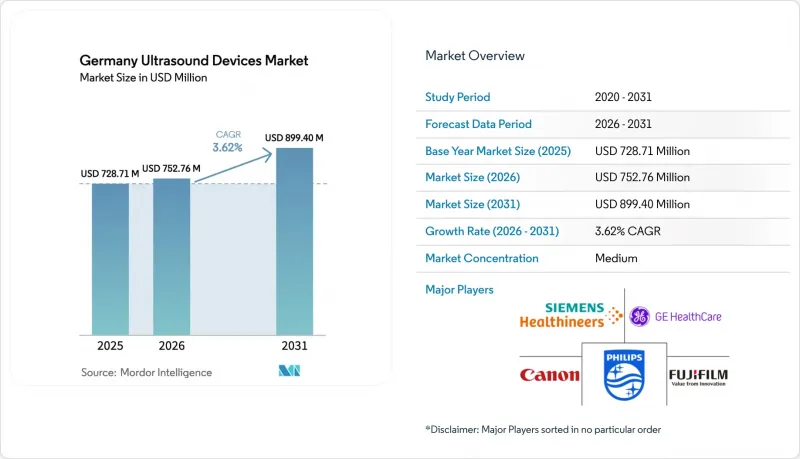
본 보고서는 용도별(마취과, 순환기과, 산부인과, 근골격계 등), 기술별(2D, 3D 및 4D, 도플러, 고강도 집속 초음파, 기타 기술), 휴대성별(고정형, 이동식 카트형, 핸드헬드/포켓형), 최종 사용자별(병원, 진단센터 등)로 분류되어 있습니다. 시장 예측은 금액(달러) 단위로 제시되어 있습니다.
독일의 초음파 기기 시장 동향 및 인사이트
만성 질환 유병률 증가
2025년 기준, 독일의 65세 이상 주민 수는 1,870만 명에 달했으며, 이는 전체 인구의 22.4%를 차지했고, 심혈관 질환 유병률은 2030년까지 12% 증가할 것으로 예측됩니다. 2025년에는 심초음파 검사 건수가 8% 증가한 반면, 류마티스 전문의들이 초음파 유도 하에 생물학적 제제 주사를 도입함에 따라 근골격계 질환의 의뢰 건수는 15% 급증했습니다. 휴대용 스캐너의 도입으로 방문 간호사가 가정 방문 시 방광 용적 및 심장 기능을 검사할 수 있게 되었으며, 바이에른주에서는 요양 시설에서의 카테터 삽입 건수가 18% 감소했습니다. 만성 질환의 영상 진단에 대한 확실한 보험 환급 덕분에 의료 기관은 예산 동결의 영향을 덜 받게 되었으며, 독일의 초음파 진단 기기 시장은 꾸준한 성장 궤도를 유지하고 있습니다.
휴대용 및 핸드헬드 초음파 장치의 기술적 진보
500g 미만의 핸드헬드형 시스템은 2025년 독일 내 출하 대수의 12%를 차지했으며, 2년 전 7%에서 증가했습니다. 이는 버터플라이(Butterfly)사의 iQ3와 클라리우스(Clarius)사의 HD3가 5G, 무선 충전, AI 기반 자동 측정 기능을 탑재했기 때문입니다. 지멘스 헬스인어즈(Siemens Healthineers)의 태블릿 크기의 ‘Sequoia Go’는 휴대전화 네트워크를 통해 암호화된 DICOM 데이터를 스트리밍 전송하여, 지방 지역의 뇌졸중 환자에 대한 이송 전 분류(triage)를 지원하고 있습니다. 4시간의 배터리 구동 시간을 자랑하는 Philips의 ‘Lumify’는 기존의 구동 시간 한계를 극복하여 응급의사의 근무 교대 요구를 충족시키고 있습니다. 중급급 카트형 장치와 동등한 성능으로 품질 격차가 해소되고, 영상진단실 1실당 설비 투자를 최대 40% 절감할 수 있어 독일의 초음파 진단 장치 시장을 견인하고 있습니다.
고급 초음파 시스템의 높은 비용
고급형 카트는 8만-15만 유로로 고가이며, 2023-2025년 실질 기준으로 6% 감소한 병원의 장비 예산에 부담을 주고 있습니다. 작센주에서는 5만 유로 미만의 기종이 선호되는 경향이 있어, 이에 따라 Mindray사와 삼성사는 할인된 가격의 3D 플랫폼으로 18%의 시장 점유율을 확보하고 있습니다. 리스는 현금 흐름의 부담을 경감시킵니다. 2025년 지멘스(Siemens)사의 도입 사례 중 35%는 5년 만기 운영 리스였으나, 높은 초기 비용으로 인한 충격이 여전히 교체 주기를 장기화시켜 독일 초음파 기기 시장의 성장을 둔화시키고 있습니다.
부문 분석
중환자 치료용 영상 진단 시장은 연평균 성장률(CAGR) 5.62%로 확대될 것으로 예측되며, 이는 독일 초음파 장비 시장에서 가장 빠른 성장 궤적을 보일 것입니다. 이는 중환자 치료팀이 소생술 중에 실시간 혈역학 데이터를 필요로 하기 때문입니다. 방사선과는 2025년 매출의 39.09%를 차지했으나, 휴대용 스캐너의 도입으로 응급의들은 검사 대기 줄을 피할 수 있게 되었으며, 프랑크푸르트 대학병원에서는 폐렴이 의심되는 사례에 대한 방사선과 의뢰 건수가 32% 감소했습니다. 2025년에는 종양학 경과 관찰에서 스트레인 이미징의 보급으로 심장 초음파 검사 건수가 9% 증가했습니다. 근골격계 클리닉에서는 병원 내 관절 평가가 점점 더 많이 이루어지면서 검사 건수가 증가하는 동시에 보조용 프로브 판매도 활성화되고 있습니다. 비뇨기과 의사들은 노인 병동에서 3,000유로 미만의 휴대용 방광 스캐너를 활용하여 감염 예방 목표 달성에 기여하고 있습니다.
고강도 집속 초음파(HIFU)는 국소성 전립선암이나 자궁근종에 대한 비침습적 절제술이 1건당 3,500유로의 보험 급여 대상이 됨에 따라 5.13%의 속도로 확대되고 있습니다. 2025년에는 3D 및 4D가 매출의 45.29%를 차지했으나, 3차 의료기관으로의 보급이 정체되면서 그 성장세는 둔화되었습니다. 지멘스의 AI 3D 렌더링 기술 덕분에 심장강 분할이 몇 초 만에 완료되어, 순환기 전문의의 판독 시간이 단축되었습니다. 캐논의 미세혈관 이미징 기술은 2025년에 등장하여 조영제를 사용하지 않고 모세혈관의 혈류 분포를 매핑합니다.
기타 혜택 :
- 엑셀 형식 시장 예측(ME) 시트
- 3개월간의 애널리스트 지원
자주 묻는 질문
목차
제1장 서론
제2장 조사 방법
제3장 주요 요약
제4장 시장 구도
제5장 시장 규모 및 성장 예측
제6장 경쟁 구도
제7장 시장 기회 및 향후 전망
AJY 26.09.15According to Mordor Intelligence, the Germany ultrasound devices market size is expected to increase from USD 728.71 million in 2025 to USD 752.76 million in 2026 and reach USD 899.40 million by 2031, growing at a CAGR of 3.62% over 2026-2031.
This report is Segmented by Application (Anesthesiology, Cardiology, Gynecology/Obstetrics, Musculoskeletal, and More), Technology (2D, 3D & 4D, Doppler, High-Intensity Focused Ultrasound, Other Technologies), Portability (Stationary, Portable Cart-Based, Hand-held/Pocket), and End User (Hospitals, Diagnostic Centers, and More). Market Forecasts are Provided in Value (USD).
Germany Ultrasound Devices Market Trends and Insights
Rising Prevalence of Chronic Diseases
Germany counted 18.7 million residents aged 65+ in 2025, representing 22.4% of the population, and cardiovascular disease prevalence is projected to increase by 12% by 2030. Echocardiography volumes rose 8 % in 2025, while musculoskeletal referrals jumped 15 % as rheumatologists embraced ultrasound-guided biologic injections. Portable scanners allow home-health nurses to check bladder volume and heart function, reducing nursing-home catheterizations by 18% in Bavaria. Reliable reimbursement for chronic-disease imaging insulates providers from budget freezes, keeping the Germany ultrasound devices market on a steady growth track.
Technological Advancements in Portable & Handheld Ultrasound
Handheld systems under 500 g captured 12 % of German unit shipments in 2025, up from 7 % two years earlier, as Butterfly's iQ3 and Clarius HD3 bundled 5G, wireless charging, and AI auto-measure. Siemens Healthineers' tablet-sized Sequoia Go streams encrypted DICOM over cellular networks, aiding pre-arrival stroke triage in rural districts. With 4-hour battery life, Philips Lumify overcomes previous endurance limits and satisfies emergency physicians' shift needs. Performance parity with mid-tier carts closes the quality gap and lowers capital expense per imaging room by up to 40 %, bolstering the Germany ultrasound devices market.
High Cost of Advanced Ultrasound Systems
Premium carts cost between EUR 80,000 and 150,000, straining hospitals whose equipment budgets fell by 6% in real terms during 2023-2025. Saxony tends to favor sub-EUR 50,000 units, allowing Mindray and Samsung to capture an 18% share with discounted 3D platforms. Leasing eases cash flow 35 % of Siemens placements in 2025 were five-year operating leases-but the upfront sticker shock still elongates replacement cycles, tempering Germany ultrasound devices market growth.
Other drivers and restraints analyzed in the detailed report include:
- Increasing Adoption in Point-Of-Care Settings
- High Cost of Advanced Ultrasound Systems
- Saturated Installed Base in Tertiary Hospitals
For complete list of drivers and restraints, kindly check the Table Of Contents.
Segment Analysis
Critical care imaging is projected to climb at a 5.62 % CAGR, the swiftest trajectory within the Germany ultrasound devices market, because intensive-care teams require real-time hemodynamic data during resuscitation. Radiology retained 39.09% of 2025 revenue, but portable scanners enable emergency physicians to bypass queues, trimming 32% of radiology referrals for suspected pneumonia at Frankfurt University Hospital. Cardiology echo volumes increased by 9% in 2025 due to wider use of strain imaging in oncology follow-up. Musculoskeletal clinics increasingly perform in-office joint assessments, elevating procedure counts and supporting ancillary probe sales. Urologists exploit sub-EUR 3,000 handheld bladder scanners on geriatric wards, aiding infection-prevention goals.
High-intensity focused ultrasound (HIFU) is expanding at 5.13 % because non-invasive ablation of localized prostate cancer and uterine fibroids commands EUR 3,500 reimbursement per case. Although 3D & 4D retained 45.29% of revenue in 2025, its growth moderated as tertiary penetration peaked. Siemens' AI 3D rendering now segments cardiac chambers in 10s, trimming cardiologist read times. Canon's micro-vascular imaging debuted in 2025 and maps capillary perfusion without contrast.
Complete Report Scope:
- By Application
- Anesthesiology
- Cardiology
- Gynecology / Obstetrics
- Musculoskeletal
- Radiology
- Critical Care
- Urology
- Vascular
- Other Applications
- By Technology
- 2D Ultrasound Imaging
- 3D & 4D Ultrasound Imaging
- Doppler Imaging
- High-Intensity Focused Ultrasound
- Other Technologies
- By Portability
- Stationary Systems
- Portable Cart-based Systems
- Hand-held / Pocket Devices
- By End User
- Hospitals
- Diagnostic Centers
- Ambulatory Surgical Centers
- Home Healthcare Settings
- Other End Users
List of Companies Covered in this Report:
- Alpinion Medical Systems
- Analogic
- Butterfly Network Inc.
- Canon
- Carestream Health
- CHISON Medical Technologies
- Clarius Mobile Health Corp.
- Esaote
- Exo Inc.
- FUJIFILM
- GE Healthcare
- Hitachi
- Hologic
- Koninklijke Philips N.V.
- Mindray Medical Intl. Ltd
- Samsung Group
- Shenzhen Kaipud Medical
- Siemens Healthineers
- SonoScape Medical Corp.
- Telemed Lithuania
- Terason (Teratech Corp.)
- Zimmer MedizinSysteme
Additional Benefits:
- The market estimate (ME) sheet in Excel format
- 3 months of analyst support
TABLE OF CONTENTS
1 Introduction
- 1.1 Study Assumptions & Market Definition
- 1.2 Scope of the Study
2 Research Methodology
3 Executive Summary
4 Market Landscape
- 4.1 Market Overview
- 4.2 Market Drivers
- 4.2.1 Rising Prevalence of Chronic Diseases Requiring Advanced Imaging
- 4.2.2 Technological Advancements in Portable & Handheld Ultrasound
- 4.2.3 Increasing Adoption in Point-Of-Care Settings
- 4.2.4 Federal Hospital Reform Incentivising Outpatient Ultrasound Use
- 4.2.5 AI-Driven Image Analysis Compliant with German Data-Protection
- 4.2.6 Growing Reimbursement for Point-Of-Care Ultrasound (POCUS)
- 4.3 Market Restraints
- 4.3.1 High Cost of Advanced Ultrasound Systems
- 4.3.2 Saturated Installed Base in Tertiary Hospitals
- 4.3.3 Stringent EU-MDR Post-Market Surveillance Requirements
- 4.3.4 Shortfall of DEGUM-Certified Sonographers In Rural Lander
- 4.4 Regulatory Landscape
- 4.5 Technological Outlook
- 4.6 Porter's Five Forces Analysis
- 4.6.1 Threat of New Entrants
- 4.6.2 Bargaining Power of Buyers
- 4.6.3 Bargaining Power of Suppliers
- 4.6.4 Threat of Substitute Products
- 4.6.5 Intensity of Competitive Rivalry
5 Market Size & Growth Forecasts (Value & Volume)
- 5.1 By Application
- 5.1.1 Anesthesiology
- 5.1.2 Cardiology
- 5.1.3 Gynecology / Obstetrics
- 5.1.4 Musculoskeletal
- 5.1.5 Radiology
- 5.1.6 Critical Care
- 5.1.7 Urology
- 5.1.8 Vascular
- 5.1.9 Other Applications
- 5.2 By Technology
- 5.2.1 2D Ultrasound Imaging
- 5.2.2 3D & 4D Ultrasound Imaging
- 5.2.3 Doppler Imaging
- 5.2.4 High-Intensity Focused Ultrasound
- 5.2.5 Other Technologies
- 5.3 By Portability
- 5.3.1 Stationary Systems
- 5.3.2 Portable Cart-based Systems
- 5.3.3 Hand-held / Pocket Devices
- 5.4 By End User
- 5.4.1 Hospitals
- 5.4.2 Diagnostic Centers
- 5.4.3 Ambulatory Surgical Centers
- 5.4.4 Home Healthcare Settings
- 5.4.5 Other End Users
6 Competitive Landscape
- 6.1 Market Concentration
- 6.2 Market Share Analysis
- 6.3 Company Profiles (includes Global Level Overview, Market Level Overview, Core Segments, Financials as Available, Strategic Information, Market Rank/Share for Key Companies, Products & Services, and Recent Developments)
- 6.3.1 Alpinion Medical Systems
- 6.3.2 Analogic Corporation
- 6.3.3 Butterfly Network Inc.
- 6.3.4 Canon Medical Systems Corporation
- 6.3.5 Carestream Health
- 6.3.6 CHISON Medical Technologies
- 6.3.7 Clarius Mobile Health Corp.
- 6.3.8 Esaote SpA
- 6.3.9 Exo Inc.
- 6.3.10 Fujifilm Holdings Corporation
- 6.3.11 GE HealthCare
- 6.3.12 Hitachi Ltd
- 6.3.13 Hologic Inc.
- 6.3.14 Koninklijke Philips N.V.
- 6.3.15 Mindray Medical Intl. Ltd
- 6.3.16 Samsung Medison Co. Ltd
- 6.3.17 Shenzhen Kaipud Medical
- 6.3.18 Siemens Healthineers AG
- 6.3.19 SonoScape Medical Corp.
- 6.3.20 Telemed Lithuania
- 6.3.21 Terason (Teratech Corp.)
- 6.3.22 Zimmer MedizinSysteme GmbH
7 Market Opportunities & Future Outlook
- 7.1 White-space & Unmet-Need Assessment


