

|
시장보고서
상품코드
2154751
통신사용 인텐트 관리 플랫폼 : 시장 점유율 분석, 업계 동향과 통계, 성장 예측(2026-2031년)Intent Management Platforms For The Telecom - Market Share Analysis, Industry Trends & Statistics, Growth Forecasts (2026 - 2031) |
||||||
 Mordor Intelligence
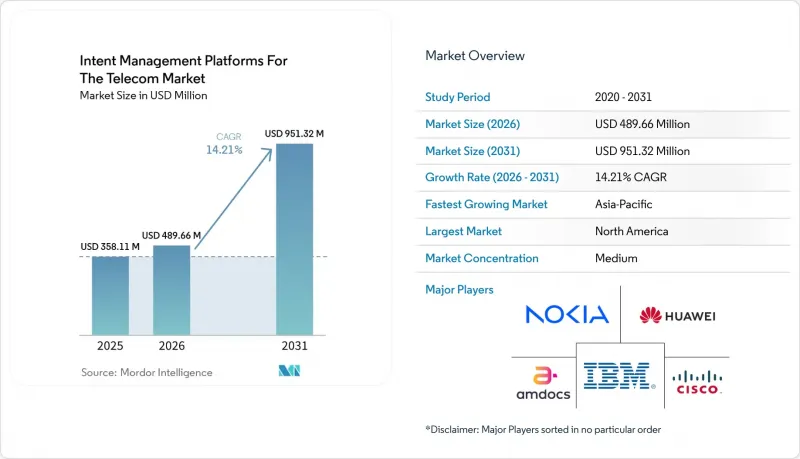
에 따르면 통신사용 인텐트 관리 플랫폼 시장 규모는 2025년 3억 5,811만 달러에서 2026년에는 4억 8,966만 달러로 확대되어, 2031년까지 9억 5,132만 달러에 달할 것으로 예상되며, 2026년부터 2031년까지 CAGR 14.21%로 확대될 전망입니다.
세계 통신사용 인텐트 관리 플랫폼 시장의 동향 및 인사이트
5G 독립형(SA) 및 네트워크 슬라이싱의 복잡성
5G 독립형(SA) 도입에 있어 통신 사업자는 공통된 서비스 목표를 달성하기 위해 무선, 전송, 코어 및 애플리케이션 리소스를 조정해야 합니다. TM 포럼은 2026년 3월 ‘IG1358 인텐트 기반 운영 사용자 가이드’를 승인하여, 다중 도메인 환경 전반에 걸쳐 인텐트를 표현하고 보고하기 위한 공통 프레임워크를 확립했습니다. 이 프레임워크는 벤더와 통신 사업자에게 상호 운용성을 위한 보다 명확한 기반을 제공함으로써, 통신 시장의 인텐트 관리 플랫폼을 지원합니다. Mavenir사는 5G 독립형 네트워크 슬라이스를 통해 도이치 텔레콤의 화상 통화 서비스를 지원하며, 서비스 제공이 네트워크 기능과 애플리케이션 간의 연동에 어떻게 의존하는지를 보여주었습니다. 통신 사업자는 슬라이스 설정 및 유지 관리에 드는 비용을 해당 슬라이스가 창출하는 수익 이하로 억제해야 합니다. 인텐트 기반 오케스트레이션은 서비스 목표를 반복 가능한 네트워크 액션으로 변환하고, 도메인 간 설정 부담을 경감함으로써 이러한 요구 사항을 충족합니다.
폐쇄 루프형 네트워크 자동화에 대한 수요
폐쇄 루프 자동화는 실제 네트워크 상황을 선언된 서비스 목표와 비교하여, 성능이 목표에서 벗어날 경우 시정 조치를 적용합니다. 3GPP의 ‘Coordinated Closed Control Loop’ 프레임워크는 최소 슬라이스 처리량 등의 목표를 포함하는 성능 기반 제어 루프를 지원합니다. 이러한 표준화 작업을 통해 통신 시장을 위한 인텐트 관리 플랫폼에 정책 정의부터 실제 네트워크 실행에 이르는 로드맵이 제공됩니다. 라쿠텐 모바일은 2026년 2월, 실제 가동중인 Open RAN 환경에서 RAN의 에너지 효율 최적화에 대해 TM Forum의 레벨 4 자율성 인증을 획득했습니다. 이를 통해 자율적이고 인텐트 기반의 운영을 통해 RAN의 에너지 소비량을 20% 절감할 수 있을 것으로 추정됩니다. 반복적인 시정 주기를 자동화할 수 있는 통신 사업자는 비용 관리를 개선하고, 서비스 보장을 위한 대응 시간을 단축할 수 있습니다.
레거시 OSS 및 BSS 통합의 복잡성
레거시 OSS 및 BSS 환경은 통신 시장에서 인텐트 관리 플랫폼의 도입을 지연시킬 가능성이 있습니다. 많은 통신 사업자는 4G 이전에 설계된, 독자적인 사양의 인터페이스나 배치 처리 패턴을 갖춘 중개 계층 및 OSS 구성요소를 여전히 유지하고 있습니다. 이러한 시스템은 인텐트 기반 제어에 필요한 실시간 데이터 교환을 쉽게 지원하지 않습니다. 통신 사업자는 플랫폼을 대규모로 배포하기 전에 데이터 액세스 방식 업데이트, 인벤토리 기록 정규화, 신뢰할 수 있는 API 공개를 수행해야 하는 경우가 많습니다. 이러한 작업으로 인해 도입 일정이 장기화되고 시스템 통합업체의 역할이 확대될 가능성이 있습니다. 이 문제는 네트워크 현대화가 OSS 업데이트 주기를 앞지르는 속도로 진행되는 남미, 중동 및 아프리카, 그리고 아시아태평양의 일부에서 특히 두드러집니다.
부문 분석
2025년, 인텐트 관리 플랫폼 시장에서 ‘플랫폼 및 솔루션’이 67.55%의 시장 점유율을 차지했습니다. 초기 도입 단계에서는 인텐트를 포착하고, 정책을 설정하며, 네트워크 작동을 제어하는 핵심 소프트웨어 확보에 중점을 두었습니다. 깊이 통합된 시스템을 교체하는 데는 막대한 비용이 소요되고 업무에 차질을 빚을 가능성이 있으므로, 통신 사업자들은 기존 OSS 환경과 통합 가능한 플랫폼을 선호하는 경향이 있습니다. 에릭슨, 노키아, 암독스, 넷크래커는 이러한 통합과 장기적인 운영 관계를 통해 확고한 입지를 구축하고 있습니다. 그 결과, 대규모 자동화 프로그램의 초기 단계에서도 플랫폼 매출은 여전히 큰 비중을 차지하고 있습니다.
서비스 시장은 2026년부터 2031년까지 연평균 성장률(CAGR) 15.76%로 성장할 것으로 예측되며, 통신 업계의 인텐트 관리 플랫폼 시장 전체를 상회하는 속도로 확대될 전망입니다. 초기 소프트웨어 도입을 거친 후, 수요는 통합, 관리형 운영, AI 모델 튜닝 및 지속적인 정책 유지 관리로 이동하고 있습니다. 2026년 2월, Amdocs는 통신 사업자를 위한 BSS 및 OSS에 의존하지 않는 인텔리전스 계층인 ‘aOS’를 출시했습니다. Amdocs는 이 플랫폼이 350개 이상의 서비스 제공업체를 위해 설계되었다고 밝혔습니다. 따라서 통신사용 인텐트 관리 플랫폼은 소프트웨어의 기능뿐만 아니라, 실제 가동중인 네트워크 전체에 배포 및 운영하기 위해 필요한 제공 능력에도 의존하고 있습니다.
2025년, 인텐트 관리 플랫폼의 통신 시장 점유율 중 클라우드 도입이 57.88%를 차지했습니다. 통신 사업자들은 정책 평가, 보증 데이터 및 동적 네트워크 워크로드 처리 능력을 확장하기 위해 클라우드 환경을 활용하고 있습니다. 도이치 텔레콤은 AI를 활용한 워크로드 스케줄링을 통해 5G 코어 운영에서 최대 65%의 에너지 절감이 가능하다고 보고했습니다. 이러한 운영 효율의 향상은 네트워크 기능 현대화에 착수한 통신 사업자에게 있어 클라우드 도입의 정당성을 더욱 강화하는 요인이 되고 있습니다. 또한 클라우드 환경을 통해 소프트웨어 업데이트가 신속해지며, 데이터 기반 자동화 도구와의 통합도 가능해집니다.
통신 시장의 인텐트 관리 플랫폼 분야에서 하이브리드 배포는 2026년부터 2031년까지 연평균 성장률(CAGR) 16.41%로 성장할 것으로 예측됩니다. 많은 통신 사업자는 수명이 긴 장비를 계속 운영하고 있으며, 온프레미스 시스템도 확립되어 있어 모든 네트워크 기능을 클라우드 환경으로 이전할 수는 없습니다. 하이브리드 플랫폼이라면 즉각적인 전면적인 전환 없이도 레거시 도메인과 클라우드 네이티브 기능 전반에 정책을 적용할 수 있습니다. 온프레미스 구축은 로컬 처리나 엄격한 데이터 관리가 필요한 주권 네트워크나 기업의 프라이빗 5G 애플리케이션에서 여전히 중요한 역할을 하고 있습니다. 따라서 통신사용 인텐트 관리 플랫폼은 단일 운영 모델이 아닌, 다양한 도입 조건에 대응할 수 있어야 합니다.
지역별 분석
2025년에는 북미가 통신 시장 내 인텐트 관리 플랫폼의 27.66%를 차지할 것으로 예측됩니다. 이 지역은 선진적인 5G SA(Standalone) 구축과 자율형 네트워크 프로그램에 대한 지속적인 투자의 혜택을 받고 있습니다. Proximus사의 예측에 따르면, 2026년 4월에는 북미 5G 연결의 32%를 독립형 아키텍처가 차지할 것으로 보입니다. 이러한 환경을 통해 미국 및 캐나다의 통신 사업자는 네트워크 슬라이싱의 서비스 및 운영 요건에 대해 더 풍부한 실무 경험을 쌓을 수 있습니다. 에릭슨은 멀티벤더 RAN 관리 및 인텐트 기반 운영을 위한 ‘지능형 자동화 플랫폼’을 구축하고 있습니다. 멕시코에서는 통신 사업자들이 주파수 할당 프로그램을 통해 5G 커버리지를 확대함에 따라 새로운 비즈니스 기회가 창출되고 있습니다.
유럽에서는 5G 스탠드얼론(SA) 구축, 멀티벤더 인프라, 그리고 자동화된 의사결정에 관한 거버넌스 요건이 계속해서 시장을 주도하고 있습니다. 프로크시머스는 2026년 4월 벨기에에서 상용 5G SA 서비스를 시작할 예정이며, 그 사용 사례는 긴급 서비스, 결제 트래픽, 미디어 전송에 이릅니다. 유럽의 통신 사업자들은 AI 기반 정책 엔진을 도입할 때 설명 가능성, 추적 가능성 및 감사 기록을 필요로 합니다. 통신 시장을 위한 인텐트 관리 플랫폼은 이러한 제어 기능이 별도의 도구로 도입되는 것이 아니라 운영 플랫폼에 통합될 때 그 이점을 발휘합니다. EANTC가 실시하는 2026년 상호운용성 테스트에서는 다양한 벤더 환경을 아우르며 운영할 때의 기술적 과제가 부각될 것으로 예상됩니다. 영국, 독일, 프랑스, 스페인 및 북유럽 국가들은 네트워크 투자와 자동화 프로그램이 활발히 진행되고 있어 계속해서 중요한 시장으로 자리매김하고 있습니다.
아시아태평양은 2026년부터 2031년까지 연평균 성장률(CAGR) 16.65%로 성장할 것으로 예측되며, 통신 인텐트 관리 플랫폼 시장에서 지역별 가장 높은 성장률을 보일 것으로 전망됩니다. 중국에서는 성숙한 5G 독립형(SA) 네트워크 환경을 통해 소비자 및 기업용 사용 사례에 걸친 상용 네트워크 슬라이싱이 지원되고 있습니다. NTT 동일본은 2026년 3월, 26개사가 참여하는 RIC(네트워크 인텔리전스 컨트롤러)를 활용한 제어 방식의 프라이빗 5G 최적화 실증 실험을 발표할 예정입니다. 이 실증 실험에서는 특정 조건 하에서 전력 소비가 최대 65% 절감되는 것이 입증될 전망입니다. 일본과 한국도 정부 주도의 프로그램을 통해 네트워크 자동화를 추진하고 있습니다. 사우디아라비아와 아랍에미리트(UAE)는 국가 차원의 디지털 전환 및 주권 네트워크 구상을 통해 중동 지역의 수요를 주도하고 있는 반면, 아프리카에서의 도입은 에너지 효율 및 운영 비용 절감과 더 밀접하게 관련되어 있습니다.
기타 혜택:
- 엑셀 형식의 시장 예측(ME) 시트
- 3개월간의 애널리스트 지원
자주 묻는 질문
목차
제1장 소개
- 조사 가정과 시장 정의
- 조사 범위
제2장 조사 방법
제3장 주요 요약
제4장 시장 구도
- 시장 개요
- 시장 성장 촉진요인
- 시장 성장 억제요인
- 거시경제 요인이 시장에 미치는 영향
- 업계 밸류체인 분석
- 규제 상황
- 기술 전망
- Porter's Five Forces 분석
제5장 시장 규모와 성장 예측
- 구성요소별
- 전개 모델별
- 플랫폼 기능별
- 기업 규모별
- 지역별
- 북미
- 미국
- 캐나다
- 멕시코
- 남미
- 브라질
- 아르헨티나
- 기타 남미 국가
- 유럽
- 영국
- 독일
- 프랑스
- 스페인
- 기타 유럽 국가
- 아시아태평양
- 중국
- 일본
- 인도
- 한국
- 기타 아시아태평양 국가
- 중동
- 사우디아라비아
- 아랍에미리트
- 기타 중동 국가
- 아프리카
- 남아프리카공화국
- 이집트
- 기타 아프리카 국가
- 북미
제6장 경쟁 구도
- 시장 집중도
- 전략적 동향
- 시장 점유율 분석
- 기업 개요
- Cisco Systems, Inc.
- Nokia Corporation
- Juniper Networks, Inc.
- Huawei Technologies Co., Ltd.
- Telefonaktiebolaget LM Ericsson
- Hewlett Packard Enterprise Company
- IBM Corporation
- Ciena Corporation
- Amdocs Limited
- Netcracker Technology Corporation
- Blue Planet, a division of Ciena Corporation
- NEC Corporation
- ZTE Corporation
- Samsung Electronics Co., Ltd.
- VMware, Inc.
- Arista Networks, Inc.
- Forward Networks, Inc.
- NetBrain Technologies, Inc.
- Gluware, Inc.
- Itential, LLC
- Anuta Networks, Inc.
- Wipro Limited
- Accenture plc
제7장 시장 기회와 향후 전망
KSM 26.10.29According to Mordor Intelligence, the intent management platforms for the telecom market size is expected to increase from USD 358.11 million in 2025 to USD 489.66 million in 2026 and reach USD 951.32 million by 2031, expanding at a CAGR of 14.21% over 2026-2031.
Global Intent Management Platforms For The Telecom Market Trends and Insights
5G Standalone and Network Slicing Complexity
5G standalone deployments require operators to coordinate radio, transport, core, and application resources against a common service objective. TM Forum approved its IG1358 Intent-Based Operation User Guide in March 2026, establishing a shared framework for expressing and reporting intent across multi-domain environments. That framework supports intent management platforms in the telecom market by providing vendors and operators with a clearer basis for interoperability. Mavenir supported Deutsche Telekom's video telephony service over a 5G standalone network slice, showing how service delivery depends on coordination between network functions and applications. Operators must keep the cost of configuring and maintaining a slice below the revenue it can generate. Intent-based orchestration addresses this requirement by turning service objectives into repeatable network actions and reducing the configuration burden across domains.
Demand for Closed-Loop Network Automation
Closed-loop automation compares live network conditions with a declared service target and applies corrective actions when performance differs from that target. 3GPP's Coordinated Closed Control Loop framework supports performance-based control loops, including targets such as minimum slice throughput. This standard work provides intent management platforms for the telecom market with a route from policy definition to live network execution. Rakuten Mobile received TM Forum Level 4 Autonomy validation in February 2026 for RAN energy efficiency optimization in a live Open RAN environment. The deployment was estimated to reduce RAN energy consumption by 20% through autonomous, intent-driven operations. Operators that can automate repetitive correction cycles can improve cost control and shorten response times for service assurance.
Legacy OSS and BSS Integration Complexity
Legacy OSS and BSS environments can slow the rollout of intent management platforms in the telecom market. Many operators retain mediation layers and OSS components that were designed before 4G, with proprietary interfaces and batch-processing patterns. These systems do not readily support the real-time data exchange required by intent-driven control. Operators often need to update data access methods, normalize inventory records, and expose reliable APIs before a platform can be deployed at scale. This work can extend deployment schedules and increase the role of systems integrators. The issue is particularly relevant in South America, the Middle East, and Africa, as well as parts of Asia-Pacific, where network modernization can outpace OSS refresh cycles.
Other drivers and restraints analyzed in the detailed report include:
- Growth of Cloud-Native and Multi-Vendor Telecom Infrastructure
- Network-as-Code and Programmable Connectivity Monetization
- Shortage of Telecom Automation and AI Engineering Skills
For complete list of drivers and restraints, kindly check the Table Of Contents.
Segment Analysis
Platforms and Solutions accounted for 67.55% of the telecom market share in intent management platforms in 2025. Early adoption focused on acquiring core software that captures intent, sets policies, and controls network actions. Operators often prefer platforms that integrate with their existing OSS environments, as replacing deeply embedded systems can be costly and disruptive. Ericsson, Nokia, Amdocs, and Netcracker have established strong positions through these integrations and long-term operational relationships. As a result, platform revenue remains significant during the initial phases of large-scale automation programs.
Services are projected to grow at a 15.76% CAGR from 2026 to 2031, outpacing the overall telecom intent management platforms market. Following initial software deployment, demand is shifting toward integration, managed operations, AI model tuning, and ongoing policy maintenance. In February 2026, Amdocs launched aOS, a BSS- and OSS-agnostic intelligence layer for telecom operators. Amdocs stated that the platform was designed for more than 350 service providers. Therefore, intent management platforms for the telecom industry depend not only on software capabilities but also on the delivery capacity needed to deploy and operate them across live networks.
Cloud deployment accounted for 57.88% of the telecom market share for intent management platforms in 2025. Operators use cloud environments to scale processing capacity for policy evaluation, assurance data, and dynamic network workloads. Deutsche Telekom reported that AI-driven workload scheduling could deliver up to 65% energy savings in 5G core operations. These operational efficiencies strengthen the case for cloud deployment among operators that have started modernizing their network functions. Cloud environments also enable faster software updates and integration with data-driven automation tools.
Hybrid deployment is projected to grow at a CAGR of 16.41% from 2026 to 2031 in the intent management platforms for the telecom market. Many operators cannot migrate all network functions to cloud environments because they continue to operate long-lived equipment and have established on-premises systems. A hybrid platform can apply policies across legacy domains and cloud-native functions without requiring an immediate, full-scale migration. On-premises deployment remains relevant for sovereign networks and private enterprise 5G applications that require local processing or stringent data controls. Therefore, the intent management platforms for the telecom industry must support diverse deployment conditions rather than a single operating model.
Complete Report Scope:
- By Component
- Platforms and Solutions
- Services
- By Deployment Model
- Cloud
- On-Premises
- Hybrid
- By Platform Capability
- Intent Capture and Natural-Language Interpretation
- Intent Modeling and Ontology Management
- Policy Translation and Configuration Generation
- Other Platform Capability
- By Enterprise Size
- Large Telecom Operators
- Regional and Challenger Operators
- Private Network and Neutral-Host Operators
- By Geography
- North America
- United States
- Canada
- Mexico
- South America
- Brazil
- Argentina
- Rest of South America
- Europe
- United Kingdom
- Germany
- France
- Spain
- Rest of Europe
- Asia-Pacific
- China
- Japan
- India
- South Korea
- Rest of Asia-Pacific
- Middle East
- Saudi Arabia
- United Arab Emirates
- Rest of Middle East
- Africa
- South Africa
- Egypt
- Rest of Africa
- North America
Geography Analysis
North America is projected to account for 27.66% of the intent management platforms for the telecom market in 2025. The region benefits from advanced 5G standalone deployments and sustained investment in autonomous network programs. Proximus is expected to report that standalone architecture will represent 32% of North American 5G connections in April 2026. This environment provides U.S. and Canadian operators with greater commercial experience in the service and operational requirements of network slicing. Ericsson has positioned its Intelligent Automation Platform for multi-vendor RAN management and intent-based operations. Mexico presents a developing opportunity as operators expand 5G coverage through spectrum allocation programs.
Europe continues to be shaped by 5G standalone deployment, multi-vendor infrastructure, and governance requirements for automated decision-making. Proximus is expected to launch commercial 5G standalone services in Belgium in April 2026, with use cases spanning emergency services, payment traffic, and media distribution. European operators require explainability, traceability, and audit records when deploying AI-driven policy engines. Intent management platforms for the telecom market benefit when these controls are integrated into the operating platform rather than deployed as separate tools. EANTC's 2026 interoperability testing is expected to highlight the engineering challenges of operating across diverse vendor environments. The United Kingdom, Germany, France, Spain, and the Nordic countries remain important markets due to their network investment and automation programs.
Asia-Pacific is projected to grow at a CAGR of 16.65% from 2026 to 2031, representing the highest regional growth rate in the telecom intent management platforms market. China's mature 5G standalone network environment supports commercial network slicing across consumer and enterprise use cases. NTT EAST is expected to report a private 5G optimization demonstration in March 2026 involving 26 companies and RIC-enabled control. The demonstration is expected to show up to a 65% reduction in power consumption under specified conditions. Japan and South Korea also support network automation through government-backed programs. Saudi Arabia and the UAE drive demand in the Middle East through national digital transformation and sovereign network initiatives, while adoption in Africa is more closely linked to energy efficiency and operating cost control.
- Cisco Systems, Inc.
- Nokia Corporation
- Juniper Networks, Inc.
- Huawei Technologies Co., Ltd.
- Telefonaktiebolaget LM Ericsson
- Hewlett Packard Enterprise Company
- IBM Corporation
- Ciena Corporation
- Amdocs Limited
- Netcracker Technology Corporation
- Blue Planet, a division of Ciena Corporation
- NEC Corporation
- ZTE Corporation
- Samsung Electronics Co., Ltd.
- VMware, Inc.
- Arista Networks, Inc.
- Forward Networks, Inc.
- NetBrain Technologies, Inc.
- Gluware, Inc.
- Itential, LLC
- Anuta Networks, Inc.
- Wipro Limited
- Accenture plc
Additional Benefits:
- The market estimate (ME) sheet in Excel format
- 3 months of analyst support
TABLE OF CONTENTS
1 INTRODUCTION
- 1.1 Study Assumptions and Market Definition
- 1.2 Scope of the Study
2 RESEARCH METHODOLOGY
3 EXECUTIVE SUMMARY
4 MARKET LANDSCAPE
- 4.1 Market Overview
- 4.2 Market Drivers
- 4.2.1 5G Standalone and Network Slicing Complexity
- 4.2.2 Demand for Closed-Loop Network Automation
- 4.2.3 Growth of Cloud-Native and Multi-Vendor Telecom Infrastructure
- 4.2.4 Network-as-Code and Programmable Connectivity Monetization
- 4.2.5 Intent-Aware Energy Optimization in Radio and Transport Networks
- 4.2.6 Agentic AI for Context-Aware Telecom Operations
- 4.3 Market Restraints
- 4.3.1 Legacy OSS and BSS Integration Complexity
- 4.3.2 Shortage of Telecom Automation and AI Engineering Skills
- 4.3.3 Non-Deterministic Behavior of Generative AI Policy Engines
- 4.3.4 Fragmented Intent Ontologies and Cross-Vendor Interoperability
- 4.4 Impact of Macroeconomic Factors on the Market
- 4.5 Industry Value Chain Analysis
- 4.6 Regulatory Landscape
- 4.6.1 Artificial Intelligence Governance and Explainability Requirements
- 4.6.2 Data Sovereignty and Cross-Border Telecom Data Controls
- 4.6.3 Critical Infrastructure Cybersecurity Requirements
- 4.6.4 Telecom Cloud, Open RAN, and Network API Standards
- 4.7 Technological Outlook
- 4.8 Porter's Five Forces Analysis
- 4.8.1 Threat of New Entrants
- 4.8.2 Bargaining Power of Suppliers
- 4.8.3 Bargaining Power of Buyers
- 4.8.4 Threat of Substitutes
- 4.8.5 Competitive Rivalry
5 MARKET SIZE AND GROWTH FORECASTS (VALUE)
- 5.1 By Component
- 5.1.1 Platforms and Solutions
- 5.1.2 Services
- 5.2 By Deployment Model
- 5.2.1 Cloud
- 5.2.2 On-Premises
- 5.2.3 Hybrid
- 5.3 By Platform Capability
- 5.3.1 Intent Capture and Natural-Language Interpretation
- 5.3.2 Intent Modeling and Ontology Management
- 5.3.3 Policy Translation and Configuration Generation
- 5.3.4 Other Platform Capability
- 5.4 By Enterprise Size
- 5.4.1 Large Telecom Operators
- 5.4.2 Regional and Challenger Operators
- 5.4.3 Private Network and Neutral-Host Operators
- 5.5 By Geography
- 5.5.1 North America
- 5.5.1.1 United States
- 5.5.1.2 Canada
- 5.5.1.3 Mexico
- 5.5.2 South America
- 5.5.2.1 Brazil
- 5.5.2.2 Argentina
- 5.5.2.3 Rest of South America
- 5.5.3 Europe
- 5.5.3.1 United Kingdom
- 5.5.3.2 Germany
- 5.5.3.3 France
- 5.5.3.4 Spain
- 5.5.3.5 Rest of Europe
- 5.5.4 Asia-Pacific
- 5.5.4.1 China
- 5.5.4.2 Japan
- 5.5.4.3 India
- 5.5.4.4 South Korea
- 5.5.4.5 Rest of Asia-Pacific
- 5.5.5 Middle East
- 5.5.5.1 Saudi Arabia
- 5.5.5.2 United Arab Emirates
- 5.5.5.3 Rest of Middle East
- 5.5.6 Africa
- 5.5.6.1 South Africa
- 5.5.6.2 Egypt
- 5.5.6.3 Rest of Africa
- 5.5.1 North America
6 COMPETITIVE LANDSCAPE
- 6.1 Market Concentration
- 6.2 Strategic Moves
- 6.3 Market Share Analysis
- 6.4 Company Profiles (includes Global Level Overview, Market Level Overview, Core Segments, Financials as available, Strategic Information, Market Rank/Share, Products and Services, Recent Developments)
- 6.4.1 Cisco Systems, Inc.
- 6.4.2 Nokia Corporation
- 6.4.3 Juniper Networks, Inc.
- 6.4.4 Huawei Technologies Co., Ltd.
- 6.4.5 Telefonaktiebolaget LM Ericsson
- 6.4.6 Hewlett Packard Enterprise Company
- 6.4.7 IBM Corporation
- 6.4.8 Ciena Corporation
- 6.4.9 Amdocs Limited
- 6.4.10 Netcracker Technology Corporation
- 6.4.11 Blue Planet, a division of Ciena Corporation
- 6.4.12 NEC Corporation
- 6.4.13 ZTE Corporation
- 6.4.14 Samsung Electronics Co., Ltd.
- 6.4.15 VMware, Inc.
- 6.4.16 Arista Networks, Inc.
- 6.4.17 Forward Networks, Inc.
- 6.4.18 NetBrain Technologies, Inc.
- 6.4.19 Gluware, Inc.
- 6.4.20 Itential, LLC
- 6.4.21 Anuta Networks, Inc.
- 6.4.22 Wipro Limited
- 6.4.23 Accenture plc
7 MARKET OPPORTUNITIES AND FUTURE OUTLOOK
- 7.1 White-Space and Unmet-Need Assessment


