

|
시장보고서
상품코드
2154864
남미의 당뇨병 케어 기기 : 시장 점유율 분석, 업계 동향과 통계, 성장 예측(2026-2031년)South America Diabetes Care Devices - Market Share Analysis, Industry Trends & Statistics, Growth Forecasts (2026 - 2031) |
||||||
 Mordor Intelligence
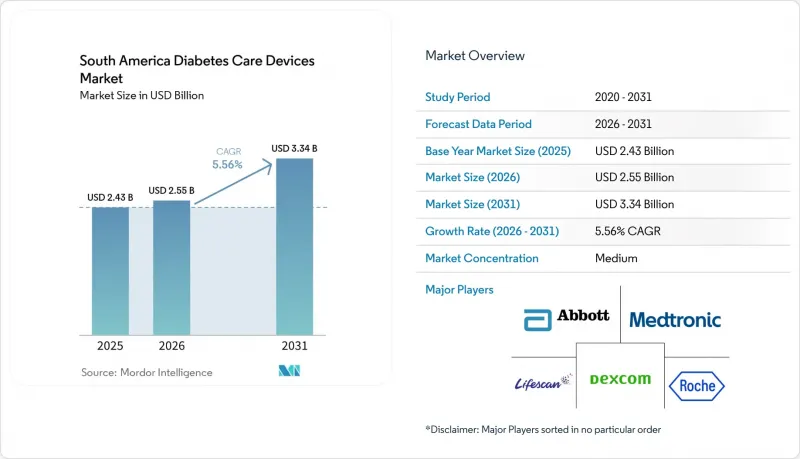
에 따르면 남미의 당뇨병 케어 기기 시장은 2025년 24억 3,000만 달러에서 확대하며, 2026년 25억 7,000만 달러를 거치고, 2031년까지 33억 4,000만 달러에 달할 것으로 예측되고 있으며, 예측 기간(2026-2031년)에 CAGR은 5.56%에 달할 전망입니다.
이 지역에서는 2024년 기준 3,540만 명의 성인이 당뇨병을 앓고 있었으나, 그중 30.4%는 진단받지 못한 상태이며, 많은 환자가 정기적인 치료나 모니터링 체계에서 벗어나 있는 실정입니다. 이 보고서는 기기 유형(모니터링 기기, 관리 기기), 당뇨병 유형(제1형 당뇨병, 제2형 당뇨병, 임신성 당뇨병 및 기타), 유통 채널(병원 약국 등), 최종사용자(병원 및 진료소 등), 국가(브라질, 아르헨티나, 콜롬비아, 칠레, 페루, 기타 남미)별로 분류되어 있습니다. 시장 전망은 금액(달러) 기준으로 제시되어 있습니다.
남미 당뇨병 관리 기기 시장의 동향 및 인사이트
당뇨병 유병률 및 진단률의 증가
당뇨병 환자 수의 증가는 남미 당뇨병 관리 기기 시장의 기본적인 수요 기반을 형성하고 있습니다. 중남미의 성인 당뇨병 환자 수는 2024년 3,540만 명에서 2050년까지 5,150만 명으로 46% 증가할 것으로 예측됩니다. 아르헨티나는 2024년 연령 조정 당뇨병 유병률이 14%를 기록했으며, 칠레(12.2%)와 브라질(10.6%)이 그 뒤를 이으며, 민간 의료 채널이 더 발달한 시장에서 수요를 지원하고 있습니다. 2024년, 이 지역에서는 임신의 12.5%가 임신성 당뇨병을 앓고 있으며, 이는 96만 7,000명의 출생에 해당합니다. 이로 인해 임신 중 모니터링에 대한 고유한 수요가 발생하고, 향후 당뇨병 관리에 대한 인식이 높아질 가능성이 있습니다. 진단 프로그램의 대상자가 확대됨에 따라 남미의 당뇨병 관리 기기 시장 전체에서 보급형 혈당 측정기, 테스트 스트립, 란셋 및 관련 지원 서비스의 중요성이 커지고 있습니다.
지속적 모니터링 및 커넥티드 모니터링의 보급 확대
남미 당뇨병 관리 기기 시장의 주요 국가에서는 연속 혈당 모니터링이 전문의의 사용을 넘어 확산되고 있습니다. 애보트(Abbott)는 2024년 6월, 브라질에서 ‘FreeStyle Libre 2 Plus’를 출시했습니다. 이 제품은 1분마다 자동으로 측정하며, 평균 절대 상대 오차는 8.2%, 센서 착용 기간은 15일입니다. 2025년 브라질에서 실시된 조사에 따르면 디지털 플랫폼을 이용하는 플래시 CGM 사용자는 혈당 측정기 사용자보다 연령대가 낮았으며, 평균 연령은 각각 31.6세와 36.2세였습니다. 동 조사에 따르면 이용이 소득 수준이 높은 남동부 지역에 집중되어 있는 것으로 나타났으며, 이는 민간 보험에 의한 비용 부담의 중요성이 여전히 높음을 반영하고 있습니다. 애보트와 메드트로닉은 2024년 8월, CGM과 인슐린 펌프 기술을 연동하기 위한 글로벌 제휴를 맺고, 치료 경로에서 상호 운용 가능한 시스템의 역할을 강화했습니다. 이러한 변화는 센서에 대한 지속적인 수요를 지원하는 한편, 환자와 의료 제공자에게는 연결된 플랫폼 간 전환을 더욱 복잡하게 만들고 있습니다.
높은 본인 부담금과 불균일한 보험 환급
남미의 당뇨병 관리 기기 시장에서 첨단 기기 도입에 대한 주요 제약 요인은 여전히 합리적인 가격 확보입니다. 브라질의 데이터에 따르면 플래시 CGM 플랫폼 이용자 중 저소득층이 많은 북부 지역에 거주하는 비율은 고작 2.5%에 불과했으며, 이용자는 남동부에 집중되어 있었습니다. 브라질의 공적 의료제도에서는 혈당 측정기와 측정 스트립이 보장 대상이지만, 대부분의 환자 그룹은 CGM 센서에 대해 공적 보험 환급을 받을 수 없습니다. 수입된 고급 시스템도 통화 약세의 영향을 받기 쉬우며, 특히 아르헨티나에서는 환율 변동에 따라 환자의 구매 가능성이 급격히 떨어질 우려가 있습니다. 보험 급여 결정과 현지 구매력이 민간 보험 가입자 이외의 계층에서 정밀 모니터링이 얼마나 널리 보급될지를 좌우하게 될 것입니다.
부문 분석
2025년, 모니터링 기기는 남미 당뇨병 관리 기기 시장 점유율의 61.24%를 차지했습니다. 혈당 측정기, 테스트 스트립, 란셋을 포함한 자가혈당측정 시스템은 브라질의 공공 조달 시스템 및 이에 상응하는 공공 네트워크에서 여전히 표준적인 접근 방식으로 자리 잡고 있습니다. 이러한 규모는 대규모 입찰, 정착된 처방 패턴, 그리고 저비용 소모품에 대한 수요에 기인합니다. 지속적 혈당 모니터링(CGM)은 2031년까지의 예측 연평균 성장률(CAGR)이 6.23%로, 가장 빠르게 성장하는 기기 하위 카테고리입니다. 새로운 센서 제품 덕분에 임상적 정확도를 유지하면서도 CGM의 사용 편의성이 향상되었습니다. 따라서 민간 의료 분야에서 센서 사용이 확대되고 있음에도 불구하고 남미 당뇨병 관리 기기 시장의 모니터링 부문 규모는 여전히 기본 제품과 밀접한 관련이 있습니다.
관리용 기기에는 인슐린 펌프, 일회용 펜, 재사용 가능한 펜 카트리지, 주사기, 제트 주사기 등이 포함됩니다. 인슐린 치료를 받고 있는 환자들에게 인슐린 투여는 여전히 널리 필요하므로 관리용 기기의 판매량 대부분은 일회용 펜과 재사용 가능한 카트리지가 차지하고 있습니다. 노보노르디스크는 브라질에 제조 거점을 두고 인슐린 공급을 지원하고 있으며, 사노피와 일라이 릴리도 이 지역에서 인슐린 투여 관련 제품 포트폴리오를 전개하고 있습니다. 인슐린 펌프의 보급은 소규모 기반에서 시작되어 상파울루, 부에노스아이레스, 산티아고의 전문 의료 센터에 집중되어 있습니다.
2025년에는 제2형 당뇨병이 수요의 86.33%를 차지할 것으로 예상되며, 2031년까지 연평균 성장률(CAGR) 7.34%로 성장할 것으로 전망됩니다. 이 환자군은 많은 환자가 테스트 스트립이나 혈당 측정기를 사용하는 반면, 일부 인슐린 치료 환자는 투여 제품이 필요하므로 남미 당뇨병 관리 기기 업계의 기기 판매량을 좌우하는 요인이 되고 있습니다. 2024년 11월 브라질에서 SUS(브라질 공적 의료제도)에 의한 인슐린 아날로그의 보험 적용 범위를 확대하라는 권고가 발표됨에 따라 많은 제2형 당뇨병 환자들이 경구약 단독 요법에서 인슐린 투여 요법으로 전환할 가능성이 있습니다. 그 결과, 선별 검사 및 진단 실시로 인해 초기 모니터링 키트와 지속적인 소모품에 대한 수요가 증가할 가능성이 있습니다.
제1형 당뇨병은 환자 수에서 차지하는 비율은 작지만, CGM 센서, 인슐린 펌프, 클로즈드 루프 시스템에 대한 강력한 수요를 창출하고 있습니다. 임신성 당뇨병이나 기타 질환의 경우에도 더 엄격한 혈당 관리가 필요한 경우에는 모니터링이 필요합니다. 임신성 당뇨병의 유병률은 2024년에 12.5%에 달할 것으로 예상되며, 임신 기간 중 일시적이긴 하지만 임상적으로 중요한 의료기기에 대한 수요를 창출하고 있습니다.
기타 혜택:
- 엑셀 형식의 시장 예측(ME) 시트
- 3개월간의 애널리스트 지원
자주 묻는 질문
목차
제1장 서론
- 조사 전제조건과 시장 정의
- 조사 범위
제2장 조사 방법
제3장 개요
제4장 시장 구도
- 시장 개요
- 시장 성장 촉진요인
- 시장 성장 억제요인
- 공급망 분석
- 규제 상황
- 기술 전망
- Porter's Five Forces 분석
제5장 시장 규모와 성장 예측
- 디바이스 유형별
- 당뇨병 유형별
- 유통 채널별
- 최종사용자별
- 국가별
- 브라질
- 아르헨티나
- 콜롬비아
- 칠레
- 페루
- 기타 남미 국가
제6장 경쟁 구도
- 시장 집중도
- 시장 점유율 분석
- 기업 개요
- Abbott Laboratories
- ARKRAY, Inc.
- Ascensia Diabetes Care Holdings AG
- B. Braun Melsungen AG
- Becton, Dickinson and Company
- DexCom, Inc.
- Eli Lilly and Company
- F. Hoffmann-La Roche Ltd.
- Insulet Corporation
- i-SENS, Inc.
- LifeScan Inc.
- Medtronic PLC
- Nipro Corporation
- Novo Nordisk A/S
- Omron Healthcare, Inc.
- Sanofi
- Senseonics Holdings, Inc.
- Tandem Diabetes Care, Inc.
- Terumo Corporation
- Ypsomed Holding AG
제7장 시장 기회와 향후 전망
KSA 26.10.28According to Mordor Intelligence, the South America diabetes care devices market is expected to grow from USD 2.43 billion in 2025 and is estimated to grow from USD 2.57 billion in 2026 to reach USD 3.34 billion by 2031, at a CAGR of 5.56% during the forecast period (2026-2031).
The region had 35.4 million adults living with diabetes in 2024, while 30.4% of those adults remained undiagnosed, leaving a large group outside regular treatment and monitoring pathways. This report is Segmented by Device Type (Monitoring Devices, Management Devices), Diabetes Type (Type 1 Diabetes, Type 2 Diabetes, Gestational & Others), Distribution Channel (Hospital Pharmacies, and More), End-User (Hospital and Clinics, and More), and Country (Brazil, Argentina, Colombia, Chile, Peru, Rest of South America). The Market Forecasts are Provided in Terms of Value (USD).
South America Diabetes Care Devices Market Trends and Insights
Rising Diabetes Prevalence and Diagnosis Rates
The growing number of people living with diabetes provides the basic demand base for the South American diabetes care devices market. The adult diabetes population in South and Central America is projected to rise from 35.4 million in 2024 to 51.5 million by 2050, a 46% increase. Argentina recorded an age-standardized diabetes prevalence of 14% in 2024, followed by Chile at 12.2% and Brazil at 10.6%, supporting demand in markets with more developed private care channels. Gestational diabetes affected 12.5% of pregnancies in the region in 2024, or 967,000 live births, which creates a separate need for monitoring during pregnancy and can increase later awareness of diabetes care. As diagnosis programs reach more people, entry-level glucose meters, strips, lancets, and related support services become more relevant across the South American diabetes care devices market.
Growing Adoption of Continuous and Connected Monitoring
Continuous glucose monitoring is moving beyond specialist use in the leading countries of the South American diabetes care devices market. Abbott launched FreeStyle Libre 2 Plus in Brazil in June 2024 with automatic readings every minute, an 8.2% mean absolute relative difference, and 15-day sensor wear. A 2025 Brazilian study found that flash CGM users on a digital platform were younger than blood glucose meter users, with mean ages of 31.6 years and 36.2 years, respectively. The same study showed that use was concentrated in the higher-income Southeast, which reflects the continued importance of private affordability. Abbott and Medtronic formed a global alliance in August 2024 to link CGM and pump technologies, strengthening the role of interoperable systems in care pathways. These changes support recurring sensor demand and make switching between connected platforms less straightforward for patients and providers.
High Out-of-Pocket Cost and Uneven Reimbursement
Affordability remains a primary constraint on advanced device adoption in the South American diabetes care devices market. Brazilian evidence showed that only 2.5% of flash CGM platform users were located in the lower-income North, while users were concentrated in the Southeast. Brazil's public system covers glucose meters and strips, but most patient groups do not receive public reimbursement for CGM sensors. Imported premium systems are also exposed to currency depreciation, especially in Argentina, where exchange-rate changes can quickly reduce patient affordability. Reimbursement decisions and local purchasing capacity will determine how widely advanced monitoring can move beyond private-pay users.
Other drivers and restraints analyzed in the detailed report include:
- Expansion of Home-Based and Remote Diabetes Management
- Public-Health Screening and Diabetes-Program Expansion
- Regulatory Fragmentation and Lengthy Device Registration
For complete list of drivers and restraints, kindly check the Table Of Contents.
Segment Analysis
Monitoring devices held 61.24% of the South American diabetes care devices market share in 2025. Self-monitoring blood glucose systems, including meters, strips, and lancets, remain the standard approach within Brazil's public procurement system and comparable public networks. Their scale comes from large tenders, familiar prescribing patterns, and the need for low-cost consumables. Continuous glucose monitoring is the fastest-growing device subcategory, with a forecasted CAGR of 6.23% through 2031. New sensor products have made CGM easier to use while retaining clinical accuracy. The South American diabetes care devices market size for monitoring, therefore, remains closely linked to basic products, even as sensor use expands in private care.
Management devices include insulin pumps, disposable pens, reusable pen cartridges, syringes, and jet injectors. Disposable pens and reusable cartridges account for most management-device volume because insulin delivery remains widely needed for insulin-treated patients. Novo Nordisk has manufacturing operations in Brazil that support insulin supply, while Sanofi and Eli Lilly maintain insulin delivery portfolios in the region. Pump adoption starts from a smaller base and is concentrated in specialist centers in Sao Paulo, Buenos Aires, and Santiago.
Type 2 diabetes accounted for 86.33% of demand in 2025 and is projected to grow at a 7.34% CAGR through 2031. This group shapes device volumes in the South American diabetes care devices industry because many patients use strips and meters, while some insulin-treated patients need delivery products. Brazil's November 2024 recommendation to extend insulin analog coverage under SUS can move more Type 2 patients from oral therapy alone toward insulin delivery use. Screening and diagnosis can therefore increase demand for starter monitoring kits and ongoing supplies.
Type 1 diabetes represents a smaller share of patient volume but creates strong demand for CGM sensors, pumps, and closed-loop systems. Gestational diabetes and other conditions also require monitoring when more intensive glycemic control is needed. Gestational diabetes prevalence reached 12.5% in 2024, creating temporary but clinically important device demand during pregnancy.
Complete Report Scope:
- By Device Type
- Monitoring Devices
- Self-Monitoring Blood Glucose (SMBG) Devices
- Glucometers
- Test Strips
- Lancets
- Continuous Glucose Monitoring (CGM) Devices
- Sensors
- Durables (Receivers & Transmitters)
- Self-Monitoring Blood Glucose (SMBG) Devices
- Management Devices
- Insulin Pump Devices
- Insulin Disposable Pens
- Insulin Cartridges in Reusable Pens
- Insulin Syringes & Jet Injectors
- Monitoring Devices
- By Diabetes Type
- Type 1 Diabetes
- Type 2 Diabetes
- Gestational Diabetes & Others
- By Distribution Channel
- Hospital Pharmacies
- Retail Pharmacies
- Online Pharmacies
- Other Distribution Channels
- By End-User
- Hospitals and Clinics
- Homecare Settings
- Other End-Users
- By Country
- Brazil
- Argentina
- Colombia
- Chile
- Peru
- Rest of South America
List of Companies Covered in this Report:
- Abbott Laboratories
- Arkray
- Ascensia Diabetes Care Holdings AG
- B. Braun
- Beckton Dickinson
- Dexcom
- Eli Lilly and Company
- Roche
- Insulet
- I-Sens
- Lifescan
- Medtronic
- Nipro
- Novo Nordisk
- OMRON
- Sanofi
- Senseonics
- Tandem Diabetes Care
- Terumo
- Ypsomed
Additional Benefits:
- The market estimate (ME) sheet in Excel format
- 3 months of analyst support
TABLE OF CONTENTS
1 Introduction
- 1.1 Study Assumptions and Market Definition
- 1.2 Scope of the Study
2 Research Methodology
3 Executive Summary
4 Market Landscape
- 4.1 Market Overview
- 4.2 Market Drivers
- 4.2.1 Rising Diabetes Prevalence and Diagnosis Rates
- 4.2.2 Growing Adoption of Continuous and Connected Monitoring
- 4.2.3 Expansion of Home-Based and Remote Diabetes Management
- 4.2.4 Public-Health Screening and Diabetes-Program Expansion
- 4.2.5 Interoperability Between CGM, Smart Pens, Pumps, and Mobile Platforms
- 4.2.6 Increasing Adoption of CGM Among Pediatric and Type 1 Diabetes Patients
- 4.3 Market Restraints
- 4.3.1 High Out-of-Pocket Cost and Uneven Reimbursement
- 4.3.2 Regulatory Fragmentation and Lengthy Device Registration
- 4.3.3 Limited Specialist, Technical-Support, and Connectivity Coverage Outside Major Cities
- 4.3.4 Dependence on Imported Diabetes Care Devices and Currency Volatility
- 4.4 Supply Chain Analysis
- 4.5 Regulatory Landscape
- 4.6 Technological Outlook
- 4.7 Porter's Five Forces Analysis
- 4.7.1 Threat of New Entrants
- 4.7.2 Bargaining Power of Suppliers
- 4.7.3 Bargaining Power of Buyers
- 4.7.4 Threat of Substitutes
- 4.7.5 Competitive Rivalry
5 Market Size & Growth Forecasts (Value, USD)
- 5.1 By Device Type
- 5.1.1 Monitoring Devices
- 5.1.1.1 Self-Monitoring Blood Glucose (SMBG) Devices
- 5.1.1.1.1 Glucometers
- 5.1.1.1.2 Test Strips
- 5.1.1.1.3 Lancets
- 5.1.1.2 Continuous Glucose Monitoring (CGM) Devices
- 5.1.1.2.1 Sensors
- 5.1.1.2.2 Durables (Receivers & Transmitters)
- 5.1.1.1 Self-Monitoring Blood Glucose (SMBG) Devices
- 5.1.2 Management Devices
- 5.1.2.1 Insulin Pump Devices
- 5.1.2.2 Insulin Disposable Pens
- 5.1.2.3 Insulin Cartridges in Reusable Pens
- 5.1.2.4 Insulin Syringes & Jet Injectors
- 5.1.1 Monitoring Devices
- 5.2 By Diabetes Type
- 5.2.1 Type 1 Diabetes
- 5.2.2 Type 2 Diabetes
- 5.2.3 Gestational Diabetes & Others
- 5.3 By Distribution Channel
- 5.3.1 Hospital Pharmacies
- 5.3.2 Retail Pharmacies
- 5.3.3 Online Pharmacies
- 5.3.4 Other Distribution Channels
- 5.4 By End-User
- 5.4.1 Hospitals and Clinics
- 5.4.2 Homecare Settings
- 5.4.3 Other End-Users
- 5.5 By Country
- 5.5.1 Brazil
- 5.5.2 Argentina
- 5.5.3 Colombia
- 5.5.4 Chile
- 5.5.5 Peru
- 5.5.6 Rest of South America
6 Competitive Landscape
- 6.1 Market Concentration
- 6.2 Market Share Analysis
- 6.3 Company Profiles (includes Global level Overview, Market level overview, Core Segments, Financials as available, Strategic Information, Market Rank/Share for key companies, Products & Services, Recent Developments)
- 6.3.1 Abbott Laboratories
- 6.3.2 ARKRAY, Inc.
- 6.3.3 Ascensia Diabetes Care Holdings AG
- 6.3.4 B. Braun Melsungen AG
- 6.3.5 Becton, Dickinson and Company
- 6.3.6 DexCom, Inc.
- 6.3.7 Eli Lilly and Company
- 6.3.8 F. Hoffmann-La Roche Ltd.
- 6.3.9 Insulet Corporation
- 6.3.10 i-SENS, Inc.
- 6.3.11 LifeScan Inc.
- 6.3.12 Medtronic PLC
- 6.3.13 Nipro Corporation
- 6.3.14 Novo Nordisk A/S
- 6.3.15 Omron Healthcare, Inc.
- 6.3.16 Sanofi
- 6.3.17 Senseonics Holdings, Inc.
- 6.3.18 Tandem Diabetes Care, Inc.
- 6.3.19 Terumo Corporation
- 6.3.20 Ypsomed Holding AG
7 Market Opportunities & Future Outlook
- 7.1 White-space & Unmet-need Assessment


