
|
시장보고서
상품코드
2121995
유럽의 당뇨병 관리 기기 : 시장 점유율 분석, 업계 동향과 통계, 성장 예측(2026-2031년)Europe Diabetes Care Devices - Market Share Analysis, Industry Trends & Statistics, Growth Forecasts (2026 - 2031) |
||||||
 Mordor Intelligence
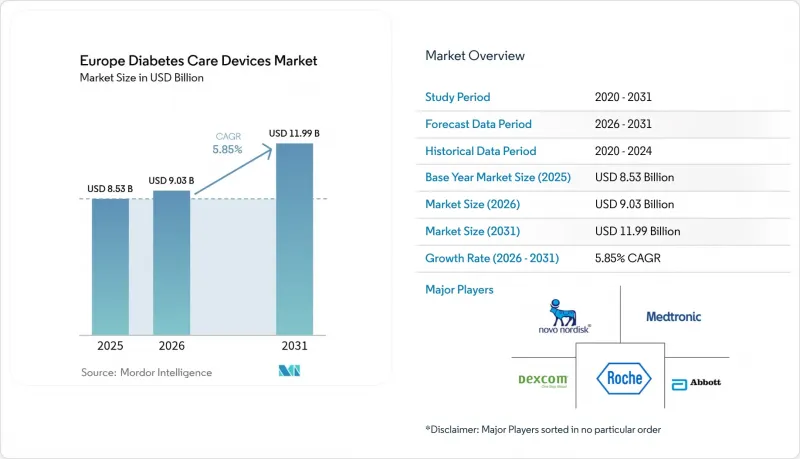
Mordor Intelligence에 의하면, 유럽의 당뇨병 관리 기기 시장 규모는 2025년 85억 3,000만 달러에서 2026년에는 90억 3,000만 달러에 이르고, 2026-2031년 CAGR 5.85%로 성장을 지속하여 2031년에는 119억 9,000만 달러에 달할 것으로 예측됩니다.
본 보고서는 기기 유형(모니터링 기기, 관리 기기), 환자 유형(1형 당뇨병, 2형 당뇨병, 임신성 당뇨병 및 기타), 최종 사용자(병원 및 클리닉, 재택 간호 환경 등), 유통 채널(병원 약국, 소매 약국 등) 및 지역별로 분류되어 있습니다. 시장 예측은 금액(달러) 기준으로 제시되어 있습니다.
유럽의 당뇨병 관리 기기 시장 동향 및 인사이트
독일 및 북유럽 국가에서 CGM 보급을 촉진하는 각국의 보험 환급 제도 개혁
독일의 공적 의료보험에서는 2024년 초에 인슐린 의존 환자 전원을 대상으로 CGM의 보험 적용 범위가 확대되어, 주요 비용상의 장벽이 즉시 해소되었습니다. 덴마크, 스웨덴, 노르웨이도 이에 뒤이어 북유럽 전체에 걸쳐 통일된 환경이 조성되었습니다. 현재 이 지역에서는 테스트 스트립보다 센서 기반 모니터링이 보험 급여 측면에서 더 우대받고 있습니다. 그 결과 처방전이 급증하고 있으며, 공급업체들은 입찰에서 우위를 확보하고 리드타임을 단축하기 위해 센서 조립을 현지화하도록 장려받고 있습니다. 의료 제공업체들은 인슐린 치료 시작 후 4주 이내에 CGM을 시작할 수 있도록 임상 경로를 재검토하고 있으며, 1차 진료와 당뇨병 전문 클리닉 간의 협력이 강화되고 있습니다. 각 제조업체는 의사의 이해도가 높아지고, 환자 자가 관리 앱이 각국의 전자건강기록(EHR)과 통합됨에 따라 향후 3년 동안 기기 이용률이 꾸준히 상승할 것으로 예상하고 있습니다. 따라서 보험 급여의 확실성은 판매량 증가, 수익 예측 가능성의 향상, 그리고 규정을 준수하는 공급업체의 협상력 강화로 이어지고 있습니다.
클래스 IIb ‘스마트 펜’에 대한 EU MDR의 패스트트랙 심사가 제품 출시를 가속화
2024년 EU 의료기기 규정(MDR)에 따라 커넥티드 인슐린 펜에 대한 12-15개월의 패스트 트랙 심사가 도입됨에 따라, 시장 출시까지의 평균 기간이 약 3분의 1로 단축되었습니다. 주요 개발 기업들은 투여 데이터를 기록하고, 투여 누락을 경고하며, 의사의 대시보드로 정보를 전송하는 블루투스 지원 펜에 대해 신속하게 승인을 신청했습니다. 조기 승인을 계기로 후속 신청이 잇따르고 있어, 규제상의 병목 현상이 조만간 재발할 가능성은 낮을 것으로 보입니다. 마케팅 팀은 이처럼 단축된 일정을 활용하여 유럽 내 출시를 전 세계적인 브랜드 캠페인과 연계함으로써 초기 보급률을 극대화하고 있습니다. 이전에는 고가 인슐린 펜의 보험 급여에 소극적이었던 각국의 보험 의약품 목록도, 실제 임상에서 약물 복용 순응도 향상을 정량화하기 쉬워짐에 따라 비용 대비 효과 모델을 재검토하고 있습니다. 이러한 요인들이 맞물려 유럽은 차세대 인슐린 투여 기기의 출시를 위한 발판이 되고 있습니다.
의료기기 및 소모품에 적용되는 부가가치세(VAT)율의 차이가 자가 혈당 측정(SMBG)의 경제성을 왜곡하고 있습니다.
EU의 일부 회원국에서는 혈당 측정기에는 경감 세율의 VAT가 적용되는 반면, 테스트 스트립에는 일반 VAT가 부과되기 때문에 자가 혈당 측정(SMBG)의 평생 비용이 증가하고 있습니다. 환자들은 검사를 미루거나 테스트 스트립 사용을 줄이려 할 가능성이 있어, 혈당 조절이 저해될 우려가 있습니다. 각 제조업체들은 의료기기에 대한 부가가치세(VAT) 제도의 통일을 요구하며 로비 활동을 펼치고 있지만, 입법상의 진전은 여전히 더딘 실정입니다. 당분간은 저가 테스트 스트립 세트 판매나 구독 모델을 통해 검사 빈도를 유지하려고 노력하고 있습니다. 세제 평준화가 실현될 때까지 테스트 스트립을 이용한 모니터링의 경제성은 유럽의 당뇨병 관리 기기 시장에서 이 부문의 성장 가능성을 제한할 것입니다.
부문 분석
2025년, 모니터링 부문은 유럽의 당뇨병 관리 기기 시장의 53.40%를 차지하며, 일상적인 치료에서 정확한 혈당 수치 데이터가 최우선시됨을 반영하고 있습니다. CGM(연속 혈당 모니터링) 시스템은 통증 없는 연속 측정이 가능하며, 스마트폰이나 병원 대시보드와 원활하게 연동될 수 있어 현재 모니터링 관련 수익의 대부분을 차지하고 있습니다. CGM의 보급률은 보험 적용 대상이 1형 당뇨병 환자에서 인슐린 치료를 받는 모든 환자로 확대됨에 따라 가속화되었습니다. 각 공급업체는 센서 착용 기간, 보정이 필요 없는 작동, 손목시계와의 직접 연결 등의 측면에서 차별화를 꾀하고 있으며, 정기적인 측정에 사용되는 손가락 채혈식 혈당 측정기는 서서히 사라지고 있습니다.
관리용 기기의 매출 규모는 작지만, 2031년까지 연평균 성장률(CAGR) 6.85%를 나타낼 것으로 예측됩니다. CGM 데이터와 폐쇄 루프 알고리즘을 결합한 자동 인슐린 투여 시스템은 이러한 추세를 상징합니다. 그 결과, 기존에는 별개였던 하드웨어 카테고리가 자율적인 혈당 조절이 가능한 통합된 생태계로 더욱 긴밀하게 융합되고 있습니다. 알고리즘의 정확도가 향상됨에 따라, 보험사들은 첨단 펌프·센서 시스템을 향후 합병증으로 인한 비용을 상쇄하는 투자로 인식하기 시작했습니다. 그 결과, 관리용 기기는 모니터링 도구와의 격차를 좁혀, 향후 10년 말 무렵에는 가치 면에서 모니터링 도구를 능가할 가능성도 있어, 유럽의 당뇨병 관리 기기 시장 경쟁 구도가 재편될 것입니다.
2025년, 유럽의 당뇨병 관리 기기 시장 규모의 80.62%를 2형 당뇨병 환자가 차지하고 있으며, 이는 1형 당뇨병 중심의 설계에서 보다 광범위한 대사 건강 이용 사례로 패러다임 전환이 진행되고 있음을 보여줍니다. 이 환자층을 대상으로 한 제품 로드맵은 간편성, 눈에 띄지 않는 디자인, 그리고 교육 부담이 적음을 지침으로 삼고 있습니다. 식사 기록 앱과 연동되는 커넥티드 센서는 집중적인 인슐린 조절보다 라이프스타일에 대한 피드백을 중시하는 2형 당뇨병 환자들에게 지지를 받고 있습니다. 현재 각국의 지침에서는 기저 인슐린 요법에서도 CGM 사용이 권장되고 있기 때문에 기기 제조업체들은 핵심적인 정확도를 유지하면서도 고가의 부가 기능을 배제한 합리적인 가격의 센서를 잇달아 출시하고 있습니다.
1형 당뇨병은 획기적인 혁신에 대해 여전히 지대한 영향력을 행사하고 있습니다. 하이브리드형 클로즈드 루프 시스템은 소아 1형 당뇨병 환자를 대상으로 완성도를 높인 후 성인 사용자로 확대되었으며, 최근에는 특정 2형 당뇨병 하위 그룹에도 적용되고 있습니다. 한편, 임신성 당뇨병의 경우 신속한 도입과 임신 기간별 구독 모델을 중시하는 특화된 솔루션이 주목받기 시작했습니다. 이러한 환자층의 다양화와 맞물려 유럽의 당뇨병 관리 기기 시장은 확대되고 있으며, 특정 치료 경로에 대한 의존도를 줄이고 있습니다.
기타 혜택:
- 엑셀 형식 시장 예측(ME) 시트
- 3개월간의 애널리스트 지원
자주 묻는 질문
목차
제1장 서론
제2장 조사 방법
제3장 주요 요약
제4장 시장 구도
제5장 시장 규모와 성장 예측
제6장 경쟁 구도
제7장 시장 기회와 향후 전망
LSH 26.09.10According to Mordor Intelligence, the Europe diabetes care devices market size is expected to grow from USD 8.53 billion in 2025 to USD 9.03 billion in 2026 and is forecast to reach USD 11.99 billion by 2031 at 5.85% CAGR over 2026-2031.
This report is Segmented by Device Type (Monitoring Devices, Management Devices), Patient Type (Type-1 Diabetes, Type-2 Diabetes, Gestational & Others), End-User (Hospitals & Clinics, Home-Care Settings, and More), Distribution Channel (Hospital Pharmacies, Retail Pharmacies, and More), and Geography. Market Forecasts are Provided in Terms of Value (USD).
Europe Diabetes Care Devices Market Trends and Insights
National Reimbursement Reforms Boosting CGM Uptake in Germany & Nordics
Statutory insurance in Germany broadened CGM coverage to all insulin-dependent patients at the start of 2024, instantly eliminating the primary cost barrier. Denmark, Sweden, and Norway mirrored the move, creating a unified northern cluster where reimbursement now favors sensor-based monitoring over test strips. The resulting surge in prescriptions is encouraging suppliers to localize sensor assembly to secure tender points and shorten lead times. Healthcare providers are revising clinical pathways so that CGM initiation happens within four weeks of insulin therapy commencement, tightening links between primary care and diabetology clinics. Manufacturers expect device utilization rates to climb steadily over the next three years as physician familiarity increases and patient self-management apps integrate national e-health records. Reimbursement certainty is therefore translating into higher volumes, more predictable revenue, and stronger negotiating power for compliant suppliers
EU MDR Fast-Track for Class IIb "Smart Pens" Accelerating Product Launches
The 2024 introduction of a twelve-to-fifteen-month fast-track review for connected insulin pens under the EU Medical Device Regulation slashed average time-to-market by roughly one-third. Leading developers rapidly submitted Bluetooth-enabled pens that capture dose data, flag omissions, and transmit information to physicians' dashboards. Early approvals have prompted a queue of follow-on filings, signaling that the regulatory bottleneck is unlikely to return soon. Marketing teams are capitalizing on the compressed timeline by aligning European launches with global brand campaigns, thereby maximizing initial uptake. National formularies that previously hesitated to reimburse premium pens are reassessing cost-benefit models because real-world adherence gains are now easier to quantify. Collectively, these factors make Europe the launchpad for next-generation insulin-delivery hardware. .
Divergent VAT Rates on Devices vs. Consumables Distorting SMBG Economics
Reduced VAT on glucose meters but full VAT on test strips in several EU states inflates lifetime costs for self-monitoring of blood glucose. Patients may defer testing or stretch strip use, undermining glycemic control. Manufacturers are lobbying for harmonized medical-device VAT schemes, yet legislative progress remains slow. In the interim, low-priced strip bundles and subscription models aim to preserve testing frequency. Until tax parity is achieved, the economics of strip-based monitoring will limit growth potential for the segment inside the Europe diabetes care devices market.
Other drivers and restraints analyzed in the detailed report include:
- Tender-Driven Consolidation of Test-Strip Pricing in Southern Europe
- Hospital-at-Home Pilots in the UK & France Driving Remote Monitoring Kits
- Data-Residency Rules Limiting Cloud CGM Platforms in the DACH Region
For complete list of drivers and restraints, kindly check the Table Of Contents.
Segment Analysis
The monitoring segment captured 53.40% of the Europe diabetes care devices market in 2025, reflecting the primacy of accurate glucose data in day-to-day therapy. CGM systems now account for a majority of monitoring revenue because they deliver painless, continuous readings and integrate seamlessly with smartphones and hospital dashboards. CGM penetration accelerated once reimbursement expanded beyond type-1 to all insulin-treated patients. Suppliers are differentiating through sensor wear time, calibration-free operation, and direct-to-watch connectivity, signalling a gradual fade-out of fingerstick meters for regular measurement.
Management devices represent a smaller revenue pool but are forecast to progress at a 6.85% CAGR to 2031. Automated insulin delivery systems that combine CGM input with closed-loop algorithms epitomize this momentum. The result is a tighter convergence of traditionally separate hardware categories into unified ecosystems capable of autonomous glucose control. As algorithm accuracy improves, payers increasingly view advanced pump-sensor systems as an investment that offsets future complication costs. Consequently, management devices will narrow the gap with monitoring tools and may even surpass them in value toward the end of the decade, reshaping the competitive centre of gravity within the Europe diabetes care devices market.
Type-2 diabetes patients accounted for 80.62% of the Europe diabetes care devices market size in 2025, underscoring a paradigm shift from type-1-centric engineering to broader metabolic-health use cases. Simplicity, discreet form factors, and low training overhead guide product roadmaps aimed at this cohort. Connected sensors that pair with diet-tracking apps appeal to type-2 users keen on lifestyle feedback rather than intensive insulin titration. As national guidelines now encourage CGM even for basal-insulin regimens, device makers are rolling out value-priced sensors that maintain core accuracy while omitting premium bells and whistles.
Type-1 diabetes retains outsized influence on breakthrough innovation. Hybrid closed-loop systems were perfected in the paediatric type-1 population before scaling to adult users and, more recently, to select type-2 subgroups. Meanwhile, gestational diabetes is beginning to attract tailored solutions that emphasise rapid onboarding and per-trimester subscription models. Collectively, patient-type diversification broadens the Europe diabetes care devices market and mitigates reliance on any single therapy pathway.
Complete Report Scope:
- By Device Type
- Monitoring Devices
- Self-Monitoring Blood Glucose
- Glucometer Devices
- Test Strips
- Lancets
- Continuous Glucose Monitoring
- Sensors
- Durables
- Self-Monitoring Blood Glucose
- Management Devices
- Insulin Pumps
- Insulin Pump Device
- Insulin Pump Reservoir
- Infusion Set
- Insulin Syringes
- Insulin Pens
- Jet Injectors
- Insulin Pumps
- Monitoring Devices
- By Patient Type
- Type-1 Diabetes
- Type-2 Diabetes
- Gestational & Others
- By End-user
- Hospitals & Clinics
- Home-care Settings
- Ambulatory Surgical Centres
- Pharmacies & Retail Chains
- By Distribution Channel
- Hospital Pharmacies
- Retail Pharmacies
- Online Pharmacies
- Direct-to-Consumer E-commerce
- By Country
- Germany
- United Kingdom
- France
- Spain
- Italy
- Rest of Europe
List of Companies Covered in this Report:
- Abbott Laboratories
- Medtronic
- Roche
- Dexcom
- Ascensia Diabetes Care Holdings AG
- Novo Nordisk
- Sanofi
- Insulet
- Tandem Diabetes Care
- Ypsomed
- Senseonics
- Beckton Dickinson
- Terumo
- Eli Lilly and Company
- B. Braun
- Owen Mumford
- Nipro
- Menarini Diagnostics Srl
- AgaMatrix Holdings LLC
- Sooil Development Co. Ltd.
Additional Benefits:
- The market estimate (ME) sheet in Excel format
- 3 months of analyst support
TABLE OF CONTENTS
1 Introduction
- 1.1 Study Assumptions & Market Definition
- 1.2 Scope of the Study
2 Research Methodology
3 Executive Summary
4 Market Landscape
- 4.1 Market Overview
- 4.2 Market Drivers
- 4.2.1 National Reimbursement Reforms Boosting CGM Uptake in Germany & Nordics
- 4.2.2 EU MDR Fast-Track for Class IIb "Smart Pens" Accelerating Product Launches
- 4.2.3 Tender-Driven Consolidation of Test-Strip Pricing in Southern Europe
- 4.2.4 Pediatric T1D Prevalence Surge in CEE Fueling Patch-Pump Demand
- 4.2.5 Hospital-at-Home Pilots in UK & France Driving Remote Monitoring Kits
- 4.2.6 AI-based Decision Support Mandates in Spain Increasing Smart Pen Sales
- 4.3 Market Restraints
- 4.3.1 Divergent VAT Rates on Devices vs. Consumables Distorting SMBG Economics
- 4.3.2 Data-Residency Rules Limiting Cloud CGM Platforms in DACH Region
- 4.3.3 Fragmented HTA Processes Delaying Insulin Pump Funding in Italy & Spain
- 4.3.4 Sensor Waste-Disposal Regulations Raising Cost of Ownership in Benelux
- 4.4 Supply-Chain Analysis
- 4.5 Regulatory Outlook
- 4.6 Technological Outlook
- 4.7 Porter's Five Forces
- 4.7.1 Bargaining Power of Suppliers
- 4.7.2 Bargaining Power of Buyers
- 4.7.3 Threat of New Entrants
- 4.7.4 Threat of Substitutes
- 4.7.5 Competitive Rivalry
5 Market Size & Growth Forecasts (Value)
- 5.1 By Device Type
- 5.1.1 Monitoring Devices
- 5.1.1.1 Self-Monitoring Blood Glucose
- 5.1.1.1.1 Glucometer Devices
- 5.1.1.1.2 Test Strips
- 5.1.1.1.3 Lancets
- 5.1.1.2 Continuous Glucose Monitoring
- 5.1.1.2.1 Sensors
- 5.1.1.2.2 Durables
- 5.1.1.1 Self-Monitoring Blood Glucose
- 5.1.2 Management Devices
- 5.1.2.1 Insulin Pumps
- 5.1.2.1.1 Insulin Pump Device
- 5.1.2.1.2 Insulin Pump Reservoir
- 5.1.2.1.3 Infusion Set
- 5.1.2.2 Insulin Syringes
- 5.1.2.3 Insulin Pens
- 5.1.2.4 Jet Injectors
- 5.1.2.1 Insulin Pumps
- 5.1.1 Monitoring Devices
- 5.2 By Patient Type
- 5.2.1 Type-1 Diabetes
- 5.2.2 Type-2 Diabetes
- 5.2.3 Gestational & Others
- 5.3 By End-user
- 5.3.1 Hospitals & Clinics
- 5.3.2 Home-care Settings
- 5.3.3 Ambulatory Surgical Centres
- 5.3.4 Pharmacies & Retail Chains
- 5.4 By Distribution Channel
- 5.4.1 Hospital Pharmacies
- 5.4.2 Retail Pharmacies
- 5.4.3 Online Pharmacies
- 5.4.4 Direct-to-Consumer E-commerce
- 5.5 By Country
- 5.5.1 Germany
- 5.5.2 United Kingdom
- 5.5.3 France
- 5.5.4 Spain
- 5.5.5 Italy
- 5.5.6 Rest of Europe
6 Competitive Landscape
- 6.1 Strategic Moves
- 6.2 Market Share Analysis
- 6.3 Company Profiles (includes Global level Overview, Market level overview, Core Segments, Financials as available, Strategic Information, Market Rank/Share, Products & Services, Recent Developments)
- 6.3.1 Abbott Laboratories
- 6.3.2 Medtronic PLC
- 6.3.3 F. Hoffmann-La Roche AG
- 6.3.4 Dexcom Inc.
- 6.3.5 Ascensia Diabetes Care Holdings AG
- 6.3.6 Novo Nordisk A/S
- 6.3.7 Sanofi S.A.
- 6.3.8 Insulet Corporation
- 6.3.9 Tandem Diabetes Care Inc.
- 6.3.10 Ypsomed AG
- 6.3.11 Senseonics Holdings Inc.
- 6.3.12 Becton, Dickinson and Company (BD)
- 6.3.13 Terumo Corporation
- 6.3.14 Eli Lilly and Company
- 6.3.15 B. Braun Melsungen AG
- 6.3.16 Owen Mumford Ltd.
- 6.3.17 Nipro Corporation
- 6.3.18 Menarini Diagnostics Srl
- 6.3.19 AgaMatrix Holdings LLC
- 6.3.20 Sooil Development Co. Ltd.
7 Market Opportunities & Future Outlook
- 7.1 White-Space & Unmet-Need Assessment