

|
시장보고서
상품코드
2156866
남미의 국제 CEP : 시장 점유율 분석, 업계 동향과 통계, 성장 예측(2026-2031년)South America International CEP - Market Share Analysis, Industry Trends & Statistics, Growth Forecasts (2026 - 2031) |
||||||
 Mordor Intelligence
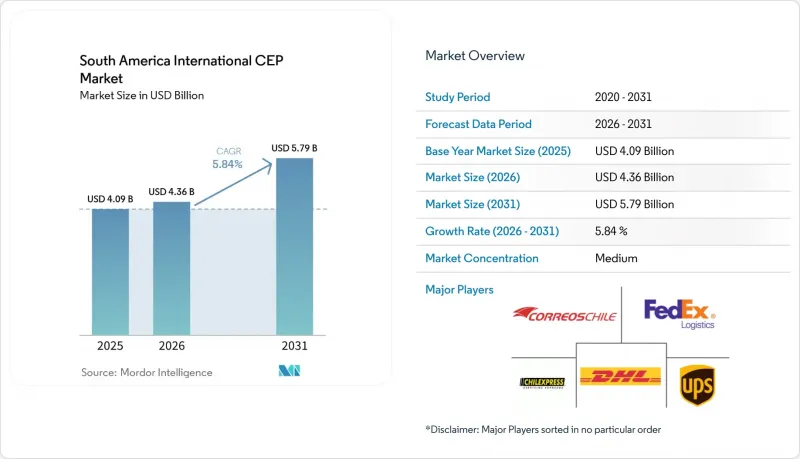
에 따르면 남미의 국제 CEP 시장 규모는 2025년에 40억 9,000만 달러로 평가되며, 2026년 43억 6,000만 달러에서 2031년에는 57억 9,000만 달러에 달할 것으로 예상되고 있으며, 2026-2031년에 CAGR 5.84%로 성장할 것으로 전망되고 있습니다.
국경을 초월한 E-Commerce, 주문 처리 네트워크의 확대, 그리고 세관 업무의 현대화가 해당 지역 전체의 소포 유통을 촉진하고 있습니다. 이 보고서는 배송 속도(특급, 비특급), 비즈니스 모델(B2B, B2C, C2C), 발송 중량(경량, 중량, 기타), 운송 수단(항공, 육상, 기타), 최종사용자 산업(E-Commerce, 금융 서비스/BFSI, 헬스케어, 기타) 및 국가(아르헨티나, 브라질, 칠레, 기타)별로 분류되어 있습니다. 시장 전망은 금액(달러) 기준으로 제시되어 있습니다.
남미 국제 CEP 시장의 동향 및 인사이트
국경을 초월한 E-Commerce 및 디지털 무역의 확대
국경을 초월한 디지털 무역의 확대로 인해 남미 지역의 국제 택배, 익스프레스 배송, 소포 서비스에 대한 수요가 증가하고 있습니다. 중국의 플랫폼, 유럽의 패션 브랜드, 북미의 소매업체들은 이 지역 전역에서 소비자에게 직접 배송(D2C)을 확대하고 있습니다. 브라질의 결제 시스템 ‘Pix’는 가맹점의 결제 지연을 줄이고 주문 처리 속도를 높이는 데 기여하고 있습니다. 페루는 2025년에 156억 달러의 E-Commerce 매출을 기록하여 전년 대비 21.2% 증가했습니다. 이 매출은 국내총생산(GDP)의 5.5%를 차지합니다. 소액이지만 빈도가 높은 온라인 구매로 인해 가구당 배송 건수가 증가하고 있습니다. 이러한 추세는 평균 주문 금액이 제한적이라 하더라도 소포 배송 빈도는 상승할 수 있으므로 남미의 국제 CEP 시장을 지원하고 있습니다.
시간 지정 국제 배송에 대한 수요 증가
배송의 확실성에 대한 수요가 높아짐에 따라 서비스 구성은 지정된 배송 시간대를 갖춘 특급 상품으로 전환되고 있습니다. 제조업체는 예정대로 생산을 유지하기 위해 부품 조달 과정에서 예측 가능한 운송을 필요로 합니다. 또한 의료 서비스 제공업체 역시 온도 관리가 필요한 의약품 수입시 신뢰할 수 있는 배송을 필요로 합니다. 이러한 요건으로 인해 단순히 최저가 제안보다 서비스 품질, 경로의 신뢰성, 통관 절차의 중요성이 더욱 높아지고 있습니다. 운송 사업자가 산업 및 의료 분야 고객과 장기 계약을 체결하는 것은 남미의 국제 CEP 시장에 긍정적인 영향을 미칩니다. 이러한 계약을 통해 수익이 단기적인 E-Commerce 배송량 변동의 영향을 덜 받게 됩니다.
거시경제 변동과 환율 리스크
환율 변동은 국경을 넘는 가격 책정 및 운송업체의 계약 관리를 더욱 어렵게 만듭니다. 운송업체는 현지 통화로 대금을 수령하는 반면, 연료비나 항공기 리스료는 달러로 지불해야 하는 경우가 있습니다. 이러한 불일치는 출하량이 증가하더라도 이익률을 저하시킬 가능성이 있습니다. 아시아와 브라질 간 운송 비용의 상승은 저가대 수입 수요에 제약을 주고 있습니다. 아르헨티나의 금융 상황은 여전히 무역 여건 및 상품 가격 변동에 취약한 상태입니다. 따라서 남미 국제 CEP 시장에서는 고객의 지급 능력과 운송업체의 이익률 보호 필요성 사이의 균형을 맞춰야 합니다.
부문 분석
2025년, 남미 국제 CEP 시장 규모의 76.70%를 비특급 서비스가 차지했습니다. 이러한 상황은 비용에 민감한 E-Commerce 수입의 중요성과 분산된 인구에 대한 서비스 제공이라는 과제를 반영하고 있습니다. 이코노미 서비스는 고정된 배송 시간이 필요하지 않은 소포에 있으며, 여전히 중요한 역할을 하고 있습니다. 아르헨티나의 농촌 지역, 브라질의 내륙 지역, 그리고 페루의 고지대 회랑에서는 광범위한 우편망과 도로망에 대한 의존이 계속되고 있습니다. 예측 기간 중 비특급 서비스의 처리량은 절대값 기준으로 감소하지 않을 것으로 전망됩니다. 이 부문은 대량의 소포 운송에 대해 저비용 대안을 제공하므로 남미 국제 CEP 시장에서 여전히 필수적인 존재로 남아 있습니다.
특급 서비스는 2031년까지 연평균 성장률(CAGR) 6.76%로 성장할 것으로 예측됩니다. 이러한 성장은 시간 지정 수입 배송이 필요한 제조업 및 제약 업계의 고객들에 의해 지원되고 있습니다. 또한 특급 서비스는 더 짧은 배송 기간을 위해 추가 요금을 지불하는 것을 꺼리지 않는 소비자들로부터도 지지를 받고 있습니다. 상파울루, 산티아고, 리마와 해외 허브를 연결하는 새로운 항공 화물 노선은 더욱 신속한 국제 운송 경로를 실현할 것입니다. ‘카프리콘 바이오션 코리도(Capricorn Byocean Corridor)’는 특정 국경을 넘는 노선에서 향후 육상 운송의 대안이 될 것입니다. 따라서 남미 국제 CEP 시장은 이코노미 서비스의 탄탄한 기반을 유지하면서, 특급 서비스가 수익 성장에 더욱 크게 기여할 것으로 전망됩니다.
B2C는 2025년 남미 국제 CEP 시장 점유율의 52.66%를 차지하고 있으며, 2031년까지 연평균 성장률(CAGR) 6.93%로 성장할 것으로 예측됩니다. 이는 가장 큰 비즈니스 모델 부문이자 가장 빠르게 성장하는 부문이기도 합니다. 소비자 직배송형 소매(D2C)를 통해 국제 판매업체는 기존의 현지 매장 네트워크 없이도 구매자에게 접근할 수 있게 됩니다. 또한 이로 인해 통관, 간선 운송, 라스트 마일 조정이 필요한 소량 발송이 빈번하게 이루어지게 됩니다. B2C 수요는 디지털 결제 및 플랫폼을 통한 주문 처리 서비스가 더욱 널리 이용되고 있는 지역에서 가장 강하게 나타나고 있습니다. 남미의 국제 CEP 업계는 이러한 지속적인 소포 수요에 점점 더 의존하고 있습니다.
B2B는 부품, 전자기기 하위 조립품, 화학 원료를 수입하는 제조업체에게 여전히 중요합니다. 이러한 고객은 대개 계약에 기반한 배송 서비스를 이용하며, 서비스 수준 보장을 필요로 하는 경우가 있습니다. C2C는 규모는 작지만, 특히 브라질-파라과이 간이나 아르헨티나-칠레 간 노선에서 비공식 국경 간 판매업자들에게 서비스를 제공하고 있습니다. 플랫폼이 상품을 구매자 근처로 이동시키면서 사전 배치 재고로의 전환이 서서히 진행되고 있습니다. 이를 통해 주문부터 소포 수령까지의 배송 시간을 단축할 수 있습니다. 남미의 국제 CEP 시장에서는 B2C, B2B, C2C 각 배송 유형마다 서비스에 대한 기대치와 배송 패턴이 다르기 때문에 유연한 네트워크 용량이 필요합니다.
기타 혜택:
- 엑셀 형식의 시장 예측(ME) 시트
- 3개월간 애널리스트 지원
자주 묻는 질문
목차
제1장 서론
- 조사 전제조건과 시장 정의
- 조사 범위
제2장 조사 방법
제3장 개요
제4장 시장 구도
- 시장 개요
- 주요 거시경제 지표(GDP, 인플레이션율, 국제 무역 등)와 시장에 대한 영향
- 시장 성장 촉진요인
- 시장 성장 억제요인
- 밸류체인 및 유통 채널 분석
- 규제 프레임워크
- 기술 전망
- E-Commerce 업계의 실적과 개요
- Porter's Five Forces 분석
- 지정학적 이벤트가 시장에 미치는 영향
제5장 시장 규모와 성장 예측
- 배송 스피드별
- 비즈니스 모델별
- 출하 중량별
- 운송 모드별
- 최종사용자 산업별
- 국가별
- 아르헨티나
- 브라질
- 칠레
- 콜롬비아
- 페루
- 기타 남미 국가
제6장 경쟁 구도
- 시장 집중도
- 주요 전략적 동향
- 시장 점유율 분석
- 기업 개요
- Empresa Brasileira de Correios e Telegrafos
- DHL Group
- FedEx Corporation
- United Parcel Service, Inc.
- Correo Argentino
- Correos de Chile
- Chilexpress S.A.
- Aramex International
- DSV A/S(Including DB Schenker)
- La Poste Group(Including GeoPost SA)
- C.H. Robinson Worldwide, Inc.
- Kuehne+Nagel International AG
- Nippon Express Co., Ltd.
- CMA CGM Group(Including CEVA Logistics)
- Mercado Libre, Inc.
- Total Express
- Andreani Logistica
- Azul Cargo Express
- SkyPostal, Inc.
- Alibaba Group(Including Cainiao Network)
- Urbano Express
- SF Express
제7장 시장 기회와 향후 전망
KSA 26.10.29According to Mordor Intelligence, the South America international CEP market size was valued at USD 4.09 billion in 2025, and it is expected to grow from USD 4.36 billion in 2026 to reach USD 5.79 billion in 2031, growing at a CAGR of 5.84% from 2026 to 2031.
Cross-border e-commerce, larger fulfillment networks, and customs modernization are supporting parcel flows across the region. This report is Segmented by Speed of Delivery (Express, Non-Express), by Business Model (B2B, B2C, C2C), by Shipment Weight (Light-Weight, Medium, and More), by Mode of Transport (Air, Road, Others), by End-User Industry (E-Commerce, Financial Services/BFSI, Healthcare, and More), and by Country (Argentina, Brazil, Chile, and More). The Market Forecasts are Provided in Terms of Value (USD).
South America International CEP Market Trends and Insights
Cross-Border E-Commerce and Digital-Trade Expansion
Cross-border digital trade is increasing the demand for international courier, express, and parcel services in South America. Chinese platforms, European fashion brands, and North American retailers are expanding direct-to-consumer fulfillment across the region. Brazil's Pix payment system reduces settlement delays for merchants and supports faster order processing. Peru recorded USD 15.6 billion in e-commerce sales in 2025, a 21.2% increase from the previous year, and those sales represented 5.5% of the national GDP. Smaller and more frequent online purchases are increasing the number of shipment events per household. This pattern supports the South America International CEP market because parcel frequency can rise even when the average order value remains limited.
Growing Demand for Time-Definite International Delivery
Demand for delivery certainty is shifting the service mix toward express products with specified delivery windows. Manufacturers need predictable transport for inbound parts that support scheduled production. Healthcare providers also need dependable delivery for temperature-sensitive pharmaceutical imports. These requirements make service quality, route reliability, and customs handling more important than a simple lowest-price offer. The South America International CEP market benefits when carriers secure longer-term contracts with industrial and healthcare customers. Such contracts can make revenue less exposed to changes in short-term e-commerce shipping volumes.
Macroeconomic Volatility and Foreign-Exchange Exposure
Currency movements make cross-border pricing and carrier contract management more difficult. Carriers may receive payment in local currencies while paying for fuel and aircraft leases in USD. This mismatch can reduce margins even when shipment volumes increase. Rising freight costs on the Asia-Brazil corridor are a constraint on lower-value import demand. Argentina's monetary conditions remain vulnerable to changes in trade conditions and commodity prices. The South America International CEP market must therefore balance customer affordability with the need to protect carrier margins.
Other drivers and restraints analyzed in the detailed report include:
- Customs Digitization and Trade-Facilitation Reforms
- E-Commerce Marketplace Fulfillment Investment
- Cargo Theft and Security-Cost Inflation
For complete list of drivers and restraints, kindly check the Table Of Contents.
Segment Analysis
Non-express services held 76.70% of the South America International CEP market size in 2025. This position reflects the importance of cost-sensitive e-commerce imports and the challenge of serving dispersed populations. Economy services remain relevant for parcels that do not require a fixed delivery time. Rural Argentina, inland Brazil, and Peru's highland corridors continue to depend on broad postal and road networks. Non-express volumes are not expected to decline in absolute terms during the forecast period. The category remains essential to the South America International CEP market because it provides the lower-cost option for high-volume parcel traffic.
Express services are forecast to grow at a 6.76% CAGR through 2031. This growth is supported by industrial and pharmaceutical customers that need time-defined inbound delivery. Express products also appeal to consumers willing to pay for shorter delivery windows. New air-cargo connections between Sao Paulo, Santiago, Lima, and overseas hubs can support faster international routing. The Capricorn Bi-Oceanic Corridor is a future surface option for selected cross-border routes. The South America International CEP market is therefore likely to retain a large economy-service base while express services make a larger contribution to revenue growth.
B2C held 52.66% of the South America International CEP market share in 2025 and is projected to grow at a 6.93% CAGR through 2031. It is the largest business-model segment and the fastest-growing segment. Direct-to-consumer retail gives international sellers access to buyers without a traditional local store network. It also creates a high frequency of smaller shipments that require customs, linehaul, and last-mile coordination. B2C demand is strongest where digital payments and platform fulfillment are becoming more widely used. The South America International CEP industry depends increasingly on this type of recurring parcel demand.
B2B remains important for manufacturers that import components, electronics subassemblies, and chemical inputs. These customers often use contracted delivery services and may require service-level commitments. C2C is smaller but serves informal cross-border sellers, especially on the Brazil-Paraguay and Argentina-Chile corridors. A gradual shift toward pre-positioned inventory as platforms move goods closer to buyers. This can reduce delivery time between order placement and parcel collection. The South America International CEP market will need flexible network capacity because B2C, B2B, and C2C shipments have different service expectations and shipment patterns.
Complete Report Scope:
- By Speed of Delivery
- Express
- Non-Express
- By Business Model
- Business-to-Business (B2B)
- Business-to-Consumer (B2C)
- Consumer-to-Consumer (C2C)
- By Shipment Weight
- Light-Weight Shipments
- Medium-Weight Shipments
- Heavy-Weight Shipments
- By Mode of Transport
- Air
- Road
- Others
- By End-User Industry
- E-Commerce
- Financial Services (BFSI)
- Healthcare
- Manufacturing
- Primary Industry
- Wholesale and Retail Trade (Offline)
- Others
- By Country
- Argentina
- Brazil
- Chile
- Colombia
- Peru
- Rest of South America
List of Companies Covered in this Report:
- Empresa Brasileira de Correios e Telegrafos
- DHL Group
- FedEx Corporation
- United Parcel Service, Inc.
- Correo Argentino
- Correos de Chile
- Chilexpress S.A.
- Aramex International
- DSV A/S (Including DB Schenker)
- La Poste Group (Including GeoPost SA)
- C.H. Robinson Worldwide, Inc.
- Kuehne + Nagel International AG
- Nippon Express Co., Ltd.
- CMA CGM Group (Including CEVA Logistics)
- Mercado Libre, Inc.
- Total Express
- Andreani Logistica
- Azul Cargo Express
- SkyPostal, Inc.
- Alibaba Group (Including Cainiao Network)
- Urbano Express
- SF Express
Additional Benefits:
- The market estimate (ME) sheet in Excel format
- 3 months of analyst support
TABLE OF CONTENTS
1 INTRODUCTION
- 1.1 Study Assumptions and Market Definition
- 1.2 Scope of the Study
2 RESEARCH METHODOLOGY
3 EXECUTIVE SUMMARY
4 MARKET LANDSCAPE
- 4.1 Market Overview
- 4.2 Key Macroeconomic Factors (GDP, Inflation, International Trades etc.) and their Impact on the Market
- 4.3 Market Drivers
- 4.3.1 Cross-Border E-Commerce and Digital-Trade Expansion
- 4.3.2 Growing Demand for Time-Definite International Delivery
- 4.3.3 Customs Digitization and Trade-Facilitation Reforms
- 4.3.4 E-Commerce Marketplace Fulfillment Investment
- 4.3.5 South America-to-Asia Air-Cargo Corridor Development
- 4.3.6 Bonded Micro-Hubs and Border-Adjacent Fulfillment
- 4.4 Market Restraints
- 4.4.1 Macroeconomic Volatility and Foreign-Exchange Exposure
- 4.4.2 Uneven Road, Airport and Border Infrastructure
- 4.4.3 Cargo Theft and Security-Cost Inflation
- 4.4.4 Fragmented Customs, Tax and Carrier-Data Standards
- 4.5 Value Chain and Distribution Channel Analysis
- 4.6 Regulatory Framework
- 4.7 Technological Outlook
- 4.8 E-commerce Industry Performance and Profile
- 4.9 Porter's Five Forces Analysis
- 4.9.1 Threat of New Entrants
- 4.9.2 Bargaining Power of Suppliers
- 4.9.3 Bargaining Power of Buyers
- 4.9.4 Threat of Substitutes
- 4.9.5 Competitive Rivalry
- 4.10 Impact of Geopolitical Events on the Market
5 MARKET SIZE AND GROWTH FORECASTS (Value, USD)
- 5.1 By Speed of Delivery
- 5.1.1 Express
- 5.1.2 Non-Express
- 5.2 By Business Model
- 5.2.1 Business-to-Business (B2B)
- 5.2.2 Business-to-Consumer (B2C)
- 5.2.3 Consumer-to-Consumer (C2C)
- 5.3 By Shipment Weight
- 5.3.1 Light-Weight Shipments
- 5.3.2 Medium-Weight Shipments
- 5.3.3 Heavy-Weight Shipments
- 5.4 By Mode of Transport
- 5.4.1 Air
- 5.4.2 Road
- 5.4.3 Others
- 5.5 By End-User Industry
- 5.5.1 E-Commerce
- 5.5.2 Financial Services (BFSI)
- 5.5.3 Healthcare
- 5.5.4 Manufacturing
- 5.5.5 Primary Industry
- 5.5.6 Wholesale and Retail Trade (Offline)
- 5.5.7 Others
- 5.6 By Country
- 5.6.1 Argentina
- 5.6.2 Brazil
- 5.6.3 Chile
- 5.6.4 Colombia
- 5.6.5 Peru
- 5.6.6 Rest of South America
6 COMPETITIVE LANDSCAPE
- 6.1 Market Concentration
- 6.2 Key Strategic Moves
- 6.3 Market Share Analysis
- 6.4 Company Profiles (includes Global Level Overview, Market Level Overview, Core Segments, Financials as available, Strategic Information, Geographic Coverage, Products and Services, Recent Developments)
- 6.4.1 Empresa Brasileira de Correios e Telegrafos
- 6.4.2 DHL Group
- 6.4.3 FedEx Corporation
- 6.4.4 United Parcel Service, Inc.
- 6.4.5 Correo Argentino
- 6.4.6 Correos de Chile
- 6.4.7 Chilexpress S.A.
- 6.4.8 Aramex International
- 6.4.9 DSV A/S (Including DB Schenker)
- 6.4.10 La Poste Group (Including GeoPost SA)
- 6.4.11 C.H. Robinson Worldwide, Inc.
- 6.4.12 Kuehne + Nagel International AG
- 6.4.13 Nippon Express Co., Ltd.
- 6.4.14 CMA CGM Group (Including CEVA Logistics)
- 6.4.15 Mercado Libre, Inc.
- 6.4.16 Total Express
- 6.4.17 Andreani Logistica
- 6.4.18 Azul Cargo Express
- 6.4.19 SkyPostal, Inc.
- 6.4.20 Alibaba Group (Including Cainiao Network)
- 6.4.21 Urbano Express
- 6.4.22 SF Express
7 MARKET OPPORTUNITIES AND FUTURE OUTLOOK
- 7.1 White-Space and Unmet-Need Assessment


