

|
시장보고서
상품코드
2157144
인도네시아의 계약 물류 : 시장 점유율 분석, 업계 동향과 통계, 성장 예측(2026-2031년)Indonesia Contract Logistics - Market Share Analysis, Industry Trends & Statistics, Growth Forecasts (2026 - 2031) |
||||||
 Mordor Intelligence
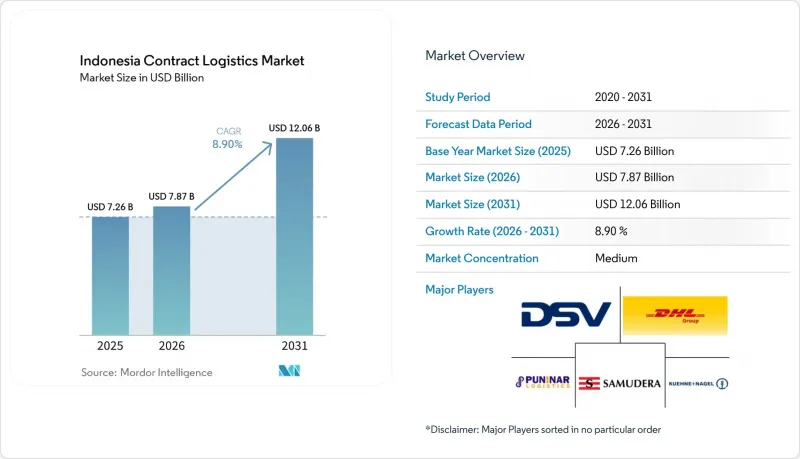
에 따르면 인도네시아의 계약 물류 시장 규모는 2025년에 72억 6,000만 달러로 평가되며, 2026년 78억 7,000만 달러에서 2031년까지 120억 6,000만 달러에 달할 것으로 예측되고 있으며, 예측 기간(2026-2031년)에 CAGR은 8.90%에 달할 전망입니다.
인도네시아 계약 물류 시장의 동향 및 인사이트
E-Commerce 주문 처리 업무의 외부 위탁이 계약 물류 수요를 가속화
인도네시아의 E-Commerce 활동은 2025년까지 두 자릿수의 처리량 성장을 유지하며, 소포 처리량, 재고 수요 및 역물류 업무량이 증가했습니다. 이러한 활동으로 인해 각 브랜드는 더 많은 거점에서 재고를 관리하고, 자카르타 대도시권 외 지역의 소비자까지 대응해야 할 필요성이 대두되었습니다. 브랜드들이 이러한 업무를 확립된 창고 및 배송 네트워크를 보유한 공급업체로 이관함에 따라 인도네시아의 계약 물류 시장은 혜택을 보았습니다. 더욱 복잡해진 주문 처리 계약에서는 상온, 냉장, 보세 구역의 재고가 단일 운영 거점 내에 통합되었습니다. 이러한 구조를 통해 개별 창고 전문 업체와의 조정 필요성이 줄어들었습니다. 또한 2급 및 3급 도시에 지역 거점을 보유한 공급업체의 가치도 높아졌습니다.
제조업의 확장이 통합 공급망에 대한 요구를 높이고 있습니다.
인도네시아의 하류 산업 정책에 따라 니켈, 구리, 보크사이트 가공의 상당 부분이 수출 전에 국내에서 이루어지게 되었습니다. 자동차 분야에 대한 투자도 이러한 요건을 가속화했으며, BYD의 수방 공장과 2026년에 가동을 시작한 지리 파리존(Geely Farizon)의 노크다운 조립 시설 등이 그 예입니다. 이러한 시설에서는 부품 조달, 보세 구역내 물류, 그리고 각 산업 단지를 아우르는 적시(JIT) 배송이 필요했습니다. 토요타 모터 매뉴팩처링 인도네시아는 2026년 기준으로 240개 이상의 1차 공급업체와 520개의 2차 및 3차 공급업체를 총괄하고 있습니다. 이러한 공급업체 기반의 확대로 인해 입고 흐름과 통관 절차를 관리할 수 있는 물류 파트너에 대한 수요가 높아지고 있습니다. 또한 중부 자바주로 이전되고 있는 섬유·의류 생산으로 인해 스마랑 주변의 화물 운송 경로, 보관 및 수출 지원에 대한 수요도 발생하고 있습니다.
섬 간 운송 비용이 계약 물류 비용을 상승시키고 있습니다.
섬 간 운송에는 해상 또는 항공 운송, 적재, 하역, 그리고 항만 체류 시간이 수반되었습니다. 이러한 작업 공정은 베트남, 태국, 혹은 말레이시아 반도의 동등한 육상 경로에는 해당되지 않았습니다. Sea Toll이 개선된 후에도 화물 집하, 혼재, 보관 및 항만 하역 작업이 여전히 필요했으므로 비용은 높은 수준을 유지했습니다. 귀로 화물 물동량이 불균형했던 점도 추가적인 압박 요인이 되었습니다. 이는 자바섬에서의 수출 수요가 자바섬으로 돌아오는 화물량을 초과했기 때문입니다. 2025년 싱가포르 국립대학교의 연구에 따르면 인프라와 화물 처리 능력의 부족이 서칼리만탄주의 물류 경쟁에 대한 지속적인 제약 요인이라고 지적되었습니다. 그 결과, 외딴 섬 간 운송 노선의 고정 가격 계약에서 비용 변동을 고객에게 전가할 수 없는 경우, 이익률에 대한 위험이 발생하게 되었습니다.
부문 분석
2025년 인도네시아 계약 물류 시장에서 운송 부문은 58.97%의 점유율을 차지하며 여전히 가장 큰 서비스 카테고리였습니다. 자바 섬의 도로망과 섬 간 해상 운송이 국내 전체 물류 흐름을 통해 그 위상을 지원하고 있었습니다. 도로 운송 서비스는 주요 섬들의 산업단지, 물류 센터, 소매 채널을 연결하고 있었습니다. 철도는 자바 섬의 특정 노선에서 대체 수단을 제공했으며, 항공 화물은 인도네시아 동부로 향하는 정시 배송 화물을 지원하고 있었습니다. NX 로지스틱스 인도네시아와 KAI 로지스틱스는 2025년 5월, 클라리, 카라왕, 수라바야 간 철도 화물 운송에 대한 제휴를 시작했습니다. 창고 및 물류 서비스는 A급 창고 시설이 그레이터 자카르타에서 수라바야, 세마랑, 메단, 마카사르로 확대됨에 따라 서비스 구성의 핵심을 형성했습니다.
부가가치 서비스는 2026-2031년까지 연평균 성장률(CAGR) 11.46%로 성장할 것으로 예상되며, 이는 서비스 구성 중 가장 높은 성장률입니다. 조립, 라벨 부착, 키트화를 통해 전자기기, 자동차, 소비재 화주들은 생산 지원 및 주문 처리 활동을 더 가까운 곳에 배치할 수 있게 되었습니다. 이로 인해 공장, 보관 장소, 배송 업무 간의 이관 과정이 줄어들었습니다. 이러한 활동이 단일 시설 내에서 이루어지게 됨에 따라 인도네시아의 계약 물류 업계는 보다 장기적이고 통합적인 고객 관계로부터 혜택을 얻었습니다. 보세 구역 인가 또한 수출 제조업체에 서비스를 제공하는 사업자들 간의 차별화 요소가 되었습니다. 마스크 로지스틱스 인도네시아는 2026년 초, 세마랑에 위치한 ‘Pusat Logistik Berikat(보세 물류 센터)’ 시설의 인가를 획득했습니다. 이 시설은 의류, 신발, 액세서리 수출업체를 대상으로 통합된 보관 및 통관 관리를 지원했습니다.
기타 혜택:
- 엑셀 형식의 시장 예측(ME) 시트
- 3개월간의 애널리스트 지원
자주 묻는 질문
목차
제1장 서론
- 조사 전제조건과 시장 정의
- 조사 범위
제2장 조사 방법
제3장 개요
- 시장 규모, 성장률 및 예측
- 주요 수요 요인과 계약 물류의 동향
- 주요 물류 네트워크와 수요 집중
- 경쟁 구도와 주요 계약 물류 프로바이더
제4장 시장 구도
- 시장 개요와 계약 물류의 중요성
- 시장 성장 촉진요인
- 시장 성장 억제요인
- 밸류체인 구조와 계약 물류 플로우 분석
- 규제 프레임워크 및 물류 컴플라이언스 요건의 분석
- 기술의 도입과 계약 물류 디지털화에 관한 분석
- 운임 및 운송 비용의 동향 분석
- 연료 가격이 운임의 동향에 미치는 영향
- 지역별 물류 투자 및 생산능력 확대의 분석
- Porter's Five Forces 분석
- 지정학적 이벤트가 공급망의 변화에 미치는 영향
제5장 시장 규모와 성장 예측
- 서비스 유형별
- 계약 기간별
- 최종사용자 산업별
- 지역별
- Java(자카르타 및 BOD)
- 수마트라
- 보르네오
- 술라웨시
- 발리 및 누사 텡가라
- 파푸아 지역 및 말루쿠 제도
제6장 경쟁 구도
- 시장 집중도
- 전략적 동향
- 시장 점유율 분석
- 기업 개요
- DHL Group
- DSV A/S
- Kuehne+Nagel
- CMA CGM Group
- A.P. Moller-Maersk
- GEODIS
- NX Group
- NYK Line(Including Yusen Logistics Co., Ltd.)
- Linfox Pty Ltd.
- CJ Logistics Corporation
- PT Karyatama Mitra Terampil(KMT Logistics)
- PT Mega Manunggal Property Tbk
- Rhenus Group
- Kiat Ananda Group
- PT Samudera Indonesia Tbk
- LINC Group
- PT Puninar Logistics
- PT Kamadjaja Logistics
- PT Cipta Krida Bahari
- Waresix
- Shipper
- MGM Bosco Logistics
제7장 시장 기회와 향후 전망
제8장 부록
KSA 26.10.30According to Mordor Intelligence, the Indonesia contract logistics market size was valued at USD 7.26 billion in 2025 and is estimated to grow from USD 7.87 billion in 2026 to reach USD 12.06 billion by 2031, at a CAGR of 8.90% during the forecast period (2026-2031).
Indonesia Contract Logistics Market Trends and Insights
E-Commerce Fulfillment Outsourcing Accelerating Contract Logistics Demand
Indonesia's e-commerce activity sustained double-digit volume growth through 2025, increasing parcel volumes, inventory needs, and reverse-logistics workloads. This activity required brands to manage stock across more locations and serve consumers beyond Greater Jakarta. The Indonesia contract logistics market benefited when brands shifted these tasks to providers with established warehouse and delivery networks. More complex fulfillment contracts combined ambient, refrigerated, and bonded-zone inventory within a single operating location. This arrangement reduced the need to coordinate separate warehouse specialists. It also increased the value of providers that had regional facilities in tier-2 and tier-3 cities.
Manufacturing Expansion Increasing Integrated Supply Chain Requirements
Indonesia's downstream industrial policy kept more nickel, copper, and bauxite processing within the country before export. Automotive investment added to these requirements, including BYD's Subang plant and Geely Farizon's knock-down assembly facility, which became operational in 2026. These facilities required component sequencing, bonded-zone flows, and just-in-time delivery across industrial locations. Toyota Motor Manufacturing Indonesia coordinates more than 240 Tier-1 suppliers and 520 Tier-2 and Tier-3 suppliers in 2026. The supplier base strengthens demand for logistics partners that can manage inbound flows and customs procedures. Textile and garment production moving toward Central Java also created a need for freight links, storage, and export support around Semarang.
Inter-Island Handling Costs Increasing Contract Logistics Expenses
Every inter-island shipment involved sea or air transfer, loading, unloading, and port dwell time. These operating steps did not apply to comparable overland routes in Vietnam, Thailand, or peninsular Malaysia. Costs remained high even after Sea Toll improvements because freight still required collection, consolidation, storage, and handling at ports. Uneven return cargo flows added further pressure because outbound demand from Java exceeded shipments moving back to Java. A 2025 National University of Singapore study identified infrastructure and cargo-handling gaps as ongoing constraints on West Kalimantan's logistics competitiveness. Fixed-price contracts in outer-island corridors, therefore, carried margin risk when cost movements could not be passed through to clients.
Other drivers and restraints analyzed in the detailed report include:
- Inter-Island Distribution Development Expanding Contract Logistics Networks
- Cold Chain Growth Driving Specialized Logistics Demand
- Zero-ODOL Compliance Increasing Fleet Operating Cost Pressures
For complete list of drivers and restraints, kindly check the Table Of Contents.
Segment Analysis
Transportation held 58.97% of the Indonesia contract logistics market share in 2025 and remained the largest service category. Java's road network and inter-island sea freight supported that position across domestic distribution flows. Road services connected industrial zones, distribution centers, and retail channels on the main islands. Rail provided an alternative on selected Java corridors, while air freight supported time-sensitive cargo moving to eastern Indonesia. NX Logistics Indonesia and KAI Logistik began a rail freight collaboration between Klari, Karawang, and Surabaya in May 2025. Warehousing and distribution formed the middle tier of the service mix as Grade-A stock expanded from Greater Jakarta into Surabaya, Semarang, Medan, and Makassar.
Value-added services are forecast to grow at an 11.46% CAGR from 2026 to 2031, the fastest rate within the service mix. Assembly, labeling, and kitting allowed electronics, automotive, and consumer goods shippers to place production support and fulfillment activities closer together. This reduced handoffs between factories, storage sites, and delivery operations. The Indonesia contract logistics industry gained from longer and more integrated client relationships when these activities sat within a single facility. Bonded-zone authorization also differentiated providers serving export manufacturers. Maersk Logistics Indonesia received approval for a Pusat Logistik Berikat facility in Semarang in early 2026. The facility supported integrated storage and customs management for apparel, footwear, and accessory exporters.
Complete Report Scope:
- By Service Type
- Transportation
- Road
- Rail
- Air
- Sea
- Warehousing & Distribution
- Value-Added Services (Assembly, Labelling, Kitting)
- Transportation
- By Contract Duration
- 1-3 Years
- Above 3 Years
- By End-User Industry
- Manufacturing and Automotive
- Food and Beverage
- Retail and E-commerce
- Healthcare and Pharmaceuticals
- Chemicals
- Other Industries
- By Region
- Java (Jakarta and BOD)
- Sumatra
- Kalimantan
- Sulawesi
- Bali and Nusa Tenggara
- Papua Region and Maluku Islands
List of Companies Covered in this Report:
- DHL Group
- DSV A/S
- Kuehne+Nagel
- CMA CGM Group
- A.P. Moller - Maersk
- GEODIS
- NX Group
- NYK Line (Including Yusen Logistics Co., Ltd.)
- Linfox Pty Ltd.
- CJ Logistics Corporation
- PT Karyatama Mitra Terampil (KMT Logistics)
- PT Mega Manunggal Property Tbk
- Rhenus Group
- Kiat Ananda Group
- PT Samudera Indonesia Tbk
- LINC Group
- PT Puninar Logistics
- PT Kamadjaja Logistics
- PT Cipta Krida Bahari
- Waresix
- Shipper
- MGM Bosco Logistics
Additional Benefits:
- The market estimate (ME) sheet in Excel format
- 3 months of analyst support
TABLE OF CONTENTS
1 INTRODUCTION
- 1.1 Study Assumptions and Market Definition
- 1.2 Scope of the Study
2 RESEARCH METHODOLOGY
3 EXECUTIVE SUMMARY
- 3.1 Market Size, Growth, and Forecast Outlook
- 3.2 Key Demand Drivers and Contract Logistics Trends
- 3.3 Major Logistics Networks and Demand Concentration
- 3.4 Competitive Landscape and Leading Contract Logistics Providers
4 MARKET LANDSCAPE
- 4.1 Market Overview and Importance of Contract Logistics
- 4.2 Market Drivers
- 4.2.1 E-commerce Fulfillment Outsourcing Accelerating Contract Logistics Demand
- 4.2.2 Manufacturing Expansion Increasing Integrated Supply Chain Requirements
- 4.2.3 Inter-Island Distribution Development Expanding Contract Logistics Networks
- 4.2.4 Cold Chain Growth Driving Specialized Logistics Demand
- 4.2.5 Integrated Visibility Demand Accelerating Control-Tower Service Adoption
- 4.2.6 Nusantara Development Shifting Logistics Demand Beyond Java Corridors
- 4.3 Market Restraints
- 4.3.1 Inter-Island Handling Costs Increasing Contract Logistics Expenses
- 4.3.2 Fragmented Regulations and Infrastructure Gaps Increasing Complexity
- 4.3.3 Zero-ODOL Compliance Increasing Fleet Operating Cost Pressures
- 4.3.4 Limited Backhaul Availability Raising Costs Outside Java
- 4.4 Value Chain Structure and Contract Logistics Flow Analysis
- 4.5 Regulatory Framework and Logistics Compliance Requirements Analysis
- 4.6 Technology Adoption and Contract Logistics Digitalization Analysis
- 4.7 Freight Rate and Transportation Cost Trend Analysis
- 4.8 Fuel Price Impact on Freight Rate Trends
- 4.9 Regional Logistics Investment and Capacity Expansion Analysis
- 4.10 Porter's Five Forces Analysis
- 4.10.1 Threat of New Entrants
- 4.10.2 Bargaining Power of Buyers
- 4.10.3 Bargaining Power of Suppliers
- 4.10.4 Threat of Substitute Services
- 4.10.5 Intensity of Competitive Rivalry
- 4.11 Impact of Geo-Political Events on Supply Chain Shifts
5 MARKET SIZE AND GROWTH FORECASTS
- 5.1 By Service Type
- 5.1.1 Transportation
- 5.1.1.1 Road
- 5.1.1.2 Rail
- 5.1.1.3 Air
- 5.1.1.4 Sea
- 5.1.2 Warehousing & Distribution
- 5.1.3 Value-Added Services (Assembly, Labelling, Kitting)
- 5.1.1 Transportation
- 5.2 By Contract Duration
- 5.2.1 1-3 Years
- 5.2.2 Above 3 Years
- 5.3 By End-User Industry
- 5.3.1 Manufacturing and Automotive
- 5.3.2 Food and Beverage
- 5.3.3 Retail and E-commerce
- 5.3.4 Healthcare and Pharmaceuticals
- 5.3.5 Chemicals
- 5.3.6 Other Industries
- 5.4 By Region
- 5.4.1 Java (Jakarta and BOD)
- 5.4.2 Sumatra
- 5.4.3 Kalimantan
- 5.4.4 Sulawesi
- 5.4.5 Bali and Nusa Tenggara
- 5.4.6 Papua Region and Maluku Islands
6 COMPETITIVE LANDSCAPE
- 6.1 Market Concentration
- 6.2 Strategic Moves
- 6.3 Market Share Analysis
- 6.4 Company Profiles (includes Global Level Overview, Market Level Overview, Core Segments, Financials as available, Strategic Information, Geographic Coverage, Products and Services, Recent Developments)
- 6.4.1 DHL Group
- 6.4.2 DSV A/S
- 6.4.3 Kuehne+Nagel
- 6.4.4 CMA CGM Group
- 6.4.5 A.P. Moller - Maersk
- 6.4.6 GEODIS
- 6.4.7 NX Group
- 6.4.8 NYK Line (Including Yusen Logistics Co., Ltd.)
- 6.4.9 Linfox Pty Ltd.
- 6.4.10 CJ Logistics Corporation
- 6.4.11 PT Karyatama Mitra Terampil (KMT Logistics)
- 6.4.12 PT Mega Manunggal Property Tbk
- 6.4.13 Rhenus Group
- 6.4.14 Kiat Ananda Group
- 6.4.15 PT Samudera Indonesia Tbk
- 6.4.16 LINC Group
- 6.4.17 PT Puninar Logistics
- 6.4.18 PT Kamadjaja Logistics
- 6.4.19 PT Cipta Krida Bahari
- 6.4.20 Waresix
- 6.4.21 Shipper
- 6.4.22 MGM Bosco Logistics
7 MARKET OPPORTUNITIES AND FUTURE OUTLOOK
- 7.1 White-Space Opportunities and Unmet Contract Logistics Needs
- 7.2 High-Potential End-User Segments and Growth Opportunities
- 7.3 Strategic Growth Priorities Across Contract Logistics Ecosystem
- 7.4 Future Market Outlook and Emerging Demand Pockets


