
|
시장보고서
상품코드
2044075
태국의 시설 관리 시장 : 점유율 분석, 산업 동향 및 통계, 성장 예측(2026-2031년)Thailand Facility Management - Market Share Analysis, Industry Trends & Statistics, Growth Forecasts (2026 - 2031) |
||||||
 Mordor Intelligence
2026년 태국의 시설 관리 시장 규모는 40억 3,000만 달러로 추정되고 있으며 2025년 38억 5,000만 달러에서 확대해, 2031년에는 50억 3,000만 달러에 이를 것으로 예측됩니다.
2026년부터 2031년까지 연평균 4.56% 성장할 것으로 예측됩니다.
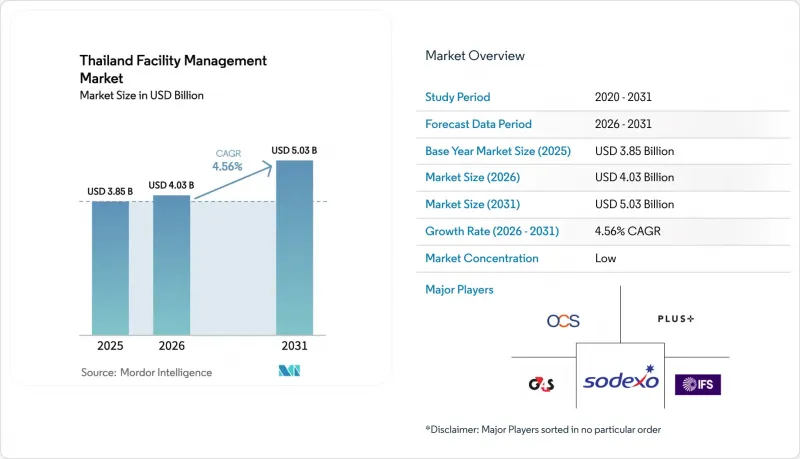
이러한 성장 궤도는 '태국 4.0'을 통한 산업 고도화, 동부 경제 회랑(EEC) 인프라 구축, 그리고 기술 기반 아웃소싱 모델로의 꾸준한 전환에 의해 뒷받침되고 있습니다. 외국간접투자 증가, 특히 2024년 첫 5개월 동안 317개 기업이 EEC에 진출함에 따라 하드웨어 및 소프트웨어 통합 서비스 대상 고객 기반이 확대되고 있습니다. IoT 플랫폼, AI를 활용한 건물 분석, 5G 연결로 자산 가동률과 에너지 효율이 향상되면서 디지털화는 서비스 제공 방식을 변화시키고 있습니다. 직원 복지에 대한 기업의 관심이 높아지면서 양질의 업무환경에 대한 수요가 증가하고 있으며, 지속가능성 관련 규제는 상업용 부동산의 리노베이션을 촉진하고 있습니다. 그러나 인력 부족, 방콕 이외의 지역에서의 규제 차이, 자재 비용의 변동으로 인해 공급자의 수익률이 압박을 받고 경쟁이 심화되고 있습니다.
태국 시설 관리 시장 동향 및 인사이트
상업용 부동산의 급속한 확장
2024년 1분기 상업 프로젝트 투자 약속은 31% 증가한 62억 달러에 달하고, 전체 라이프사이클에 걸친 시설 솔루션에 대한 수요를 촉진하고 있습니다. EEC(동부경제회랑) 내 산업단지 용지 판매는 2025년까지 연간 18-20%씩 증가하고 있으며, FM 제공업체들은 자산 관리 및 에너지 서비스 팀의 규모를 확대할 수밖에 없습니다. WHA그룹의 290만 평방미터의 산업용 포트폴리오와 2024년 1분기 이익이 154% 증가했다는 사실은 유틸리티 관리를 통한 수익이 현재 임대 수익에 버금가는 수준까지 도달했음을 보여줍니다. 센트럴 파타나의 150억 바트(4억 3,000만 달러) 규모의 파이프라인과 LEED 골드 인증을 획득한 SINGHA COMPLEX와 같은 상징적인 복합용도 프로젝트에는 보안, 공조(HVAC), 청소, ESG 보고에 걸친 다분야 FM 프로그램이 요구됩니다. 프로그램이 요구됩니다. 방콕과 동부 경제 회랑(EEC)에 신규 부동산을 집중 배치함으로써 서비스 기업들은 노선 밀도를 최적화하고 공유 모바일 엔지니어링 허브를 구축할 수 있습니다.
기술 통합(IoT, AI, 자동화)
태국 IoT 시장은 정부의 스마트시티 추진 정책에 따라 커넥티드 빌딩 도입이 가속화되면서 2030년까지 21억 9,000만 달러 규모에 달할 것으로 예측됩니다. 방콕의 세인트 레지스 호텔은 AI 기반 냉각기 분석 시스템을 도입한 결과 9%의 에너지 절감 효과를 달성하여 데이터 기반 설비 최적화를 통한 빠른 투자 회수를 입증했습니다. 청주에 위치한 얼라이언스 세탁소의 공장에 AIS의 5G mm파 구축은 밀리초 단위의 텔레메트리를 구현하여 미션 크리티컬한 장비의 예지보전을 가능하게 합니다. 방콕에 위치한 히타치의 루마다 센터는 전체 포트폴리오를 아우르는 대시보드를 제공하여 납기를 단축하고 있습니다. 또한, KaaIoT와 Sensative의 파트너십을 통해 센서와 클라우드 플랫폼을 결합하여 구독형 FM 분석 서비스를 제공합니다. 디지털 트윈의 도입이 성숙해짐에 따라, 전통적인 전문 기술과 소프트웨어 기술을 겸비한 업체들이 우량한 계약을 따내고 있으며, 태국 시설 관리 시장은 기술 중심의 지속 가능한 성장을 위한 준비를 하고 있습니다.
인력 부족과 기술 격차
경비, 청소, 엔지니어링 직종은 만성적인 인력 부족에 직면하고 있으며, 공급업체들은 노동 강도를 줄이기 위해 로봇 공학 및 소프트웨어를 도입해야 합니다. Metthier의 SaaS(Security-as-a-Service) 플랫폼과 자율 주행 청소 차량은 인력 부족에 대한 자동화에 대한 대응의 한 예입니다. 국경 간 노동자 관리는 여전히 복잡하며, 학계에서는 아세안의 자유로운 노동이동 규칙이 유동성을 심화시키기 전에 미얀마, 라오스, 캄보디아에서 온 이민자에 대한 보다 명확한 프레임워크 구축이 필요하다는 지적이 나오고 있습니다. 고용주들은 AI 숙련도를 중요하게 여기고 있지만, 64%는 적격 후보자를 확보하는 데 어려움을 겪고 있어 디지털 FM 도입에 어려움을 겪고 있습니다. 정부의 'AI Ready' 교육을 통해 5만 명의 기술력 향상을 도모했지만, 그 규모가 수요를 따라잡지 못해 임금 상승과 수익률 압박을 초래하고 있습니다. 그 결과, 경쟁 우위는 인간의 전문성과 기술의 융합을 추구하는 기업으로 이동하고 있습니다.
부문 분석
하드 서비스는 2025년 매출의 56.78%를 차지하여 태국 시설관리 시장의 구조적 핵심으로 확고히 자리 잡았습니다. NS-Siam United Steel이 에너지 절약 유지보수 분야에서 국무총리상을 수상한 것은 공정 플랜트가 지속가능성 성과를 얻기 위해 FM 팀에 거는 기대가 크다는 것을 증명합니다. EEC(동부경제회랑) 내 부동산 자산관리 업무가 급증하고 있습니다. Amata Corporation의 1,322MW에 달하는 열병합발전 포트폴리오에서 데이터 기반 스케줄링을 도입하여 가스 사용량을 10-15% 절감하고 있습니다. 마찬가지로, 방콕의 고밀도 사무실에서는 HVAC(공조설비) 개조가 활발히 이루어지고 있으며, 상업용 빌딩의 경우, 대상별 개보수를 통해 평균 18.1%의 전력 사용량을 절감하고 있습니다.
소프트 서비스 부문은 현재 규모는 작지만, 호텔, 의료, 헬스케어, 고급 오피스 단지를 중심으로 4.73%의 가장 높은 CAGR을 나타낼 것으로 보입니다. 메티에의 로봇 청소기와 AI 순찰 로봇은 기술이 어떻게 작업 시간을 줄이면서 더 높은 위생 기준을 충족시킬 수 있는지를 보여줍니다. 케이터링 산업은 전문화되고 있으며, 에피큐어가 헬스케어 및 기업 식당 시장에서 70%의 점유율을 차지하고 있는 것은 영양 균형 잡힌 메뉴와 엄격한 식품 안전 프로토콜에 대한 수요가 높다는 것을 보여줍니다. 기술 서비스와 체험형 서비스의 융합으로 기존 분야 간 경계가 허물어지고, 부동산 당 지출을 늘리면서 이용자 만족도를 높이는 통합형 계약이 촉진되고 있습니다.
기타 특전:
- 엑셀 형식 시장 예측(ME) 시트
- 3개월간 애널리스트 지원
자주 묻는 질문
목차
제1장 서론
제2장 조사 방법
제3장 주요 요약
제4장 시장 구도
제5장 시장 규모와 성장 예측
제6장 경쟁 구도
제7장 시장 기회와 향후 전망
JHS 26.06.02Thailand facility management market size in 2026 is estimated at USD 4.03 billion, growing from 2025 value of USD 3.85 billion with 2031 projections showing USD 5.03 billion, growing at 4.56% CAGR over 2026-2031.
The growth trajectory is underpinned by Thailand 4.0 industrial upgrades, the Eastern Economic Corridor's (EEC) infrastructure build-out, and a steady pivot toward technology-enabled outsourced models. Rising foreign direct investment, especially the 317 firms that entered the EEC during the first five months of 2024, is widening the addressable base for integrated hard and soft services. Digitalisation is reshaping service delivery as IoT platforms, AI-driven building analytics, and 5G connectivity improve asset uptime and energy performance. Growing corporate focus on employee wellbeing is amplifying demand for premium workplace experience offerings, while sustainability mandates are spurring retrofit work across commercial real estate. Nevertheless, labour shortages, regulatory fragmentation outside Bangkok, and volatile material costs are squeezing provider margins and intensifying competition.
Thailand Facility Management Market Trends and Insights
Rapid Commercial Real Estate Expansion
Investment pledges for commercial projects surged 31% to USD 6.2 billion during Q1 2024, fuelling demand for cradle-to-grave facility solutions. Industrial-estate land sales within the EEC are rising 18-20% annually to 2025, compelling FM providers to scale asset-management and energy-services teams. WHA Group's 2.9 million m2 industrial portfolio and 154% jump in Q1 2024 profit underline how utility management revenues now rival rental income. Mixed-use icons like Central Pattana's THB 15 billion (USD 0.43 billion) pipeline and the LEED-Gold SINGHA COMPLEX require multi-disciplinary FM programmes spanning security, HVAC, cleaning and ESG reporting. Concentration of new builds in Bangkok and the EEC lets service firms optimise route density and deploy shared mobile engineering hubs.
Technology Integration (IoT, AI, Automation)
Thailand's IoT market is tracking toward USD 2.19 billion by 2030 as government smart-city incentives accelerate connected-building adoption. The St. Regis Bangkok achieved 9% energy savings after installing AI-based chiller analytics, validating quick pay-backs for data-driven plant optimisation. AIS's 5G mmWave deployment at Alliance Laundry's factory in Chonburi delivers millisecond telemetry, enabling predictive maintenance for mission-critical equipment. Hitachi's Lumada Center in Bangkok provides portfolio-wide dashboards that cut delivery lead times, and KaaIoT-Sensative partnerships bundle sensors with cloud platforms to offer subscription-based FM analytics. As digital-twin rollouts mature, providers embedding software skills alongside traditional trade capabilities are capturing premium contracts, positioning the Thailand facility management market for sustained tech-led growth.
Labor Shortages and Skill Gaps
Security, cleaning, and engineering roles face chronic scarcity, compelling providers to embrace robotics and software to ease labour intensity. Metthier's security-as-a-service platform and autonomous cleaning fleet exemplify automation responses to staff deficits. Cross-border worker management remains cumbersome; academic studies urge clearer frameworks for Myanmar, Lao, and Cambodian migrants before ASEAN free-labour rules deepen mobility.Employers prize AI fluency, but 64% struggle to find qualified candidates, straining digital-FM rollouts. Government "AI Ready" training has up-skilled 50,000 people, yet scale lags demand, pushing wages upward and compressing margins. Consequently, competitive advantage shifts toward companies melding human expertise with tech augmentation.
Other drivers and restraints analyzed in the detailed report include:
- Increasing Outsourcing Trend
- Rising Focus on Workplace Experience and Employee Wellbeing
- Margin Pressure from Rising Operational Costs
For complete list of drivers and restraints, kindly check the Table Of Contents.
Segment Analysis
Hard Services represented 56.78% of 2025 revenue, confirming their status as the structural backbone of the Thailand facility management market. NS-Siam United Steel's Prime Minister's Award for energy-efficient maintenance proves how process plants look to FM crews for sustainability wins. Asset-management assignments inside EEC estates are proliferating; Amata Corporation's 1,322 MW co-generation portfolio now features data-driven scheduling that trims gas usage 10-15%. High-density Bangkok offices likewise heighten HVAC retrofits, with commercial buildings cutting average electricity use 18.1% after targeted upgrades.
Soft Services, though smaller today, post the briskest 4.73% CAGR, anchored by hospitality, healthcare and premium office complexes. Metthier's robotic cleaners and AI patrol bots illustrate how technology compresses task times while meeting higher hygiene standards. Catering continues to professionalise; Epicure's 70% share in healthcare and corporate dining demonstrates appetite for nutritionally-balanced menus and strict food-safety protocols. The fusion of technical and experiential offerings is blurring historic silos, encouraging integrated contracts that lift spend per property while improving user satisfaction.
The Thailand Facility Management Market Report is Segmented by Service Type (Hard Services, and Soft Services), Offering Type (In-House, and Outsourced), and End-User Industry (Commercial, Hospitality, Institutional and Public Infrastructure, Healthcare, Industrial and Process, and More). The Market Forecasts are Provided in Terms of Value (USD).
List of Companies Covered in this Report:
- IFS Inc.
- PCS Security And Facility Services Limited (OCS Group Holdings Ltd)
- G4S Security Services (Thailand) Limited (G4S plc)
- Sodexo Facilities Management Services (Sodexo Group)
- Plus Property Co. Ltd
- Swift Dynamics Co. Ltd
- Siam Piwat Company Limited
- Amata Facility Service Co. Ltd (Amata Corporation)
- ISS Facility Services
- Savills Thailand
- KJTN Engineering Co., Ltd.
Additional Benefits:
- The market estimate (ME) sheet in Excel format
- 3 months of analyst support
TABLE OF CONTENTS
1 INTRODUCTION
- 1.1 Study Assumptions and Market Definition
- 1.2 Scope of the Study
2 RESEARCH METHODOLOGY
3 EXECUTIVE SUMMARY
4 MARKET LANDSCAPE
- 4.1 Market Overview
- 4.1.1 Current Occupancy Rates
- 4.1.2 Profitability Rates of Major FM Players
- 4.1.3 Workforce Indicators - Labor Participation
- 4.1.4 Facility Management Market Share (%), by Service Type
- 4.1.5 Facility Management Market Share (%), by Hard Services
- 4.1.6 Facility Management Market Share (%), by Soft Services
- 4.1.7 Urbanization and Population Growth in Major Metros
- 4.1.8 Sector Investment Priorities in Thailand's Infrastructure Pipeline
- 4.1.9 Regulatory Drivers Specific to Labour and Safety Standards
- 4.2 Market Drivers
- 4.2.1 Rapid Commercial Real Estate Expansion
- 4.2.2 Technology Integration (IoT, AI, Automation)
- 4.2.3 Increasing Outsourcing Trend
- 4.2.4 Rising Focus on Workplace Experience and Employee Wellbeing
- 4.2.5 Government Incentives for FDI in Industrial Corridors
- 4.2.6 Growing Demand for Green and Energy-Efficient Buildings
- 4.3 Market Restraints
- 4.3.1 Labor Shortages and Skill Gaps
- 4.3.2 Margin Pressure from Rising Operational Costs
- 4.3.3 Fragmented Provincial Regulatory Compliance
- 4.3.4 High Client Churn Among Price-Sensitive SMEs
- 4.4 Value Chain Analysis
- 4.5 PESTEL Analysis
- 4.6 Regulatory and Legislative Framework for Market Entrants
- 4.7 Impact of Macroeconomic Indicators on FM Demand
- 4.8 Porter's Five Forces Analysis
- 4.8.1 Bargaining Power of Suppliers
- 4.8.2 Bargaining Power of Buyers
- 4.8.3 Threat of New Entrants
- 4.8.4 Threat of Substitute Services
- 4.8.5 Intensity of Competitive Rivalry
- 4.9 Investment and Funding Analysis
5 MARKET SIZE AND GROWTH FORECASTS (VALUE)
- 5.1 By Service Type
- 5.1.1 Hard Services
- 5.1.1.1 Asset Management
- 5.1.1.2 MEP and HVAC Services
- 5.1.1.3 Fire Systems and Safety
- 5.1.1.4 Other Hard FM Services
- 5.1.2 Soft Services
- 5.1.2.1 Office Support and Security
- 5.1.2.2 Cleaning Services
- 5.1.2.3 Catering Services
- 5.1.2.4 Other Soft FM Services
- 5.1.1 Hard Services
- 5.2 By Offering Type
- 5.2.1 In-house
- 5.2.2 Outsourced
- 5.2.2.1 Single FM
- 5.2.2.2 Bundled FM
- 5.2.2.3 Integrated FM
- 5.3 By End-user Industry
- 5.3.1 Commercial (IT and Telecom, Retail and Warehouses, etc.)
- 5.3.2 Hospitality (Hotels, Eateries, Large-scale Restaurants)
- 5.3.3 Institutional and Public Infrastructure (Govt, Education, Transportation)
- 5.3.4 Healthcare (Public and Private Facilities)
- 5.3.5 Industrial and Process (Manufacturing, Energy, Mining)
- 5.3.6 Other End-user Industries (Multi-housing, Entertainment, Sports and Leisure)
6 COMPETITIVE LANDSCAPE
- 6.1 Market Concentration
- 6.2 Strategic Moves and Partnerships
- 6.3 Market Share Analysis
- 6.4 Company Profiles
- 6.4.1 IFS Inc.
- 6.4.2 PCS Security And Facility Services Limited (OCS Group Holdings Ltd)
- 6.4.3 G4S Security Services (Thailand) Limited (G4S plc)
- 6.4.4 Sodexo Facilities Management Services (Sodexo Group)
- 6.4.5 Plus Property Co. Ltd
- 6.4.6 Swift Dynamics Co. Ltd
- 6.4.7 Siam Piwat Company Limited
- 6.4.8 Amata Facility Service Co. Ltd (Amata Corporation)
- 6.4.9 ISS Facility Services
- 6.4.10 Savills Thailand
- 6.4.11 KJTN Engineering Co., Ltd.
7 MARKET OPPORTUNITIES AND FUTURE OUTLOOK
- 7.1 White-space and Unmet-Need Assessment
- 7.2 Technology-led Integrated FM (IoT, BMS, AI-based Predictive Maintenance)
- 7.3 ESG-compliant FM Solutions Demand
- 7.4 Future Service-Model Shifts (Outcome-based Contracts)