

|
시장보고서
상품코드
2063910
미국의 유기 폐기물 수집 서비스 시장 : 점유율 분석, 업계 동향과 통계, 성장 예측(2026-2031년)United States Organic Waste Collection Services - Market Share Analysis, Industry Trends & Statistics, Growth Forecasts (2026 - 2031) |
||||||
 Mordor Intelligence
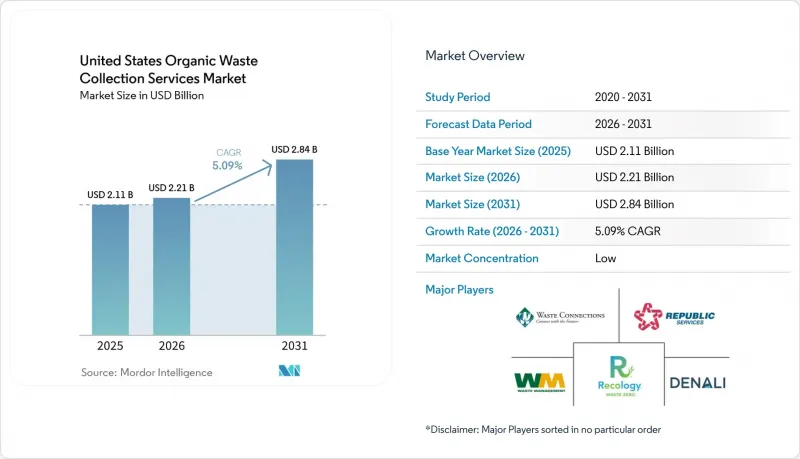
Mordor Intelligence에 의하면, 미국 유기 폐기물 수집 서비스 시장 규모는 2025년 21억 1,000만 달러, 2026년 22억 1,000만 달러에서 2031년까지 28억 4,000만 달러로 확대되어 2026년부터 2031년까지 연평균 복합 성장률(CAGR)은 5.09%를 나타낼 것으로 예측됩니다.
본 보고서는 폐기물의 유형(식품 폐기물, 정원·조경 폐기물 등), 최종 사용자(주택, 상업시설 등), 수거 방법(가정별 수거, 직접 반입 시스템 등) 및 기술·설비(수작업 수거, 반자동 등)별로 분류되어 있습니다. 시장 전망은 금액(달러) 및 수량(톤) 단위로 제시되어 있습니다.
미국 유기 폐기물 수거 서비스 시장 동향 및 인사이트
엄격한 정부 규제 및 유기 폐기물 재활용 의무화법
캘리포니아주의 SB 1383 법안은 2014년을 기준으로 2025년까지 유기 폐기물 처리량을 75% 감축하도록 의무화했습니다. 이 법은 식용 식품의 회수율을 20%로 규정하고 있으며, 모든 관할 구역에 대해 주민 및 기업을 대상으로 유기 폐기물 수거 서비스를 제공하도록 의무화하고 있습니다. 각 지자체는 규제 준수를 유지하고 벌칙을 피하기 위해 가구별 유기 폐기물 수거, 식용 식품 회수 위탁 및 회수된 유기 제품의 조달을 실시하고 있으며, 이를 통해 각 도시와 군 전체에 걸쳐 수거·처리 능력에 대한 안정적인 수요가 창출되고 있습니다. 워싱턴주의 HB 2301 법안은 2026년까지 기업 대상 유기 폐기물 재활용 요건을 단계적으로 도입하는 한편, 오염 위험에 대처하기 위해 주택용 개별 유기 폐기물 수거에 대한 명확한 일정, 표준 수거 용기의 색상, 그리고 제품 표시 관리에 관한 사항을 규정하고 있습니다. 연방 기관들도 이러한 추세를 뒷받침하고 있으며, EPA, USDA, FDA는 2030년까지 식품 손실과 폐기물을 50% 감축하는 국가 전략을 마련하고 있습니다. 이는 여러 주에서 추진 중인 노력과 일치하며, 2026년 프로그램 확대를 앞두고 지자체에 명확한 정책 신호를 보내고 있습니다. EPA의 SWIFR 프로그램 지침 및 USDA의 협력 협정은 새로운 문 앞 수거 시스템 도입 및 후단 인프라 업그레이드에 수반되는 실행 위험을 완화하기 위한 자금을 지원하고 있습니다.
매립 처리비 및 폐기 비용의 상승
2024년, 일반 폐기물 매립 처리비는 전국 평균 10% 상승하여 톤당 62.28달러에 달했습니다. 북동부 지역이 가장 높고, 남중부 지역이 가장 낮은데, 이로 인해 고비용 시장에서 유기물 자원화의 경제적 타당성이 더욱 높아지고 있습니다. 폐기물 에너지화(WTE)를 시행하고 있는 주에서는 WTE를 시행하지 않는 주에 비해 매립 처리 비용이 28% 더 높은 것으로 나타났으며, 이는 처리 능력의 제약이 가격 신호를 변화시켜 유기물 수거·처리 등 대체 수단의 도입을 가속화하고 있음을 보여줍니다. 지자체들이 계약을 갱신함에 있어, 기존의 처리 방식과 유기물 처리 프로그램 간의 비용 격차가 확대되고 있는 점은 특히 매립지 선택지가 제한적인 인구 밀집 도시에서 예산 중립 또는 경비 절감을 중시하는 새로운 가정별 유기물 수거 서비스 도입 제안을 뒷받침하고 있습니다. 국제적인 사례에서도 일반 폐기물(그레이빈)의 처분과 유기물 재활용 사이에 상당한 비용 차이가 발생할 경우, 정책이나 가격 책정이 주민들의 행동을 변화시킨다는 동일한 논점을 뒷받침하고 있습니다. 2026년에도 이러한 가격 환경은 대규모 산업 배출업체와 지자체로 하여금 매립 처리에 대한 의존도를 낮추고, 향후 처리 비용 상승에 따른 책임을 경감할 수 있는 유기물 수거 계약으로 계속해서 이끌고 있습니다.
유기 폐기물 처리 및 처리 시설의 인프라 용량 한계
EPA의 전국 인프라 평가에 따르면, 퇴비화 및 혐기성 소화 처리 능력을 확대하기 위해서는 막대한 자금이 필요하며, 예상되는 전국 재활용률 61%를 달성하기 위해서는 2030년까지 140억-160억 달러가 필요할 것으로 추정됩니다. 이 자금 지원 범위는 시설 개발, 수거 시스템 확충 및 인식 제고 활동에 이르기까지 포괄하며, 수거량 증대는 단일 프로젝트에 의존하는 것이 아니라 공급망 전반에 걸친 균형 잡힌 투자에 달려 있음을 강조하고 있습니다. 처리 능력 부족은 남부, 남서부, 로키산맥 지역에서 가장 심각하며, 이는 원료의 잠재량은 높으나 시설이 부족한 지역에서 대상 지역을 좁혀 입지를 선정하고 인허가 지원을 할 필요성을 여실히 보여주고 있습니다. 2026년, 처리 능력의 제약으로 인해 일부 주에서는 새로운 지자체에 의한 도입이나 민간 계약이 계속해서 제한되고 있으며, 명확한 정책 방침이 있음에도 불구하고 폐기물 재활용의 진전이 더딘 상황입니다. 이러한 병목 현상을 해결하기 위해서는 공공 자금, 조달 개혁, 그리고 장기적인 원자재 공급 보장 및 데이터 투명성을 결합한 민간 파트너십을 통합하여 자금 조달과 실행을 가속화해야 합니다.
부문별 분석
생산 전 및 소비 후 과정을 포함하는 식품 폐기물은 주요 주 전반에 걸쳐 규정 준수 기한과 사업 요건이 강화됨에 따라, 2026년부터 2031년까지 연평균 성장률(CAGR) 5.9%로 가장 빠르게 성장할 것으로 전망됩니다. 미국의 유기 폐기물 수거 서비스 시장은 연중 내내 음식물 쓰레기를 수거하는 것을 보편적인 서비스로 규정하는 SB 1383의 요건에 힘입어 성장하고 있습니다. 이를 통해 프로그램의 지속성이 확보되고, 수거업체 및 처리업체에 있어 예측 가능한 처리량 기반이 마련됩니다. 워싱턴주의 HB 2301은 사업자를 대상으로 한 단계별 재활용률 기준을 정하고, 주택용 유기물 분리수거를 정해진 일정에 따라 실시하도록 의무화하고 있으며, 이를 통해 시간이 지남에 따라 수거 노선의 밀도와 시설 이용률 향상이 촉진됩니다. 업소용 주방, 시설 내 구내식당 및 가공업체에서 발생하는 생산 전 식품 폐기물은 톤당 밀도가 높고 오염 위험이 낮기 때문에 대규모 배출 사업자를 대상으로 한 전문적인 서비스 모델이나 예측 가능한 수거 일정에 적합합니다. 업계 단체와 사업자들이 원료 조달을 조정하고 바이오가스 및 소화 잔여물로 효율적으로 전환할 수 있게 됨에 따라, 수거와 혐기성 소화를 연계하는 파트너십이 확대되고 있습니다. 2025년에도 정원 및 조경 폐기물은 70.9%로 가장 큰 비중을 유지하고 있으며, 이는 수년에 걸친 지자체 프로그램의 성숙에 힘입은 결과입니다. 그러나 인구 동향의 변화와 정원에서 발생하는 양이 적은 공동주택 증가로 인해, 그 점진적인 성장은 제한되고 있습니다.
2026년에는 정책에 따른 의무화 및 자발적인 도입을 통해 주요 도시권에서 주택에서 발생하는 소비 후 식품 폐기물의 수거가 보편화되고, 일반 가정의 이용 기회가 확대됨과 동시에 시간이 지남에 따라 분리 수거에 대한 이해도도 깊어질 것입니다. 농업 잔여물의 점유율은 여전히 낮은 수준입니다. 많은 자재가 현장에서 처리되거나 전문 중개업체를 통해, 지자체 시스템에서는 반드시 파악되지 않는 영양분이나 에너지로의 경로로 전환되고 있기 때문입니다. 한편, 바이오솔리드 및 산업계 유기물을 포함한 기타 분야는 규정 준수 체계와 유익한 이용 기준이 매립 처리에 대한 의존도를 줄이고 시장성이 있는 부산물을 생산하는 일관된 처리 경로를 촉진함으로써 꾸준히 성장하고 있습니다. 미국의 유기 폐기물 수거 서비스 시장은 교육, 오염 관리, 설비 업그레이드를 통해 대규모 성과 향상이 이루어짐에 따라, 식품 폐기물의 비중이 높아지는 방향으로 계속해서 변화해 나갈 것입니다. 시설 차원에서 검증 가능한 자원화를 평가하는 기업의 ESG 프로그램에서 투명성이 높은 보고에 대한 기대감으로 인해, 미국 유기 폐기물 수거 서비스 시장 규모에서 식품 폐기물이 차지하는 비중은 더욱 커지고 있습니다.
기타 혜택:
- 엑셀 형식 시장 예측(ME) 시트
- 3개월간의 애널리스트 지원
자주 묻는 질문
목차
제1장 서론
제2장 조사 방법
제3장 주요 요약
제4장 시장 구도
제5장 시장 규모와 성장 예측(금액 : 달러, 수량 : 톤)
제6장 경쟁 구도
제7장 시장 기회와 향후 전망
JHS 26.06.23According to Mordor Intelligence, the united states organic waste collection services market size is projected to expand from USD 2.11 billion in 2025 and USD 2.21 billion in 2026 to USD 2.84 billion by 2031, registering a CAGR of 5.09% between 2026 to 2031.
This report is Segmented by Waste Type (Food Waste, Yard & Landscape Waste, and More), End-User (Residential, Commercial, and More), Collection Method (Door-To-Door Collection, Drop-Off / Bring Systems, and Others), and Technology & Equipment (Manual Collection, Semi-Automated, and More). The Market Forecasts are Provided in Terms of Value (USD) and Volume (Tons).
United States Organic Waste Collection Services Market Trends and Insights
Stringent Government Regulations and Mandatory Organic Waste Diversion Laws
California's SB 1383 mandated a 75% reduction in organic waste disposal by 2025 versus a 2014 baseline. It required 20% edible food recovery, compelling every jurisdiction to provide organic waste collection services to residents and businesses . Jurisdictions are implementing curbside organics, edible food recovery contracting, and the procurement of recovered organic products to maintain compliance and avoid penalties, thereby creating steady demand for collection and processing capacity across cities and counties. Washington's HB 2301 phases in organic waste diversion requirements for businesses through 2026 and sets firm timelines for residential curbside organics collection, standard bin colors, and product labeling controls to address contamination risks. Federal agencies are reinforcing this trajectory as the EPA, USDA, and FDA coordinate a national strategy to cut food loss and waste by 50% by 2030, which aligns with multistate action and gives municipalities a clear policy signal for program expansion in 2026. EPA's SWIFR program guidance and USDA cooperative agreements provide funding to reduce execution risk for new curbside rollouts and upgrades to back-end infrastructure.
Rising Landfill Tipping Fees and Disposal Costs
Tipping fees for municipal solid waste disposal rose 10% nationally in 2024 to USD 62.28 per ton, with the Northeast showing the highest fees and the South Central the lowest, which tightens the economic case for organics diversion across high-cost markets. Waste-to-energy states paid 28% more for landfill disposal than non-WTE states, indicating that constrained disposal capacity alters price signals and accelerates the adoption of alternatives, such as organics collection and processing. As municipalities update contracts, the widening cost gap between traditional disposal and organics programs supports budget-neutral or savings-oriented pitches for new curbside organics service, especially in dense metros with scarce landfill options. International examples reinforce the same thesis as policy and pricing shift behavior when residents face meaningful cost differentials between gray-bin disposal and organics recycling. In 2026, this price environment continues to steer large commercial generators and municipalities toward organics collection contracts that reduce landfill exposure and future liability for disposal escalators.
Limited Infrastructure Capacity for Organic Waste Processing and Treatment Facilities
EPA's national infrastructure assessment identifies a sizable funding requirement to expand composting and anaerobic digestion capacity, with USD 14-16 billion needed by 2030 to reach a projected national recycling rate of 61%. The funding envelope spans facility development, collection system expansion, and education, underscoring that collection growth depends on balanced investments across the chain rather than stand-alone projects. Capacity gaps are most acute in the South, Southwest, and Rocky Mountain regions, which underscores the need for targeted siting and permitting support where feedstock potential is high but facilities are sparse. In 2026, constrained throughput continues to limit new municipal rollouts and private contracts in several states, which slows diversion despite clear policy direction. Addressing this bottleneck requires blending public funding, procurement reforms, and private partnerships that bundle long-term feedstock commitments with data transparency to accelerate financing and delivery.
Other drivers and restraints analyzed in the detailed report include:
- Growing Environmental Awareness and Corporate ESG/Sustainability Commitments
- Technological Advancements in Collection Systems, Sorting Automation, and Processing
- High Capital and Operational Costs for Collection and Processing Systems
For complete list of drivers and restraints, kindly check the Table Of Contents.
Segment Analysis
Food waste, including pre-consumer and post-consumer streams, is projected to grow the fastest, with a 5.9% CAGR from 2026 to 2031, as compliance deadlines and business thresholds tighten across major states. The United States organic waste collection services market benefits from SB 1383 requirements that make year-round food scrap collection a universal service, which establishes program continuity and a predictable volume base for haulers and processors. Washington's HB 2301 establishes tiered diversion thresholds for businesses and requires residential curbside organics collection on a set timetable, thereby supporting improvements in route density and equipment utilization over time. Pre-consumer food waste from commercial kitchens, institutional cafeterias, and processors offers higher tonnage density and lower contamination risk, which aligns with specialized service models and predictable pickups for large generators. Partnerships linking collection with anaerobic digestion have expanded as industry groups and operators coordinate feedstock sourcing to enable efficient conversion to biogas and digestate. Yard and landscape waste continued to hold the largest share at 70.9% in 2025, driven by the long-standing maturity of municipal programs. However, incremental growth is limited by demographic shifts and the rise of multi-family housing, where yard generation is lower.
In 2026, residential post-consumer food waste collection gains coverage in major metros through policy mandates and voluntary rollouts, expanding household access and building familiarity with source separation over time. Agricultural Residues remain a smaller share, as many materials are managed on-site or move through specialized brokers into nutrient and energy pathways that are not always visible to municipal systems. Others, including biosolids and industrial organics, grow steadily as compliance frameworks and beneficial use standards drive consistent processing routes that reduce landfill exposure and produce marketable outputs. The United States organic waste collection services market will continue to shift toward higher food waste penetration as education, contamination controls, and equipment upgrades improve performance at scale. Food waste's contribution to the United States organic waste collection services market size is reinforced by transparent reporting expectations in corporate ESG programs that reward verifiable diversion at the facility level.
List of Companies Covered in this Report:
- Waste Management, Inc. (WM)
- Republic Services
- Waste Connections
- Denali
- Recology
- Synagro
- CompostNow
- Agri-Cycle Energy
- Compost Crew
- Black Earth Compost
- Bootstrap Compost
- Groot Industries
- Atlas Organics
- Vanguard Renewables
- Anaergia Technologies
- RNG Energy Solutions LLC
- PurposeEnergy
- Convertus Group
- Remix Organics
- AgRecycle
- Action Carting Environmental Services, Inc.
Additional Benefits:
- The market estimate (ME) sheet in Excel format
- 3 months of analyst support
TABLE OF CONTENTS
1 Introduction
- 1.1 Study Assumptions & Market Definition
- 1.2 Scope of the Study
2 Research Methodology
3 Executive Summary
4 Market Landscape
- 4.1 Market Overview
- 4.2 Market Drivers
- 4.2.1 Stringent Government Regulations and Mandatory Organic Waste Diversion Laws
- 4.2.2 Rising Landfill Tipping Fees and Disposal Costs
- 4.2.3 Growing Environmental Awareness and Corporate ESG/Sustainability Commitments
- 4.2.4 Technological Advancements in Collection Systems, Sorting Automation, and Processing
- 4.2.5 Circular Economy Adoption and Waste-to-Wealth Paradigm Shift
- 4.2.6 Renewable Energy Incentives and Carbon Credit Monetization Opportunities
- 4.3 Market Restraints
- 4.3.1 Limited Infrastructure Capacity for Organic Waste Processing and Treatment Facilities
- 4.3.2 High Capital and Operational Costs for Collection and Processing Systems
- 4.3.3 Low Participation Rates in Residential and Commercial Collection Programs
- 4.3.4 Insufficient Community Outreach, Education, and Behavior Change Programs
- 4.4 Value / Supply-Chain Analysis
- 4.5 Regulatory Landscape
- 4.6 Technological Outlook
- 4.6.1 RFID Smart Bins for Waste Tracking
- 4.6.2 AI Revolutionizes Waste Sorting
- 4.6.3 IoT Optimizing for Fleet Routes
- 4.7 Porter's Five Forces
- 4.7.1 Threat of New Entrants
- 4.7.2 Bargaining Power of Suppliers
- 4.7.3 Bargaining Power of Buyers
- 4.7.4 Threat of Substitutes
- 4.7.5 Industry Rivalry
- 4.8 Fleet Modernization & Electrification in Waste Collection
- 4.9 Analysis of Biomethane Impact on Organic Waste Collection
- 4.10 Collaboration Between Municipalities and Private Operators is Gaining Traction
- 4.11 Growing Focus on Methane Capture from Organic Waste to Meet Climate Targets
5 Market Size & Growth Forecasts (Value in USD & Volume in Tons)
- 5.1 By Waste Type
- 5.1.1 Food Waste
- 5.1.2 Yard & Landscape Waste
- 5.1.3 Agricultural Residues
- 5.1.4 Others
- 5.2 By End-User
- 5.2.1 Residential
- 5.2.2 Commercial Food Service
- 5.2.3 Industrial (Food Processing & Manufacturing)
- 5.2.4 Others (Agri-waste)
- 5.3 By Collection Method
- 5.3.1 Door-to-Door Collection
- 5.3.2 Drop-Off / Bring Systems
- 5.3.3 Others
- 5.4 By Technology & Equipment
- 5.4.1 Manual Collection Systems
- 5.4.2 Semi-Automated Systems
- 5.4.3 Fully Automated Systems
- 5.4.4 Others
6 Competitive Landscape
- 6.1 Market Concentration
- 6.2 Strategic Moves
- 6.3 Market Share Analysis
- 6.4 Company Profiles {(Includes Global Level Overview, Market Level Overview, Core Segments, Financials as Available, Strategic Information, Products & Services, and Recent Developments)}
- 6.4.1 Waste Management, Inc. (WM)
- 6.4.2 Republic Services
- 6.4.3 Waste Connections
- 6.4.4 Denali
- 6.4.5 Recology
- 6.4.6 Synagro
- 6.4.7 CompostNow
- 6.4.8 Agri-Cycle Energy
- 6.4.9 Compost Crew
- 6.4.10 Black Earth Compost
- 6.4.11 Bootstrap Compost
- 6.4.12 Groot Industries
- 6.4.13 Atlas Organics
- 6.4.14 Vanguard Renewables
- 6.4.15 Anaergia Technologies
- 6.4.16 RNG Energy Solutions LLC
- 6.4.17 PurposeEnergy
- 6.4.18 Convertus Group
- 6.4.19 Remix Organics
- 6.4.20 AgRecycle
- 6.4.21 Action Carting Environmental Services, Inc.
7 Market Opportunities & Future Outlook
- 7.1 Smart Cities & IoT Integration
- 7.2 Producer Responsibility Expansion
- 7.3 Shift Toward Decentralized Organic Waste Processing


