|
시장보고서
상품코드
2063927
영국의 콤바인 수확기 시장 : 점유율 분석, 업계 동향과 통계, 성장 예측(2026-2031년)United Kingdom Combined Harvester - Market Share Analysis, Industry Trends & Statistics, Growth Forecasts (2026 - 2031) |
||||||
 Mordor Intelligence
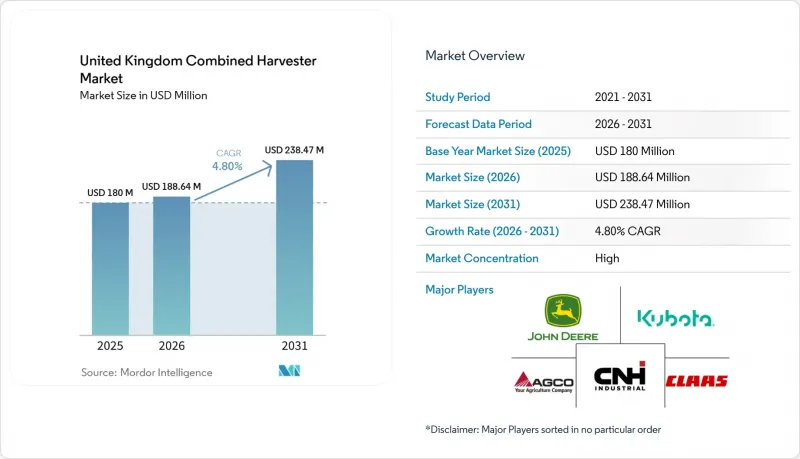
Mordor Intelligence에 의하면, 영국 콤바인 시장은 2025년 1억 8,000만 달러에서 2026년에는 1억 8,864만 달러, 2031년까지 2억 3,847만 달러로 성장하여 2026년부터 2031년까지 CAGR 4.8%를 나타낼 것으로 예측됩니다.
본 보고서는 제품 유형(자주식 콤바인 및 트랙터 견인식 콤바인), 출력(200마력 이하 및 그 이상), 기술(기존 및 기타), 곡물 탱크 용량(8,000리터 이하, 8,001-1만 2,000리터, 그 이상), 그리고 최종 사용자(대규모 상업 농장 및 기타)별로 분류되어 있습니다. 시장 전망은 금액(달러) 기준으로 제시되어 있습니다.
영국 콤바인 시장 동향 및 인사이트
노후화된 콤바인의 교체 수요
영국 콤바인 시장의 교체 수요는 농장에서 구형 수확기를 장기간 사용해 온 데 따른 영향을 받고 있습니다. 농업기술자협회(Agricultural Engineers Association)에 따르면, 영국의 콤바인 판매 대수는 2024/25 시즌에 280대로 감소하여, 전 시즌에 비해 30% 감소한 것으로 나타났습니다. 이러한 신규 기계 구매 감소는 농장의 수익성 부진과 농업 수익의 변동으로 인해 생산자들이 설비 투자를 미루고 있기 때문인 것으로 분석됩니다. 농가들이 기존 콤바인의 가동 기간을 연장함에 따라, 전국적으로 연비 효율이 높고, 대용량이며, 기술적으로 진보된 수확기에 대한 장기적인 교체 수요가 확대될 것으로 전망됩니다.
농업 기계 보조금을 통한 정부의 지원
농업 기계 보조금을 통한 정부의 지원은 영국 콤바인 시장에서 기계의 현대화와 정밀 농업 도입을 촉진하고 있습니다. 영국 정부에 따르면, ‘농업 기계·기술 기금 2025(Farming Equipment and Technology Fund 2025)’를 통해 1,000파운드(1,340달러)에서 2만 5,000파운드(3만 3,500달러) 범위의 보조금이 제공되고 있습니다. 이 사업은 정밀 농업 시스템, 작물 모니터링 도구, 콤바인 탑재형 잡초·잡종자 감소 시스템 등 첨단 농업 기술을 촉진하기 위한 것입니다. 정부의 지속적인 자금 지원 덕분에 농가와 도급업체들은 기술적으로 첨단인 수확 장비나 정밀 농업에 대응하는 콤바인에 대한 투자를 확대하고 있으며, 이를 통해 농업 시장의 업무 효율 향상, 투입 비용 절감, 그리고 지속 가능한 농업 관행의 지원이 도모되고 있습니다.
농산물 가격 변동이 농가 소득에 영향을 미칩니다.
작물 가격 변동은 영국의 콤바인 시장에서 농가의 수익성에 영향을 미치며, 투자 능력을 제한하고 있습니다. Brown &Co사의 분기별 농업 보고서에 따르면, 영국의 사료용 밀 가격은 2024년 톤당 158파운드(210.35달러)였던 데 비해, 2025년 2월 말까지 178.3파운드(212.18달러)로 하락했습니다. 곡물 가격의 하락은 특히 생산 비용의 상승과 농업 소득의 불확실성이 커지는 가운데, 곡물 생산자의 이익률을 크게 압박하고 있습니다. 그 결과, 많은 밭농사 농가들은 새로운 콤바인 수확기 등 자본 집약적인 장비의 구입을 미루고, 기존 기계의 사용 수명을 연장하고 있습니다.
부문별 분석
2025년, 영국의 콤바인 시장 점유율에서 자가주행형 콤바인이 67%로 가장 높은 비중을 차지했습니다. 대규모 상업 농장이나 농업 도급업체들은 수확 기간이 짧은 상황에서 자체 주행식 콤바인이 작업 효율이 높고, 수확 폭이 넓으며, 수확 속도가 빠르기 때문에 이를 선호하여 도입하고 있습니다. 특히, 노동력에 대한 의존도를 낮추고 농지의 생산성을 높이는 것을 목표로 하는 대규모 농장에서의 도입이 두드러집니다. 이러한 기계에는 첨단 자동화, 텔레매틱스, 정밀 농업 기술이 점점 더 많이 탑재되어, 연비 향상과 수확물 손실 최소화에 기여하고 있습니다. 또한, 탄탄한 딜러 지원 체계와 제조업체가 지원하는 금융 프로그램 덕분에 대용량 자가주행 수확기에 대한 수요가 지속적으로 증가하고 있습니다.
트랙터 견인형 콤바인 시장 규모는 2026년부터 2031년까지 연평균 성장률(CAGR) 6.8%라는 가장 높은 성장률을 기록하며 확대될 것으로 전망됩니다. 이러한 성장은 초기 투자 비용을 절감한 비용 대비 효과가 높은 수확 솔루션을 원하는 중소규모 농가들 수요 증가에 힘입어 이루어지고 있습니다. 이러한 시스템은 소유 비용을 절감하고 복합 농업 경영에 유연성을 부여하기 때문에 제한된 곡물 재배 면적을 관리하는 생산자들에게 특히 매력적입니다. 중고 기계 시장과 도급업체가 제공하는 수확 서비스에 대한 의존도 또한 이 부문 수요를 더욱 끌어올리고 있습니다. 또한, 농장 통합 추세에 따라 소규모 농업 경영자들은 대형 자가주행 콤바인에 투자하기보다는 보다 저렴한 수확 수단을 채택하는 추세입니다.
2025년, 영국 콤바인 시장의 46%를 300마력 이상의 기종이 차지했습니다. 대규모 곡물 농장이나 도급업체가 운영하는 수확 차량 군에서는 수확 속도 향상, 밭 통과 횟수 감소, 그리고 짧은 수확 기간 동안 폭이 넓은 헤더를 사용할 수 있게 되기 때문에 고출력 콤바인이 점점 더 선호되고 있습니다. 이러한 기계들은 인력 부족이나 기상 변화로 인해 신속한 작물 수확이 요구되는 통합 농업 경영 분야에서 보급이 확대되고 있습니다. 또한, 자동화 기술, 대용량 곡물 탱크, 정밀 농업 시스템을 탑재한 자가주행형 콤바인의 도입 확대도 수요를 뒷받침하고 있습니다. 고급 콤바인 모델은 여전히 상업용 농장, 업무 생산성 극대화와 수확 시 가동 중단 시간 단축에 주력하는 도급업체에 집중되어 있습니다.
200마력 이하의 기계는 2026년부터 2031년까지 연평균 성장률(CAGR) 7.3%로 가장 높은 성장세를 보일 것으로 전망됩니다. 엔트리급 콤바인은 대형 수확기에 비해 소유 비용을 절감하고 자금 조달 부담을 덜고자 하는 중소규모 농장들의 지속적인 관심을 받고 있습니다. 이러한 콤바인은 대규모 기계 도입이 경제적으로 타당하지 않은 혼합 농업이나 소규모 곡물 재배에 적합합니다. 이 부문의 성장은 합리적인 가격의 수확 솔루션에 대한 수요 증가, 최신 기능을 갖춘 소형 기계의 보급 확대, 그리고 수작업이나 하청업체를 통한 수확에서 기계화 작업으로 전환하는 생산자들의 도입 확대에 힘입어 더욱 가속화되고 있습니다.
기타 혜택:
- 엑셀 형식 시장 예측(ME) 시트
- 3개월간의 애널리스트 지원
자주 묻는 질문
목차
제1장 서론
제2장 조사 방법
제3장 주요 요약
제4장 시장 구도
제5장 시장 규모와 성장 예측
제6장 경쟁 구도
제7장 시장 기회와 향후 전망
JHS 26.06.23According to Mordor Intelligence, the united kingdom combined harvester market is projected to grow from USD 180.0 million in 2025 to USD 188.64 million in 2026 and USD 238.47 million by 2031, registering a CAGR of 4.8% between 2026 and 2031.
This report is Segmented by Product Type (Self-Propelled Combine Harvester and Tractor-Pulled Combine Harvester), by Power Rating (Up To 200 HP and More), by Technology (Conventional and More), by Grain Tank Capacity (Up To 8, 000 L, 8, 001-12, 000 L, and More), and by End User (Large-Scale Commercial Farms and More). The Market Forecasts are Provided in Terms of Value (USD).
United Kingdom Combined Harvester Market Trends and Insights
Replacement Demand for Aging Combine Harvesters
Replacement demand in the United Kingdom's combined harvester market is being influenced by the prolonged use of older harvesting equipment on farms. According to the Agricultural Engineers Association, combine harvesters in the United Kingdom dropped to 280 units during the 2024/25 season, marking a 30% decrease compared to the previous season. This reduction in new machinery purchases is attributed to weak farm profitability and growers' postponed capital investments due to fluctuating agricultural returns. As farmers extend the operational lifespan of their existing combines, long-term replacement demand is anticipated to grow for more fuel-efficient, high-capacity, and technologically advanced harvesting equipment nationwide.
Government Support Through Farming Equipment Grants
Government support through agricultural equipment grants is driving machinery modernization and the adoption of precision farming in the United Kingdom's combined harvester market. According to the United Kingdom Government, the Farming Equipment and Technology Fund 2025 offers grants ranging from GBP 1,000 (USD 1,340) to GBP 25,000 (USD 33,500). This initiative promotes advanced agricultural technologies, including precision farming systems, crop-monitoring tools, and combine-mounted weed-seed-reduction systems. The continued availability of government-backed funding is encouraging farmers and contractors to invest in technologically advanced harvesting equipment and precision-compatible combine harvesters, enhancing operational efficiency, reducing input costs, and supporting sustainable farming practices within the agricultural market.
Fluctuating Crop Prices Affecting Farmer Income
Fluctuating crop prices are impacting farmer profitability and limiting investment capacity in the United Kingdom's combine harvester market. According to Brown & Co's Quarterly Agricultural Update, feed wheat prices in the United Kingdom fell to GBP 178.3 (USD 212.18) per metric ton by the end of Feb 2025, against GBP 158.0 (USD 210.35) in 2024. Declining grain prices have significantly reduced margins for cereal growers, particularly amid rising input costs and uncertain farm incomes. Consequently, many arable farmers are postponing capital-intensive purchases, such as new combine harvesters, and extending the operational lifespan of existing machinery.
Other drivers and restraints analyzed in the detailed report include:
- Growth in Average Farm Size from Land Consolidation
- Farm Labor Shortages and Rising Wages
- High Purchase Cost Compared to Tractor Attachments
For complete list of drivers and restraints, kindly check the Table Of Contents.
Segment Analysis
Self-propelled combine harvesters accounted for the largest 67% of the United Kingdom's combined harvester market share in 2025. Large commercial farms and agricultural contractors prefer self-propelled combines due to their higher operational efficiency, wider cutting capacity, and faster harvesting speeds during short crop collection periods. Adoption is particularly strong among consolidated farming estates aiming to reduce labor dependency and enhance field productivity. These machines increasingly feature advanced automation, telematics, and precision farming technologies, improving fuel efficiency and minimizing crop losses. Additionally, strong dealer support networks and manufacturer-backed financing programs are driving sustained demand for high-capacity self-propelled harvesting equipment.
The tractor-pulled combine harvesters market size is projected to grow at the fastest CAGR of 6.8% from 2026 to 2031. Growth is driven by increasing demand from small and medium-sized farms seeking cost-effective harvesting solutions with lower initial investment requirements. These systems are particularly appealing to growers managing limited cereal acreage, as they reduce ownership costs and offer flexibility for mixed-farming operations. The reliance on used machinery markets and contractor-supported harvesting services is further boosting demand in this segment. Additionally, trends in farm consolidation are encouraging smaller agricultural operators to adopt more affordable harvesting alternatives instead of investing in large self-propelled combine harvesters.
Above 300 HP held 46% of the United Kingdom's combined harvester market share in 2025. Large-scale cereal farms and contractor-operated harvesting fleets increasingly prefer high-horsepower combines because they improve harvesting speed, reduce field passes, and support wider headers during short harvesting windows. These machines are gaining traction across consolidated farming operations where labor shortages and weather variability require faster crop collection. Demand also benefits from rising adoption of self-propelled combines equipped with automation technologies, larger grain tanks, and precision farming systems. Premium combine models remain concentrated among commercial farms, and contractors focused on maximizing operational productivity and reducing harvesting downtime.
Up to 200 HP machines are anticipated to grow at the fastest 7.3% CAGR from 2026 to 2031. Entry-level combine harvesters continue attracting small and medium-sized farms seeking lower ownership costs and reduced financing burdens compared to larger harvesting equipment. These combines remain suitable for mixed-farming operations and smaller cereal acreage where high-capacity machinery is not economically viable. Growth in this segment is further supported by increasing demand for affordable harvesting solutions, the availability of compact machines with modern features, and expanding adoption among growers shifting from manual or contractor-based harvesting toward mechanized operations.
List of Companies Covered in this Report:
- Deere & Company
- CNH Industrial N.V.
- AGCO Corporation
- CLAAS KGaA mbH
- Kubota Corporation
- SAME DEUTZ-FAHR Italia S.p.A.
- ISEKI & CO., LTD.
- Yanmar Holdings Co., Ltd.
- Rostselmash Ltd.
- Mahindra & Mahindra Limited
- Buhler Industries Inc.
- Gomselmash
- Ploeger Oxbo Group B.V.
- PREET TRACTORS PRIVATE LIMITED
- Tractors and Farm Equipment Limited (TAFE)
Additional Benefits:
- The market estimate (ME) sheet in Excel format
- 3 months of analyst support
TABLE OF CONTENTS
1 Introduction
- 1.1 Study Assumptions and Market Definition
- 1.2 Scope of the Study
2 Research Methodology
3 Executive Summary
4 Market Landscape
- 4.1 Market Overview
- 4.2 Market Drivers
- 4.2.1 Replacement demand for aging combine harvesters
- 4.2.2 Government support through farming equipment grants
- 4.2.3 Growth in average farm size from land consolidation
- 4.2.4 Farm labor shortages and rising wages
- 4.2.5 Demand for harvesters suited for regenerative farming
- 4.2.6 Manufacturer financing reducing equipment investment barriers
- 4.3 Market Restraints
- 4.3.1 Fluctuating crop prices affecting farmer income
- 4.3.2 High purchase cost compared to tractor attachments
- 4.3.3 Limited dealer expertise in telematics-based servicing
- 4.3.4 Rising import tariffs on non-European machinery after Brexit
- 4.4 Regulatory Landscape
- 4.5 Technological Outlook
- 4.6 Porter's Five Forces
- 4.6.1 Threat of New Entrants
- 4.6.2 Bargaining Power of Suppliers
- 4.6.3 Bargaining Power of Buyers
- 4.6.4 Threat of Substitutes
- 4.6.5 Intensity of Competitive Rivalry
5 Market Size and Growth Forecasts (Value)
- 5.1 By Product Type
- 5.1.1 Self-Propelled Combine Harvesters
- 5.1.2 Tractor-Pulled Combine Harvesters
- 5.2 By Power Rating
- 5.2.1 Up to 200 HP
- 5.2.2 201-300 HP
- 5.2.3 Above 300 HP
- 5.3 By Technology
- 5.3.1 Conventional
- 5.3.2 Precision/Smart
- 5.4 By Grain Tank Capacity
- 5.4.1 Up to 8,000 L
- 5.4.2 8,001-12,000 L
- 5.4.3 Above 12,000 L
- 5.5 By End User
- 5.5.1 Large-Scale Commercial Farms
- 5.5.2 Small and Medium Farms
- 5.5.3 Custom Hiring Service Providers
6 Competitive Landscape
- 6.1 Market Concentration
- 6.2 Strategic Moves
- 6.3 Market Share Analysis
- 6.4 Company Profiles (Includes Country Level Overview, Market Level Overview, Core Segments, Financials as Available, Strategic Information, Market Rank/Share for Key Companies, Products and Services, and Recent Developments)
- 6.4.1 Deere & Company
- 6.4.2 CNH Industrial N.V.
- 6.4.3 AGCO Corporation
- 6.4.4 CLAAS KGaA mbH
- 6.4.5 Kubota Corporation
- 6.4.6 SAME DEUTZ-FAHR Italia S.p.A.
- 6.4.7 ISEKI & CO., LTD.
- 6.4.8 Yanmar Holdings Co., Ltd.
- 6.4.9 Rostselmash Ltd.
- 6.4.10 Mahindra & Mahindra Limited
- 6.4.11 Buhler Industries Inc.
- 6.4.12 Gomselmash
- 6.4.13 Ploeger Oxbo Group B.V.
- 6.4.14 PREET TRACTORS PRIVATE LIMITED
- 6.4.15 Tractors and Farm Equipment Limited (TAFE)