

|
시장보고서
상품코드
2063970
미국의 콤바인 수확기 시장 : 시장 점유율 분석, 업계 동향 및 통계, 성장 예측(2026-2031년)United States Combine Harvesters - Market Share Analysis, Industry Trends & Statistics, Growth Forecasts (2026 - 2031) |
||||||
 Mordor Intelligence
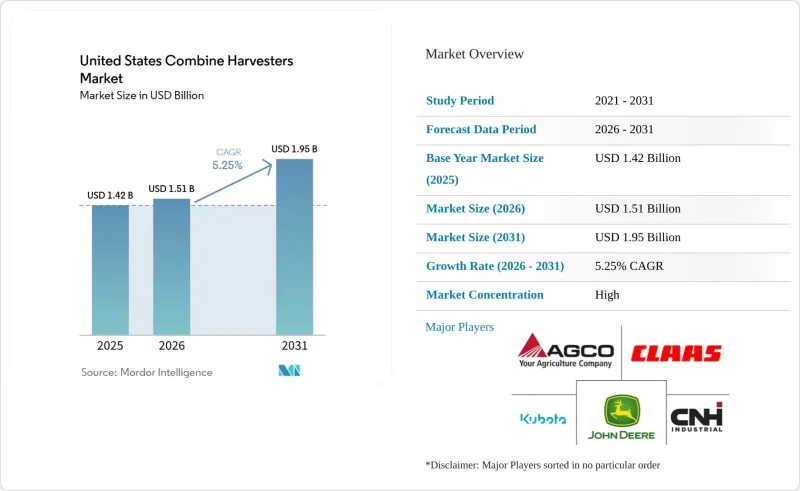
Mordor Intelligence에 의하면, 미국의 콤바인 수확기 시장 규모는 2025년에 14억 2,000만 달러로 평가되었고, 2026년 15억 1,000만 달러로 추정되고, 2031년까지 19억 5,000만 달러에 이를 것으로 예측되며, 예측 기간(2026-2031년) CAGR은 5.25%를 나타낼 전망입니다.
본 보고서는 유형별(자주식 콤바인, 트랙터 견인식 콤바인, PTO 구동식 콤바인), 출력별(150마력 미만, 151-300마력, 301-450마력, 450마력 이상), 구동 기술별(기존 디젤, 하이브리드 전기, 완전 전기)로 분류되어 있습니다. 시장 전망은 금액(달러) 기준으로 제시되어 있습니다.
미국의 콤바인 수확기 시장 동향 및 인사이트
노후화된 VII-IX급 콤바인에 대한 교체 수요 증가
미국의 콤바인 수확기의 평균 사용 연한이 늘어나고 있으며, 지난번 상품 가격 상승 국면에서 구입된 많은 클래스 VII-IX 기종들이 현재 교체 시점에 가까워지고 있습니다. 기계의 사용 시간이 늘어날수록 수리 및 유지보수 비용은 크게 상승하는 반면, 오래되고 가동 시간이 긴 장비의 재판매 가격은 급락합니다. 이로 인해 기체군의 교체 압력이 높아지고 있습니다. 게다가 최근공급망 혼란과 장비 가격 급등으로 인한 구매 연기 현상이 소유 기간을 더욱 연장시키고 있습니다. 또한, 정밀 농업의 도입도 교체 수요를 가속화하고 있습니다. 이는 첨단 센서나 연결 시스템을 갖춘 신형 첨단 기술 대응 기종에 투자하는 것에 비해, 구형 콤바인을 업그레이드하는 것이 비용 대비 효과가 낮은 경우가 많기 때문입니다. 이러한 요인들이 복합적으로 작용하여 갱신 주기가 지속되고 있으며, 판매 대수는 완만하게 회복되고 있는 가운데, 장기적인 시장 가치의 성장을 뒷받침하고 있습니다.
옥수수와 대두의 재배 면적 확대가 기계화를 촉진
2026년에는 생산자들이 옥수수를 9,530만 에이커, 대두를 8,470만 에이커 재배할 것으로 예상되며, 수익성 추세의 변화에 따라 대두 재배로 전환하는 추세가 이어지고 있습니다. 아이오와주, 사우스다코타주, 위스콘신주 등에서는 옥수수 재배 면적을 줄이고 대두 재배 면적을 늘리고 있으며, 이러한 추세는 작물 전환을 신속하게 수행할 수 있고 40-45피트의 유연한 드레이퍼 헤드를 지원하는 콤바인에 대한 수요를 견인하고 있습니다. 또한, 2025년에 수확된 옥수수의 약 94%, 대두의 약 96%가 생명공학 품종이었으며, 이로 인해 수확량이 증가하고 수확 기간이 단축되었습니다. 수확 기간이 단축됨에 따라, 가동 중지 시간을 줄여주는 대용량 기계와 자율 주행 곡물 운반 시스템의 가치가 높아지고 있습니다. 따라서, 재배 면적의 구성 변화에 따라 미국 콤바인 수확기 시장에서 듀얼 헤더 패키지를 지원하는 중-고마력 모델의 구매가 앞당겨지고 있습니다.
농산물 가격 변동이 구매 주기에 영향을 미침
2024-2025년 발생한 옥수수 및 대두 선물 가격의 변동은 농가 수익률을 크게 압박했으며, 미국 콤바인 수확기 시장에서 기계 교체 시기를 늦추는 요인이 되었습니다. 클레이튼 농촌 메인스트리트 지수는 2026년 초까지 성장 중립 수준을 계속 밑돌며, 농촌 경제의 지속적인 침체와 농업 기계 투자에 대한 자금 조달 제약을 보여주고 있습니다. 업계 자료에 따르면, 2024년 콤바인 출하 대수는 급감했으며, 2025년에도 여전히 부진한 모습을 보였습니다. 이는 시장이 농산물 가격 변동이나 생산자의 신뢰도 하락에 민감하다는 것을 보여줍니다. 그 결과, 많은 농업 경영자들이 시장 환경이 안정될 때까지 장비 보유 기간을 연장하고 있어, 제조업체 입장에서는 수요의 주기적인 변동과 재고 관리상의 문제가 발생하고 있습니다.
부문별 분석
2025년 기준으로, 미국 내 콤바인 수확기 시장 점유율의 약 86.0%를 자가주행식 콤바인이 차지했습니다. 이러한 압도적인 시장 점유율은 대규모 줄 재배 농장에서의 보급에 기인하며, 해당 기종은 수확 효율 향상과 작업 시간 단축을 실현하고 있습니다. 반면, PTO 구동형 부문은 2026-2031년 12.4%라는 가장 높은 연평균 성장률(CAGR)을 보일 것으로 전망됩니다. 이러한 성장은 유기농 농장, 특산 작물 생산자, 그리고 낮은 설비 투자와 운영 비용을 우선시하는 협동조합 소유 모델에서 수요 증가에 힘입어 이루어지고 있습니다.
각 제조업체는 대용량 곡물 처리 시스템, 자동화 기술, 생산성 향상을 위한 업그레이드를 도입함으로써 자체 주행형 콤바인의 제품 라인업을 강화하고, 수확기의 제한된 기간 동안 효율성을 높이고 있습니다. 한편, PTO 구동식 콤바인은 구입 비용이 저렴하고 기존 트랙터 인프라와 호환성이 있어 지지를 넓혀가고 있습니다. 또한, 이 부문은 구독형 디지털 생태계나 텔레매틱스 플랫폼에 대한 의존도가 낮다는 장점도 누리고 있습니다. 그러나 처리 능력의 부족이나 헤더 호환성 제한과 같은 문제들로 인해, 미국 콤바인 수확기 시장에서 대규모 상업 농업에 PTO 구동식 콤바인을 도입하는 데 여전히 장애가 되고 있습니다.
기타 혜택 :
- 엑셀 형식 시장 예측(ME) 시트
- 3개월간의 애널리스트 지원
자주 묻는 질문
목차
제1장 서론
제2장 조사 방법
제3장 주요 요약
제4장 시장 구도
제5장 시장 규모 및 성장 예측
제6장 경쟁 구도
제7장 시장 기회 및 향후 전망
AJY 26.06.24According to Mordor Intelligence, the united states combine harvesters market size was valued at USD 1.42 billion in 2025 and is estimated to grow from USD 1.51 billion in 2026 to reach USD 1.95 billion by 2031, at a CAGR of 5.25% during the forecast period (2026-2031).
This report is Segmented by Type (Self-Propelled Combine, Tractor-Pulled Combine, and PTO-Powered Combine), by Power Output (Less Than 150 HP, 151 - 300 HP, 301 - 450 HP, and Above 450 HP), and by Propulsion Technology (Conventional Diesel, Hybrid-Electric, and Fully Electric). The Market Forecasts are Provided in Terms of Value (USD).
United States Combine Harvesters Market Trends and Insights
Increased Replacement Demand for Aging Class VII to IX fleets
The average combine harvester in the United States is aging, with many Class VII to IX units purchased during the previous commodity upcycle now nearing replacement thresholds. As machine usage hours increase, repair and maintenance costs rise significantly, while resale values for older, high-hour equipment decline sharply. This creates pressure for fleet replacement. Additionally, deferred purchases caused by recent supply chain disruptions and higher equipment prices have further extended ownership cycles. The adoption of precision agriculture is also accelerating replacement demand, as upgrading older combines with advanced sensors and connectivity systems is often less cost-effective than investing in newer, technology-enabled machines. These factors collectively contribute to a sustained replacement cycle, supporting long-term market value growth despite a gradual recovery in unit sales.
Rising Corn and Soybean Acreage Incentivizing Mechanization
Growers are anticipated to plant 95.3 million acres of corn and 84.7 million acres of soybeans in 2026, shifting toward soybeans as profitability signals change. States such as Iowa, South Dakota, and Wisconsin are increasing soybean acres while reducing corn, a pattern that drives demand for combines able to switch quickly between crops and handle flexible 40- to 45-foot draper heads. Additionally, about 94% of corn and 96% of soybeans harvested in 2025 used biotech varieties, raising yields and compressing harvest windows. Shorter harvest periods heighten the value of high-capacity machines and autonomous grain-cart systems that cut downtime. The acreage mix, therefore, pulls forward purchases of mid- to high-horsepower models equipped for dual-header packages within the United States combine harvesters market.
Volatility in Commodity Crop Prices Affecting Purchase Cycles
Fluctuations in corn and soybean futures during 2024-2025 significantly compressed farm margins, leading to delays in equipment upgrades within the United States combine harvesters market. The Creighton Rural Mainstreet Index remained below the growth-neutral threshold through early 2026, indicating persistent weakness in the rural economy and restricted financing conditions for machinery investments. Industry data also shows a sharp decline in combine shipments during 2024, with continued weakness in 2025. This underscores the market's sensitivity to commodity price volatility and declining grower confidence. Consequently, many operators are extending equipment ownership cycles until market conditions stabilize, resulting in cyclical demand patterns and inventory management challenges for manufacturers.
Other drivers and restraints analyzed in the detailed report include:
- OEM Financing Programs Lowering Up-Front Cost Barriers
- Carbon-Credit Premiums for Residue-Balancing Harvesting
- High Initial Capital Cost Versus Custom-Harvesting Alternatives
For complete list of drivers and restraints, kindly check the Table Of Contents.
Segment Analysis
Self-propelled combines accounted for about 86.0% of the United States combine harvesters market share in 2025. This dominance is attributed to their widespread adoption on large-scale row-crop farms, where they enhance harvesting efficiency and reduce operational time. In contrast, the PTO-powered segment is anticipated to exhibit the fastest CAGR of 12.4% from 2026 to 2031. This growth is driven by increasing demand from organic farms, specialty-crop producers, and cooperative ownership models that prioritize lower capital investment and operating costs.
Manufacturers are enhancing self-propelled combine offerings by incorporating higher-capacity grain handling systems, automation technologies, and productivity-focused upgrades to improve efficiency during narrow crop windows. Meanwhile, PTO-powered combines are gaining traction due to their lower purchase costs and compatibility with existing tractor infrastructure. Additionally, this segment benefits from reduced reliance on subscription-based digital ecosystems and telematics platforms. However, challenges such as lower throughput capacity and limited header compatibility continue to hinder the adoption of PTO-powered combines in large commercial farming operations within the United States combine harvesters market.
List of Companies Covered in this Report:
- Deere & Company
- CNH Industrial N.V.
- AGCO Corporation
- Claas KGaA mbH
- SDF Group
- Kubota Corporation
- Mahindra & Mahindra Ltd.
- Tribine Industries, Inc.
- Rostselmash Group
- Yanmar Holdings Co., Ltd.
- Gomselmash OJSC
- Weichai Lovol Intelligent Agricultural Technology CO., LTD
- Wintersteiger AG
- ALMACO
Additional Benefits:
- The market estimate (ME) sheet in Excel format
- 3 months of analyst support
TABLE OF CONTENTS
1 Introduction
- 1.1 Study Assumptions and Market Definition
- 1.2 Scope of the Study
2 Research Methodology
3 Executive Summary
4 Market Landscape
- 4.1 Market Overview
- 4.2 Market Drivers
- 4.2.1 Increased replacement demand for aging Class VII to IX fleets
- 4.2.2 Rising corn and soybean acreage incentivizing mechanization
- 4.2.3 OEM financing programs lowering up-front cost barriers
- 4.2.4 Tax incentives under Section 179 for farm equipment
- 4.2.5 Autonomous guidance retrofits on flagship models
- 4.2.6 Carbon-credit premiums for residue-balancing harvesting
- 4.3 Market Restraints
- 4.3.1 Volatility in commodity crop prices affecting purchase cycles
- 4.3.2 High initial capital cost versus custom-harvesting alternatives
- 4.3.3 Shortage of skilled operators for advanced machines
- 4.3.4 Right-to-repair legislative uncertainty impacting OEM margins
- 4.4 Regulatory Landscape
- 4.5 Technological Outlook
- 4.6 Porter's Five Forces Analysis
- 4.6.1 Threat of New Entrants
- 4.6.2 Bargaining Power of Buyers
- 4.6.3 Bargaining Power of Suppliers
- 4.6.4 Threat of Substitutes
- 4.6.5 Intensity of Competitive Rivalry
5 Market Size and Growth Forecasts (Value)
- 5.1 By Type
- 5.1.1 Self-Propelled Combine
- 5.1.2 Tractor-Pulled Combine
- 5.1.3 PTO-Powered Combine
- 5.2 By Power Output
- 5.2.1 Less Than 150 HP
- 5.2.2 151 - 300 HP
- 5.2.3 301 - 450 HP
- 5.2.4 Above 450 HP
- 5.3 By Propulsion Technology
- 5.3.1 Conventional Diesel
- 5.3.2 Hybrid-Electric
- 5.3.3 Fully Electric
6 Competitive Landscape
- 6.1 Market Concentration
- 6.2 Strategic Moves
- 6.3 Market Share Analysis
- 6.4 Company Profiles (Includes Global Level Overview, Market Level Overview, Core Segments, Financials as Available, Strategic Information, Market Rank/Share for Key Companies, Products and Services, and Recent Developments)
- 6.4.1 Deere & Company
- 6.4.2 CNH Industrial N.V.
- 6.4.3 AGCO Corporation
- 6.4.4 Claas KGaA mbH
- 6.4.5 SDF Group
- 6.4.6 Kubota Corporation
- 6.4.7 Mahindra & Mahindra Ltd.
- 6.4.8 Tribine Industries, Inc.
- 6.4.9 Rostselmash Group
- 6.4.10 Yanmar Holdings Co., Ltd.
- 6.4.11 Gomselmash OJSC
- 6.4.12 Weichai Lovol Intelligent Agricultural Technology CO., LTD
- 6.4.13 Wintersteiger AG
- 6.4.14 ALMACO


