

|
시장보고서
상품코드
2122787
인도의 콤바인 수확기 : 시장 점유율 분석, 업계 동향 및 통계, 성장 예측(2026-2031년)India Combine Harvester - Market Share Analysis, Industry Trends & Statistics, Growth Forecasts (2026 - 2031) |
||||||
 Mordor Intelligence
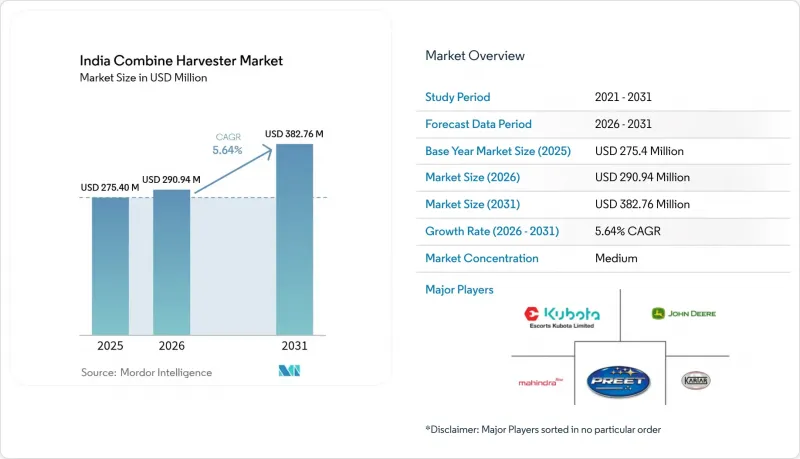
Mordor Intelligence에 의하면, 인도의 콤바인 수확기 시장 규모는 2025년에 2억 7,540만 달러로 평가되었습니다. 2026년 2억 9,094만 달러에서 2031년까지 3억 8,276만 달러에 이를 것으로 예상되며, 예측 기간(2026-2031년) CAGR은 5.64%를 나타낼 전망입니다.

본 보고서는 유형별(자주식 콤바인, 크롤러식 콤바인, 트랙터 구동식 콤바인), 정격 출력별(150HP 미만, 150-300HP, 300HP 초과),작물 유형별(밀, 쌀, 옥수수, 기타), 구동 방식별(바퀴 구동, 크롤러 구동)로 분류되어 있습니다. 시장 예측은 금액(달러) 기준으로 제시되어 있습니다.
인도의 콤바인 수확기 시장 동향 및 인사이트
곡물 재배 면적 증가
식량 곡물의 재배 면적은 2021-2022년도 1억 3,016만 9,000헥타르에서 2023-2024년도에는 1억 3,210만 4,000헥타르에 달했습니다. 경작지 확대와 수확 기간 단축으로 인해 생산자들은 최적의 수분 임계값 범위 내에서 작물을 수확하고 수확 후 손실을 최소화할 수 있는 콤바인 수확기 도입을 추진하고 있습니다. 국가 식량 안보 미션(National Food Security Mission) 등 중앙 정부의 정책은 고수확 종자 품종의 보급을 촉진하고 있으며, 1에이커당 생산 목표를 상향 조정함으로써 간접적으로 기계 수요를 끌어올리고 있습니다. 동시에 주 정부는 볏짚 소각 대책의 일환으로 기계화된 잔여물 관리를 장려하고 있으며, 볏짚 처리 부착 장치를 장착한 콤바인 수확기가 특히 주목받고 있습니다. 옥수수, 콩류, 유지종자의 재배 면적이 확대되는 가운데, 각 제조업체는 여러 작물을 재배하는 지역에 대응하기 위해 다작물 대응 헤더를 출시하고 있습니다. 그 결과 작물의 다양화가 진행되면서, 인도의 콤바인 수확기 시장에서 지리적으로 분산된 지속적인 성장이 뒷받침되고 있습니다.
기계화에 대한 정부의 보조금
‘농업 기계화 미션(SMAM)’에 따라 연방 정부와 주 정부는 장비 구입 가격의 40-50%를 보조하고 있습니다. ‘디지털 농업 미션’에서는 281억 7,000만 루피(3억 3,940만 달러)를 배정하고, 전자 농장 ID 시스템을 통해 보조금 지급을 효율화함으로써 승인 기간 단축과 부정 수급 방지를 도모하고 있습니다. ‘키산 신용카드’ 프로그램은 농업 기계 구매에 대해 최대 50만 루피(6,024 달러)의 저리 대출을 제공하여, 소규모 농업 종사자들의 자금 조달 장벽을 낮추고 있습니다. 일부 주에서는 추가적인 우대 조치를 시행하고 있는데, 카르나타카주는 민관 공동의 CHC(지역사회 보건 센터)에 자금을 지원하고 있으며, 펀자브주는 볏짚 소각을 억제하기 위해 ‘해피 시더’ 기능을 갖춘 콤바인 수확기에 보조금을 지급하고 있습니다. 이러한 시책을 종합함으로써, 새로운 콤바인의 투자 회수 기간은 5시즌에서 3시즌으로 단축되어 인도의 콤바인 시장에 결정적인 활력을 불어넣고 있습니다.
기계의 고액 초기 비용
중급급 자가주행형 콤바인의 소매 가격은 220만 루피(2만 6,506달러)로, 이는 대다수의 소규모 농업 종사자들에게는 감당하기 어려운 투자 금액입니다. 50%의 자본 보조금이 있더라도 나머지 지불액은 연간 농업 소득을 초과하는 경우가 많아, 임대 모델에 의존할 수밖에 없는 상황입니다. 금융 회사는 지리적으로 분산된 마을에서는 담보 회수가 복잡하기 때문에 농업 기계 대출에는 높은 채무 불이행 위험이 있다고 인식하고 있습니다. ‘키산 신용카드’에서는 우대 금리가 제공되고 있지만, 2024년 기준에서 이용 자격이 있는 농업 종사자 중 유효한 카드를 소지하고 있는 비율은 61%에 그치고 있어, 당장의 자금 사정 개선에는 한계가 있습니다. 작물 보험 가입률이 낮은 점도 대출 기관의 위험 인식을 더욱 강화하고 있습니다. 그 결과, 소유자는 대규모 농업 종사자나 CHC(콤바인 수확기 협동조합) 운영자에게 집중되어 있어, 인도의 콤바인 수확기 시장의 판매 대수 증가세를 둔화시키고 있습니다.
부문별 분석
자주식 기계 유형은 2025년 매출의 55.68%를 차지했으며, 모든 작물에 대한 범용성과 자율적인 이동 능력 덕분에 중규모에서 대규모 농장에서 그 매력이 두드러집니다. 구매자들은 통합형 엔진, 대용량 곡물 탱크, 장기간 수확 기간 동안 작업자의 편의성을 중시하며, 이러한 기계들은 생산성의 기준이 되고 있습니다. 트랙터 구동식 콤바인 수확기는 기계화율이 낮은 지역에서 여전히 널리 보급되어 있으며, 기존의 50-70HP 트랙터를 재활용함으로써 설비 투자를 절감하고 있습니다. 크롤러식 콤바인 수확기는 틈새 시장 제품이지만, 물에 잠긴 논 지역에서의 견인력 문제를 해결해 주며, 특히 해안 지역인 안드라프라데시 주에서 기후 변화에 강한 기계화를 목표로 한 정부의 조달 목록에 등재되어 있습니다.
앞으로 신기술 도입을 뒷받침하는 ‘스테이지 V’ 배기가스 규제의 혜택을 받아, 자가주행형 콤바인 수확기의 판매는 연평균 성장률(CAGR) 7.04%로 성장할 전망입니다. 각 OEM 업체들은 GNSS 오토스티어, 4G 텔레매틱스, 짚 절단 부착 장치를 통합하고 있으며, 이로 인해 가격대와 대당 평균 매출액이 상승하고 있습니다. 마힌드라 앤 마힌드라와 케이스 IH의 ‘액시얼 플로우’ 시리즈를 통한 밭 현장 실증 결과, 곡물 손실이 3-4% 감소하는 것으로 나타났으며, 이를 통해 높은 구매 비용이 정당화되고 있습니다. 이러한 성능상의 우위 덕분에 양사는 인도의 콤바인 수확기 시장에서 선도적인 입지를 유지하고 있습니다.
150-300HP급 콤바인 수확기는 2025년 판매 대수의 47.12%를 차지하며, 처리 능력과 합리적인 가격의 균형을 잘 맞춘 ‘스위트 스팟’을 포착했습니다. 이러한 기계 유형은 다양한 작물에 대응하는 헤더를 장착하고 있으며, 4-6헥타르 규모의 밭을 장시간의 선회 시간 없이 이동할 수 있어 인도의 다양한 농지 규모에 적합합니다. 150HP 이하 기계 유형은 여전히 소규모 콤바인 수확기 임대 사업자(CHC)들의 관심을 끌고 있지만, 곡물 탱크 용량과 헤더 폭에 제한이 있어 밭에서의 작업 속도가 저하되는 과제를 안고 있습니다. 300HP를 초과하는 모델은 고가임에도 불구하고, 대규모 농업 종사자나 법인 농업 종사자들이 가동 시간을 집중시키기 위해 도입함에 따라 7.32%라는 가장 높은 연평균 성장률(CAGR)을 기록하고 있습니다.
2023년 1월부터 시행된 스테이지 IV TREM(운송 관련 엔진 배기가스 규제) 준수에 따라 각 OEM 업체들은 엔진 재설계를 할 수밖에 없었으며, 175HP 이상의 생산 대수가 증가했습니다. 펀자브주와 마디아프라데시주의 렌탈 사업자들은 수확기가 짧은 성수기 동안 렌탈 수익을 극대화하기 위해 이러한 고출력 기계 유형을 선호하고 있습니다. 그 결과, 출력 등급의 선택이 인도의 콤바인 수확기 시장의 차량 구성과 수익 구조를 직접 좌우하고 있습니다.
기타 혜택
- 엑셀 형식 시장 예측(ME) 시트
- 3개월간의 애널리스트 지원
자주 묻는 질문
목차
제1장 서론
제2장 조사 방법
제3장 주요 요약
제4장 시장 구도
제5장 시장 규모 및 성장 예측
제6장 경쟁 구도
제7장 시장 기회 및 향후 전망
KTH 26.09.08According to Mordor Intelligence, the India combine harvester market size was valued at USD 275.4 million in 2025 and estimated to grow from USD 290.94 million in 2026 to reach USD 382.76 million by 2031, at a CAGR of 5.64% during the forecast period (2026-2031).
This report is Segmented by Type (Self-Propelled Combine Harvester, Track Combine Harvester, and Tractor-Powered Combine Harvester), Power Rating (Below 150 HP, 150 To 300 HP, and Above 300 HP), Crop Type (Wheat, Rice, Corn, and Other Crops), and Drive Mechanism (Wheel Drive and Track Drive). The Market Forecasts are Provided in Terms of Value (USD).
India Combine Harvester Market Trends and Insights
Rising area under grain crops
Area cover under foodgrains reached 1,321.04 lakh hectares during 2023-2024 from 1,301.69 lakh hectares during 2021-2022. Larger fields and tighter harvest windows motivate growers to adopt combine harvesters that can clear crops within optimal moisture thresholds, thereby minimizing post-harvest losses. Central schemes such as the National Food Security Mission promote high-yield seed varieties, indirectly boosting machine demand by raising per-acre output targets. State governments are simultaneously incentivizing mechanized residue management to combat stubble burning, making combines equipped with straw-handling attachments particularly attractive. As acreage under maize, pulses, and oilseeds widens, manufacturers are introducing multi-crop headers to serve mixed-farming zones. The resulting diversity in crop profiles reinforces sustained, geographically dispersed growth for the India combine harvester market.
Government subsidies for mechanization
Under the Sub-Mission on Agricultural Mechanization (SMAM), the federal and state governments reimburse 40-50% of the equipment purchase price. The Digital Agriculture Mission earmarks INR 2,817 crore (USD 339.4 million) to streamline subsidy delivery via an electronic farm identity stack, cutting approval time and leakage. The Kisan Credit Card program offers low-interest loans up to INR 500,000 (USD 6,024) for machinery purchases, easing capital hurdles for smallholders. Several states layer additional incentives, Karnataka co-funds public-private CHCs, while Punjab subsidizes Happy Seeder-ready combines to curb paddy-straw burning. Combined, these instruments reduce payback periods on new harvesters from five seasons to three, decisively energizing the India combine harvester market.
High upfront cost of machines
A mid-range self-propelled harvester retails for INR 2.2 million (USD 26,506), an investment beyond the reach of most smallholders. Even with a 50% capital subsidy, the remaining payment often surpasses annual farm income, forcing reliance on rental models. Finance houses perceive higher default risk for equipment loans because collateral recovery is complex in geographically dispersed villages. Although the Kisan Credit Card offers subsidized rates, only 61% of eligible farmers held active cards in 2024, limiting immediate cash-flow relief. Limited uptake of crop insurance further compounds lenders' risk perception. Consequently, ownership concentrates among larger farmers and CHC operators, tempering unit-sales momentum for the India combine harvester market.
Other drivers and restraints analyzed in the detailed report include:
- Precision-ag retrofit kits for aging fleets
- Growing harvester-as-a-service models
- Fragmented and small land holdings
For complete list of drivers and restraints, kindly check the Table Of Contents.
Segment Analysis
Self-propelled units generated 55.68% of 2025 revenue, underscoring their appeal among medium-to-large farms for all-crop versatility and standalone mobility. Buyers value integrated engines, larger grain tanks, and operator comfort during extended harvest windows, making these machines the benchmark for productivity. Tractor-powered combine harvesters remain prevalent in lower-mechanization districts, leveraging existing 50-70 HP tractor fleets to reduce capital outlay. Track combines, though niche, solve traction issues in waterlogged paddy areas and appear in government procurement lists for climate-resilient mechanization, especially in coastal Andhra Pradesh.
Looking forward, self-propelled sales are positioned to expand at a 7.04% CAGR, benefiting from Stage V emission mandates that favor new-technology adoption. OEMs integrate GNSS auto-steer, 4G telematics, and straw chopper attachments, elevating price points and average revenue per unit. Field demonstrations by Mahindra & Mahindra Ltd. and Case IH's Axial-Flow series show 3-4% grain-loss reduction, justifying higher acquisition costs. This performance edge sustains their lead in the India combine harvester market.
Combines rated 150-300 HP accounted for 47.12% of 2025 sales, capturing the sweet spot between throughput and affordability. They handle multi-crop headers and traverse 4-6 hectare plots without extensive turnaround time, aligning well with India's farm-size spectrum. Below-150 HP machines still interest small CHCs but face limitations in grain-tank capacity and header width, slowing field progress. Above-300 HP models, despite commanding premium prices, are registering the fastest 7.32% CAGR because large-acreage farmers and corporate growers pursue machine hours aggregation.
Stage IV TREM (Transport Related Engine Emission Norms) compliance as of January 2023 nudged OEMs to redesign engines, increasing 175 HP-plus production runs. Custom-hiring entrepreneurs in Punjab and Madhya Pradesh gravitate toward these high-output machines to maximize rental income during brief harvest peaks. Consequently, power-rating choices directly steer fleet mix and revenue profiles in the India combine harvester market.
Complete Report Scope:
- By Type
- Self-propelled Combine Harvester
- Track Combine Harvester
- Tractor-powered Combine Harvester
- By Power Rating
- Below 150 HP
- 150 to 300 HP
- Above 300 HP
- By Crop Type
- Wheat
- Rice
- Corn
- Other Crops
- By Drive Mechanism
- Wheel Drive
- Track Drive
List of Companies Covered in this Report:
- Mahindra & Mahindra Ltd.
- Deere & Company
- PREET Group
- Tractors and Farm Equipment Limited
- Kartar Agro Industries Private Limited
- Dasmesh Group
- International Tractors Limited (Sonalika)
- Indo Farm Equipment Limited
- Yanmar Holdings Co., Ltd.
- CNH Industrial N.V.
- Escorts Kubota Limited
- Tirth Agro Technology Private Limited
- KS Agrotech PVT.LTD
Additional Benefits:
- The market estimate (ME) sheet in Excel format
- 3 months of analyst support
TABLE OF CONTENTS
1 Introduction
- 1.1 Study Assumptions and Market Definition
- 1.2 Scope of the Study
2 Research Methodology
3 Executive Summary
4 Market Landscape
- 4.1 Market Overview
- 4.2 Market Drivers
- 4.2.1 Rising area under grain crops
- 4.2.2 Escalating farm labor costs
- 4.2.3 Government subsidies for mechanization
- 4.2.4 Rapid growth of custom-hiring centers
- 4.2.5 Precision-ag retrofit kits for aging fleets
- 4.2.6 Growing availability of harvester-as-a-service models
- 4.3 Market Restraints
- 4.3.1 High upfront cost of machines
- 4.3.2 Fragmented and small land holdings
- 4.3.3 Expensive after-sales maintenance
- 4.3.4 Slow rural credit disbursement to small farmers
- 4.4 Regulatory Landscape
- 4.5 Technological Outlook
- 4.6 Porter's Five Forces Analysis
- 4.6.1 Bargaining Power of Suppliers
- 4.6.2 Bargaining Power of Buyers
- 4.6.3 Threat of New Entrants
- 4.6.4 Threat of Substitute Products
- 4.6.5 Intensity of Competitive Rivalry
5 Market Size and Growth Forecasts (Value)
- 5.1 By Type
- 5.1.1 Self-propelled Combine Harvester
- 5.1.2 Track Combine Harvester
- 5.1.3 Tractor-powered Combine Harvester
- 5.2 By Power Rating
- 5.2.1 Below 150 HP
- 5.2.2 150 to 300 HP
- 5.2.3 Above 300 HP
- 5.3 By Crop Type
- 5.3.1 Wheat
- 5.3.2 Rice
- 5.3.3 Corn
- 5.3.4 Other Crops
- 5.4 By Drive Mechanism
- 5.4.1 Wheel Drive
- 5.4.2 Track Drive
6 Competitive Landscape
- 6.1 Market Concentration
- 6.2 Strategic Moves
- 6.3 Market Share Analysis
- 6.4 Company Profiles (Includes Global Level Overview, Market Level Overview, Core Segments, Financials as Available, Strategic Information, Market Rank/Share for Key Companies, Products and Services, and Recent Developments)
- 6.4.1 Mahindra & Mahindra Ltd.
- 6.4.2 Deere & Company
- 6.4.3 PREET Group
- 6.4.4 Tractors and Farm Equipment Limited
- 6.4.5 Kartar Agro Industries Private Limited
- 6.4.6 Dasmesh Group
- 6.4.7 International Tractors Limited (Sonalika)
- 6.4.8 Indo Farm Equipment Limited
- 6.4.9 Yanmar Holdings Co., Ltd.
- 6.4.10 CNH Industrial N.V.
- 6.4.11 Escorts Kubota Limited
- 6.4.12 Tirth Agro Technology Private Limited
- 6.4.13 KS Agrotech PVT.LTD


