

|
시장보고서
상품코드
2114041
콤바인 수확기 : 시장 점유율 분석, 업계 동향 및 통계, 성장 예측(2026-2031년)Combine Harvester - Market Share Analysis, Industry Trends & Statistics, Growth Forecasts (2026 - 2031) |
||||||
 Mordor Intelligence
Mordor Intelligence에 의하면, 2026년 콤바인 수확기 시장 규모는 127억 4,000만 달러로 추정되고 2025년 121억 달러에서 확대해, 2031년에는 164억 8,000만 달러에 이를 것으로 예측됩니다.
2026년부터 2031년까지 연평균 성장률(CAGR) 5.28%로 성장할 것으로 전망됩니다.
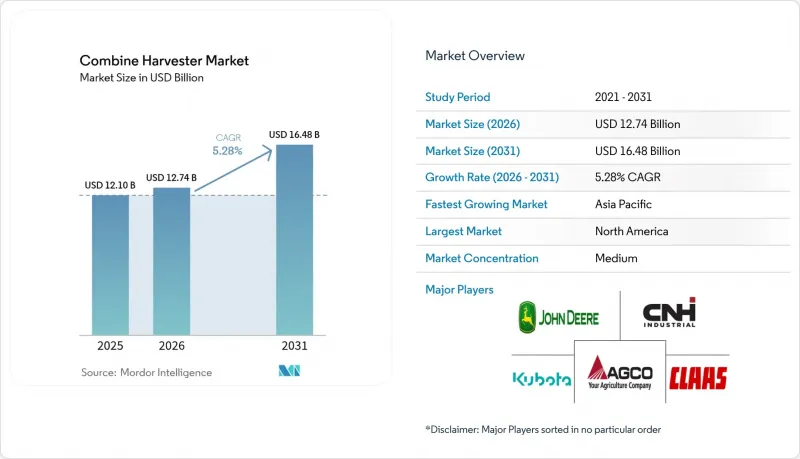
본 보고서는 유형별(자주식, 트랙터 견인식, PTO 구동식), 출력별(150 HP 미만, 151-300 HP, 301-450 HP, 450 HP 이상), 지역별(북미, 남미, 유럽,아시아태평양, 중동 및 아프리카)로 분류되어 있습니다. 시장 전망은 금액(달러) 기준으로 제시되어 있습니다.
세계의 콤바인 수확기 시장 동향 및 인사이트
신흥 경제국에서의 농업 기계화 진전
정부의 보조금 및 대여 거점 확대로 인해 농업 기계에 대한 접근성은 지속적으로 확대되고 있습니다. 인도의 ‘농업 기계화 지원 정책’에서는 구매 비용의 40-50%가 보조되며, 4만 900곳 이상의 임대 센터가 설치되어 있어 기계화율은 40%에서 중국의 60%라는 벤치마크를 향해 상승하고 있습니다. 2025년까지 기계화율 75%를 달성하겠다는 중국의 정책 목표는 다국적 공급업체를 유치하고, 수입 관세를 회피하기 위한 합작 투자로 이어지고 있습니다. 브라질과 아프리카 여러 국가에서 시행되고 있는 유사한 보조금 제도는 콤바인 수확기 시장을 확대하는 구조적인 견인력을 보여주고 있습니다.
농촌 지역의 만성적인 노동력 부족과 임금 상승
많은 곡물 생산 지역에서 실업률이 3% 미만으로 떨어지면서 농업 임금은 사상 최고 수준에 도달했고, 자율형 탈곡 플랫폼의 투자 회수 기간이 단축되고 있습니다. 현재 미국의 대규모 농가들은 1명의 작업자가 여러 교대 근무를 소화할 수 있는 고출력 콤바인으로의 전환을 정당화하는 주된 이유로 인력 부족을 꼽고 있습니다. 서유럽에서도 유사한 상황이 나타나고 있으며, 낙농 및 밭작물 생산자들은 수확 작업 인력을 제때 확보하지 못할 경우 재배 면적을 줄이고 있습니다. 이러한 인력 부족은 타이밍이 극히 중요한 수확기에 특히 심각하며, 인적 개입을 최소화하면서 작업 가능 기간을 극대화할 수 있는 대용량 콤바인에 대한 수요를 부추기고 있습니다.
높은 초기 투자 비용
신형 플래그십 모델의 가격은 대개 40만-50만 달러 범위입니다. 금리 상승으로 인해 대당 연간 유지비가 상승하여, 자금력이 있는 농장이라 해도 손익분기점 도달까지의 기간이 길어지고 있습니다. 리스나 운영리스 계약을 통해 그 타격은 완화되고 있지만, 소규모 생산자들은 여전히 구매를 미루고 있어 콤바인 수확기 시장의 단기적인 성장을 둔화시키고 있습니다. AGCO가 OEM 금융 솔루션에 전략적 초점을 맞추고 있고, 존 디어가 브라질에서 금융 기능을 확충하고 있는 것은 제조업체들이 장비 접근성이 기존의 구매 모델이 아닌 혁신적인 지불 구조에 점점 더 의존하고 있음을 인식하고 있음을 보여줍니다.
부문 분석
2025년, 자가 주행식 콤바인은 콤바인 수확기 시장에서 71.35%의 점유율을 차지하며 광활한 농지에서 그 우위를 부각시켰습니다. 듀얼 플로우 탈곡 기술로 인해 곡물 보유율이 향상됨에 따라, 트랙터 견인형 모델만으로도 2031년까지 해당 부문의 연평균 성장률(CAGR)을 7.35%까지 끌어올릴 것으로 예측됩니다. PTO 구동식 콤바인은 비용을 중시하는 농가들 사이에서 여전히 유력한 선택지이지만, 자율 주행 기능의 지속적인 사후 장착으로 인해 기존 카테고리 간의 경계가 모호해지기 시작하고 있습니다. 트랙터 견인식 콤바인은 비용을 중시하는 농가나 세분화된 농지, 특히 자본력이 제한된 지역에서 여전히 널리 사용되고 있습니다. 각 제조업체는 연료 소비량을 최대 10% 절감하는 하이브리드 구동 시스템을 개선하고 있어, 디젤 연료, 애드블루 및 유지보수 비용의 균형을 맞추어야 하는 운전자들에게 그 매력이 더욱 커지고 있습니다.
차량 소유주들은 뛰어난 기동성, 통합된 텔레매틱스 기능, 그리고 12-18열 헤더와의 호환성을 이유로 자행식 플랫폼을 선호하고 있습니다. OEM 업체들은 현재 작물의 수분 함량에 따라 콘케이브의 간격과 로터 속도를 조정하는 무선 펌웨어를 출시하여, 기존 마력 대역에서 더 많은 처리 능력을 이끌어내고 있습니다. 향후 토양 다짐 규제의 준수가 더욱 엄격해짐에 따라, 콤바인 수확기 시장의 이 주요 부문에서는 아티큘레이트식 언더캐리지 및 와이드 트랙 사양의 채택이 확대되고 있습니다. 이 부문의 혁신은 한 명의 운전자가 인접한 밭에 배치된 여러 대의 장비를 감독할 수 있는 자율형 모듈을 통해 콤바인 수확기 시장 규모를 확대하는 데 초점을 두고 있습니다.
지역별 분석
북미는 2025년에 매출의 31.85%를 차지했으며, 이는 높은 기계화 수준과 확립된 교체 주기를 반영합니다. 그러나 2025년 중 대형 농업 기계 인도 대수가 감소할 것으로 예측됨에 따라 생산자들이 대비를 강화하면서 설비 투자는 둔화되었습니다. 기후 친화적 농업을 위해 배정된 연방 정부 보조금은 특히 토양 건강 보조금 대상인 잔여물 균형 조정 키트를 장착한 콤바인에 대해 하반기 수주를 뒷받침할 가능성이 있습니다. 캐나다 농업 부문은 곡물 수출 수요의 견조함과 정밀 농업 도입에 대한 정부의 지원 혜택을 누리고 있습니다. 한편, 멕시코의 농업 기계화 진전은 북미 제조업체들에게 사업 확대의 기회를 제공합니다.
아시아태평양은 2031년까지 연평균 성장률(CAGR) 7.85%로 성장을 주도하고 있습니다. 인도의 기계화 격차는 급속히 줄어들고 있습니다. 보조금으로 지원되는 도급 센터는 현재 아직 기계를 전액 구매할 수 없는 소규모 농가를 위해 탈곡 작업 비용을 부담하고 있습니다. 중국이 제시한 75% 기계화 목표는 수입 관세를 피하면서도 외국산 센서군을 유지할 수 있는 국내 조립형 고급 콤바인에 대한 수요를 뒷받침하고 있습니다. 일본과 호주는 정밀 농업과 자동화 기술에 중점을 둔 성숙한 시장인 반면, 동남아시아 국가들에서는 농업 생산성에 대한 수요가 높아짐에 따라 새로운 기회가 생겨나고 있습니다.
유럽 시장은 생산 자재비 급등과 환경 규제 강화를 배경으로 위축되고 있습니다. EU의 기계 규정(2023/1230)은 자율 주행의 안전성 검증에 관한 새로운 기준을 정하고 있으며, 이에 부합하기 위한 연구개발 예산이 증가하고 있습니다. 대조적으로, 브라질과 아르헨티나는 수출 주도형 현금 흐름을 재원으로 삼아 텔레매틱스 포드가 탑재된 350 HP 이상의 콤바인으로의 교체를 추진하고 있으며, 이를 통해 차량군의 최적화가 용이해지고 있습니다. 남미는 견조한 농산물 수출의 혜택을 누리고 있으며, 2023년 브라질이 7억 1,300만 톤이라는 사상 최대의 사탕수수 처리량을 기록한 것이 장비 수요를 뒷받침하는 한편, 아르헨티나의 농업 생명공학 분야 리더십은 정밀 농업 통합을 위한 기회를 창출하고 있습니다.
기타 혜택 :
- 엑셀 형식 시장 예측(ME) 시트
- 3개월간의 애널리스트 지원
자주 묻는 질문
목차
제1장 서론
제2장 조사 방법
제3장 주요 요약
제4장 시장 구도
제5장 시장 규모 및 성장 예측
제6장 경쟁 구도
제7장 시장 기회 및 향후 전망
KTH 26.08.26According to Mordor Intelligence, the combine harvester market size in 2026 is estimated at USD 12.74 billion, growing from 2025 value of USD 12.10 billion with 2031 projections showing USD 16.48 billion, growing at 5.28% CAGR over 2026-2031.
This report is Segmented by Type (Self-Propelled, Tractor-Pulled Combine, and PTO-Powered Combine), by Power Output (Less Than 150 HP, 151 To 300 HP, 301 To 450 HP, and Above 450 HP), and by Geography (North America, South America, Europe, Asia-Pacific, Middle East, and Africa). The Market Forecasts are Provided in Terms of Value (USD).
Global Combine Harvester Market Trends and Insights
Rising Farm Mechanization in Emerging Economies
Government grants and custom-hiring hubs continue to widen equipment access. India's Sub-Mission on Agricultural Mechanization reimburses 40-50% of purchase costs and has deployed more than 40,900 rental centers, lifting mechanization from 40% toward China's 60% benchmark . China's policy goal of 75% mechanization by 2025 attracts multinational suppliers into joint ventures that sidestep import tariffs . Similar subsidy schemes in Brazil and multiple African nations illustrate a structural push that enlarges the combine harvester market.
Persistent Rural Labor Shortage and Wage Inflation
Unemployment rates below 3% in many grain-producing regions have driven farm wages to record highs, narrowing the payback window for autonomous threshing platforms. Large United States growers now cite workforce scarcity as the primary justification for migrating to high-horsepower combines configured for one-operator, multi-shift deployment. Western Europe mirrors this tension, with dairy and arable producers trimming acreage whenever harvest labor cannot be secured in time. This labor scarcity is particularly acute during harvest seasons when timing is critical, driving demand for high-capacity combines that can maximize operational windows with minimal human intervention.
High Upfront Capital Requirement
New flagship frequently lists between USD 400,000 and USD 500,000. Elevated interest rates push annual carrying costs per unit, lengthening break-even periods even for well-capitalized farms. Although leasing and operating-rent contracts soften the blow, smaller growers still postpone purchases, slowing near-term combine harvester market growth. AGCO's strategic focus on OEM financing solutions and John Deere's expansion of financing capabilities in Brazil demonstrate manufacturers' recognition that equipment accessibility depends increasingly on innovative payment structures rather than traditional purchase models.
Other drivers and restraints analyzed in the detailed report include:
- Adoption of Precision-Ag Mechanization Suites
- Integration of AI-Enabled Predictive Maintenance
- Limited Aftermarket Service Networks
For complete list of drivers and restraints, kindly check the Table Of Contents.
Segment Analysis
The self-propelled segment generated a 71.35% market share in the combine harvester market in 2025, underscoring its primacy in high-acreage operations. Tractor-pulled variants alone are projected to lift the segment's CAGR to 7.35% through 2031 as dual-flow threshing boosts grain retention. PTO-powered combine remain viable among cost-sensitive growers, but ongoing autonomy retrofits are beginning to blur the lines between legacy categories. The Tractor-pulled combine endures in cost-sensitive or fragmented landholdings, especially where capital pools are modest. Manufacturers refine hybrid drivelines that reduce fuel consumption by up to 10%, increasing the appeal for operators who must juggle diesel, AdBlue, and maintenance costs.
Fleet owners prefer self-propelled platforms due to their tight turning radius, integrated telematics, and compatibility with 12- to 18-row headers. OEMs now release over-the-air firmware that tunes concave clearance and rotor speed to crop moisture, squeezing extra throughput from existing horsepower bands. As adherence to future compaction rules tightens, articulated undercarriages and wide-track options are gaining traction within this leading segment of the combine harvester market. The segment's innovation pipeline centers on the expansion of the combined harvesters market size through autonomous modules that enable a single driver to supervise multiple units across adjacent fields.
Complete Report Scope:
- By Type
- Self-propelled
- Tractor-pulled combine
- PTO-powered combine
- By Power Output (HP)
- Less than 150 HP
- 151 to 300 HP
- 301 to 450 HP
- Above 450 HP
- By Geography
- North America
- United States
- Canada
- Mexico
- Rest of North America
- South America
- Brazil
- Argentina
- Rest of South America
- Europe
- Germany
- France
- United Kingdom
- Spain
- Italy
- Russia
- Rest of Europe
- Asia-Pacific
- China
- India
- Japan
- Australia
- Rest of Asia-Pacific
- Middle East
- Saudi Arabia
- Turkey
- Rest of Middle East
- Africa
- South Africa
- Egypt
- Rest of Africa
- North America
Geography Analysis
North America retained 31.85% revenue in 2025, reflecting deep mechanization and entrenched replacement cycles. Capital spending nonetheless softened as growers braced for a predicted dip in large-equipment deliveries during 2025. Federal aid earmarked for climate-smart agriculture may cushion orders in the latter half of the year, especially for combines outfitted with residue-balancing kits that qualify for soil-health grants. Canada's agricultural sector benefits from strong grain export demand and government support for the adoption of precision agriculture, while Mexico's growing agricultural mechanization presents opportunities for expansion for North American manufacturers.
Asia-Pacific leads growth at an 7.85% CAGR through 2031. India's mechanization gap has narrowed swiftly. Subsidy-backed custom-hiring centers now finance threshing sessions for smallholders who cannot yet buy machines outright. China's 75% mechanization target propels demand for domestically assembled high-end combines that avoid import tariffs while retaining foreign sensor suites. Japan and Australia represent mature markets with a focus on precision agriculture and automation technologies, while Southeast Asian countries present emerging opportunities as agricultural productivity demands increase.
Europe's market cools amid input-cost inflation and stricter environmental mandates. The EU Machinery Regulation 2023/1230 sets new guardrails for autonomous safety validation, raising R&D budgets for compliance. In contrast, Brazil and Argentina ride export-led cash flows that fund upgrades to 350 HP-plus combines equipped with telematics pods that simplify fleet optimization. South America benefits from a strong agricultural export performance, with Brazil's record sugarcane processing of 713 million tons in 2023 supporting equipment demand, while Argentina's agricultural biotechnology leadership creates opportunities for precision agriculture integration.
- Deere & Company
- CNH Industrial N.V.
- AGCO Corporation
- Claas KGaA mbH
- Kubota Corporation
- SDF Group
- Jiangsu World Agricultural Machinery (World Group)
- Yanmar Holdings Co., Ltd.
- Mahindra and Mahindra Ltd. (Mahindra Group)
- Iseki and Co., Ltd.
- Versatile (Buhler Industries)
- Rostselmash
- Tractors and Farm Equipment Ltd. (Amalgamations Group)
- LOVOL Heavy Industry (Weichai Group)
- Zoomlion Heavy Industry Science and Technology
Additional Benefits:
- The market estimate (ME) sheet in Excel format
- 3 months of analyst support
TABLE OF CONTENTS
1 Introduction
- 1.1 Study Assumptions and Market Definition
- 1.2 Scope of the Study
2 Research Methodology
3 Executive Summary
4 Market Landscape
- 4.1 Market Overview
- 4.2 Market Drivers
- 4.2.1 Rising farm mechanization in emerging economies
- 4.2.2 Persistent rural labor shortage and wage inflation
- 4.2.3 Adoption of precision ag mechanization suites
- 4.2.4 Integration of AI-enabled predictive maintenance
- 4.2.5 Carbon-credit monetization for low-loss harvesting
- 4.2.6 OEM financing platforms targeting smallholders
- 4.3 Market Restraints
- 4.3.1 High upfront capital requirement
- 4.3.2 Limited aftermarket service networks
- 4.3.3 Dependence on volatile commodity crop pricing
- 4.3.4 Rapid soil-compaction regulations
- 4.4 Regulatory Landscape
- 4.5 Technological Outlook
- 4.6 Porter's Five Forces Analysis
- 4.6.1 Bargaining Power of Suppliers
- 4.6.2 Bargaining Power of Buyers
- 4.6.3 Threat of New Entrants
- 4.6.4 Threat of Substitutes
- 4.6.5 Intensity of Competitive Rivalry
5 Market Size and Growth Forecasts (Value)
- 5.1 By Type
- 5.1.1 Self-propelled
- 5.1.2 Tractor-pulled combine
- 5.1.3 PTO-powered combine
- 5.2 By Power Output (HP)
- 5.2.1 Less than 150 HP
- 5.2.2 151 to 300 HP
- 5.2.3 301 to 450 HP
- 5.2.4 Above 450 HP
- 5.3 By Geography
- 5.3.1 North America
- 5.3.1.1 United States
- 5.3.1.2 Canada
- 5.3.1.3 Mexico
- 5.3.1.4 Rest of North America
- 5.3.2 South America
- 5.3.2.1 Brazil
- 5.3.2.2 Argentina
- 5.3.2.3 Rest of South America
- 5.3.3 Europe
- 5.3.3.1 Germany
- 5.3.3.2 France
- 5.3.3.3 United Kingdom
- 5.3.3.4 Spain
- 5.3.3.5 Italy
- 5.3.3.6 Russia
- 5.3.3.7 Rest of Europe
- 5.3.4 Asia-Pacific
- 5.3.4.1 China
- 5.3.4.2 India
- 5.3.4.3 Japan
- 5.3.4.4 Australia
- 5.3.4.5 Rest of Asia-Pacific
- 5.3.5 Middle East
- 5.3.5.1 Saudi Arabia
- 5.3.5.2 Turkey
- 5.3.5.3 Rest of Middle East
- 5.3.6 Africa
- 5.3.6.1 South Africa
- 5.3.6.2 Egypt
- 5.3.6.3 Rest of Africa
- 5.3.1 North America
6 Competitive Landscape
- 6.1 Market Concentration
- 6.2 Strategic Moves
- 6.3 Market Share Analysis
- 6.4 Company Profiles (Includes Global Overview, Market Overview, Core Segments, Financials, Strategic Information, Market Rank/Share, Products and Services, and Recent Developments)
- 6.4.1 Deere & Company
- 6.4.2 CNH Industrial N.V.
- 6.4.3 AGCO Corporation
- 6.4.4 Claas KGaA mbH
- 6.4.5 Kubota Corporation
- 6.4.6 SDF Group
- 6.4.7 Jiangsu World Agricultural Machinery (World Group)
- 6.4.8 Yanmar Holdings Co., Ltd.
- 6.4.9 Mahindra and Mahindra Ltd. (Mahindra Group)
- 6.4.10 Iseki and Co., Ltd.
- 6.4.11 Versatile (Buhler Industries)
- 6.4.12 Rostselmash
- 6.4.13 Tractors and Farm Equipment Ltd. (Amalgamations Group)
- 6.4.14 LOVOL Heavy Industry (Weichai Group)
- 6.4.15 Zoomlion Heavy Industry Science and Technology


