

|
시장보고서
상품코드
2065451
유럽의 직원 온보딩 시장 : 시장 점유율 분석, 업계 동향 및 통계, 성장 예측(2026-2031년)Europe Employee Onboarding - Market Share Analysis, Industry Trends & Statistics, Growth Forecasts (2026 - 2031) |
||||||
 Mordor Intelligence
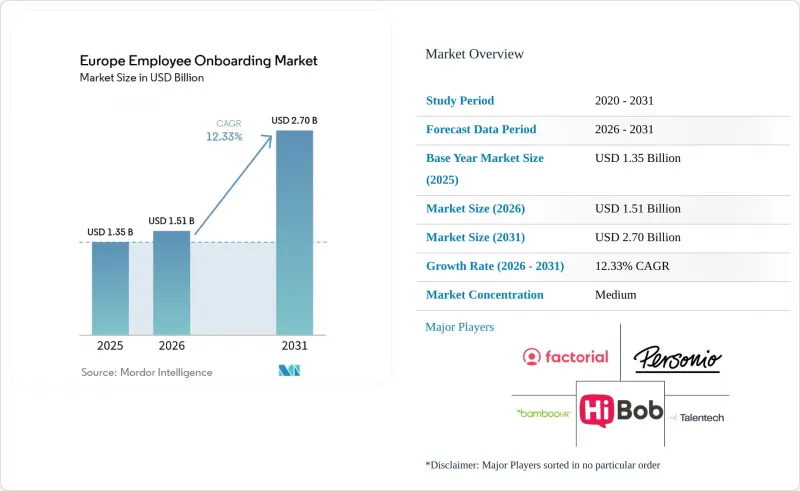
Mordor Intelligence에 의하면, 유럽의 직원 온보딩 시장 규모는 2025년에 13억 5,000만 달러로 평가되었고, 2026년에 15억 1,000만 달러로 추정되고, 2031년까지 27억 달러에 이를 것으로 예측됩니다. 2026-2031년 CAGR 12.33%로 성장할 전망입니다.
본 보고서는 도입 형태별(클라우드 기반 등), 기업 규모별(대기업, 중소기업), 최종 사용자 산업 분야별(은행, 금융서비스 및 보험(BFSI), 헬스케어 및 생명과학 등), 기능별(워크플로우 자동화 및 작업 오케스트레이션, 문서 관리 및 전자 서명 등) 및 지역별로 분류되어 있습니다. 시장 전망은 금액(달러) 기준으로 제시되어 있습니다.
유럽의 직원 온보딩 시장 동향 및 인사이트
GDPR(EU 개인정보보호규정) 준수 및 다국어 지원을 갖춘 온보딩에 대한 수요 증가
유럽의 고용주들은 단순히 양식이나 알림을 자동화하는 도구가 아닌, 동의, 데이터 최소화 및 삭제 절차에 관한 입증 가능한 기록을 생성할 수 있는 온보딩 시스템을 점점 더 많이 요구하고 있습니다. 유럽의 직원 온보딩 시장에서 이 요건이 특히 중요하게 여겨지는 이유는 하나의 채용 과정에서 신입 사원이 정식으로 근무를 시작하기까지 여러 노동법 제도, 언어 및 사내 심사 담당자가 관여할 가능성이 있기 때문입니다. 필드 수준 암호화, 테넌트 분리, 기록 관리 기능을 핵심 아키텍처에 통합한 벤더는 개인정보 보호 규정 준수를 사후 조치로만 취급하던 범용 인사 관리 제품들 시장 점유율을 빼앗고 있습니다. 다국어 지원 요건은 구매자의 긴급성을 더욱 높이고 있습니다. 독일, 프랑스, 스페인, 네덜란드에서 사업을 영위하는 고용주들은 이러한 문서를 수작업으로 관리할 필요 없이 현지 언어로 된 계약서, 정책, 교육 자료를 필요로 하기 때문입니다. 유럽 전역의 디지털화 진행 상황에는 여전히 편차가 있으며, GDPR(EU 개인정보보호규정)에 따라 설계된 플랫폼이 시간이 지남에 따라 수작업 워크플로우를 대체할 여지가 남아 있습니다. 유로스타트(EUROSTAT)에 따르면, 2025년에는 EU 기업의 52.7%가 유료 클라우드 컴퓨팅 서비스를 이용하고 있었으며, 그 도입 현황은 기업 유형이나 국가에 따라 여전히 큰 차이를 보였습니다. 개인정보 보호 대책의 철저함과 언어 현지화를 모두 갖추고 있다는 점은 조달 팀이 장기적인 규정 준수 위험을 평가할 때 유럽의 직원 온보딩 시장에서 전문 공급업체에게 지속적인 경쟁 우위를 가져다주고 있습니다.
수동 인사 관리에서 자동화된 워크플로우 오케스트레이션으로의 전환
유럽에서는 일련의 업무 처리 과정에서 발생하는 운영상의 문제가 자동화 추진의 요인이 되고 있습니다. 이는 신입 사원의 입사 준비가 인사, IT, 급여 계산, 법무 및 라인 매니저가 순차적으로가 아니라 동시에 협력하여 행동하는 데 달려 있기 때문입니다. 유럽의 직원 온보딩 시장에서는 계약서 서명을 통해 수동 추적 작업 없이도 노트북 지급, 급여 계산 설정, 규정 준수 등록, 관리자 알림과 같은 후속 조치가 자동으로 실행되기를 점점 더 기대하고 있습니다. 이 모델은 현재 유럽 전역에 널리 보급된 광범위한 엔터프라이즈 기술 기반과 호환됩니다. 2025년에는 EU 기업의 52.7%가 유료 클라우드 서비스를 이용하고 있었으며, 대기업의 85%는 이미 클라우드 서비스를 도입한 상태였습니다. 실질적인 영향으로 볼 때, 온보딩의 ROI는 더 이상 인사 부서 내에서만 판단되는 것이 아닙니다. IT 환경 구축이나 ID 설정의 지연은 도입 시점에 실질적인 비즈니스 비용으로 계상되기 때문입니다. 구매자에게 기존 시스템을 교체하도록 요구하기보다는 ATS, HRIS, 급여 계산, IT 스택의 최상위에 위치하는 벤더가 지지를 얻고 있습니다. 이는 기존 엔터프라이즈 아키텍처 내에서 도입 위험을 줄일 수 있기 때문입니다. 따라서 유럽의 직원 온보딩 시장에서는 전면적인 대체 전략에 의존하는 플랫폼보다, 시스템 간 작업 라우팅을 간소화하는 오케스트레이션 계층이 더 높이 평가받고 있습니다.
ATS, HRIS, 급여 계산 및 IT 시스템 전반에 걸친 통합의 복잡성
도입 과정에서 가장 큰 운영상의 장애물은 소프트웨어 선정이 아니라, 공통 형식으로 데이터를 공유하도록 설계되지 않은 분산된 엔터프라이즈 시스템에 온보딩 계층을 연결하는 데 따르는 어려움에 있습니다. 유럽의 직원 온보딩 시장에서는 다국적 기업이 단일 ATS, 단일 핵심 HR 시스템, 국가별로 다른 급여 계산 서비스 제공업체, 그리고 독립적인 IT 프로비저닝 스택을 사용하는 경우가 있으며, 이로 인해 도입 과정은 여러 단계로 이루어지는 통합 프로젝트가 됩니다. ATS에 저장된 후보자 데이터를 신규 채용자 레코드로 변환한 뒤, 다시 급여 계산 시스템이나 IT 시스템으로 재변환해야 하는 경우, 그 비용과 지연은 플랫폼 라이선스 비용 자체에 비해 불균형할 수 있습니다. 독일에서는 DATEV가 미텔슈탄트(중견 기업)의 급여 계산 환경에 깊이 뿌리내리고 있기 때문에 범용적인 API 연동이 아닌 인증된 인터페이스 파트너가 필요한 경우가 많으며, 이것이 특유의 장벽이 되고 있습니다. 직원 ID의 구조나 분류 규칙의 차이 등 데이터 모델의 불일치로 인해 수작업에 의한 대조가 불가피해지며, 본래 소프트웨어를 통해 간소화되어야 할 프로세스에 다시 관리 업무가 돌아오게 됩니다. 유럽의 직원 온보딩 시장에서는 Workday, SAP SuccessFactors, DATEV, AFAS 등의 시스템과 연동되는 인증된 커넥터를 제공하는 벤더들이 선호되고 있습니다. 이는 구매자가 더 신속한 도입과 전문 서비스에 대한 의존도 감소를 원하기 때문입니다.
부문별 분석
2025년 기준으로 유럽의 직원 온보딩 시장 규모 중 68.41%를 클라우드 기반 솔루션이 차지한 반면, 하이브리드형은 2031년까지 연평균 성장률(CAGR) 13.82%로 확대될 것으로 예측됩니다. 이러한 우위는 GDPR(EU 개인정보보호규정)을 준수하는 데이터 거주 요건, 보안 인증, 워크플로우 도구를 선택적 애드온이 아닌 표준 기능으로 갖춘 SaaS 플랫폼에 대해 유럽의 고용주들이 수년에 걸쳐 투자해 온 사실을 반영하고 있습니다. 유럽의 직원 온보딩 시장은 여전히 탄탄한 인프라의 혜택을 누리고 있습니다. 2025년에는 EU 기업의 52.7%가 유료 클라우드 서비스를 이용했으며, 이는 2023년 대비 7.4포인트 증가한 수치입니다. 같은 데이터 세트에 따르면, 대기업의 클라우드 도입률은 이미 85%에 달하며, 이것이 고부가가치 구매자들이 여전히 호스팅형 제공 모델을 선호하는 이유 중 하나입니다. 따라서 클라우드는 보다 신속한 도입, 사내 유지보수 비용 절감, 단일 플랫폼 내에서의 다국적 확장이 용이한 점을 추구하는 조직에게 여전히 기본적인 선택지로 남아 있습니다.
그러나 하이브리드형의 성장 속도는 더욱 빨라지고 있습니다. 많은 고용주들이 클라우드 전략을 포기하는 것이 아니라, 규제된 운영 조건이나 레거시 시스템의 현실에 맞추어 전략을 조정하고 있기 때문입니다. 유럽의 직원 온보딩 업계에서 하이브리드형 설계를 통해 고용주는 기밀성이 높은 신원 확인, 서류 관리, 급여 계산 프로세스를 엄격하게 관리되는 환경에서 유지하면서, 협업 및 진행 상황 관리에는 SaaS 워크플로를 활용할 수 있습니다. 이 접근 방식은 자국 내 호스팅 의무, 내부 보안 정책 또는 중요 인프라 관련 규정으로 인해 완전한 클라우드 전환을 승인받기 어려운 산업 분야에 적합합니다. 또한, 온프레미스 인사(HR) 및 IT 스택에 이미 막대한 투자를 한 상태이며, 이제는 파괴적인 교체가 아닌 단계적인 전환을 희망하는 기업에도 적합합니다. 따라서 유럽의 직원 온보딩 시장에서는 조달 및 규정 준수상의 제약을 무시하고 구매자에게 단일 아키텍처를 강요하지 않으면서, 클라우드, 하이브리드, 온프레미스 등 각 방식을 모두 지원할 수 있는 공급업체가 높이 평가받고 있습니다.
2025년 유럽의 직원 온보딩 시장 규모 중 대기업이 61.29%를 차지한 반면, 중소기업(SME)은 2031년까지 연평균 성장률(CAGR) 15.47%로 성장할 것으로 전망됩니다. 대기업이 주도적인 위치를 차지하고 있는 이유는 국경을 초월한 채용, 다국어 계약서 작성, 직원 대표 기구에 대한 의무, 그리고 인사, 급여, ID 관리, 컴플라이언스 시스템 간의 긴밀한 통합 등 가장 어려운 조정 부담에 직면해 있기 때문입니다. 실무적인 관점에서 볼 때, 이러한 고용주에게 체계적인 온보딩은 단순한 소프트웨어 구매 그 이상으로, 복잡한 채용 업무 전반에 걸쳐 실수를 줄이기 위한 관리층으로서의 역할을 수행하고 있습니다. 또한, 유럽의 직원 온보딩 시장이 여전히 대기업 주도로 운영되는 이유는 대규모 구매자가 소프트웨어 라이선스뿐만 아니라 도입 서비스, 정책 재설계, 관리자 교육에 드는 비용까지 감당할 수 있는 예산력을 갖추고 있기 때문입니다. 이러한 규모의 우위 덕분에, 공급업체들이 도입 절차를 간소화하고 셀프 서비스 기능을 확충하고 있음에도 불구하고, 대기업 수요는 여전히 견조한 추세를 보이고 있습니다.
중소기업의 급속한 성장은 진입 장벽이 낮고, 온보딩의 질과 예방 가능한 이직률 간의 연관성이 더욱 명확하다는 점을 중심으로 한, 서로 다른 상황을 반영한 것입니다. 2025년 조사에 따르면, 인사 담당자의 20.5%가 신입 사원의 최대 50%가 입사 후 90일 이내에 퇴사했다고 응답했으며, 조기 퇴사가 빈번하게 발생하는 상황에서는 비록 소규모의 소프트웨어 투자라 할지라도 그 정당성을 설명하기가 더 쉬워집니다. 또한, 2026년 보고서에서는 중소기업의 클라우드 도입률이 여전히 대기업에 비해 크게 뒤처져 있는 것으로 나타났으며, 이는 소규모 사업주층에서 첫 번째 디지털화를 위한 여지가 크다는 점을 시사하고 있습니다. 가격 하락과 템플릿 및 가이드 기반 설정을 통한 도입 편의성 증대에 따라, 유럽의 직원 온보딩 업계에서는 중소기업이 주변적인 부문에서 핵심 성장 분야로 위치를 전환하고 있습니다. 이러한 변화가 중요한 이유는 중소규모 고용주들 사이에서 조기에 시장 점유율을 확보한 공급업체가, 해당 조직들이 더 복잡한 인력 관리 및 규정 준수 요구 사항을 갖게 되기 전에 장기적인 고객 라이프사이클을 구축할 수 있기 때문입니다.
기타 혜택 :
- 엑셀 형식 시장 예측(ME) 시트
- 3개월간의 애널리스트 지원
자주 묻는 질문
목차
제1장 서론
제2장 조사 방법
제3장 주요 요약
제4장 시장 구도
제5장 시장 규모 및 성장 예측
제6장 경쟁 구도
제7장 시장 기회 및 향후 전망
LSH 26.06.24According to Mordor Intelligence, the europe employee onboarding market size is projected to be USD 1.35 billion in 2025, USD 1.51 billion in 2026, and reach USD 2.70 billion by 2031, growing at a CAGR of 12.33% from 2026 to 2031.
This report is Segmented by Deployment Mode (Cloud-Based, and More), Enterprise Size (Large Enterprises, and Small and Medium-Sized Enterprises), End-User Industry (BFSI, Healthcare and Life Sciences, and More), Functionality (Workflow Automation and Task Orchestration, Document Management and E-Signature, and More), and Geography. The Market Forecasts are Provided in Terms of Value (USD).
Europe Employee Onboarding Market Trends and Insights
Rising Demand for GDPR-Compliant and Multilingual Onboarding
European employers increasingly want onboarding systems that create a defensible record of consent, data minimization, and deletion handling, rather than tools that only automate forms and reminders. That requirement matters more in the Europe employee onboarding market because a single hiring process may involve several labor regimes, languages, and internal reviewers before a new hire is active. Vendors that built field-level encryption, tenant separation, and records support into their core architecture are taking share from generic HR products that treated privacy compliance as an afterthought. The multilingual requirement adds another layer of buyer urgency because employers operating across Germany, France, Spain, and the Netherlands need contracts, policies, and training content in local languages without maintaining manual versions of these documents. Digital adoption is still uneven across Europe, leaving room for GDPR-native platforms to replace manual workflows over time. 52.7% of EU enterprises used paid cloud computing services in 2025, and adoption still varied widely by enterprise type and country, according to EUROSTAT. That combination of privacy depth and language localization is giving specialized vendors a durable edge in the Europe employee onboarding market when procurement teams evaluate long-term compliance risk.
Shift From Manual HR Administration to Automated Workflow Orchestration
Operational breakdowns in sequential task handling are driving the automation case in Europe, because new-hire readiness depends on HR, IT, payroll, legal, and line managers acting simultaneously rather than in sequence. In the Europe employee onboarding market, a contract signature is increasingly expected to trigger downstream actions such as laptop provisioning, payroll setup, compliance enrollment, and manager notifications without manual chasing. That model aligns with the wider enterprise technology base now in place across Europe, where 52.7% of EU enterprises used paid cloud services in 2025, and 85% of large enterprises had already adopted cloud services. The practical effect is that onboarding ROI is no longer judged solely within HR, because delays in IT provisioning and identity setup are counted as real business costs at the point of deployment. Vendors that can sit above the ATS, HRIS, payroll, and IT stack, rather than asking buyers to replace them, are gaining traction because this lowers implementation risk within existing enterprise architectures. The Europe employee onboarding market is therefore rewarding orchestration layers that simplify task routing across systems rather than platforms that depend on a full replacement strategy.
Integration Complexity Across ATS, HRIS, Payroll, and IT Systems
The biggest operational drag on adoption is not software selection, but the difficulty of connecting the onboarding layer to fragmented enterprise systems that were never designed to share data in a common format. In the Europe employee onboarding market, a multinational employer may use a single ATS, a single core HR system, different payroll providers by country, and a separate IT provisioning stack, which makes implementation a multi-stream integration project. When candidate data must be translated from the ATS into a new hire record, then again into payroll and IT systems, the cost and delay can become disproportionate to the platform license itself. Germany adds a specific friction point because DATEV remains deeply embedded in the Mittelstand payroll environment and often requires certified interface partners rather than generic API links. Data-model mismatches, such as different employee ID structures or classification rules, then force manual reconciliation, which puts administrative work back into a process the software was meant to simplify. The Europe employee onboarding market is favoring vendors that bring certified connectors to systems such as Workday, SAP SuccessFactors, DATEV, and AFAS because buyers want faster deployment and lower professional services exposure.
Other drivers and restraints analyzed in the detailed report include:
- Stronger Focus on Early Retention and Employee Experience
- Need To Coordinate HR, IT, and Compliance Tasks in One Workflow
- Budget and Change-Management Friction Among Small and Medium-Sized Enterprises
For complete list of drivers and restraints, kindly check the Table Of Contents.
Segment Analysis
Cloud-based deployment held 68.41% of the Europe employee onboarding market size in 2025, while hybrid is projected to expand at a 13.82% CAGR through 2031. That lead reflected years of investment by European employers in SaaS platforms that package GDPR data residency, security certifications, and workflow tools as standard capabilities rather than optional add-ons. The Europe employee onboarding market still benefits from a favorable infrastructure base, as 52.7% of EU enterprises used paid cloud services in 2025, up 7.4 percentage points from 2023. The same dataset showed that cloud adoption among large enterprises had already reached 85%, which helps explain why higher-value buyers remain comfortable with hosted delivery models. Cloud, therefore, remained the default choice for organizations seeking faster deployment, lower internal maintenance costs, and easier multi-country rollouts within a single platform.
Hybrid, however, is growing faster because many employers are not abandoning cloud strategy; they are adapting it to regulated operating conditions and legacy system realities. In the Europe employee onboarding industry, hybrid design lets employers keep sensitive identity, document, or payroll steps in tightly controlled environments while still using SaaS workflows for collaboration and progress management. That approach fits sectors where sovereign hosting obligations, internal security policies, or critical infrastructure rules make a full cloud migration difficult to approve. It also suits enterprises that already invested heavily in on-premises HR or IT stacks and now want a layered transition rather than a disruptive replacement. The Europe employee onboarding market is therefore rewarding vendors that can support cloud, hybrid, and on-premises paths without forcing buyers into a single architecture that ignores procurement and compliance constraints.
Large enterprises accounted for 61.29% of the Europe employee onboarding market size in 2025, while SMEs are projected to grow at a 15.47% CAGR through 2031. Large organizations held the lead because they face the hardest coordination burden, including cross-border hiring, multi-language contract generation, works council obligations, and deep integration across HR, payroll, identity, and compliance systems. In practical terms, structured onboarding for these employers is less a discretionary software purchase and more a control layer that reduces errors across complex hiring operations. The Europe employee onboarding market also remains enterprise-led because large buyers have budget capacity to absorb implementation services, policy redesign, and manager training alongside the software license. That scale advantage keeps enterprise demand strong even as vendors simplify implementation and broaden self-service features.
The faster expansion in SMEs reflects a different set of conditions, centered on lower entry barriers and a clearer link between onboarding quality and avoidable turnover. A 2025 survey showed that 20.5% of HR leaders said up to 50% of new hires left within the first 90 days, which makes even a smaller software investment easier to justify when early exits are frequent. A 2026 publication also showed that SME cloud adoption still trailed that of large enterprises by a wide margin, indicating substantial room for first-time digitalization across the smaller employer base. As pricing falls and setup becomes easier through templates and guided configuration, the Europe employee onboarding industry is turning SMEs from a peripheral segment into a core expansion field. That shift matters because vendors that win early among smaller employers can create long customer lifecycles before those organizations move into more complex workforce and compliance needs.
List of Companies Covered in this Report:
- BambooHR LLC
- Hi Bob Limited
- Personio SE and Co. KG
- Deel, Inc.
- Enboarder Pty Ltd.
- Click Boarding, LLC
- Jobvite, Inc.
- Greenhouse Software, Inc.
- ClearCompany, LLC
- Leapsome GmbH
- Zavvy GmbH
- Appical B.V.
- Talentech Group AS
- HR-ON ApS
- Valamis Group Oy
- WorkMotion Software GmbH
- Employment Hero Pty Ltd.
- Factorial HR, S.L.
- Teamtailor AB
- Abacus Umantis AG
Additional Benefits:
- The market estimate (ME) sheet in Excel format
- 3 months of analyst support
TABLE OF CONTENTS
1 INTRODUCTION
- 1.1 Study Assumptions and Market Definition
- 1.2 Scope of the Study
2 RESEARCH METHODOLOGY
3 EXECUTIVE SUMMARY
4 MARKET LANDSCAPE
- 4.1 Market Overview
- 4.2 Market Drivers
- 4.2.1 Rising Demand For GDPR-Compliant and Multilingual Onboarding
- 4.2.2 Shift From Manual HR Administration To Automated Workflow Orchestration
- 4.2.3 Stronger Focus On Early Retention and Employee Experience
- 4.2.4 Need To Coordinate HR, IT, and Compliance Tasks In One Workflow
- 4.2.5 EU Pay Transparency Directive Readiness Reshaping Hiring and Onboarding Data Flows
- 4.2.6 EUDI Wallet and Verified Digital Credential Adoption For Faster Identity Checks
- 4.3 Market Restraints
- 4.3.1 Integration Complexity Across HR/IT Systems
- 4.3.2 SME Budget and Change-Management Limits
- 4.3.3 Works Council and Labor Rule Delays
- 4.3.4 Data Sovereignty Narrowing Vendor Pools
- 4.4 Impact of Macroeconomic Factors on the Market
- 4.5 Industry Value Chain Analysis
- 4.6 Regulatory Landscape
- 4.7 Technological Outlook
- 4.8 Porter's Five Forces Analysis
- 4.8.1 Threat of New Entrants
- 4.8.2 Bargaining Power of Buyers
- 4.8.3 Bargaining Power of Suppliers
- 4.8.4 Threat of Substitutes
- 4.8.5 Intensity of Competitive Rivalry
5 MARKET SIZE AND GROWTH FORECASTS (VALUE)
- 5.1 By Deployment Mode
- 5.1.1 Cloud-based
- 5.1.2 On-premises
- 5.1.3 Hybrid
- 5.2 By End User Enterprise Size
- 5.2.1 Large Enterprises
- 5.2.2 Small and Medium-sized Enterprises
- 5.3 By End User Industry
- 5.3.1 BFSI
- 5.3.2 Healthcare and Life Sciences
- 5.3.3 Information Technology and Telecom
- 5.3.4 Retail and E-commerce
- 5.3.5 Industrial Manufacturing
- 5.3.6 Government and Public Sector
- 5.3.7 Other End-user Industries
- 5.4 By Functionality
- 5.4.1 Workflow Automation and Task Orchestration
- 5.4.2 Document Management and E-signature
- 5.4.3 Learning and Training Management
- 5.4.4 Compliance and Policy Acknowledgment
- 5.4.5 Analytics and Progress Tracking
- 5.4.6 Employee Self-service and Communication
- 5.5 By Geography
- 5.5.1 United Kingdom
- 5.5.2 Germany
- 5.5.3 France
- 5.5.4 Italy
- 5.5.5 Spain
- 5.5.6 Russia
- 5.5.7 Netherlands
- 5.5.8 Rest of Europe
6 COMPETITIVE LANDSCAPE
- 6.1 Market Concentration
- 6.2 Strategic Moves
- 6.3 Market Share Analysis
- 6.4 Company Profiles (includes Global Level Overview, Market Level Overview, Core Segments, Financials as available, Strategic Information, Market Rank/Share, Products and Services, Recent Developments).
- 6.4.1 BambooHR LLC
- 6.4.2 Hi Bob Limited
- 6.4.3 Personio SE and Co. KG
- 6.4.4 Deel, Inc.
- 6.4.5 Enboarder Pty Ltd.
- 6.4.6 Click Boarding, LLC
- 6.4.7 Jobvite, Inc.
- 6.4.8 Greenhouse Software, Inc.
- 6.4.9 ClearCompany, LLC
- 6.4.10 Leapsome GmbH
- 6.4.11 Zavvy GmbH
- 6.4.12 Appical B.V.
- 6.4.13 Talentech Group AS
- 6.4.14 HR-ON ApS
- 6.4.15 Valamis Group Oy
- 6.4.16 WorkMotion Software GmbH
- 6.4.17 Employment Hero Pty Ltd.
- 6.4.18 Factorial HR, S.L.
- 6.4.19 Teamtailor AB
- 6.4.20 Abacus Umantis AG
7 MARKET OPPORTUNITIES AND FUTURE OUTLOOK
- 7.1 White-space and unmet-need assessment


