

|
시장보고서
상품코드
2065566
북미의 인사 컴플라이언스 소프트웨어 시장 : 시장 점유율 분석, 업계 동향 및 통계, 성장 예측(2026-2031년)North America HR Compliance Software - Market Share Analysis, Industry Trends & Statistics, Growth Forecasts (2026 - 2031) |
||||||
 Mordor Intelligence
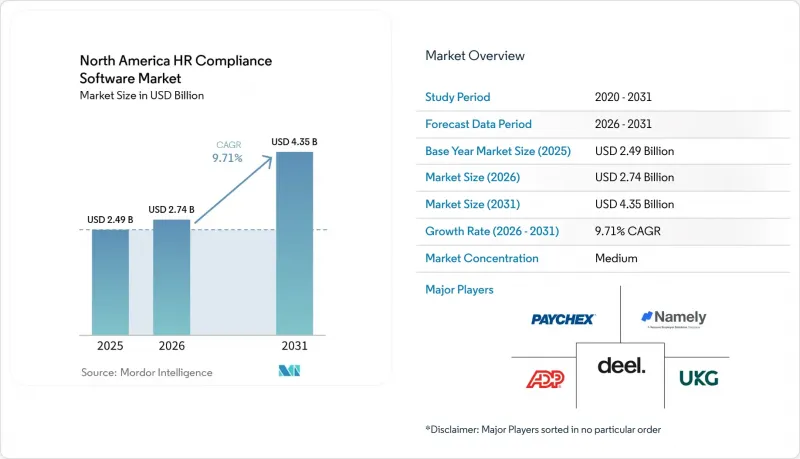
Mordor Intelligence에 의하면, 북미의 인사 컴플라이언스 소프트웨어 시장 규모는 2025년에 24억 9,000만 달러로 평가되었고, 2031년까지 43억 5,000만 달러에 이를 것으로 예측되며, 2026-2031년 CAGR 9.71%를 기록할 전망입니다.
본 보고서는 기능별(근태 관리 및 규정 준수, 급여 계산, 핵심 HR 등), 도입 형태별(클라우드, 온프레미스, 하이브리드), 조직 규모별(대기업, 중소기업), 최종 사용자 산업별(은행/금융서비스/보험 등) 및 지역별로 분류되어 있습니다. 시장 전망치는 금액(달러)으로 표시되어 있습니다.
북미의 인사 컴플라이언스 소프트웨어 시장 동향 및 인사이트
여러 주에 걸쳐 발생하는 임금, 휴가, 급여 투명성과 관련된 복잡성이 커지고 있습니다.
북미의 인사 컴플라이언스 소프트웨어 시장은 고용주가 여러 관할 구역에 걸쳐 추적해야 하는 규제 변경 사항이 늘어나면서 계속해서 성장세를 보이고 있습니다. ADP는 2026 회계연도 3분기 보고서에서 2026년 연초 몇 달 동안만 해도 미국에서 200건 이상의 인사 관련 규정 준수 법안이 제정되었다고 밝혔으며, 이는 여러 주에서 사업을 영위하는 고용주들에게 법적 기준이 얼마나 급속도로 변화하고 있는지를 여실히 보여주고 있습니다. Mitratech의 보고서에 따르면, 54%의 조직이 지난 2년 동안 규정 준수 요구 사항이 증가했다고 응답했으며, 75%는 해당 기간 동안 규정 준수 체계가 변화했다고 응답했는데, 이는 단순한 단기적인 활동의 급증에 그치지 않음을 뒷받침합니다. 해당 보고서에서는 급여 투명성에 관한 법률 및 데이터 개인정보 보호 요건이, 인사 부서가 비공식적인 추적이 아닌 반복 가능한 프로세스를 통해 관리해야 할 필요가 생긴, 확대되는 의무의 일부라고 지적하고 있습니다. 북미의 인사 컴플라이언스 소프트웨어 시장에서 규제 관리는 여전히 구매 결정의 핵심 요소로 자리 잡고 있습니다. 이는 고용주가 의무를 파악하고, 업데이트 내용을 기록하며, 여러 사업장에 걸친 규정 준수 조치의 증거를 보관할 수 있는 시스템이 필요하기 때문입니다. 또한, 정책 변경을 채용 공고 심사, 직원 통지, 급여 조정 등 후속 워크플로우와 연계할 수 있는 플랫폼의 가치도 높아지고 있습니다.
중소기업에서의 ‘클라우드 퍼스트’ 방식의 컴플라이언스 자동화 도입
북미의 인사 컴플라이언스 소프트웨어 시장에서는 수작업에 따른 규정 준수 유지 비용이 증가하는 반면, 소프트웨어에 대한 접근성이 높아짐에 따라 중소규모 고용주들 사이에서 도입이 가속화되고 있습니다. Gusto사는 2026년 4월, 미국에서 50만 개 이상의 중소기업에 서비스를 제공하고 있으며, 이들 고객사는 이미 급여 계산, 세액 공제, 규정 준수, 인사 관리 분야에서 해당 회사의 플랫폼에 의존하고 있다고 발표했습니다. 이는 컴플라이언스 소프트웨어가 중소기업의 업무 흐름에서 주류로 자리 잡았음을 보여줍니다. 또한, Gusto사는 중소기업의 규정 준수 격차를 해소하기 위해 Mosey사를 인수했습니다. 이는 각 공급업체들이 주 및 지방 자치단체의 규정 준수를 부수적인 서비스가 아닌 직접적인 비즈니스 기회로 인식하고 있음을 강조하는 것입니다. Paychex는 2026 회계연도 3분기 매출이 18억 달러에 달했다고 보고하며, 고객들이 급변하는 환경 속에서 규정 준수에 있어 매우 중요한 복잡한 인사 및 인력 관련 과제를 해결하기 위해 자사의 자문 및 복리후생 솔루션에 대한 의존도를 높이고 있다고 밝혔습니다. 이러한 경향이 중요한 이유는 북미 인사 컴플라이언스 소프트웨어 시장이 대기업과의 계약을 통해서만 확대되고 있는 것은 아니기 때문입니다. 사내 컴플라이언스 담당자가 제한적인 소규모 고용주를 대상으로 한 구독 모델을 통해서도 사업을 확장하고 있습니다. 그 결과, 중소기업의 소프트웨어 도입은 자동 업데이트 제공, 명확한 업무 표시, 급여 계산, 등록, 신고, 알림 등을 단일 워크플로우로 통합하는 기능과 점점 더 밀접하게 연결되고 있습니다.
기존 HRIS 및 급여 계산 시스템과의 통합 과정에서 발생하는 문제점
통합 지연은 북미의 인사 컴플라이언스 소프트웨어 시장에 여전히 큰 걸림돌이 되고 있습니다. 특히, 여러 인사 및 급여 계산 시스템을 병행하여 계속 운영하고 있는 대기업에서 이러한 현상이 두드러집니다. Mitratech사는 규정 준수 인프라의 취약점을 파악했습니다. 많은 조직이 여전히 분산된 시스템, 수작업에 의존하는 프로세스, 비공식적인 조정에 의존하고 있어, 정책 변경 사항을 일관된 업무 절차에 반영하기가 어려워지고 있습니다. 이러한 단편화가 문제가 되는 이유는 컴플라이언스 소프트웨어가 급여 계산, 입사 절차, 본인 확인, 근태 관리 시스템에서 수작업으로 반복적으로 수정할 필요 없이 정확한 데이터를 확보해야만 비로소 적절하게 기능하기 때문입니다. WorkBright는 200개 이상의 HR 시스템과 연동할 수 있도록 플랫폼을 확장함으로써 이러한 과제를 해결했으며, 신속한 도입과 광범위한 연동 기능이 제품 가치 그 자체의 일부임을 입증했습니다. ADP가 자사의 광범위한 HCM 스택에 WorkForce Software의 기능을 추가한 것도, 이와 유사한 문제를 지적하고 있습니다. 이는 기업의 구매 담당자들이 여전히 대규모 환경 전반에 걸쳐 인력 관리, 급여 계산, 규정 준수 업무 간의 보다 긴밀한 연계가 필요하기 때문입니다. 북미 인사 컴플라이언스 소프트웨어 시장에서는 통합 작업의 부담을 줄여주는 공급업체들이 계속해서 빠르게 시장을 장악하는 반면, 막대한 맞춤 설정이 필요한 플랫폼은 판매 주기가 길어지거나 도입이 지연될 가능성이 있습니다.
부문별 분석
2025년 매출액 중 HR 규정 준수 및 규제 관리가 56.41%를 차지했으며, 북미 HR 규정 준수 소프트웨어 시장에서 가장 큰 기능 분야로 부상했습니다. 이러한 우위는 고용주가 연방, 주, 지방 각 수준의 제도 하에서 적용되는 규정을 파악하고, 개정 사항을 추적하며, 기록을 보관하고, 조치에 대한 증거를 제시하기 위해 사용하는 기반 시스템으로서의 역할을 반영합니다. ADP에 따르면, 2026년 첫 몇 달 동안 미국에서 200건 이상의 인사 관련 법안이 제정되었습니다. 이는 수작업에 의한 확인에 의존하지 않고도 법 개정에 발맞출 수 있는 핵심 시스템의 필요성을 뒷받침하는 것입니다. 실제로, 이러한 법적 기반이 이미 체계화되어 최신 상태로 유지될 때 다른 기능들이 가장 효과적으로 작동하기 때문에 규제 관리는 대부분의 구매 결정에서 계속해서 핵심적인 위치를 차지하고 있습니다.
근태 관리의 컴플라이언스 분야는 2031년까지 연평균 성장률(CAGR) 10.54%로 확대될 것으로 예상되며, 북미 인사 컴플라이언스 소프트웨어 업계에서 가장 빠르게 성장하는 기능으로 자리매김하고 있습니다. 이 분야의 성장은 시간제 근로, 근무 교대 변경, 원격 입사 절차 및 자격 심사에 관한 정확한 기록을 유지해야 한다는 고용주에 대한 압박이 커지고 있는 것과 밀접한 관련이 있습니다. ADP가 2025년 11월에 WorkForce Software를 인수함에 따라, 해당 회사의 플랫폼 제품군에 고급 근태 규정 준수 및 스케줄링 기능이 추가되었습니다. 이는 주요 벤더들이 이 워크플로우를 단순한 부가 모듈이 아닌 전략적 성장 분야로 간주하고 있음을 보여줍니다. WorkBright를 통한 I-9 및 E-Verify 규정 준수 자동화 역시, 근태 관리, 채용 준비, 감사 추적이 단일 운영 프로세스 내에서 점점 더 통합되고 있음을 보여줍니다. 급여 계산, 핵심 HR, 기타 규정 준수를 중시하는 도구들도 여전히 중요하지만, 가장 강력한 성장은 고용주가 직면한 일상적인 기록 관리 부담과 밀접하게 관련된 기능 쪽으로 향하고 있습니다.
2025년, 북미 인사 컴플라이언스 소프트웨어 시장에서 클라우드가 67.89%의 점유율을 차지했습니다. 이는 대부분의 구매자가 로컬에서 패치를 적용하지 않고도 규칙과 워크플로를 업데이트할 수 있는 제공 모델을 선호한다는 사실을 뒷받침합니다. 그 매력은 명백합니다. 급여 계산, 휴가, 채용, 서류 작성 등 끊임없이 변화하는 사항에 대응해야 하는 고용주에게는 최소한의 개입으로 항상 최신 상태를 유지할 수 있는 시스템이 필요하기 때문입니다. 또한, 규정 준수 대응 업무는 급여 담당자, 관리자, 재택근무 직원, 외부 심사 담당자 등 다양한 주체가 관여하기 때문에 클라우드 기반 서비스는 현재 많은 인사팀의 업무 방식에 부합하고 있습니다. 이에 따라 북미 인사 컴플라이언스 소프트웨어 시장은 업데이트를 신속하게 반영하고, 연동된 전체 워크플로우에서 데이터를 시각화할 수 있는 플랫폼을 중시하는 추세가 지속되고 있습니다.
하이브리드형은 2031년까지 연평균 성장률(CAGR) 11.18%를 나타낼 것으로 예측되며, 이는 많은 기업들이 기존의 급여 계산 및 인사 핵심 시스템을 완전히 교체하기보다는 여전히 단계적인 접근 방식을 선호하고 있음을 보여줍니다. 이러한 경우, 구매자는 기밀성이 높은 기록이나 고도의 맞춤 설정을 위해 기존 시스템을 유지하면서, 규제 관리, 문서 워크플로우, 분석을 위해 클라우드 계층을 추가하는 경우가 많습니다. Rippling의 2026년 1월 업데이트에는 캐나다 연말 세금 신고에 대한 네이티브 지원 및 면세 처리 기능 등이 포함되어 있으며, 이는 클라우드 도구가 얼마나 더 경직된 아키텍처보다 신속하게 지역별 규정 변경 사항을 적용할 수 있는지를 보여줍니다. 엄격한 내부 통제가 요구되는 환경에서는 온프레미스 방식도 여전히 중요하지만, 북미의 인사 컴플라이언스 소프트웨어 업계는 핵심 시스템의 안정성과 보다 신속한 규정 준수 업데이트 주기를 결합한 모델로 전환되고 있습니다. 따라서 클라우드가 여전히 매출액 면에서 압도적인 우위를 유지하고 있음에도 불구하고, 하이브리드형이 기세를 더해가고 있는 것입니다.
기타 혜택 :
- 엑셀 형식 시장 예측(ME) 시트
- 3개월간의 애널리스트 지원
자주 묻는 질문
목차
제1장 서론
제2장 조사 방법
제3장 주요 요약
제4장 시장 구도
제5장 시장 규모 및 성장 예측
제6장 경쟁 구도
제7장 시장 기회 및 향후 전망
LSH 26.06.24According to Mordor Intelligence, the north america hR compliance software market size was valued at USD 2.49 billion in 2025 and is projected to reach USD 4.35 billion by 2031, registering a CAGR of 9.71% during 2026-2031.
This report is Segmented by Functionality (Time and Attendance Compliance, Payroll Processing, Core HR, and More), Deployment Mode (Cloud, On-Premise, and Hybrid), Organization Size (Large Enterprises, and Small and Medium-Sized Enterprises), End-User Industry (Banking, Financial Services and Insurance, and More), and Geography. The Market Forecasts are Provided in Terms of Value (USD).
North America HR Compliance Software Market Trends and Insights
Rising Multi-State Wage, Leave, and Pay-Transparency Complexity
The North America HR Compliance Software market continues to gain momentum amid the growing volume of rule changes employers must track across multiple jurisdictions. ADP stated in its Q3 fiscal 2026 filing that more than 200 HR-related compliance laws were enacted across the United States in the opening months of 2026 alone, underscoring how quickly the legal baseline is evolving for employers with operations in more than one state. Mitratech reported that 54% of organizations said their compliance needs had increased over the prior 2 years, and 75% said their compliance posture had changed during that period, which reinforces that this is not a short-term spike in activity. The same report pointed to pay transparency laws and data privacy requirements as part of the expanding set of obligations that HR teams are now expected to manage through repeatable processes rather than informal tracking. In the North America HR Compliance Software market, regulatory management remains central to buying decisions, as employers need a system that maps obligations, logs updates, and preserves evidence of compliance actions across locations. It also increases the value of platforms that connect policy changes with downstream workflows, such as job posting reviews, employee notices, and payroll adjustments.
Cloud-First Compliance Automation Adoption Among Small and Medium-Sized Enterprises
The North America HR Compliance Software market is seeing faster adoption among smaller employers because the cost of staying compliant through manual methods is rising, while access to software is becoming easier. Gusto said in April 2026 that it serves more than 500,000 small businesses in the United States, and that those customers already rely on the platform for payroll, tax credits, compliance, and HR, showing how compliance software has moved into the mainstream of small-business workflows. Gusto also acquired Mosey to close the compliance gap for small businesses, underscoring how vendors view state and local compliance as a direct product opportunity rather than an adjacent service. Paychex reported fiscal third-quarter 2026 revenue of USD 1.8 billion and said clients are increasingly relying on its advisory and benefits solutions to navigate complex, compliance-critical HR and workforce challenges in a dynamic environment. That pattern matters because the North America HR Compliance Software market is not expanding only through large enterprise contracts; it is also expanding through subscription models that serve smaller employers with limited internal compliance staff. As a result, software adoption among SMEs is increasingly tied to the ability to deliver updates automatically, present clear tasks, and combine payroll, registrations, filings, and alerts into a single workflow.
Legacy HRIS and Payroll Integration Friction
Integration debt remains a meaningful brake on the North America HR Compliance Software market, especially in large organizations that still run several HR and payroll systems side by side. Mitratech identified a compliance infrastructure gap, where many organizations continue to rely on fragmented systems, manual processes, and informal coordination, making it harder to translate policy changes into consistent operational steps. That fragmentation matters because compliance software only works well when it can draw clean data from payroll, onboarding, identity, and time systems without repeated manual fixes. WorkBright responded to this friction by expanding its platform to work with more than 200 HR systems, demonstrating that implementation speed and connector breadth are part of the product value itself. ADP's addition of WorkForce Software capabilities into its broader HCM stack also points to the same issue, since enterprise buyers still need stronger links between workforce management, payroll, and compliance tasks across large environments. For the North America HR Compliance Software market, vendors that reduce integration effort will continue to win faster, while platforms that require heavy custom work may see longer sales cycles and slower rollouts.
Other drivers and restraints analyzed in the detailed report include:
- Remote and Hybrid Work Expanding Jurisdictional Exposure
- AI-Enabled Audit Readiness and Compliance Analytics
- Employee Data Privacy and Sovereignty Concerns
For complete list of drivers and restraints, kindly check the Table Of Contents.
Segment Analysis
HR Compliance and Regulatory Management accounted for 56.41% of 2025 revenue, making it the largest functionality in the North America HR Compliance Software market. That lead reflects its role as the base system employers use to identify applicable rules, track updates, store records, and show evidence of action across federal, state, provincial, and local frameworks. ADP said more than 200 HR-related laws were enacted across the United States in the first months of 2026, which supports the need for a core system that can keep pace with legal change without relying on manual review. In practice, this keeps regulatory management at the center of most buying decisions because other functions work best when that legal baseline is already organized and up to date.
Time and Attendance Compliance is projected to expand at a 10.54% CAGR through 2031, which makes it the fastest-growing functionality in the North America HR Compliance Software industry. Growth in this area is tied to rising pressure on employers to maintain accurate records for hourly work, shift changes, remote onboarding, and eligibility checks. ADP's November 2025 acquisition of WorkForce Software added advanced time-and-attendance compliance and scheduling capabilities to its platform suite, indicating that major vendors view this workflow as a strategic growth area rather than a peripheral module. WorkBright's compliance automation for I-9 and E-Verify also illustrates how attendance, hiring readiness, and audit trails are increasingly integrated within a single operating process. Payroll Processing, Core HR, and other compliance-focused tools continue to matter, but the strongest growth is moving toward functions that sit closer to the daily recordkeeping burden employers face.
Cloud held 67.89% of the North America HR Compliance Software market share in 2025, which confirms that most buyers prefer delivery models that can update rules and workflows without local patching. The appeal is straightforward, since employers dealing with constant payroll, leave, hiring, and documentation changes need a system that stays current with minimal intervention. Cloud delivery also aligns with how many HR teams now work, as compliance actions often span payroll staff, managers, remote employees, and external reviewers. This keeps the North America HR Compliance Software market oriented toward platforms that can push updates quickly and keep data visible across connected workflows.
Hybrid is projected to grow at a 11.18% CAGR through 2031, indicating that many enterprises still prefer a staged approach rather than a full replacement of legacy payroll and HR cores. In those accounts, buyers often keep established systems for sensitive records or deep customization while adding cloud layers for regulatory management, document workflows, and analytics. Rippling's January 2026 updates, including native Canadian year-end filing support and tax exemption handling, show how cloud tools can roll out localized compliance changes faster than more rigid architectures. On-premise remains relevant in settings with strict internal controls, but the North America HR Compliance Software industry is moving toward models that combine core system stability with faster compliance refresh cycles. That is why hybrid is gaining momentum even while cloud remains the clear revenue leader.
List of Companies Covered in this Report:
- Automatic Data Processing, Inc.
- Paychex, Inc.
- UKG Inc.
- Dayforce, Inc.
- Paycom Software, Inc.
- Paylocity Holding Corporation
- Gusto, Inc.
- BambooHR LLC
- TriNet Group, Inc.
- Rippling, Inc.
- Deel, Inc.
- Namely, Inc.
- PrismHR, Inc.
- ComplianceHR, LLC
- SixFifty Technologies, LLC
- OnBlick Inc.
- WorkBright, Inc.
- Trak Holdings LLC (HRlogics)
- Compliance Works Inc.
- Vensure Employer Services, Inc.
- Insynctive, Inc.
Additional Benefits:
- The market estimate (ME) sheet in Excel format
- 3 months of analyst support
TABLE OF CONTENTS
1 INTRODUCTION
- 1.1 Study Assumptions and Market Definition
- 1.2 Scope of the Study
2 RESEARCH METHODOLOGY
3 EXECUTIVE SUMMARY
4 MARKET LANDSCAPE
- 4.1 Market Overview
- 4.2 Market Drivers
- 4.2.1 Rising Multi-State Wage, Leave, and Pay-Transparency Complexity
- 4.2.2 Cloud-First Compliance Automation Adoption Among Small and Medium-Sized Enterprises
- 4.2.3 Remote and Hybrid Work Expanding Jurisdictional Exposure
- 4.2.4 AI-Enabled Audit Readiness and Compliance Analytics
- 4.2.5 State AI-in-Hiring Rules Creating New Governance Demand
- 4.2.6 Canada and Mexico Compliance Digitization Expanding Cross-Border Orchestration Needs
- 4.3 Market Restraints
- 4.3.1 Legacy HRIS and Payroll Integration Friction
- 4.3.2 Employee Data Privacy and Sovereignty Concerns
- 4.3.3 Limited Trust in Pure-AI Compliance Recommendations
- 4.3.4 Canada and Mexico Localization Burden for Multi-Jurisdiction Workflows
- 4.4 Industry Value Chain Analysis
- 4.5 Regulatory Landscape
- 4.6 Technological Outlook
- 4.7 Impact of Macroeconomic Factors on the Market
- 4.8 Porter's Five Forces Analysis
- 4.8.1 Threat of New Entrants
- 4.8.2 Bargaining Power of Buyers
- 4.8.3 Bargaining Power of Suppliers
- 4.8.4 Threat of Substitutes
- 4.8.5 Intensity of Competitive Rivalry
5 MARKET SIZE AND GROWTH FORECASTS (VALUE)
- 5.1 By Functionality
- 5.1.1 HR Compliance and Regulatory Management
- 5.1.2 Time and Attendance Compliance
- 5.1.3 Payroll Processing
- 5.1.4 Core HR
- 5.1.5 Other Functionalities
- 5.2 By Deployment Mode
- 5.2.1 Cloud
- 5.2.2 On-premise
- 5.2.3 Hybrid
- 5.3 By Organization Size
- 5.3.1 Large Enterprises
- 5.3.2 Small and Medium-Sized Enterprises
- 5.4 By End-user Industry
- 5.4.1 Banking, Financial Services and Insurance
- 5.4.2 Healthcare and Life Sciences
- 5.4.3 Information Technology and Telecommunications
- 5.4.4 Manufacturing
- 5.4.5 Retail and E-commerce
- 5.4.6 Government and Public Sector
- 5.4.7 Other End-User Industries
- 5.5 By Geography
- 5.5.1 United States
- 5.5.2 Canada
- 5.5.3 Mexico
6 COMPETITIVE LANDSCAPE
- 6.1 Market Concentration
- 6.2 Strategic Moves
- 6.3 Market Share Analysis
- 6.4 Company Profiles (includes Global Level Overview, Market Level Overview, Core Segments, Financials as available, Strategic Information, Market Rank/Share, Products and Services, Recent Developments)
- 6.4.1 Automatic Data Processing, Inc.
- 6.4.2 Paychex, Inc.
- 6.4.3 UKG Inc.
- 6.4.4 Dayforce, Inc.
- 6.4.5 Paycom Software, Inc.
- 6.4.6 Paylocity Holding Corporation
- 6.4.7 Gusto, Inc.
- 6.4.8 BambooHR LLC
- 6.4.9 TriNet Group, Inc.
- 6.4.10 Rippling, Inc.
- 6.4.11 Deel, Inc.
- 6.4.12 Namely, Inc.
- 6.4.13 PrismHR, Inc.
- 6.4.14 ComplianceHR, LLC
- 6.4.15 SixFifty Technologies, LLC
- 6.4.16 OnBlick Inc.
- 6.4.17 WorkBright, Inc.
- 6.4.18 Trak Holdings LLC (HRlogics)
- 6.4.19 Compliance Works Inc.
- 6.4.20 Vensure Employer Services, Inc.
- 6.4.21 Insynctive, Inc.
7 MARKET OPPORTUNITIES AND FUTURE OUTLOOK
- 7.1 White-space and Unmet-Need Assessment


