

|
시장보고서
상품코드
2097472
인사 컴플라이언스 소프트웨어 : 시장 점유율 분석, 업계 동향 및 통계, 성장 예측(2026-2031년)HR Compliance Software - Market Share Analysis, Industry Trends & Statistics, Growth Forecasts (2026 - 2031) |
||||||
 Mordor Intelligence
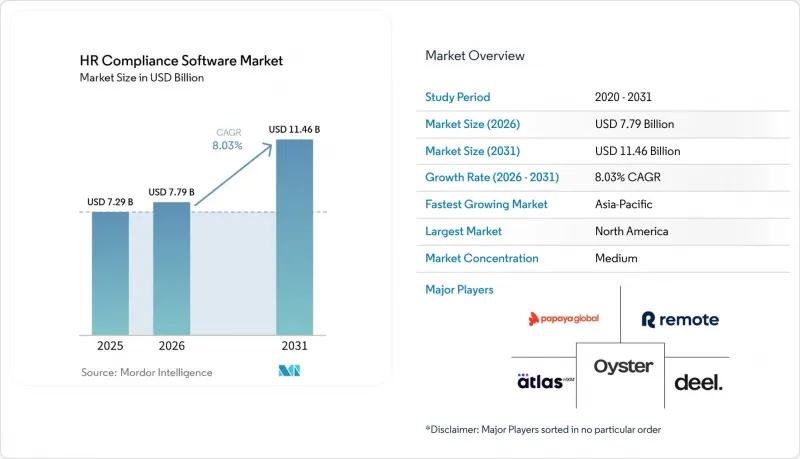
Mordor Intelligence에 의하면, 인사 컴플라이언스 소프트웨어 시장 규모는 2025년 72억 9,000만 달러로 평가되었습니다. 2026년에는 77억 9,000만 달러로 확대되어 2031년까지 114억 6,000만 달러에 이를 것으로 예상되고 2026년부터 2031년에 걸쳐 CAGR 8.03%로 성장할 전망입니다.
본 보고서는 기능별(인사 규정 준수 및 규제 관리, 근태 관리 규정 준수 등), 도입 형태별(클라우드 기반, On-Premise형 등), 기업 규모별(중소기업, 대기업), 최종 사용자 산업별(은행/금융서비스/보험 등) 및 지역별로 분류되어 있습니다. 시장 전망은 금액(달러) 기준으로 제시되어 있습니다.
세계의 인사 컴플라이언스 소프트웨어 시장 동향 및 인사이트
여러 관할 구역에 걸친 노동 및 세무 문제의 복잡화 심화
2026년에는 30개국 이상이 법정 최저임금 인상을 시행할 예정이며, 미국에서는 30개 주 및 준주에서 연방 정부가 정한 최저임금 수준을 상회하는 최저임금이 설정되었고, 각각 다른 시행일과 산정 규칙이 마련되었습니다. 인사 규정 준수 소프트웨어 시장에서 중복되는 의무가 확대됨에 따라, 관할 구역 추적은 가끔 이루어지는 법적 검토가 아닌 일상적인 업무 과제가 되었습니다. Strada Global의 보고서에 따르면, 2025년에는 주요 경제권 전반에서 급여 계산의 복잡성이 사상 최고 수준에 도달했습니다. 그 요인으로는 실시간 보고 의무, 근로자 분류 변경, 그리고 임금 기준액 개정이 꼽힙니다. 규제가 복잡해짐에 따라 스프레드시트, 알림, 컨설턴트 주도 모니터링에 드는 비용은 자동화 비용보다 더 빠르게 증가하고 있습니다. 이러한 변화가 중요한 이유는 HR 규정 준수 소프트웨어 시장의 구매자들이 규제 관리를 백오피스의 부가 기능이 아닌 핵심 운영 인프라로 인식하게 되었기 때문입니다. Remote사의 조사에 따르면, 2025년에는 인사 담당 임원의 51%가 새로운 통합형 규정 준수 플랫폼을 적극적으로 찾았으며, 그 주된 이유로 다국적 규제 관리를 꼽았습니다.
중소기업의 클라우드 도입 가속화
영국 정부의 2024년 조사에 따르면, 중소기업 고용주의 69%가 사업 운영 관리에 기술이나 웹 기반 소프트웨어를 활용하고 있었습니다. 인사 컴플라이언스 소프트웨어 시장에서 소프트웨어에 대한 수용도가 높아짐에 따라 클라우드 기반 컴플라이언스 도구의 판매 주기가 단축되고 있습니다. 이는 몇년전과 비교해 필요한 업무상의 변경 사항이 줄어들었기 때문입니다. Mosey사의 2025년 조사에 따르면, 전용 컴플라이언스 플랫폼을 도입한 조직은 불과 37%에 그쳤으며, 55%는 여전히 적어도 일부 컴플라이언스 추적에 스프레드시트를 사용하고 있었습니다. 이러한 격차로 인해, 일반적인 업무는 디지털화되었으나 규제 관리는 디지털화되지 않은 기업들 사이에서 인사 컴플라이언스 소프트웨어 시장에는 큰 전환의 여지가 남아 있습니다. 또한 Mosey사의 보고서에 따르면, 2025년 외부 규정 준수 컨설턴트, 법률 고문, 회계사에게 지출된 연간 평균 비용은 2만 5,000달러였으며, 이 금액이 SaaS 구독 비용을 초과하는 경우가 적지 않습니다. ISG사의 2025년 조사에 따르면, 완전히 통합된 인사 생태계는 사일로화된 시스템에 비해 투자 수익률(ROI)이 거의 2배에 달하는 것으로 밝혀졌으며, 이는 성장 중인 고용주들 사이에서 플랫폼 통합이 진행되고 있음을 뒷받침합니다.
국경을 넘는 데이터 개인정보 보호 및 주권과 관련된 복잡성
HR 규정 준수 소프트웨어 시장은 국경을 넘는 데이터 개인정보 보호와 관련해 뿌리 깊은 마찰점에 직면해 있습니다. 이는 GDPR(EU 개인정보보호규정)이 각국의 규정을 통일된 기준으로 대체하는 것이 아니라, 그 규정들과 상호 작용하기 때문입니다. 이러한 구조로 인해 공급업체는 국가별로 저장, 전송 및 보유 논리를 조정해야 하므로 다국적 도입이 더욱 어려워지고 있습니다. 독일 연방노동법원은 적절한 법적 근거 없이 클라우드 기반 HR 시스템을 통해 직원 데이터를 전송하는 고용주는 손해배상 책임을 질 수 있음을 명확히 했습니다. 베트남 최초의 AI법은 2026년 3월에 시행되며, 기존의 데이터 현지화 규정에 더해 외국 기술 공급업체에 대한 거버넌스 의무가 추가되었습니다. HR 규정 준수 소프트웨어 시장에서 이러한 주권 관련 요건은 인프라 및 법무 비용을 증가시켜, 클라우드 공급업체가 일반적으로 의존하는 규모의 경제 효과를 약화시키고 있습니다. 고용주는 여전히 소프트웨어가 필요하지만, 보고 방식, 보존 기간, 상담 의무가 관할권마다 여전히 다르기 때문에 많은 경우 법률 자문의 지원도 필요로 합니다.
부문 분석
2025년, HR 규정 준수 및 규제 관리는 매출의 36.51%를 차지하며, 기능 그룹 중 HR 규정 준수 소프트웨어 시장에서 가장 큰 점유율을 기록했습니다. 이러한 우위는 새로운 관할 구역에 진출하는 고용주에게 기반층으로서의 역할을 수행하기 때문입니다. 인접한 모듈이 부가가치를 창출하기 전에, 일반적으로 규정 라이브러리, 제출 로직, 업데이트 모니터링이 이미 구축되어 있기 때문입니다. 또한, 정부가 변조 방지 기능을 갖추고 접근성이 더 높은 근로 시간 기록 시스템의 도입을 추진함에 따라, 인사 규정 준수 소프트웨어 시장에서는 ‘근태 관리 규정 준수’에 대한 수요도 견조한 추세를 보였습니다. 스페인은 2026년, 노동 감독관을 위한 상호 운용 가능한 기록을 의무화하는 디지털 근로시간 등록령을 제정했습니다. 독일에서는 2027년 1월까지 ‘Beitragsverfahrensverordnung(사회보험료 절차 규정)’에 따라 완전히 전자화된 임금 서류가 의무화될 예정이며, 이로 인해 근태 기록과 급여 명세가 밀접하게 연계될 것입니다.
2026년, 미국 노동부가 기존의 독립 계약자 규정을 폐지하고 개정된 ‘경제적 실체 테스트’로 대체할 것을 제안함에 따라, 인사 컴플라이언스 소프트웨어 업계에서 ‘근로자 분류 및 고용 적격성’의 중요성이 급부상했습니다. 이러한 변화로 인해 다수의 계약자를 보유한 조직은 여러 사업 부문에 걸친 지위, 문서 및 감사 위험을 재검토해야만 했습니다. '규정 준수 교육 및 정책 관리' 분야도 정책의 신속한 작성 및 변호사의 검토를 거친 템플릿 모델의 도입을 통해 법적 감독을 저해하지 않으면서 업데이트 부담을 줄일 수 있었기 때문에 혜택을 보았습니다. 복리후생 관리 및 문서 규정 준수는 2031년까지 연평균 성장률(CAGR) 8.69%를 나타낼 것으로 예측되며, HR 규정 준수 소프트웨어 시장의 이 부문은 급여 구성 요소 및 복리후생을 보다 세분화된 형태로 보고해야 할 필요성에 의해 주도되고 있습니다. KPMG는 EU의 임금 투명성 지침에 따라 고용주가 보고 시 기본급, 변동급, 복리후생을 구분해야 할 의무가 있는 반면, 일부 회원국에서는 고정된 템플릿보다 사용자 정의가 가능한 시스템을 우선시하는 더 엄격한 국내 규정을 계속 적용할 가능성이 있다고 지적하고 있습니다.
2025년에는 On-Premise 도입이 매출의 57.29%를 차지한 것으로 나타나, 인사 규정 준수 소프트웨어 시장에는 여전히 레거시 급여 계산 시스템이나 ERP 시스템과 연계된 대규모 도입 기반이 존재함을 보여줍니다. 이러한 상황은 클라우드 모델에 대한 관심 부족이라기보다는 데이터 소재지 요건, 감사 추적의 연속성 필요성, 그리고 통합상의 제약을 반영한 것입니다. Strada Global은 2025년에도 전 세계 기업의 40% 가까이가 여전히 레거시 On-Premise형 플랫폼을 이용했으며, 통합의 어려움과 예산 압박이 전환을 지연시키고 있다고 지적했습니다. 실제로 많은 고용주들은 기밀성이 높은 급여 기록을 사내에 보관하면서, 규정 모니터링 및 보고 워크플로를 벤더 관리 환경으로 이전하는 하이브리드 모델을 채택하고 있습니다. 이러한 중간적인 접근 방식을 통해 도입 기업은 규제가 활발하게 변화하는 상황에서도 완전한 전환에 따른 위험을 감수하지 않고, 의존하고 있는 HR 규정 준수 소프트웨어의 아키텍처를 현대화할 수 있습니다.
클라우드 기반 도입은 2031년까지 연평균 성장률(CAGR) 9.41%로 성장할 것으로 예측되며, 인사 규정 준수 소프트웨어 시장에서 가장 빠르게 성장하는 도입 모델이 되고 있습니다. ISG는 2025년 조사에서 전 세계 조직의 69%에서 SaaS 또는 하이브리드 클라우드 아키텍처가 인사 기술의 핵심을 형성하고 있음을 밝혔습니다. 이 점이 중요한 이유는 컴플라이언스 소프트웨어가 빈번한 컨텐츠 및 규칙 업데이트에 의존하고 있으며, 이러한 업데이트는 기업 주도의 패치 적용보다 중앙 집중화된 릴리스 주기를 통해 제공하는 것이 더 쉽기 때문입니다. 중소기업이 이러한 성장의 상당 부분을 주도하고 있습니다. 중소기업은 대개 인프라에 대한 매몰 비용이 없으며, 규정 준수 자동화를 별도로 구매하기보다는 HR 소프트웨어의 번들 기능의 일부로 기대하는 경향이 강해지고 있기 때문입니다. 지역별 개인정보 보호 규정 및 AI 관련 문서화 의무는 여전히 클라우드 공급업체에게 걸림돌이 되고 있지만, 데이터 처리를 지역에 맞게 최적화할 수 있는 공급업체는 규정 준수 설계를 경쟁 우위로 전환해 나가고 있습니다.
지역별 분석
2025년, 북미는 매출의 34.22%를 차지하며 인사 규정 준수 소프트웨어 시장에서 가장 규모가 큰 지역이 되었습니다. 미국은 여전히 주요 견인차 역할을 하고 있습니다. 주 차원에서 고용법이 연간 600회 이상 개정되기 때문에 여러 주에 직원을 두고 있는 고용주에게 있어 수작업에 의한 모니터링은 더 이상 유지하기 어려운 상황이 되었기 때문입니다. 캘리포니아주, 뉴욕주, 콜로라도주, 코네티컷주에서는 임금, 휴가 및 고용 분야에서 AI 활용에 관한 가장 엄격한 규정 중 일부가 제정되어, 단일 국가 내에서도 규정 준수 대상 범위가 광범위하게 적용되고 있습니다. Paychex는 2025년 7월 SixFifty를 인수하여, 고용법 대응 자동화 기능을 자사의 급여 계산 및 인사 서비스군과 통합함으로써 해당 지역에서의 입지를 강화했습니다. 그 후, 2026년 2월 미국 노동부가 새로운 독립 계약자 관련 규정안을 제시함에 따라 많은 고용주가 분류 관리를 재검토해야 하는 상황에 직면했고, 인사 규정 준수 소프트웨어에 대한 관심이 다시 높아졌습니다.
유럽은 계속해서 인사 규정 준수 소프트웨어의 지역별 시장 규모에서 2위를 유지하고 있으며, 영국, 독일, 프랑스가 주요 수익원으로 자리 잡고 있습니다. 직원 수가 150명 이상인 고용주는 EU 임금 투명성 지침에 따라 2026년 직원 데이터를 바탕으로 2027년 6월 7일까지 첫 번째 남녀 간 임금 격차 보고서를 제출해야 합니다. 이는 현재 주기에서 가장 명확한 지출 기한 중 하나입니다. 독일 노동법원이 인사 데이터 이전에 관한 규정을 엄격히 적용하고, 스페인이 근무 시간 디지털 기록 요건을 강화함에 따라, EU 기준과 마찬가지로 각국의 국내 규정도 중요한 요소로 대두되고 있습니다. 이에 대응하여 SD Worx는 2026년 4월, 유럽 여러 국가에서 ‘Legal Watch’를 출시하여 규제 모니터링을 해당 지역의 인사 규정 준수 소프트웨어 시장 내 상용 제품으로 전환했습니다.
아시아태평양은 2031년까지 연평균 성장률(CAGR) 9.02%로 성장할 것으로 예측되며, 인사 규정 준수 소프트웨어 시장에서 가장 빠르게 성장하는 지역 부문이 될 전망입니다. 싱가포르는 2025년에 직장 내 형평성에 관한 지침을 강제력 있는 법률로 격상시켰고, 한국은 2026년 3월에 직장 내 AI 활용에 관한 3자 협의 절차를 시작했으며, 베트남은 2026년 3월부터 시행될 최초의 AI법을 제정했습니다. ADP는 2025년 12월, 페어워크법(Fair Work Act), 싱글 터치 페이롤(Single Touch Payroll), 국세청(ATO) 요건을 준수하도록 설계된 기능을 갖춘 ‘Lyric HCM’을 호주 및 뉴질랜드에 출시하며, 각 벤더들이 지역에 적합한 제품을 현지화하고 있음을 보여주었습니다. 남미, 중동 및 아프리카는 여전히 인사 규정 준수 소프트웨어 시장에서 비교적 작은 비중을 차지하고 있지만, 브라질의 노동 디지털화, UAE의 임금 보호, 사우디아라비아의 ‘사우디화’ 정책이 계속해서 특정 수요를 창출하고 있습니다.
기타 혜택 :
- 엑셀 형식 시장 예측(ME) 시트
- 3개월간의 애널리스트 지원
자주 묻는 질문
목차
제1장 서론
제2장 조사 방법
제3장 주요 요약
제4장 시장 구도
제5장 시장 규모 및 성장 예측
제6장 경쟁 구도
제7장 시장 기회 및 향후 전망
KTH 26.08.05According to Mordor Intelligence, the HR compliance software market size is expected to increase from USD 7.29 billion in 2025 to USD 7.79 billion in 2026 and reach USD 11.46 billion by 2031, growing at a CAGR of 8.03% over 2026-2031.
This report is Segmented by Functionality (HR Compliance and Regulatory Management, Time and Attendance Compliance, and More), Deployment Mode (Cloud-Based, On-Premises, and More), Organization Size (Small and Medium-Sized Enterprises, and Large Enterprises), End-User Industry (Banking, Financial Services and Insurance, and More), and Geography. The Market Forecasts are Provided in Terms of Value (USD).
Global HR Compliance Software Market Trends and Insights
Rising Multi-Jurisdiction Labor and Tax Complexity
More than 30 countries raised statutory minimum wage floors in 2026, and the United States had 30 states plus territories with minimums above the federal floor, each with separate effective dates and calculation rules. In the HR compliance software market, the spread of overlapping obligations has made jurisdiction tracking a daily operational task rather than an occasional legal review. Strada Global reported record payroll complexity across major economies in 2025, driven by real-time reporting mandates, changes in worker classification, and revised wage thresholds. As rule sets multiply, the cost of spreadsheets, reminders, and consultant-led monitoring rises faster than the cost of automation. That shift matters because buyers in the HR compliance software market are now treating regulatory management as core operating infrastructure rather than a back-office add-on. Remote found that 51% of HR leaders were actively looking for a new integrated compliance platform in 2025, with multi-country regulatory management cited as the main reason.
Accelerating SME Cloud Adoption
The UK Government found in 2024 that 69% of SME employers were using technology or web-based software to manage business operations. In the HR compliance software market, broader software comfort shortens the sales cycle for cloud compliance tools because the operational change required is lower than it was a few years ago. Mosey found in 2025 that only 37% of organizations had a dedicated compliance platform, while 55% still used spreadsheets for at least some compliance tracking. That mismatch leaves the HR compliance software market with a large conversion pool among firms that have digitized general operations but not regulatory control. Mosey also reported average annual spending of USD 25,000 on external compliance consultants, legal advisors, and accountants in 2025, a level that often exceeds the cost of a SaaS subscription. ISG found in 2025 that fully integrated HR ecosystems delivered nearly twice the return on investment of siloed systems, which supports platform consolidation among growing employers.
Cross-Border Data Privacy and Sovereignty Complexity
The HR compliance software market faces a durable friction point in cross-border data privacy because GDPR interacts with national rules rather than replacing them with a uniform standard. That structure makes multinational deployment more difficult, since vendors must tailor storage, transfer, and retention logic by country. Germany's Federal Labor Court clarified that employers who transfer employee data through cloud-based HR systems without an adequate legal basis may face liability for damages. Vietnam's first AI law took effect in March 2026 and added governance duties for foreign technology vendors alongside existing data localization rules. In the HR compliance software market, these sovereignty requirements increase infrastructure and legal costs, weakening the scale advantage that cloud vendors typically rely on. Employers still need software, but they often need legal advisory support as well because reporting methods, retention windows, and consultation duties continue to vary across jurisdictions.
Other drivers and restraints analyzed in the detailed report include:
- AI-Driven Payroll Error Detection
- Regulated-Industry HR Digitization
- High Switching Costs From Legacy ERP-Linked Payroll
For complete list of drivers and restraints, kindly check the Table Of Contents.
Segment Analysis
HR Compliance and Regulatory Management accounted for 36.51% of revenue in 2025, giving this module the largest share of the HR compliance software market among functionality groups. Its lead came from its role as the base layer for employers entering new jurisdictions, since rule libraries, filing logic, and update monitoring are usually in place before adjacent modules add value. The HR compliance software market also saw steady demand for Time and Attendance Compliance as governments pushed for tamper-resistant and more accessible working-time records. Spain advanced a digital working-time registration decree in 2026 that required interoperable records for labor inspectors. Germany will require fully electronic wage documentation under the Beitragsverfahrensverordnung by January 2027, which keeps attendance records and payroll evidence closely linked.
Worker Classification and Employment Eligibility gained urgency in the HR compliance software industry during 2026 after the U.S. Department of Labor proposed rescinding the prior independent contractor rule and replacing it with a revised economic reality test. That change pushed organizations with large contractor pools to review status, documentation, and audit exposure across multiple business units. Compliance Training and Policy Management also benefited from faster policy generation and attorney-reviewed template models that lowered update friction without removing legal oversight. Benefits Administration and Document Compliance is projected to grow at an 8.69% CAGR through 2031, and this segment of the HR compliance software market is being driven by the need to report pay components and benefits in more disaggregated forms. KPMG noted that the EU Pay Transparency Directive requires employers to separate base pay, variable pay, and benefits in reporting, while member states may still apply stricter national rules that favor configurable systems over fixed templates.
On-premises deployment accounted for 57.29% of revenue in 2025, indicating that the HR compliance software market still has a large installed base tied to legacy payroll and ERP systems. This position reflects data residency demands, audit-trail continuity needs, and integration constraints rather than a lack of interest in cloud models. Strada Global said in 2025 that nearly 40% of global businesses remained on legacy on-premises platforms, with integration difficulty and budget pressure slowing migration. In practice, many employers are using hybrid models that keep sensitive payroll records in-house while shifting rule monitoring and reporting workflows into vendor-managed environments. That middle path lets buyers modernize the HR compliance software market architecture they depend on without taking full cutover risk during active regulatory change.
Cloud-based deployment is projected to grow at a 9.41% CAGR through 2031, making it the fastest-moving deployment model in the HR compliance software market. ISG found in 2025 that SaaS or hybrid cloud architectures formed the HR technology core for 69% of organizations globally. That matters because compliance software depends on frequent content and rules updates, which are easier to deliver through centralized release cycles than through enterprise-managed patching. SMEs are pushing much of this growth because they often lack sunk infrastructure costs and increasingly expect compliance automation as part of bundled HR software rather than as a separate purchase. Regional privacy rules and AI documentation duties still raise the bar for cloud vendors, but providers that can localize data handling are turning compliance design into a competitive advantage.
Complete Report Scope:
- By Functionality
- HR Compliance and Regulatory Management
- Time and Attendance Compliance
- Benefits Administration and Document Compliance
- Worker Classification and Employment Eligibility
- Compliance Training and Policy Management
- Other Functionalities
- By Deployment Mode
- Cloud-Based
- On-Premises
- Hybrid
- By Organization Size
- Small and Medium-Sized Enterprises
- Large Enterprises
- By End-User Industry
- Banking, Financial Services and Insurance
- Healthcare and Life Sciences
- Information Technology and Telecommunications
- Manufacturing
- Retail and E-commerce
- Government and Public Sector
- Other End-User Industries
- By Geography
- North America
- United States
- Canada
- Mexico
- South America
- Brazil
- Argentina
- Chile
- Rest of South America
- Europe
- United Kingdom
- Germany
- France
- Italy
- Spain
- Russia
- Rest of Europe
- Asia-Pacific
- China
- Japan
- India
- South Korea
- Australia and New Zealand
- Rest of Asia-Pacific
- Middle East
- United Arab Emirates
- Saudi Arabia
- Turkey
- Rest of Middle East
- Africa
- South Africa
- Nigeria
- Rest of Africa
- North America
Geography Analysis
North America accounted for 34.22% of revenue in 2025, making it the largest geography in the HR compliance software market. The United States remains the central driver because employment law changes more than 600 times each year at the state level, making manual monitoring unsustainable for employers with multi-state workforces. California, New York, Colorado, and Connecticut have enacted some of the most stringent rules on wages, leave, and AI use in employment, which keeps the compliance scope wide even within a single country. Paychex strengthened its regional position when it acquired SixFifty in July 2025 and combined employment law automation with its payroll and HR services stack. The U.S. Department of Labor then proposed a new independent contractor rule in February 2026, prompting many employers to review classification controls and sparking renewed interest in HR compliance software.
Europe remained the second-largest regional market for HR compliance software, with the United Kingdom, Germany, and France as major revenue drivers. Employers with 150 or more workers must submit their first gender pay gap reports by June 7, 2027, using 2026 workforce data under the EU Pay Transparency Directive, which has created one of the clearest spending deadlines in the current cycle. National layers matter as much as the EU baseline because Germany's labor court tightened rules on HR data transfers and Spain advanced digital working-time registration requirements. SD Worx responded in April 2026 by launching Legal Watch across several European countries, turning regulatory monitoring into a commercial product inside the regional HR compliance software market.
Asia-Pacific is projected to expand at a 9.02% CAGR through 2031, making it the fastest-growing regional segment in the HR compliance software market. Singapore moved workplace fairness from guidance to enforceable law in 2025, South Korea opened a tripartite process on AI use in workplaces in March 2026, and Vietnam enacted its first AI law, effective from March 2026. ADP extended Lyric HCM into Australia and New Zealand in December 2025 with design features tied to Fair Work, Single Touch Payroll, and Inland Revenue requirements, showing how vendors are localizing product fit for the region. South America, the Middle East, and Africa remain smaller parts of the HR compliance software market, but labor digitization in Brazil, wage protection in the UAE, and Saudization in Saudi Arabia continue to create targeted demand.
- Atlas Technology Solutions, Inc.
- Cezanne HR Limited
- ComplianceHR
- Deel Inc.
- Emtrain, Inc.
- Employment Hero Pty Ltd.
- EVERYDAY SOFTWARE, S.L.
- Hi Bob Limited
- Mitratech Holdings, Inc.
- Multiplier Technologies Pte. Ltd.
- Namely, Inc.
- Neeyamo Enterprise Solution Private Limited
- Oyster HR, Inc.
- Papaya Global Ltd.
- PayFit SAS
- Personio SE & Co. KG
- Remote Technology Services, Inc.
- Rippling People Center Inc.
- SixFifty Technologies, LLC
- VirgilHR, Inc.
Additional Benefits:
- The market estimate (ME) sheet in Excel format
- 3 months of analyst support
TABLE OF CONTENTS
1 INTRODUCTION
- 1.1 Study Assumptions and Market Definition
- 1.2 Scope of the Study
2 RESEARCH METHODOLOGY
3 EXECUTIVE SUMMARY
4 MARKET LANDSCAPE
- 4.1 Market Overview
- 4.2 Market Drivers
- 4.2.1 Rising Multi-Jurisdiction Labor and Tax Complexity
- 4.2.2 Accelerating SME Cloud Adoption
- 4.2.3 AI-Driven Payroll Error Detection
- 4.2.4 Regulated-Industry HR Digitization
- 4.2.5 EU Pay Transparency Readiness Spending
- 4.2.6 AI-In-Employment Governance Requirements
- 4.3 Market Restraints
- 4.3.1 Cross-Border Data Privacy and Sovereignty Complexity
- 4.3.2 High Switching Costs From Legacy ERP-Linked Payroll
- 4.3.3 AI Decision Explainability and Record-Retention Burden
- 4.3.4 Rule Change Velocity Outpacing Vendor Release Cycles
- 4.4 Industry Value Chain Analysis
- 4.5 Regulatory Landscape
- 4.6 Technological Outlook
- 4.7 Impact of Macroeconomic Factors on the Market
- 4.8 Porter's Five Forces Analysis
- 4.8.1 Threat of New Entrants
- 4.8.2 Bargaining Power of Buyers
- 4.8.3 Bargaining Power of Suppliers
- 4.8.4 Threat of Substitutes
- 4.8.5 Industry Rivalry
5 MARKET SIZE AND GROWTH FORECASTS (VALUE)
- 5.1 By Functionality
- 5.1.1 HR Compliance and Regulatory Management
- 5.1.2 Time and Attendance Compliance
- 5.1.3 Benefits Administration and Document Compliance
- 5.1.4 Worker Classification and Employment Eligibility
- 5.1.5 Compliance Training and Policy Management
- 5.1.6 Other Functionalities
- 5.2 By Deployment Mode
- 5.2.1 Cloud-Based
- 5.2.2 On-Premises
- 5.2.3 Hybrid
- 5.3 By Organization Size
- 5.3.1 Small and Medium-Sized Enterprises
- 5.3.2 Large Enterprises
- 5.4 By End-User Industry
- 5.4.1 Banking, Financial Services and Insurance
- 5.4.2 Healthcare and Life Sciences
- 5.4.3 Information Technology and Telecommunications
- 5.4.4 Manufacturing
- 5.4.5 Retail and E-commerce
- 5.4.6 Government and Public Sector
- 5.4.7 Other End-User Industries
- 5.5 By Geography
- 5.5.1 North America
- 5.5.1.1 United States
- 5.5.1.2 Canada
- 5.5.1.3 Mexico
- 5.5.2 South America
- 5.5.2.1 Brazil
- 5.5.2.2 Argentina
- 5.5.2.3 Chile
- 5.5.2.4 Rest of South America
- 5.5.3 Europe
- 5.5.3.1 United Kingdom
- 5.5.3.2 Germany
- 5.5.3.3 France
- 5.5.3.4 Italy
- 5.5.3.5 Spain
- 5.5.3.6 Russia
- 5.5.3.7 Rest of Europe
- 5.5.4 Asia-Pacific
- 5.5.4.1 China
- 5.5.4.2 Japan
- 5.5.4.3 India
- 5.5.4.4 South Korea
- 5.5.4.5 Australia and New Zealand
- 5.5.4.6 Rest of Asia-Pacific
- 5.5.5 Middle East
- 5.5.5.1 United Arab Emirates
- 5.5.5.2 Saudi Arabia
- 5.5.5.3 Turkey
- 5.5.5.4 Rest of Middle East
- 5.5.6 Africa
- 5.5.6.1 South Africa
- 5.5.6.2 Nigeria
- 5.5.6.3 Rest of Africa
- 5.5.1 North America
6 COMPETITIVE LANDSCAPE
- 6.1 Market Concentration
- 6.2 Strategic Moves
- 6.3 Market Share Analysis
- 6.4 Company Profiles (includes Global Level Overview, Market Level Overview, Core Segments, Financials as available, Strategic Information, Market Rank/Share, Products and Services, Recent Developments)
- 6.4.1 Atlas Technology Solutions, Inc.
- 6.4.2 Cezanne HR Limited
- 6.4.3 ComplianceHR
- 6.4.4 Deel Inc.
- 6.4.5 Emtrain, Inc.
- 6.4.6 Employment Hero Pty Ltd.
- 6.4.7 EVERYDAY SOFTWARE, S.L.
- 6.4.8 Hi Bob Limited
- 6.4.9 Mitratech Holdings, Inc.
- 6.4.10 Multiplier Technologies Pte. Ltd.
- 6.4.11 Namely, Inc.
- 6.4.12 Neeyamo Enterprise Solution Private Limited
- 6.4.13 Oyster HR, Inc.
- 6.4.14 Papaya Global Ltd.
- 6.4.15 PayFit SAS
- 6.4.16 Personio SE & Co. KG
- 6.4.17 Remote Technology Services, Inc.
- 6.4.18 Rippling People Center Inc.
- 6.4.19 SixFifty Technologies, LLC
- 6.4.20 VirgilHR, Inc.
7 MARKET OPPORTUNITIES AND FUTURE OUTLOOK
- 7.1 White-Space and Unmet-Need Assessment


