
|
시장보고서
상품코드
2073604
비료 시장 : 점유율 분석, 업계 동향과 통계, 성장 예측(2026-2031년)Fertilizers - Market Share Analysis, Industry Trends & Statistics, Growth Forecasts (2026 - 2031) |
||||||
 Mordor Intelligence
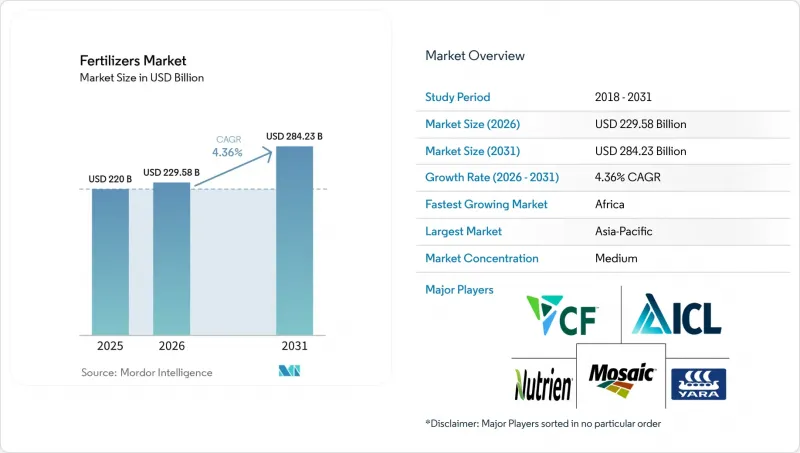
Mordor Intelligence에 의하면, 비료 시장 규모는 2025년 2,200억 달러, 2026년 2,295억 8,000만 달러에서 2031년까지 2,842억 3,000만 달러로 확대한다고 예측되고 있어 2026년부터 2031년까지 연평균 복합 성장률(CAGR)은 4.36%를 나타낼 전망입니다.
본 보고서는 유형별(복합비료 및 단일비료), 형태별(기존 및 특수형), 시비 방법별(시비 관개, 엽면 시비, 토양 시비), 작물 유형별(밭작물, 원예작물, 잔디 및 관상용 작물), 지역별(북미, 남미, 유럽, 아시아태평양, 중동 및 아프리카)로 분류되어 있습니다. 시장 전망은 금액(달러) 및 수량(미터톤) 단위로 제시되어 있습니다.
세계 비료 시장 동향과 인사이트
정밀 농업 프로젝트로 인한 비료 수요의 급증
정밀 농업에서는 전지구위성항법시스템(GNSS), 토양 센서, 머신러닝 알고리즘을 통합하여 작물이 영양분을 필요로 하는 장소와 시기에만 비료를 시비합니다. 이러한 목표 지향적인 접근 방식을 통해, 미국에서 실시된 옥수수 시험 재배에서 부셸당 질소 사용량이 감소하여, 비용 절감과 아산화질소(N₂O) 배출량 감축으로 이어지고 있습니다. 농장 통합이 진행되고, 신뢰성 높은 통신 환경이 갖춰지며, 가변 시비율 제어 장치를 탑재한 대형 농기계의 도입이 촉진되는 지역에서는 이 기술의 도입이 가속화되고 있습니다. 농기계 제조업체들이 살포기나 비료 살포기에 농업용 소프트웨어를 탑재함에 따라, 생산자들은 밭마다 맞춤형 처방전에 따라 방출 조절 비료나 액체 비료를 요구하고 있습니다. 그 결과 발생하는 수요 견인 효과로 인해 북미 및 서유럽 전역에서 특수 영양소 수요가 꾸준히 증가하고 있으며, 중국과 브라질에서도 유사한 추세가 나타나기 시작하고 있습니다. 2시즌 이내에 투자 회수가 가능하다는 사실이 입증됨에 따라, 소규모 생산자들에게도 투자의 타당성이 더욱 강화되었으며, 마이크로존에 맞춘 디지털 농업 및 영양소 조합에 대한 총 잠재 시장이 확대되고 있습니다.
기후를 고려한 영양 관리 정책으로의 전환
비료 생산과 농경지에서의 배출이 모두 농업에서 발생하는 온실가스 배출에 크게 기여하고 있기 때문에 각국 정부는 기후 변화 대책 공약에 양분 관리를 포함시키고 있습니다. 유럽연합(EU)의 “농장에서 식탁까지(Farm to Fork)” 전략은 2030년까지 비료 사용량을 20% 감축하는 것을 목표로 하고 있는 반면, 인도는 “지속 가능한 농업을 위한 국가적 사명”에 따라 균형 잡힌 비료 시비를 추진하고 있습니다. 이러한 규제로 인해 영양분의 방출을 지연시키고 휘발을 억제하는 질산화 억제제, 우레아제 억제제, 그리고 고분자 코팅 요소에 대한 수요가 증가하고 있습니다. 중국의 지침에 따르면, 비료를 구매하기 전에 토양 검사를 실시해야 하며, 일률적인 시비에서 정밀 시비로 전환하는 추세가 가속화되고 있습니다. 고효율 제품을 공급할 수 있는 제조업체는 가격 결정력을 확보하는 반면, 규제 지역에서는 범용 등급의 대량 생산품은 가격 하락 압력에 직면해 있습니다. 장기적으로는 탄소 회계 체계의 통합을 통해, 반영된 배출량을 기준으로 공급업체 간의 차별화가 더욱 심화되어, 저탄소 질소 생산 경로의 전략적 가치가 강화될 가능성이 있습니다.
확대되는 유기농업의 재배 면적
유기농업의 재배 면적이 확대됨에 따라 합성 질소계 비료 수요는 크게 감소하고 있는 반면, 유기비료, 바이오비료 및 퇴비 수요는 증가하고 있습니다. 유기농산물에 대한 소비자의 선호도가 높아짐에 따라 인증을 받은 농지 면적이 확대되고 있으며, 해당 농지에서는 합성 영양소의 사용이 금지되어 있습니다. 유럽연합(EU)의 ‘유기농업 행동계획(2021-2030)”는 “농장에서 식탁까지(Farm to Fork)” 전략의 중요한 구성 요소이며, 2030년까지 농지의 최소 25%를 유기농으로 경작하겠다는 목표 달성을 목표로 하고 있습니다. 유기농업은 188개국에서 실천되고 있으며, 2024년 기준으로 9,600만 헥타르 이상의 농지가 최소 450만 명의 농가에 의해 유기적으로 관리되고 있습니다. 유기농으로 전환되는 1헥타르마다 화학비료의 잠재 시장 규모가 축소되게 되며, 이는 기술로는 만회할 수 없는 구조적인 역풍이 되고 있습니다. 유기농 농장의 헥타르당 수확량은 낮은 편이지만, 프리미엄 가격 책정이 경작 면적 증가 추세를 뒷받침하며, 고소득 지역에서의 장기적인 수요를 억제하고 있습니다.
부문별 분석
유종별로는 단일 비료가 여전히 가장 큰 부문을 차지하고 있으며, 2025년에는 전 세계 비료 시장 점유율의 63.0%를 차지했습니다. 이러한 우위는 작물 생산 시스템이 여전히 질소, 인, 칼륨 등 각 영양소를 개별적으로 시비하는 방식에 의존하고 있기 때문입니다. 이 부문에서는 질소 비료가 가장 큰 판매량을 차지하고 있으며, 요소, 무수 암모니아, 질산암모늄 등의 제품이 주요 농업 지역 전반에서 수요를 주도하고 있습니다. 국제비료협회(IFA)에 따르면, 2024년 전 세계 요소 생산량은 2억 100만 메트르톤에 달하고, 2023년 대비 3% 증가했습니다. 중국에서는 새로운 생산 설비가 가동됨에 따라 2026년까지 요소 생산량이 7,650만 메트르톤에 달할 것으로 전망됩니다. 인산이암모늄, 인산이암모늄, 단과인산, 삼과인산 등의 인산계 비료는 조달 비용 상승에도 불구하고, 작물의 생육에 여전히 필수적인 역할을 하고 있습니다. 염화칼륨을 비롯한 칼륨계 비료는 생산 능력 확대에 힘입어 안정적인 수요를 지속적으로 유지하고 있습니다. 또한, 이 부문에는 2차 영양소와 미량 영양소도 포함되어 있으며, 미량 영양소 중에서는 아연이 가장 큰 비중을 차지하고 있고, 붕소의 경우 집약적 재배 시스템에서의 사용이 증가하고 있습니다.
복합비료는 유형별로는 가장 빠르게 성장할 것으로 예상되는 부문으로, 2026년부터 2031년까지 연평균 성장률(CAGR) 5.8%를 기록하며 시장 전체의 성장률을 상회할 것으로 전망됩니다. 이러한 비료는 여러 가지 영양소를 하나의 배합으로 조합함으로써 작물의 영양 균형을 촉진하는 동시에, 시비 과정을 간소화하고 필요한 노동력을 줄여줍니다. 특히 생산성 측면에서 영양분 이용 효율이 매우 중요한 원예, 플랜테이션 및 기타 고부가가치 작물 시스템에서 그 도입이 확대되고 있습니다. 유럽에서는 영양염 감축 목표와 지속가능성 노력을 배경으로, 시비량을 줄이면서도 영양염 이용 효율을 높이는 고농도 복합비료의 사용이 장려되고 있습니다. 또한, 정밀 농업 기술, 가변 시비 시스템, 토양에 맞춘 영양 관리 기법의 도입 확대가 균형 잡힌 비료 제품에 대한 수요를 뒷받침하고 있습니다. 생산자들이 수확량 극대화와 비료 효율 향상에 주력하는 가운데, 복합비료는 단일 영양소 제품을 대체할 유망한 대안으로 부상하며, 예측 기간 동안 꾸준한 성장을 뒷받침하고 있습니다.
기존 비료는 가장 주류를 이루는 형태이며, 2025년 비료 시장 규모의 88.5%를 차지하고 있지만, 규제가 엄격한 지역의 생산자들은 수확량을 희생하지 않고도 환경 목표를 달성할 수 있는 고효율 형태로 점차 전환하고 있습니다. 이러한 제품은 일반적으로 코팅되지 않은 과립 또는 펠릿 형태이며, 살포기를 사용하여 살포되거나 경작 시 토양에 혼합됩니다. 영양소의 이용 가능성은 토양 수분, 온도, 미생물의 활동 등의 요인에 따라 달라집니다. 제조 비용이 저렴하고 기존 농기계와의 호환성이 높기 때문에 곡물, 유지종자, 사탕수수 등 가격에 민감한 시장에서 기존 제품은 여전히 널리 보급되고 있습니다. 한편, 기존 제품은 사용량에 대한 규제상의 제한과 영양소의 유출에 대한 환경적 우려로 인해 점점 더 어려운 상황에 직면하고 있습니다. 이 때문에 비용에 민감한 부문에서도 고효율 대체 제품으로의 전환이 서서히 진행되고 있습니다.
특수 비료 시장은 2026년부터 2031년까지 연평균 성장률(CAGR) 6.3%로 성장할 것으로 전망됩니다. 이러한 성장은 영양소의 이용 효율을 높이고 노동력을 절감하는 서방형, 지연형, 액상, 수용성 제제의 도입에 힘입어 이루어지고 있습니다. 폴리머나 유황으로 코팅된 방출 조절 비료는 토양 온도와 수분 함량에 따라 영양분을 방출하므로, 영양분 공급을 작물 수요에 맞출 수 있으며, 기존 비료에 비해 침출로 인한 손실을 20%에서 40%까지 줄여줍니다. 요소 포름알데히드나 이소부틸리덴디우레아 등의 화학 물질을 함유한 방출 조절 비료는 영양분의 방출이 장기간 지속되어 비용 대비 효과가 높은 대안을 제공하므로, 잔디나 관상용 식물에 시비하기에 적합합니다. 액체 비료는 북미와 유럽에서 눈부신 성장을 보이고 있으며, 대규모 농장에서는 기존의 분무 시스템에 통합하여 엽면 시비나 스타터 시비에 활용함으로써 균일한 살포와 식물의 신속한 영양분 흡수를 보장하고 있습니다.
지역별 분석
아시아태평양은 가장 규모가 큰 지역 부문으로, 2025년에는 비료 시장 점유율의 52.3%를 차지할 것으로 예상되며, 중국과 인도가 이를 주도하고 있습니다. 중국의 국내 요소 생산 능력은 2024년에 8,045만 메트르톤을 넘어섰으며, 안정적인 공급이 확보되어 있습니다. 그러나 구형 석탄 화력 발전 시설은 배출 규제 강화에 직면할 가능성이 있어 가동 중단으로 이어질 우려가 있는 반면, 탄소 포집 기술을 갖춘 연안 지역의 가스 화력 발전소에게는 사업 기회가 될 수 있습니다. 인도에서는 농업부의 보고에 따르면, 2023-24 회계연도의 연간 비료 소비 총량은 약 6,010만 메트르톤이었습니다. 이 중 5,030만 메트르톤은 국내에서 생산되었고, 1,770만 메트르톤은 수입되었습니다. 동남아시아에서는 팜유, 쌀, 고무 농장이 수요를 주도하고 있습니다. 또한, 인도네시아의 정유업체들은 지속가능성 인증 요건을 충족하기 위해 대규모 논에서 방출 조절 비료의 혼합 시험을 진행하고 있습니다.
아프리카에서는 2031년까지 연평균 성장률(CAGR)이 6.2%를 기록하며 가장 높은 성장세를 보일 것으로 전망됩니다. 사하라 이남 아프리카의 비료 수요는 농업의 현대화, 인구 증가, 그리고 식량 자급 달성을 위한 정부의 이니셔티브에 의해 형성되고 있습니다. 이 지역의 비료 시비량은 세계 평균보다 훨씬 낮은 수준이며, 인프라 개선과 가격 관련 문제가 해결된다면 상당한 성장 여지가 있을 것으로 보입니다. 이 지역 최대의 경제 대국인 나이지리아와 남아프리카공화국은 수입 의존도를 낮추고 가격을 안정시키기 위해 국내 생산 능력 확충에 주력하고 있습니다. 또한 에티오피아, 케냐, 탄자니아에서는 벌크 요소와 인산이암모늄(DAP)을 수입하여, 커피, 차, 옥수수 등 현지 작물에 맞춘 독자적인 NPK 비율의 비료를 제조하기 위한 배합 시설을 확충하고 있습니다. 중동에서는 사우디아라비아, 아랍에미리트, 튀르키예 등의 국가들이 건조한 기후와 제한된 경작지 면적 때문에 농업 성장이 제약을 받고 있어, 국내 생산 능력과 수입을 병행하여 비료 수요를 충족시키고 있습니다. 튀르키예는 전략적인 지리적 위치 덕분에 유럽, 아시아, 아프리카를 가로지르는 비료 무역의 물류 허브로서의 입지를 확고히 하고 있습니다.
유럽에서는 엄격한 영양염 규제와 에너지 비용의 급등에 직면해 있으며, 이로 인해 일반 비료의 출하량은 감소하는 반면, 특수 비료의 이익률은 향상되고 있습니다. 동유럽 시장, 특히 우크라이나와 러시아는 계속해서 요소, 질산암모늄, 칼륨의 주요 수출국으로 자리 잡고 있습니다. 그러나 지정학적 불안정과 수출 규제로 인해 무역 흐름이 혼란을 겪으면서, 출하량은 아시아와 아프리카로 전환되고 있습니다. 영국에서는 브렉시트 이후의 농업 정책이 환경 친화적인 토지 관리에 중점을 두고 있으며, 보조금은 생산 지원에서 생태계 서비스로 전환되고 있습니다. 이러한 변화로 인해 기존 비료 수요에는 더욱 큰 압박이 가해지는 반면, 유기 비료나 생장 촉진제 제품에는 새로운 기회가 생겨나고 있습니다. 프랑스와 스페인의 농작물 생산자들은 곡물 생산량을 줄이지 않으면서도 질소 제한 규정을 준수하기 위해 정밀 살포기에 투자하고 있으며, 이로 인해 억제제 코팅 제품에 대한 수요가 증가하고 있습니다.
기타 혜택:
- 엑셀 형식 시장 예측(ME) 시트
- 3개월간의 애널리스트 지원
자주 묻는 질문
목차
제1장 서론
제2장 개 보고서의 내용
제3장 주요 요약 및 주요 조사 결과
제4장 주요 업계 동향
제5장 시장 규모와 성장 예측
제6장 경쟁 구도
제7장 비료 업계 CEO가 직면하는 중요 전략적 과제
JHS 26.07.09According to Mordor Intelligence, the fertilizers market size is projected to expand from USD 220.00 billion in 2025 and USD 229.58 billion in 2026 to USD 284.23 billion by 2031, registering a CAGR of 4.36% between 2026 and 2031.
This report is Segmented by Type (Complex and Straight), by Form (Conventional and Specialty), by Application Mode (Fertigation, Foliar, and Soil), by Crop Type (Field Crops, Horticultural Crops, and Turf and Ornamental), and by Geography (North America, South America, Europe, Asia-Pacific, Middle East and Africa). The Market Forecasts are Provided in Terms of Value (USD) and Volume (Metric Tons).
Global Fertilizers Market Trends and Insights
Surge in Fertilizer Demand from Precision-Agriculture Projects
Precision agriculture integrates global navigation satellite systems, soil sensors, and machine-learning algorithms to apply nutrients only where and when crops need them. This targeted approach reduces nitrogen use per bushel in United States corn trials, saving money and cutting nitrous oxide emissions. Adoption accelerates where farm consolidation and reliable connectivity support large machinery fleets fitted with variable-rate controllers. As equipment manufacturers embed agronomic software in sprayers and spreaders, growers seek controlled-release and liquid fertilizers that match site-specific prescriptions. The resulting pull effect spurs a steady rise in specialty nutrient demand across North America and Western Europe, with early signs of replication in China and Brazil. Evidence of payback within two seasons strengthens the investment case for smaller producers, widening the total addressable market for digital agronomy and nutrient combinations tailored to micro-zones.
Transition to Climate-Smart Nutrient-Management Policies
Governments embed nutrient stewardship in climate commitments because both fertilizer production and field emissions contribute significantly to agricultural greenhouse gas emissions. The European Union Farm to Fork Strategy targets a 20% cut in fertilizer use by 2030, while India promotes balanced fertilization under the National Mission for Sustainable Agriculture. Such mandates elevate demand for nitrification inhibitors, urease inhibitors, and polymer-coated urea that slow nutrient release and curb volatilization. China's guidelines require soil testing before fertilizer purchase, accelerating the shift from blanket doses to precision prescriptions. Producers capable of supplying enhanced-efficiency products gain pricing power, whereas commodity-grade volume faces downward pressure in regulated regions. Over the long term, harmonized carbon accounting may further differentiate suppliers on embedded emissions, reinforcing the strategic value of low-carbon nitrogen routes.
Growing Organic Farming Acreage
The expansion of organic farming acreage is substantially decreasing the demand for synthetic nitrogen-based fertilizers while increasing the demand for organic fertilizers, biofertilizers, and compost. As consumer preference for organic produce rises, certified farmland grows and prohibits synthetic nutrient inputs. The European Union Organic Action Plan (2021-2030) serves as a fundamental component of the Farm to Fork Strategy, aiming to achieve a target of at least 25% of agricultural land under organic farming by 2030. Organic agriculture is practiced in 188 countries, with over 96 million hectares of agricultural land managed organically by at least 4.5 million farmers as of 2024. Each converted hectare removes volume from the addressable market for chemical fertilizers, constituting a structural headwind that technology cannot offset. Although organic farms often yield less per hectare, their premium pricing sustains the acreage trend and dampens long-term demand in high-income regions.
Other drivers and restraints analyzed in the detailed report include:
- Rapid Adoption of Specialty and Slow-Release Formulations
- Artificial Intelligence Enabled Variable-Rate Application Platforms
- Scarcity of Water for Fertigation in Arid Regions
For complete list of drivers and restraints, kindly check the Table Of Contents.
Segment Analysis
Straight fertilizers remained the largest segment by type and accounted for 63.0% of the global fertilizers market share in 2025. This dominance is attributed to the continued reliance of crop production systems on separate applications of nitrogen, phosphorus, and potassium nutrients. Within this segment, nitrogen fertilizers accounted for the largest volume, with products such as urea, anhydrous ammonia, and ammonium nitrate driving demand across major agricultural regions. According to the International Fertilizer Association, global urea production reached 201 million metric tons in 2024, up 3% compared to 2023. China's urea output is projected to reach 76.5 million metric tons by 2026 as new production capacities become operational. Phosphatic fertilizers, including diammonium phosphate, monoammonium phosphate, single superphosphate, and triple superphosphate, remained critical for crop establishment despite higher procurement costs. Potassic fertilizers, led by muriate of potash, continued to experience stable demand, supported by expanding production capacities. Additionally, the segment encompasses secondary nutrients and micronutrients, with zinc holding the largest share among micronutrients, and boron witnessing increased adoption in intensively cultivated farming systems.
Complex fertilizers are anticipated to be the fastest-growing segment by type, with a projected CAGR of 5.8% from 2026 to 2031, surpassing the overall market growth rate. These fertilizers combine multiple nutrients into a single formulation, promoting balanced crop nutrition while simplifying application processes and reducing labor requirements. Adoption is particularly increasing in horticultural, plantation, and other high-value crop systems where nutrient efficiency is crucial for productivity. In Europe, nutrient reduction targets and sustainability initiatives are driving the use of nutrient-dense formulations that enhance nutrient-use efficiency while lowering application volumes. Furthermore, the growing adoption of precision agriculture technologies, variable-rate application systems, and soil-specific nutrient management practices is bolstering demand for balanced fertilizer products. As growers focus on maximizing yields and improving fertilizer efficiency, complex fertilizers are emerging as a preferred alternative to standalone nutrient products, supporting consistent growth throughout the forecast period.
Conventional fertilizers are the largest form and account for 88.5% of the fertilizers market size in 2025, yet growers in regulated regions are gradually shifting to enhanced-efficiency forms that meet environmental targets without sacrificing yield. These products, generally uncoated granules or prills, are applied using broadcast spreaders or incorporated into the soil during tillage. Nutrient availability depends on factors such as soil moisture, temperature, and microbial activity. Their low production cost and compatibility with existing farming equipment support their continued prevalence in price-sensitive markets, including cereals, oilseeds, and sugarcane. Conventional products are increasingly challenged by regulatory restrictions on application rates and by environmental concerns about nutrient runoff. This has led to a gradual shift toward enhanced-efficiency alternatives, even in cost-sensitive segments.
Specialty fertilizers are projected to grow at a CAGR of 6.3% during the period 2026-2031. This growth is driven by the adoption of controlled-release, slow-release, liquid, and water-soluble formulations, which enhance nutrient-use efficiency and reduce labor requirements. Controlled-release fertilizers, coated with polymers or sulfur, release nutrients based on soil temperature and moisture, aligning nutrient availability with crop demand and reducing leaching losses by 20% to 40% compared to conventional fertilizers. Slow-release fertilizers, formulated with chemicals such as urea-formaldehyde or isobutylidene diurea, provide a cost-effective option with extended nutrient release, making them suitable for turfgrass and ornamental applications. Liquid fertilizers are witnessing significant growth in North America and Europe, where large farms incorporate them into existing sprayer systems for foliar or starter applications, ensuring uniform coverage and rapid nutrient uptake by plants.
Complete Report Scope:
- By Type
- Complex
- Straight
- Micronutrients
- Boron
- Copper
- Iron
- Manganese
- Molybdenum
- Zinc
- Others
- Nitrogenous
- Ammonium Nitrate
- Anhydrous Ammonia
- Urea
- Others
- Phosphatic
- Di-ammonium Phosphate (DAP)
- Mono Ammonium Phosphate (MAP)
- Single Super Phosphate (SSP)
- Triple Superphosphate (TSP)
- Others
- Potassic
- Muriate of Potash (MoP)
- Sulphate of Potash (SoP)
- Others
- Secondary Macronutrients
- Calcium
- Magnesium
- Sulfur
- Micronutrients
- By Form
- Conventional
- Specialty
- Controlled-Release Fertilizer (CRF)
- Liquid Fertilizer
- Slow-Release Fertilizer (SRF)
- Water Soluble
- By Application Mode
- Fertigation
- Foliar
- Soil
- By Crop Type
- Field Crops
- Horticultural Crops
- Turf and Ornamental
- By Geography
- North America
- Canada
- Mexico
- United States
- Rest of North America
- Europe
- France
- Germany
- Italy
- Netherlands
- Russia
- Spain
- Ukraine
- United Kingdom
- Rest of Europe
- Asia-Pacific
- Australia
- Bangladesh
- China
- India
- Indonesia
- Japan
- Pakistan
- Philippines
- Thailand
- Vietnam
- Rest of Asia-Pacific
- South America
- Argentina
- Brazil
- Rest of South America
- Middle East
- Turkey
- Saudi Arabia
- Rest of Middle East
- Africa
- Nigeria
- South Africa
- Rest of Africa
- North America
Geography Analysis
Asia-Pacific is the largest geography segment, accounting for 52.3% of the fertilizers market share in 2025, led by China and India. China's domestic urea production capacity exceeded 80.45 million metric tons in 2024, ensuring a stable supply. However, older coal-based facilities may face stricter emissions regulations, potentially leading to idled operations and creating opportunities for coastal gas-based plants equipped with carbon capture technology. In India, the Ministry of Agriculture reported that total annual fertilizer consumption for 2023-24 was approximately 60.1 million metric tons. Of this, 50.3 million metric tons were produced domestically, while 17.7 million metric tons were imported. In Southeast Asia, demand is driven by palm oil, rice, and rubber plantations. Additionally, Indonesian refiners are testing controlled-release fertilizer blends in large rice paddies to meet sustainability certification requirements.
Africa is projected to record the fastest compound annual growth rate (CAGR) of 6.2% through 2031. Fertilizer demand in Sub-Saharan Africa is shaped by agricultural modernization, population growth, and government efforts to achieve food self-sufficiency. Fertilizer application rates in the region are considerably lower than global averages, indicating significant growth potential as infrastructure improves and affordability challenges are addressed. Nigeria and South Africa, the region's largest economies, are focusing on increasing domestic production capacities to reduce reliance on imports and stabilize prices. Additionally, Ethiopia, Kenya, and Tanzania are expanding blending facilities that import bulk urea and diammonium phosphate (DAP) to create customized NPK ratios tailored to local crops such as coffee, tea, and maize. In the Middle East, countries like Saudi Arabia, the United Arab Emirates, and Turkey combine domestic production capabilities with imports to meet fertilizer demand, as arid climates and limited arable land restrict agricultural growth. Turkey's strategic location positions it as a logistics hub for fertilizer trade across Europe, Asia, and Africa.
Europe confronts stringent nutrient caps and elevated energy costs that curb straight-fertilizer volumes but boost specialty margins. Eastern European markets, particularly Ukraine and Russia, remain key exporters of urea, ammonium nitrate, and potash. However, geopolitical instability and export restrictions have disrupted trade flows, redirecting volumes toward Asia and Africa. In the United Kingdom, post-Brexit agricultural policy focuses on environmental land management, with subsidies transitioning from production support to ecosystem services. This shift has placed additional pressure on conventional fertilizer demand while creating opportunities for organic and biostimulant products. Crop producers in France and Spain invest in precision-spreaders to comply with nitrogen limits without depressing grain output, reinforcing demand for inhibitor-coated products.
- Nutrien Ltd.
- Uralkali PJSC (Uralchem Group)
- The Mosaic Company
- K+S Aktiengesellschaft
- ICL Group Ltd.
- EuroChem Group AG
- CF Industries Holdings, Inc.
- OCP S.A.
- PhosAgro PJSC
- Coromandel International Limited
- Indian Farmers Fertiliser Cooperative Limited (IFFCO)
- Haifa Chemicals Ltd.
- Yara International ASA
- Koch Fertilizer, LLC
- Grupa Azoty S.A. (Compo Expert)
- BHP Group Limited
- Qinghai Salt Lake Industry Co., Ltd.
Additional Benefits:
- The market estimate (ME) sheet in Excel format
- 3 months of analyst support
TABLE OF CONTENTS
1 INTRODUCTION
- 1.1 Study Assumptions and Market Definition
- 1.2 Scope of the Study
- 1.3 Research Methodology
2 REPORT OFFERS
3 EXECUTIVE SUMMARY AND KEY FINDINGS
4 KEY INDUSTRY TRENDS
- 4.1 Acreage of Major Crop Types
- 4.1.1 Field Crops
- 4.1.2 Horticultural Crops
- 4.2 Average Nutrient Application Rates
- 4.2.1 Micronutrients
- 4.2.1.1 Field Crops
- 4.2.1.2 Horticultural Crops
- 4.2.2 Primary Nutrients
- 4.2.2.1 Field Crops
- 4.2.2.2 Horticultural Crops
- 4.2.3 Secondary Macronutrients
- 4.2.3.1 Field Crops
- 4.2.3.2 Horticultural Crops
- 4.2.1 Micronutrients
- 4.3 Agricultural Land Equipped for Irrigation
- 4.4 Regulatory Framework
- 4.5 Value Chain and Distribution Channel Analysis
- 4.6 Market Drivers
- 4.6.1 Surge in fertilizer demand from precision-agriculture projects
- 4.6.2 Transition to climate-smart nutrient-management policies
- 4.6.3 Rapid adoption of specialty and slow-release formulations
- 4.6.4 Capacity expansions in low-cost natural-gas regions
- 4.6.5 Carbon-credit incentives for green ammonia production
- 4.6.6 Artificial intelligence enabled variable-rate application platforms
- 4.7 Market Restraints
- 4.7.1 Volatile feedstock prices
- 4.7.2 Regulatory caps on nitrogen usage in Europe
- 4.7.3 Growing organic farming acreage
- 4.7.4 Scarcity of water for fertigation in arid regions
5 MARKET SIZE AND GROWTH FORECASTS (VALUE AND VOLUME)
- 5.1 By Type
- 5.1.1 Complex
- 5.1.2 Straight
- 5.1.2.1 Micronutrients
- 5.1.2.1.1 Boron
- 5.1.2.1.2 Copper
- 5.1.2.1.3 Iron
- 5.1.2.1.4 Manganese
- 5.1.2.1.5 Molybdenum
- 5.1.2.1.6 Zinc
- 5.1.2.1.7 Others
- 5.1.2.2 Nitrogenous
- 5.1.2.2.1 Ammonium Nitrate
- 5.1.2.2.2 Anhydrous Ammonia
- 5.1.2.2.3 Urea
- 5.1.2.2.4 Others
- 5.1.2.3 Phosphatic
- 5.1.2.3.1 Di-ammonium Phosphate (DAP)
- 5.1.2.3.2 Mono Ammonium Phosphate (MAP)
- 5.1.2.3.3 Single Super Phosphate (SSP)
- 5.1.2.3.4 Triple Superphosphate (TSP)
- 5.1.2.3.5 Others
- 5.1.2.4 Potassic
- 5.1.2.4.1 Muriate of Potash (MoP)
- 5.1.2.4.2 Sulphate of Potash (SoP)
- 5.1.2.4.3 Others
- 5.1.2.5 Secondary Macronutrients
- 5.1.2.5.1 Calcium
- 5.1.2.5.2 Magnesium
- 5.1.2.5.3 Sulfur
- 5.1.2.1 Micronutrients
- 5.2 By Form
- 5.2.1 Conventional
- 5.2.2 Specialty
- 5.2.2.1 Controlled-Release Fertilizer (CRF)
- 5.2.2.2 Liquid Fertilizer
- 5.2.2.3 Slow-Release Fertilizer (SRF)
- 5.2.2.4 Water Soluble
- 5.3 By Application Mode
- 5.3.1 Fertigation
- 5.3.2 Foliar
- 5.3.3 Soil
- 5.4 By Crop Type
- 5.4.1 Field Crops
- 5.4.2 Horticultural Crops
- 5.4.3 Turf and Ornamental
- 5.5 By Geography
- 5.5.1 North America
- 5.5.1.1 Canada
- 5.5.1.2 Mexico
- 5.5.1.3 United States
- 5.5.1.4 Rest of North America
- 5.5.2 Europe
- 5.5.2.1 France
- 5.5.2.2 Germany
- 5.5.2.3 Italy
- 5.5.2.4 Netherlands
- 5.5.2.5 Russia
- 5.5.2.6 Spain
- 5.5.2.7 Ukraine
- 5.5.2.8 United Kingdom
- 5.5.2.9 Rest of Europe
- 5.5.3 Asia-Pacific
- 5.5.3.1 Australia
- 5.5.3.2 Bangladesh
- 5.5.3.3 China
- 5.5.3.4 India
- 5.5.3.5 Indonesia
- 5.5.3.6 Japan
- 5.5.3.7 Pakistan
- 5.5.3.8 Philippines
- 5.5.3.9 Thailand
- 5.5.3.10 Vietnam
- 5.5.3.11 Rest of Asia-Pacific
- 5.5.4 South America
- 5.5.4.1 Argentina
- 5.5.4.2 Brazil
- 5.5.4.3 Rest of South America
- 5.5.5 Middle East
- 5.5.5.1 Turkey
- 5.5.5.2 Saudi Arabia
- 5.5.5.3 Rest of Middle East
- 5.5.6 Africa
- 5.5.6.1 Nigeria
- 5.5.6.2 South Africa
- 5.5.6.3 Rest of Africa
- 5.5.1 North America
6 COMPETITIVE LANDSCAPE
- 6.1 Market Concentration
- 6.2 Strategic Moves
- 6.3 Market Share Analysis
- 6.4 Company Profiles (Includes Global Level Overview, Market Level Overview, Core Segments, Financials as Available, Strategic Information, Market Rank/Share for Key Companies, Products and Services, and Recent Developments)
- 6.4.1 Nutrien Ltd.
- 6.4.2 Uralkali PJSC (Uralchem Group)
- 6.4.3 The Mosaic Company
- 6.4.4 K+S Aktiengesellschaft
- 6.4.5 ICL Group Ltd.
- 6.4.6 EuroChem Group AG
- 6.4.7 CF Industries Holdings, Inc.
- 6.4.8 OCP S.A.
- 6.4.9 PhosAgro PJSC
- 6.4.10 Coromandel International Limited
- 6.4.11 Indian Farmers Fertiliser Cooperative Limited (IFFCO)
- 6.4.12 Haifa Chemicals Ltd.
- 6.4.13 Yara International ASA
- 6.4.14 Koch Fertilizer, LLC
- 6.4.15 Grupa Azoty S.A. (Compo Expert)
- 6.4.16 BHP Group Limited
- 6.4.17 Qinghai Salt Lake Industry Co., Ltd.