|
시장보고서
상품코드
2073613
남미의 미량영양소 비료 시장 : 점유율 분석, 업계 동향과 통계, 성장 예측(2026-2031년)South America Micronutrient Fertilizer - Market Share Analysis, Industry Trends & Statistics, Growth Forecasts (2026 - 2031) |
||||||
 Mordor Intelligence
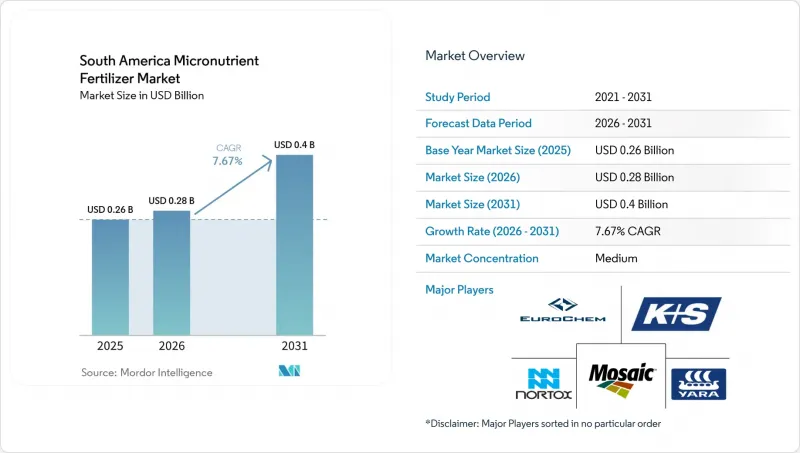
Mordor Intelligence에 의하면, 남미 미량영양소 비료 시장 규모는 2025년에 2억 6,000만 달러로 평가되었고 2026년 2억 8,000만 달러에서 2031년까지 4억 달러에 이를 것으로 예측되며, 예측 기간(2026-2031년) CAGR은 7.67%를 나타낼 전망입니다.
본 보고서는 제품별(붕소, 구리, 철, 망간, 몰리브덴, 아연, 기타), 시비 방법별(비료 관개, 엽면 시비, 토양 시비), 작물 유형별(밭작물, 원예작물, 잔디 및 관상용 작물), 국가별(아르헨티나, 브라질, 기타 남미 국가)로 분류되어 있습니다. 시장 전망은 금액(달러) 및 수량(미터톤) 단위로 제시되어 있습니다.
남미 미량영양소 비료 시장 동향과 인사이트
아연 결핍 토양의 광범위한 존재가 보충 수요를 견인하고 있습니다.
광범위한 토양 조사 결과, 브라질과 아르헨티나 농지의 절반 이상에서 DTPA로 추출 가능한 아연 농도가 임계치를 밑도는 것으로 밝혀졌으며, 지속적인 아연 공급에 대한 구조적인 필요성이 부각되고 있습니다. 이러한 아연 결핍은 아르헨티나의 팜파스 지역만 해도 1,215만 헥타르에 달할 전망입니다. 브라질의 세라두 지역에서는 토양 내 총 아연 함량이 충분해 보일지라도, pH 값이 높은 조건으로 인해 아연의 생물학적 이용률이 더욱 낮아집니다. 그 결과, 단백질과 곡물의 품질이 저하되고 수출 프리미엄이 손실되므로, 생산자들은 아연 보충 프로그램에 투자할 수밖에 없습니다. 일반적으로 최적의 상태를 회복하는 데는 2시즌 이상이 걸립니다. 토양 내 아연의 회복 속도가 완만하기 때문에 예측 가능한 보충 주기가 공급업체의 구매량을 안정적으로 유지해 줍니다. 이러한 결핍 상태의 지속성이 미량영양소 비료 시장의 장기적인 성장을 뒷받침하고 있습니다.
대두 및 옥수수 재배 면적 확대
2025년에 3억 4,100만 메트르톤에 달할 것으로 예상되는 브라질의 기록적인 곡물 수확량은 현재 경작 면적의 4분의 3을 차지하는 대두와 옥수수의 경작 면적이 지속적으로 확대되고 있음을 반영하고 있습니다. 대두는 질소 고정을 촉진함으로써 몰리브덴 수요를 높이지만, 반면 옥수수는 칼륨과 인을 대량으로 흡수하기 때문에 2차적인 아연 및 망간 결핍을 일으키는 경우가 많습니다. 하이브리드 옥수수 품종은 수확량의 잠재력을 최대한 끌어내기 위해 15-20% 더 많은 아연이 필요하며, 이로 인해 헥타르당 미량영양소 수요가 증가하고 있습니다. 변방 지역으로의 진출을 추진하는 아르헨티나 생산자들은 유기물이 부족한 토양에 직면해 있으며, 이로 인해 미량영양소의 고갈이 더욱 심각해지고 있습니다. 현재 미량 원소의 최소 함유량을 규정하는 수출 계약이 체결되어 있는 만큼, 균형 잡힌 영양 관리 프로그램에 대한 상업적 필요성이 더욱 커지고 있습니다. 경작 면적의 확대와 품질 기준의 향상이 맞물려, 미량영양소 비료 시장 전체에서 지속적인 수주를 이끌어내고 있습니다.
소규모 농가의 높은 가격 민감도
브라질과 아르헨티나의 농장 중 약 60%는 100헥타르 미만의 규모로 운영되고 있으며, 이들 중 상당수가 1메트르톤당 약 800달러인 기본 황산염 제제에 의존하고 있는 반면, 킬레이트화된 대체제는 1메트르톤당 2,000달러를 초과하는 경우가 많습니다. 대출 프로그램에서는 NPK 비료가 우선시되기 때문에 미량영양소에 대한 자금 지원은 부족합니다. 협동조합을 통한 공동 구매로 일부 비용은 상쇄되지만, 다양한 토양의 요구 사항을 충족시키기는 어렵습니다. 상품 가격이 하락하면 생산자들은 임의의 투입 자재를 줄이게 되므로, 농업적 ROI가 분명하더라도 킬레이트화된 미량영양소의 도입이 지연되고 맙니다. 따라서 공급업체는 미량영양소 비료 시장에서 입지를 유지하기 위해, 프리미엄 포지셔닝과 합리적인 가격의 보급형 제품 간의 균형을 맞추어야 합니다.
부문별 분석
2025년, 남미의 미량영양소 비료 시장에서 아연은 31.4%를 차지했으며, 2026년부터 2031년까지 연평균 성장률(CAGR) 7.0%를 기록하며 가장 빠른 성장세를 보였습니다. 1,215만 헥타르에 걸친 보충 시비가 시장에서 아연의 지속적인 주도적 지위를 뒷받침하고 있습니다. 수출 계약에 명시된 엄격한 곡물 품질 기준에 힘입어, 아연계 미량영양소 비료에 대한 수요는 꾸준히 확대될 것으로 전망됩니다. 몰리브덴은 시장 규모는 작지만, 대두 재배 면적이 증가함에 따라 질소 고정 효율에 대한 관심이 높아지면서 성장이 가속화되고 있습니다. 구리, 철, 망간은 칠레산 과일, 아르헨티나산 밀, pH 수치가 높은 대두 재배지 등 작물별 특화된 틈새 시장에 대응하고 있습니다. 붕소는 커피나 망고와 같은 개화 작물에서 여전히 필수적입니다. 고도의 킬레이트화 기술, 특히 EDDHA는 가격이 비싸음에도 불구하고 고pH 분야에서 보급이 확대되고 있으며, 이는 염기성 황산염에서 부가가치가 높은 화학제품으로의 전환이 진행 중임을 보여줍니다.
이차 결핍증에 대한 인식이 높아짐에 따라, 생산자들은 숨겨진 수확량 손실을 줄여주는 멀티 미량 원소 혼합제의 도입을 확대되고 있습니다. 아연, 망간, 붕소를 조합한 제품을 공급하는 업체들은 교차 판매를 통해 시너지 효과를 누리고 있습니다. 브라질의 규제 조치로 인해 국내 생산 능력 확대가 가속화되는 가운데, 현지에서 킬레이트제를 생산함으로써 가격 차이가 줄어들고 도입 곡선이 완만해질 가능성이 있습니다. 동시에, 나노캡슐화 및 서방형 제제에 관한 특허 활동은 영양분 이용 효율의 점진적인 향상을 약속하며, 제품 라인업을 한층 더 강화함으로써 장기적인 시장 가치의 성장을 뒷받침하고 있습니다.
기타 혜택:
- 엑셀 형식 시장 예측(ME) 시트
- 3개월간의 애널리스트 지원
자주 묻는 질문
목차
제1장 서론
제2장 개 보고서의 내용
제3장 주요 요약 및 주요 조사 결과
제4장 주요 업계 동향
제5장 시장 규모와 성장 예측
제6장 경쟁 구도
제7장 비료 업계 CEO가 직면하는 중요 전략적 과제
JHS 26.07.09According to Mordor Intelligence, the south america micronutrient fertilizer market size was valued at USD 0.26 billion in 2025 and estimated to grow from USD 0.28 billion in 2026 to reach USD 0.40 billion by 2031, at a CAGR of 7.67% during the forecast period (2026-2031).
This report is Segmented by Product (Boron, Copper, Iron, Manganese, Molybdenum, Zinc, and Others), by Application Mode (Fertigation, Foliar, and Soil), by Crop Type (Field Crops, Horticultural Crops, and Turf and Ornamental), and by Country (Argentina, Brazil, and Rest of South America). The Market Forecasts are Provided in Terms of Value (USD) and Volume (Metric Tons).
South America Micronutrient Fertilizer Market Trends and Insights
Widespread Zinc-Deficient Soils Driving Corrective Demand
Extensive soil tests reveal that more than half of Brazilian and Argentine croplands exhibit DTPA-extractable zinc levels below critical thresholds, underscoring a structural requirement for sustained zinc supplementation . These deficiencies span 12.15 million hectares across the Argentine Pampas alone . High-pH conditions in Brazil's Cerrado further diminish zinc bioavailability, even when total soil zinc appears sufficient. Resulting protein and grain-quality penalties erode export premiums, prompting growers to invest in corrective zinc programs that typically require two or more seasons to restore optimal status. Because soil zinc recovery is slow, a predictable replacement cycle stabilizes purchasing volumes for suppliers. The enduring nature of the deficiency anchors the long-term growth of the micronutrient fertilizer market.
Expansion of Soybean and Corn Acreage
Brazil's record grain harvest, projected at 341 million metric tons for 2025, reflects the continued expansion of soybean and corn acreage that today represents three-quarters of the planted area . Soybeans lift molybdenum demand by facilitating nitrogen fixation, while corn's high uptake of potassium and phosphorus often triggers secondary zinc and manganese deficiencies. Hybrid corn varieties require 15-20% more zinc to realize full yield potential, intensifying per-hectare micronutrient needs. Argentinian growers pushing into marginal lands face soils with lower organic matter, magnifying micronutrient depletion. Export contracts that now specify trace-element minimums reinforce the commercial necessity of balanced nutrient programs. Together, acreage gains and quality standards ignite recurring orders across the micronutrient fertilizer market.
High Price Sensitivity Among Smallholders
Roughly 60% of Brazilian and Argentine farms operate on less than 100 ha, and many rely on basic sulfate formulations costing around USD 800 per metric ton, while chelated alternatives often exceed USD 2,000 per metric ton. Credit programs prioritize NPK fertilizers, leaving micronutrients underfinanced. Cooperative purchases offset some costs, but struggle to align diverse soil needs. During commodity price dips, growers trim discretionary inputs, delaying chelated micronutrient adoption even when agronomic ROI is evident. Suppliers must therefore balance premium positioning with affordable entry-level offerings to sustain penetration in the micronutrient fertilizer market.
Other drivers and restraints analyzed in the detailed report include:
- Precision-ag Adoption and Soil Testing Penetration
- National Fertilizer Plan 2050 Incentives for Domestic Supply
- Logistics Bottlenecks Inflating Delivered Cost
For complete list of drivers and restraints, kindly check the Table Of Contents.
Segment Analysis
Zinc accounted for 31.4% of the South America micronutrient fertilizer market zinc in 2025 and posted the fastest growth, with a 7.0% CAGR through 2026-2031. Corrective applications across 12.15 million hectares support its sustained leadership in the market. Demand for zinc-based micronutrient fertilizers is projected to expand steadily, driven by stringent grain-quality specifications in export contracts. Molybdenum, though smaller, accelerates as soybean acreage rises, elevating attention to nitrogen-fixing efficiency. Copper, iron, and manganese cater to crop-specific niches such as Chilean fruits, Argentine wheat, and high-pH soybean soils. Boron remains essential in flowering crops such as coffee and mango. Advanced chelation, notably EDDHA, gains traction in high-pH zones despite higher prices, signaling an ongoing shift from basic sulfates toward value-added chemistries.
Growing awareness of secondary deficiencies pushes growers to adopt multi-micro mixes that mitigate hidden yield losses. Suppliers that bundle zinc with manganese and boron capture cross-selling synergies. As Brazilian regulation fast-tracks domestic capacity, local chelate production may narrow price gaps, smoothing the adoption curve. Concurrently, patent activity in nano-encapsulation and controlled-release formats promises step-wise improvements in nutrient-use efficiency, further enriching the product landscape and supporting long-term market value growth.
Complete Report Scope:
- By Product
- Boron
- Copper
- Iron
- Manganese
- Molybdenum
- Zinc
- Others
- By Application Mode
- Fertigation
- Foliar
- Soil
- By Crop Type
- Field Crops
- Horticultural Crops
- Turf and Ornamental
- By Country
- Argentina
- Brazil
- Rest of South America
List of Companies Covered in this Report:
- BMS Micro-Nutrients NV
- Grupa Azoty S.A. (Compo Expert GmbH)
- EuroChem Group
- Haifa Group
- ICL Group Ltd
- Inquima LTDA
- K+S Aktiengesellschaft
- Nortox S.A.
- The Mosaic Company
- Yara International ASA
- Nutrien
- SQM S.A.
- TIMAC Agro Brasil (Groupe Roullier)
- Koch Agronomic Services (Koch Industries Inc.)
- FertGrow
Additional Benefits:
- The market estimate (ME) sheet in Excel format
- 3 months of analyst support
TABLE OF CONTENTS
1 INTRODUCTION
- 1.1 Study Assumptions and Market Definition
- 1.2 Scope of the Study
- 1.3 Research Methodology
2 REPORT OFFERS
3 EXECUTIVE SUMMARY AND KEY FINDINGS
4 KEY INDUSTRY TRENDS
- 4.1 Acreage of Major Crop Types
- 4.1.1 Field Crops
- 4.1.2 Horticultural Crops
- 4.2 Average Nutrient Application Rates
- 4.2.1 Micronutrients
- 4.3 Agricultural Land Equipped for Irrigation
- 4.4 Regulatory Framework
- 4.5 Value Chain and Distribution Channel Analysis
- 4.6 Market Drivers
- 4.6.1 Widespread zinc-deficient soils driving corrective demand
- 4.6.2 Expansion of soybean and corn acreage
- 4.6.3 Precision-ag adoption and soil-testing penetration
- 4.6.4 National Fertilizer Plan 2050 incentives for domestic supply
- 4.6.5 Premium micronutrient blends for specialty coffee and fruit exports
- 4.6.6 Sugarcane ethanol clusters adopting fertigation infrastructure
- 4.7 Market Restraints
- 4.7.1 High price sensitivity among smallholders
- 4.7.2 Logistics bottlenecks inflating delivered cost
- 4.7.3 Volatile by-product supply of industrial metals
- 4.7.4 Export-market scrutiny of chelate residues
5 MARKET SIZE AND GROWTH FORECASTS (VALUE AND VOLUME)
- 5.1 By Product
- 5.1.1 Boron
- 5.1.2 Copper
- 5.1.3 Iron
- 5.1.4 Manganese
- 5.1.5 Molybdenum
- 5.1.6 Zinc
- 5.1.7 Others
- 5.2 By Application Mode
- 5.2.1 Fertigation
- 5.2.2 Foliar
- 5.2.3 Soil
- 5.3 By Crop Type
- 5.3.1 Field Crops
- 5.3.2 Horticultural Crops
- 5.3.3 Turf and Ornamental
- 5.4 By Country
- 5.4.1 Argentina
- 5.4.2 Brazil
- 5.4.3 Rest of South America
6 COMPETITIVE LANDSCAPE
- 6.1 Key Strategic Moves
- 6.2 Market Share Analysis
- 6.3 Company Landscape
- 6.4 Company Profiles (includes Global-level Overview, Market-level Overview, Core Segments, Financials as available, Strategic Information, Market Rank/Share, Products and Services, and Recent Developments)
- 6.4.1 BMS Micro-Nutrients NV
- 6.4.2 Grupa Azoty S.A. (Compo Expert GmbH)
- 6.4.3 EuroChem Group
- 6.4.4 Haifa Group
- 6.4.5 ICL Group Ltd
- 6.4.6 Inquima LTDA
- 6.4.7 K+S Aktiengesellschaft
- 6.4.8 Nortox S.A.
- 6.4.9 The Mosaic Company
- 6.4.10 Yara International ASA
- 6.4.11 Nutrien
- 6.4.12 SQM S.A.
- 6.4.13 TIMAC Agro Brasil (Groupe Roullier)
- 6.4.14 Koch Agronomic Services (Koch Industries Inc.)
- 6.4.15 FertGrow