|
시장보고서
상품코드
2124326
유럽의 전기 버스 시장 : 점유율 분석, 업계 동향과 통계, 성장 예측(2026-2031년)Europe Electric Bus - Market Share Analysis, Industry Trends & Statistics, Growth Forecasts (2026 - 2031) |
||||||
 Mordor Intelligence
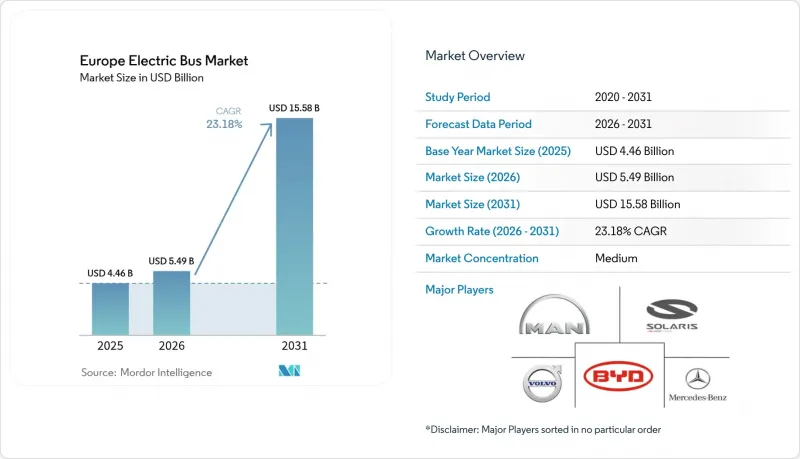
Mordor Intelligence에 의하면, 유럽 전기 버스 시장 규모는 2025년에 44억 6,000만 달러로 평가되었고 2026년 54억 9,000만 달러에서 2031년까지 155억 8,000만 달러에 이를 것으로 예측되며, 예측 기간(2026-2031년) CAGR은 23.18%를 나타낼 전망입니다.
본 보고서는 추진 방식별(배터리식 전기 버스(BEB), 플러그인 하이브리드 전기 버스(PHEB), 기타), 배터리 화학 성분별(인산철리튬(LFP), 니켈수소전지(NiMH), 기타),버스 길이별(9m 미만, 9-14m(표준), 기타), 소비자 유형별, 용도별, 국가별로 분류되어 있습니다. 시장 예측은 금액(달러) 기준으로 제시되어 있습니다.
유럽 전기 버스 시장 동향 및 인사이트
2026년 이후, 디젤 차량 대비 총 소유 비용(TCO) 감소
2024년에는 LFP 채택 확대에 따라 배터리 가격이 급락하여, NMC와 비교했을 때 팩 비용이 약 20% 절감되었습니다. 유지보수 비용 절감과 ETS-2의 탄소 배출료를 고려하면, 2025년에 구매된 전기 버스는 운행 개시 후 4년 이내에 디젤 차량과 TCO(총 소유 비용)가 동등해질 것으로 예측됩니다. 베를린과 위트레흐트에서 메르세데스-벤츠 ‘eCitaro’를 초기 도입한 사례에 따르면, 구동계의 마모 부품이 줄어든 덕분에 연간 유지보수 비용 절감률이 30%를 넘었습니다. 현재 차량 운영 사업자들은 3교대 운영 주기를 표준화하고 있으며, 이를 통해 전기 이용률이 96% 이상으로 상승하여 투자 회수가 가속화되고 있습니다. 이러한 경제성이 민간 부문의 신뢰를 뒷받침하고 있으며, 2025년에 전문 전기 버스 운영 사업자에 대한 벤처 자금 조달이 18% 증가한 이유도 여기에 있습니다.
EU의 ‘청정 차량 지침’ 기한
‘청정 차량 지침’에 따른 구속력 있는 조달 목표는 도시 교통 기관의 불확실성을 해소하고, 차량 공급과 충전 솔루션을 세트로 한 다년 계약 입찰을 촉진하고 있습니다. 독일의 ‘청정 차량 조달법(Saubere-Fahrzeuge-Beschaffungs-Gesetz)’에서는 2026년부터 2030년까지 청정 차량 구매 의무 비율을 65%로 상향 조정하며, 그중 절반은 무공해 차량이어야 한다고 규정하고 있습니다. 프랑스와 스페인에서도 유사한 법 제정이 진행되고 있으며, 수요가 대규모이자 예측 가능한 물량으로 집약됨에 따라 제조업체는 생산 라인을 최적화하고 단위당 비용을 절감할 수 있게 되었습니다. 또한, 각 발주 기관 간 조달 목표를 통합할 수 있는 각국의 유연성 덕분에 구매력이 향상되어 소규모 도시에서도 수량 할인을 받을 수 있게 되었습니다. 그 결과, 2024년에는 EU의 신형 도시 버스 중 49% 이상이 이미 무공해 차량이며, 이 비율은 2027년까지 70%를 넘어설 것으로 예측됩니다.
구형 차고지의 전력망 연결 병목 현상
디젤 차량용으로 건설된 거점의 변전소 및 배선 업그레이드는 전력 회사가 허가 절차의 장기적인 지연에 직면해 있어 여전히 늦어지고 있습니다. 밀라노와 뮌헨의 사업자들은 2MW 연결을 위해 18개월 이상 기다려야 한다는 보고를 하고 있으며, 야간 충전량을 제한할 수밖에 없는 이동식 충전기에 임시로 의존할 수밖에 없는 상황입니다. 유럽연합 집행위원회의 ‘전력망 행동 계획’에 따르면 2030년까지 전력 수요가 60% 증가할 것으로 예측되지만, 많은 도심 지역에서는 집중 충전에 대응할 수 있는 여유 케이블 용량이 거의 없습니다. 이러한 지연으로 인해 계약 시작일이 연기되거나 차고 개조 예산이 늘어나는 등, 수주 잔고는 견조함에도 불구하고 단기 납기일이 연기되는 사태가 발생하고 있습니다.
부문 분석
2025년, 유럽 전기 버스 시장에서는 규제에 따른 의무화와 구매 가격 격차를 줄이는 공급망의 성숙화에 힘입어 배터리식 전기 버스 기술이 시장의 81.95%를 차지했습니다. 강력한 정책 지원, 단순화된 구동 시스템, 배터리 비용의 하락으로 인해 2031년까지 해당 부문의 연평균 성장률(CAGR)은 24.10%로 전망됩니다. 연료전지 버스는 하루 400km를 초과하는 노선에서 여전히 전략적인 선택지로 남아 있지만, 수소 충전소 부족이 보급을 저해하고 있습니다. 플러그인 하이브리드 전기 버스는 현재 주로 차고 개조가 완료되지 않은 과도기적인 계약 하에서 운영되고 있습니다.
각 제조업체는 전기 버스 및 수소 버스의 전체 라인업에 걸쳐 전력 전자 장치와 열 관리 시스템을 표준화하여 개발 비용을 절감하고 있습니다. Solaris는 볼로냐 시로부터 수주한 130대의 수소 버스 주문을 이행하는 한편, 배터리식 전기 버스의 양산도 유지하고 있어 정책 방향이 변화하더라도 유연하게 대응할 수 있는 체제를 갖추고 있습니다. 지자체에서 제공하는 막대한 보조금은 특정 기술이 아닌 ‘배기관에서 제로 배출’을 목표로 하고 있기 때문에 차량 관리자들은 단기적인 규제 준수 및 비용 안정성을 고려하여 계속해서 배터리식 전기버스를 선택하고 있으며, 이로 인해 향후 5년간 해당 부문에서 주도적인 입지가 확고해질 것으로 보입니다.
인산철리튬(LFP) 배터리 팩은 2025년 유럽 전기 버스 시장에서 48.75%의 점유율을 차지할 것으로 보이며, 비용 면에서의 우위와 뛰어난 열 안정성-이는 사업자의 안전성과 경제성 우선 순위에 부합합니다--에 힘입어 2031년까지 연평균 성장률(CAGR) 24.60%라는 가장 빠른 성장세를 보일 것으로 예상되며, 이 부문을 선도하고 있습니다. 이 화학 조성의 사이클 수명은 4,000회 이상의 충방전을 지원하므로, 사업자는 배터리 중간 교체가 필요 없이 12년의 자산 수명을 계획할 수 있어 수명 기간 동안의 자본 지출(CAPEX)을 절감할 수 있습니다. 르노가 CATL의 헝가리 공장에서 LFP 모듈을 조달하기로 결정한 것은 유럽공급 안정성에 대한 OEM의 신뢰를 보여줍니다. 리튬-니켈-망간-코발트 산화물(NMC)은 높은 에너지 밀도가 필요한 연결형 버스에 여전히 최적의 화학 조성물이지만, 코발트 가격의 급등과 ESG 측면에서의 면밀한 검토가 역풍으로 작용하고 있습니다.
LFP에 기인한 유럽 전기 버스 시장 규모의 확대는 EU 배터리 규정의 재활용 함량 할당 기준에 힘입고 있습니다. 이 기준은 철계 양극재를 사용함으로써 달성하기가 더 쉬워졌습니다. 헬싱키와 비엔나의 운영사들로부터 초기 NMC 채택 차량에 비해 배터리 보증 청구 건수가 감소하는 추세라는 보고가 있어, 기술적 위험이 줄어들고 있음을 시사합니다. 예측 기간 동안 나트륨 이온 배터리 연구로 인해 더욱 저비용인 화학 조성이 추가될 가능성은 있으나, 2030년 이전에 상용 규모로 도입되기는 어려울 것으로 보이며, LFP가 계속해서 주류를 이룰 것으로 예측됩니다.
기타 혜택
- 엑셀 형식 시장 예측(ME) 시트
- 3개월간의 애널리스트 지원
자주 묻는 질문
목차
제1장 서론
제2장 조사 방법
제3장 주요 요약
제4장 시장 구도
제5장 시장 규모와 성장 예측
제6장 경쟁 구도
제7장 시장 기회와 향후 전망
JHS 26.09.11According to Mordor Intelligence, the Europe electric bus market size was valued at USD 4.46 billion in 2025 and estimated to grow from USD 5.49 billion in 2026 to reach USD 15.58 billion by 2031, at a CAGR of 23.18% during the forecast period (2026-2031).
This report is Segmented by Propulsion Type (Battery Electric Bus (BEB), Plug-In Hybrid Electric Bus (PHEB), and More), Battery Chemistry (Lithium-Iron-Phosphate (LFP), Nickel-Metal Hydride (NiMH), and More), Bus Length (Less Than 9 M, 9-14 M (Standard), and More), Consumer Type, Application and Country. The Market Forecasts are Provided in Terms of Value (USD).
Europe Electric Bus Market Trends and Insights
Falling Total Cost of Ownership Versus Diesel After 2026
Battery prices fell sharply in 2024 on wider LFP adoption, cutting pack costs by about 20% compared with NMC. When maintenance savings and ETS-2 carbon charges are added, an electric bus purchased in 2025 is projected to reach TCO parity with a diesel unit within four years of service. Early deployments of the Mercedes-Benz eCitaro in Berlin and Utrecht reveal annual maintenance savings exceeding 30% thanks to fewer drivetrain wear parts. Fleet operators are now standardizing three-shift duty cycles that push electric utilization above 96%, which accelerates payback. Such economics underpin private-sector confidence and explain why venture funding for specialized e-bus operators climbed 18% in 2025 .
EU Clean-Vehicles Directive Deadlines
Binding procurement targets under the Clean-Vehicles Directive remove uncertainty for city transport agencies, prompting multi-year tenders that bundle vehicle supply and charging solutions. Germany's Saubere-Fahrzeuge-Beschaffungs-Gesetz lifts required clean-vehicle purchases to 65% for 2026-2030, half of which must be zero-emission. Similar transpositions in France and Spain are clustering demand into large, predictable tranches that let manufacturers optimize production lines and reduce per-unit costs. National flexibility to pool targets across contracting authorities also raises purchasing power, helping smaller cities gain volume discounts. As a result, more than 49% of new EU city buses were already zero-emission in 2024, a share expected to exceed 70% by 2027 .
Grid-Connection Bottlenecks at Legacy Depots
Upgrading substations and cabling at sites built for diesel fleets remains slow because utilities face long permitting backlogs. Operators in Milan and Munich report waits of 18 months or more for 2-MW connections, forcing interim reliance on mobile chargers that limit overnight energy intake. The European Commission's Action Plan for Grids identifies a 60% increase in electricity demand by 2030, yet many city centers have little spare cabling capacity to handle clustered charging. Delays can push back contract start dates and inflate depot conversion budgets, cooling near-term delivery schedules despite healthy order books.
Other drivers and restraints analyzed in the detailed report include:
- National Zero-Emission Public-Procurement Quotas
- On-Site Depot Battery-Storage Shaving Peak-Demand Charges
- Residual-Value Uncertainty for First-Generation E-Buses
For complete list of drivers and restraints, kindly check the Table Of Contents.
Segment Analysis
Battery-electric technology controlled 81.95% of the Europe electric bus market in 2025, driven by regulatory mandates and the maturing supply chain that reduce purchase price gaps. Strong policy backing, simpler drivetrains, and falling battery costs support a 24.10% CAGR for the segment through 2031. Fuel-cell buses remain a strategic hedge for routes exceeding 400 km daily, but scarce hydrogen refueling sites restrict widespread adoption. Plug-in hybrids now serve mostly in transitional contracts where depot upgrades are incomplete.
Manufacturers are standardizing power electronics and thermal-management systems across their electric and hydrogen lines, which lowers development expense. Solaris is executing a 130-unit hydrogen order for Bologna while maintaining battery-electric production at volume, ensuring flexibility if policy signals shift. Because heavy municipal subsidies target zero tailpipe emissions rather than a specific technology, fleet managers continue to pick battery-electric options for near-term compliance and cost reliability, cementing segment leadership for the next five years.
Lithium-iron-phosphate packs captured 48.75% Europe electric bus market share in 2025 and lead the category with the fastest projected expansion of 24.60% CAGR through 2031, driven by cost advantages and superior thermal stability that resonate with operator safety and economic priorities. The chemistry's cycle life of 4,000+ charge events helps operators plan for 12-year asset lives without mid-life battery swaps, cutting lifetime capex. Renault's decision to source LFP modules from CATL's Hungarian plant illustrates OEM confidence in European supply security. Lithium nickel manganese cobalt oxide remains the chemistry of choice for articulated buses that need high energy density, but rising cobalt prices and ESG scrutiny create headwinds.
Europe electric bus market size gains tied to LFP are reinforced by EU Battery Regulation recycled-content quotas that are easier to meet with iron-based cathodes. Operators in Helsinki and Vienna report battery warranty claims trending lower than early NMC fleets, signaling reduced technical risk. Over the forecast horizon, sodium-ion research may add yet another low-cost chemistry, but commercial scale is unlikely before 2030, leaving LFP dominant.
Complete Report Scope:
- By Propulsion Type
- Battery Electric Bus (BEB)
- Plug-in Hybrid Electric Bus (PHEB)
- Fuel-Cell Electric Bus (FCEB)
- By Battery Chemistry
- Lithium-Iron-Phosphate (LFP)
- Lithium Nickel Manganese Cobalt Oxide (NMC)
- Nickel-Metal Hydride (NiMH)
- Others (Sodium-ion, Solid-state)
- By Bus Length
- Less than 9 m
- 9-14 m (Standard)
- Above 14 m (Articulated/Double-decker)
- By Consumer Type
- Government / Municipal Transit Agencies
- Private Fleet Operators
- By Application
- Intra-city Urban Transit
- Inter-city & Regional
- Airport & Shuttle Services
- By Country
- Germany
- United Kingdom
- France
- Italy
- Spain
- Netherlands
- Norway
- Poland
- Sweden
- Finland
- Belgium
- Switzerland
- Rest of Europe
List of Companies Covered in this Report:
- Solaris Bus & Coach sp. z o.o.
- MAN Truck & Bus
- Mercedes-Benz Group AG
- Volvo Buses
- BYD Auto Co., Ltd
- VDL Bus & Coach
- Ebusco
- IVECO Group
- Scania
- Otokar
- Van Hool
- Yutong Europe
- Irizar e-mobility
- Wrightbus
- Karsan
- CaetanoBus
- Temsa
- Bozankaya
- Switch Mobility
Additional Benefits:
- The market estimate (ME) sheet in Excel format
- 3 months of analyst support
TABLE OF CONTENTS
1 Introduction
- 1.1 Study Assumptions & Market Definition
- 1.2 Scope of the Study
2 Research Methodology
3 Executive Summary
4 Market Landscape
- 4.1 Market Overview
- 4.2 Market Drivers
- 4.2.1 EU Clean-Vehicles Directive compliance deadlines
- 4.2.2 Falling total-cost-of-ownership versus diesel after 2026
- 4.2.3 National zero-emission public-procurement quotas
- 4.2.4 On-site depot battery-storage shaving peak-demand charges
- 4.2.5 Battery-as-a-Service contracts lowering capex risk
- 4.2.6 Escalating EU carbon-pricing under ETS-2 boosts diesel operating costs, accelerating e-bus switch
- 4.3 Market Restraints
- 4.3.1 Grid-connection bottlenecks at legacy depots
- 4.3.2 High residual-value uncertainty for first-generation e-buses
- 4.3.3 Potential EU tariffs on Chinese e-buses could raise system costs
- 4.3.4 Shortage of certified high-voltage maintenance technicians
- 4.4 Value / Supply-Chain Analysis
- 4.5 Regulatory Landscape
- 4.6 Technological Outlook
- 4.7 Porter's Five Forces
- 4.7.1 Threat of New Entrants
- 4.7.2 Bargaining Power of Buyers
- 4.7.3 Bargaining Power of Suppliers
- 4.7.4 Threat of Substitutes
- 4.7.5 Intensity of Competitive Rivalry
5 Market Size & Growth Forecasts (Value (USD))
- 5.1 By Propulsion Type
- 5.1.1 Battery Electric Bus (BEB)
- 5.1.2 Plug-in Hybrid Electric Bus (PHEB)
- 5.1.3 Fuel-Cell Electric Bus (FCEB)
- 5.2 By Battery Chemistry
- 5.2.1 Lithium-Iron-Phosphate (LFP)
- 5.2.2 Lithium Nickel Manganese Cobalt Oxide (NMC)
- 5.2.3 Nickel-Metal Hydride (NiMH)
- 5.2.4 Others (Sodium-ion, Solid-state)
- 5.3 By Bus Length
- 5.3.1 Less than 9 m
- 5.3.2 9-14 m (Standard)
- 5.3.3 Above 14 m (Articulated/Double-decker)
- 5.4 By Consumer Type
- 5.4.1 Government / Municipal Transit Agencies
- 5.4.2 Private Fleet Operators
- 5.5 By Application
- 5.5.1 Intra-city Urban Transit
- 5.5.2 Inter-city & Regional
- 5.5.3 Airport & Shuttle Services
- 5.6 By Country
- 5.6.1 Germany
- 5.6.2 United Kingdom
- 5.6.3 France
- 5.6.4 Italy
- 5.6.5 Spain
- 5.6.6 Netherlands
- 5.6.7 Norway
- 5.6.8 Poland
- 5.6.9 Sweden
- 5.6.10 Finland
- 5.6.11 Belgium
- 5.6.12 Switzerland
- 5.6.13 Rest of Europe
6 Competitive Landscape
- 6.1 Market Concentration
- 6.2 Strategic Moves
- 6.3 Market Share Analysis
- 6.4 Company Profiles (includes Global Level Overview, Market Level Overview, Core Segments, Financials as Available, Strategic Information, Market Rank/Share for Key Companies, Products and Services, SWOT Analysis, and Recent Developments)
- 6.4.1 Solaris Bus & Coach sp. z o.o.
- 6.4.2 MAN Truck & Bus
- 6.4.3 Mercedes-Benz Group AG
- 6.4.4 Volvo Buses
- 6.4.5 BYD Auto Co., Ltd
- 6.4.6 VDL Bus & Coach
- 6.4.7 Ebusco
- 6.4.8 IVECO Group
- 6.4.9 Scania
- 6.4.10 Otokar
- 6.4.11 Van Hool
- 6.4.12 Yutong Europe
- 6.4.13 Irizar e-mobility
- 6.4.14 Wrightbus
- 6.4.15 Karsan
- 6.4.16 CaetanoBus
- 6.4.17 Temsa
- 6.4.18 Bozankaya
- 6.4.19 Switch Mobility
7 Market Opportunities & Future Outlook
- 7.1 White-space & Unmet-need Assessment