

|
시장보고서
상품코드
2097305
AI 가속기 : 시장 점유율 분석, 업계 동향 및 통계, 성장 예측(2026-2031년)AI Accelerators - Market Share Analysis, Industry Trends & Statistics, Growth Forecasts (2026 - 2031) |
||||||
 Mordor Intelligence
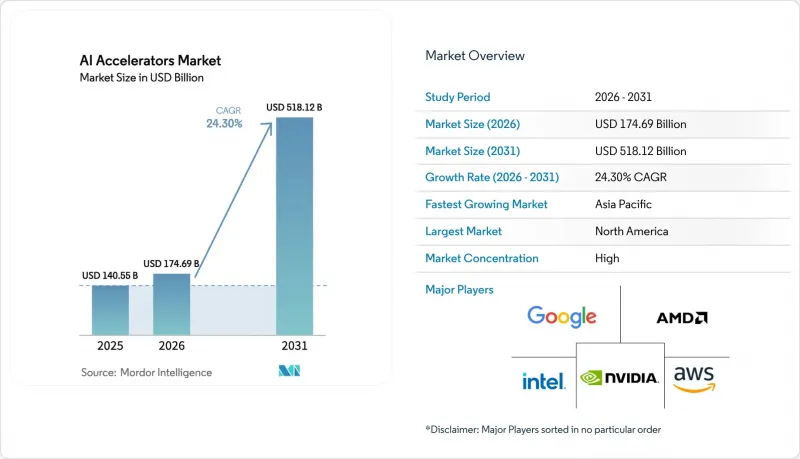
Mordor Intelligence에 의하면, AI 가속기 시장 규모는 2025년 1,405억 5,000만 달러로 평가되었습니다. 2026년에는 1,746억 9,000만 달러로 확대되어 2026년부터 2031년에 걸쳐 CAGR 24.30%로 성장을 지속하여, 2031년에는 5,181억 2,000만 달러에 이를 것으로 예측됩니다.
본 보고서는 프로세서 유형별(GPU, ASIC/TPU, FPGA, CPU/NPU/기타), 처리 장소별(클라우드/데이터센터, 엣지/온디바이스, On-Premise HPC), 기능별(훈련, 추론), 최종 사용자 산업별(하이퍼스케일·클라우드 서비스 제공업체, 엔터프라이즈 및 코로케이션 데이터센터, 자동차 OEM 및 Tier 1, 헬스케어 및 생명과학, 기타), 그리고 지역별로 분류되어 있습니다. 시장 전망은 금액(달러) 기준으로 제시되어 있습니다.
세계의 AI 가속기 시장 동향 및 인사이트
하이퍼스케일 데이터센터에서 생성형 AI용 컴퓨팅에 대한 폭발적인 수요
하이퍼스케일 사업자들은 모델 훈련과 연중무휴 24시간 추론을 모두 지원하기 위해 캠퍼스당 수십만 대 규모의 고성능 GPU로 확장을 추진하고 있습니다. 업계 예측에 따르면, 2025년까지 연간 도입 대수는 650만-700만 대에 달했으며, 전력 수요는 84GW로 증가했습니다. 이는 미국 한 주 전체의 현재 전력 부하에 해당하는 규모입니다(CSIS.ORG). 이러한 지속적인 수요로 인해 NVIDIA의 데이터센터 관련 매출은 2024년 1,100억 달러에서 2025년에는 1,730억 달러에 달했으며, 공급 안정성의 중요성이 더욱 높아지는 한편, 첨단 패키징 역량에 대한 전례 없는 투자가 촉진되었습니다.
저전력 가속기가 필요한 엣지 AI 기기의 보급
자동차 및 헬스케어 플랫폼에서는 2밀리초 미만의 지연 시간과 엄격한 데이터 주권 규정 준수가 요구되고 있어, 이에 따라 기기 내 추론으로의 전환이 진행되고 있습니다. 자동차용 AI 칩셋 시장은 2034년까지 146억 8,000만 달러에 달하며, 연평균 20%의 성장률을 보일 것으로 예측됩니다. 한편, 미국 식품의약국(FDA)은 추적 시작 이후 950건의 AI 탑재 의료기기를 승인했으며, 2024년 상반기에는 15% 증가했습니다. Telechips의 A2X와 같은 새로운 솔루션은 통합된 시스템 온 칩(SoC) 패키지 내에서 200 TOPS를 구현하여, 비용 효율이 뛰어난 로컬 AI로 가는 명확한 길을 제시하고 있습니다.
5nm 미만 웨이퍼 공급 부족으로 출하량 억제
공정 양산 확대가 진행되고 있음에도 불구하고, 최첨단 웨이퍼 수요는 공급을 상회하고 있습니다. TSMC의 3nm 공정의 월간 생산량은 2025년 하반기에 12만 5,000장에 달했지만, 가전 제조업체 및 데이터센터 기업들의 경쟁적인 수주로 인해 공급자 우위 시장이 지속되고 있으며, 웨이퍼 가격은 2만 1,000달러 전후로 형성되고 있습니다. 대체 생산 능력이 제한적이어서 납기 기간이 길어지고, 새로운 AI 설계의 자본 집약도가 높아지고 있습니다.
부문 분석
2025년, AI 가속기 시장에서 GPU의 매출 점유율은 59.20%를 차지했습니다. CUDA로 대표되는 광범위한 소프트웨어 생태계 덕분에 GPU는 연구 개발 및 초기 개발 단계에서 여전히 필수적인 존재로 남아 있습니다. ASIC용 AI 가속기 시장 규모는 정상 상태 추론에서 에너지 효율과 비용 효율을 추구하는 하이퍼스케일러의 맞춤형 설계를 반영하여 연평균 성장률(CAGR) 27.15%로 확대될 것으로 예측됩니다. 벤더의 로드맵에 따르면, 클라우드 사업자들은 사내 테이프아웃을 늘리고 자체 개발한 실리콘을 위해 파운드리 생산량을 할당하고 있습니다. FPGA(Field Programmable Gate Array)는 재구성 가능성이 낮은 피크 처리량을 보완하는 경우, 특히 진화하는 엣지 워크로드에서 여전히 매력적인 선택지로 남아 있습니다. CPU/NPU 하이브리드는 호스트 처리, 보안 엔진, 신경망을 밀접하게 통합함으로써 비용 효율성을 중시하는 소비자용 기기에 대응하고 있으며, 범용 공급업체의 비즈니스 기회를 확대되고 있습니다.
ASIC으로의 전환이 자본 배분을 변화시키고 있습니다. Broadcom은 2027년까지 600억-900억 달러 규모의 ASIC 시장 기회를 전망하고 있으며, 자체 개발한 TPU, Tranium 또는 Inferentia 디바이스가 생산 클러스터에 점점 더 많이 도입되고 있습니다. 따라서 훈련 집약적인 연구 분야에서는 GPU의 우위가 지속될 것으로 예상되지만, 컴파일러의 성숙도, 오픈소스 툴체인, 그리고 소프트웨어 추상화가 진행됨에 따라 추론 관련 지출의 구조적으로 높은 비율이 ASIC으로 이동할 것입니다. 그 결과로 발생하는 혼합 아키텍처 환경에서는 이종 하드웨어 타겟 전반에 걸쳐 통합된 툴체인을 제공할 수 있는 공급업체가 유리할 것입니다.
2025년 지출 중 클라우드 및 코로케이션 시설이 74.30%를 차지했으며, 이는 규모의 경제와 5nm 미만 웨이퍼에 대한 접근성 향상에 힘입은 것입니다. 그럼에도 불구하고, 자동차 자율 주행, 의료 현장의 진단, 개인정보 보호 규제로 인해 로컬 추론이 요구됨에 따라 엣지 배포는 연평균 성장률(CAGR) 26.20%로 급증하고 있습니다. AI 가속기 시장은 현재 집중형 훈련과 분산형 추론을 결합한 2층 모델을 채택하고 있어, 애플리케이션 개발자는 지연 시간을 최소화하면서 대역폭 부하를 줄일 수 있게 되었습니다. On-Premise 고성능 컴퓨팅(HPC) 클러스터는 데이터를 관리하고 결정론적 지연 시간을 보장해야 하는 금융 서비스 기업 및 국립 연구소에 여전히 중요한 역할을 하고 있습니다.
자동차 OEM 각사는 엣지 분야의 전환점을 여실히 보여주고 있습니다. NVIDIA의 'Orin' 및 'Thor' 제품 로드맵에 따라, 중국 자동차 제조업체들은 자체 개발 반도체 프로그램을 강화하고 있으며, 한국의 각 벤더들은 패키징 로드맵을 차량용 등급의 온도 및 안전 기준에 부합하도록 조정하고 있습니다. 의료 분야도 유사한 추세를 보이고 있으며, 영상 진단 장비 공급업체들은 AI 파이프라인을 스캐너에 직접 통합함으로써 워크플로우 효율을 저해하거나 환자 개인정보를 침해할 우려가 있는 클라우드와의 왕복 통신을 피하고 있습니다.
지역별 분석
2025년, 북미는 AI 가속기 시장에서 43.50%의 점유율을 차지했습니다. 하이퍼스케일 클라우드 기업의 본사가 집중되어 있고, 벤처 자금이 풍부하며, ‘CHIPS 법’에 따른 지원책이 계속해서 수요와 생산 능력을 모두 이 지역에 집중시키고 있습니다. 국내 파운드리, 첨단 패키징 및 고대역폭 메모리 조립에 대한 지속적인 투자를 통해 공급망의 다각화가 진행되어 지정학적 리스크 완화가 기대됩니다.
아시아태평양은 가장 빠른 성장세를 기록하며, 2025년부터 2031년까지 연평균 성장률(CAGR) 27.00%로 성장할 전망입니다. 중국의 전기차 제조업체들은 독자적인 자동차용 반도체를 빠르게 개선하고 있으며, 한편 Rebellions와 Sapeon의 합병으로 대표되는 한국의 업계 재편을 통해 리소그래피 및 패키징 생산 능력에 대해 협상할 수 있는 ‘국가 대표 기업’이 탄생하고 있습니다. 5nm 미만 웨이퍼 생산에서 대만의 우위는 여전히 중요하지만, 지정학적 리스크가 고조됨에 따라 첨단 메모리 테스트 및 조립을 전문으로 하는 일본, 인도, 싱가포르의 시설에 대한 관심이 높아지고 있습니다.
유럽은 엄격한 규제 체제와 견고한 자동차 제조거점을 바탕으로 규모는 작지만 영향력 있는 위치를 차지하고 있습니다. 조만간 시행될 ‘AI법’과 지속가능성에 관한 규제로 인해 가속기 설계는 투명성, 에너지 효율, 수명 주기 전반에 걸친 설명 책임의 방향으로 나아가고 있습니다. 한편, 중동 및 아프리카 국가들에서는 재생에너지 공급을 기반으로 한 그린필드형 데이터센터 건설이 진행되고 있으며, 정책, 인재, 통신 인프라가 성숙해지면 향후 지역 성장을 위한 기반이 마련될 것입니다.
기타 혜택 :
- 엑셀 형식 시장 예측(ME) 시트
- 3개월간의 애널리스트 지원
자주 묻는 질문
목차
제1장 서론
제2장 조사 방법
제3장 주요 요약
제4장 시장 구도
제5장 시장 규모 및 성장 예측
제6장 경쟁 구도
제7장 시장 기회 및 향후 전망
제8장 미개척 분야 및 미충족 수요 평가
KTH 26.08.10According to Mordor Intelligence, the AI accelerators market size is expected to grow from USD 140.55 billion in 2025 to USD 174.69 billion in 2026 and is forecast to reach USD 518.12 billion by 2031 at 24.30% CAGR over 2026-2031.
This report is Segmented by Processor Type (GPU, ASIC/TPU, FPGA, CPU/NPU/Others), Processing Location (Cloud/Data-center, Edge/On-device, On-Prem HPC), Function (Training, Inference), End-User Industry (Hyperscale Cloud Service Providers, Enterprise & Colocation Data-Centers, Automotive OEMs & Tier-1, Healthcare & Life-Sciences, Others), and Geography. The Market Forecasts are Provided in Terms of Value (USD).
Global AI Accelerators Market Trends and Insights
Explosive Demand for Generative-AI Compute in Hyperscale Data Centers
Hyperscale operators are scaling to hundreds of thousands of high-end GPUs per campus to support both model training and 24-7 inference. Industry forecasts indicate the installed base may reach 6.5-7 million units annually by 2025, lifting power requirements toward 84 GW, or roughly one additional U.S. state's present-day grid load [CSIS.ORG]. Sustained demand has driven NVIDIA's data-center revenue from USD 110 billion in 2024 to an expected USD 173 billion in 2025, reinforcing the importance of supply security and driving unprecedented investment in advanced packaging capacity.
Proliferation of Edge AI Devices Needing Low-Power Accelerators
Automotive and healthcare platforms require sub-20 millisecond latency and stringent data-sovereignty compliance, prompting a shift toward on-device inference. The automotive AI chipset market is projected to reach USD 14.68 billion by 2034, growing at 20% annually, while the U.S. Food and Drug Administration has cleared 950 AI-enabled medical devices since tracking began, up 15% in the first half of 2024. New solutions such as Telechips' A2X deliver 200 TOPS within integrated system-on-chip packages, signaling a clear path toward cost-efficient, localized intelligence.
<5 nm Wafer Shortages Throttling Shipment Volumes
Even after process ramp-ups, leading-edge wafer demand exceeds supply. TSMC's monthly 3 nm output is expected to reach 125,000 wafers in the second half of 2025, yet competing orders from consumer electronics and data-center firms sustain a sellers' market that keeps wafer prices near USD 21,000. Limited alternative capacity prolongs delivery lead-times and raises the capital intensity of new AI designs.
Other drivers and restraints analyzed in the detailed report include:
- Chiplet & Advanced-Packaging Breakthroughs Boosting Memory Bandwidth
- Government CHIPS-Style Incentives for Domestic AI-Silicon Fabs
- Escalating TCO of Liquid-Cooled GPU Clusters
For complete list of drivers and restraints, kindly check the Table Of Contents.
Segment Analysis
GPUs held 59.20% revenue share of the AI accelerators market in 2025. Their broad software ecosystem, epitomized by CUDA, keeps them indispensable for research and early-stage development. The AI accelerators market size for ASICs is projected to expand at a 27.15% CAGR, reflecting bespoke designs by hyperscalers seeking energy and cost efficiency during steady-state inference. Vendor roadmaps show cloud operators increasing internal tape-outs and committing foundry volume to proprietary silicon. Field-programmable gate arrays (FPGAs) remain attractive where reconfigurability offsets lower peak throughput, notably for evolving edge workloads. CPU/NPU hybrids address cost-sensitive consumer devices through tight integration of host processing, security engines, and neural cores, broadening merchant supplier opportunities.
Momentum toward ASICs is reshaping capital allocation. Broadcom anticipates a USD 60-90 billion ASIC opportunity by 2027, and internal TPUs, Tranium, or Inferentia devices increasingly enter production clusters. Continued GPU primacy is therefore expected in training-intensive research, yet a structurally higher share of inference spend will migrate to ASICs as compiler maturity, open-source toolchains, and software abstractions progress. The resulting mixed-architecture environment favors suppliers capable of delivering unified toolchains across heterogeneous hardware targets.
Cloud and colocation facilities accounted for 74.30% of 2025 spending, underpinned by economies of scale and better access to sub-5 nm wafers. Nevertheless, edge delivery is surging at a 26.20% CAGR as automotive autonomy, point-of-care health diagnostics, and privacy regulation require local inference. The AI accelerators market now supports a two-tier model in which centralized training is complemented by distributed inference, enabling application developers to minimize latency while relieving bandwidth stress. On-premises high-performance computing (HPC) clusters retain importance for financial-services firms and national laboratories that must control data and ensure deterministic latency.
Automotive OEMs illustrate the edge inflection. NVIDIA's Orin and Thor product timelines prompted Chinese brands to bolster internal silicon programs, and Korean vendors are aligning packaging roadmaps with vehicle-grade temperature and safety standards. Healthcare follows a similar arc as diagnostic imaging vendors embed AI pipelines directly into scanners, avoiding cloud round-trips that would compromise workflow efficiency or patient privacy.
Complete Report Scope:
- By Processor Type
- GPU
- ASIC / TPU
- FPGA
- CPU / NPU / Others
- By Processing Location
- Cloud / Data-center
- Edge / On-device
- On-prem HPC
- By Function
- Training
- Inference
- By End-User Industry
- Hyperscale Cloud Service Providers
- Enterprise & Colocation Data-centers
- Automotive OEMs & Tier-1s
- Healthcare & Life-sciences
- Financial Services
- Telecom & 5G Infrastructure
- Other End user (Government, Cyber security, Manufacturing among others)
- By Geography
- North America
- United States
- Canada
- Mexico
- South America
- Brazil
- Argentina
- Chile
- Rest of South America
- Europe
- Germany
- United Kingdom
- France
- Italy
- Spain
- Russia
- Rest of Europe
- Asia-Pacific
- China
- Japan
- South Korea
- India
- ASEAN
- Australia & New Zealand
- Rest of Asia-Pacific
- Middle East & Africa
- Middle East
- Saudi Arabia
- UAE
- Turkey
- Israel
- Rest of Middle East
- Africa
- South Africa
- Nigeria
- Egypt
- Rest of Africa
- Middle East
- North America
Geography Analysis
North America captured a 43.50% share of the AI accelerators market in 2025. Concentration of hyperscale cloud headquarters, venture funding depth, and CHIPS Act stimulants continue to channel both demand and fabrication capacity into the region. Ongoing investments in on-shore foundries, advanced packaging, and high-bandwidth-memory assembly are expected to diversify supply chains and mitigate geopolitical exposure.
Asia-Pacific posted the fastest growth, advancing at a 27.00% CAGR between 2025 and 2031. Chinese EV firms rapidly iterate proprietary automotive silicon, while South Korean consolidation-exemplified by the Rebellions-Sapeon merger-creates national champions able to negotiate lithography and packaging capacity. Taiwan's dominance in sub-5 nm wafer output remains critical, though geopolitical risk elevates incentives for Japanese, Indian, and Singaporean facilities specializing in advanced memory test and assembly.
Europe holds a smaller but influential position, guided by stringent regulatory regimes and a robust automotive manufacturing base. The forthcoming AI Act, together with sustainability mandates, is nudging accelerator design toward transparency, energy efficiency, and lifecycle accountability. Meanwhile, Middle East and African countries are commissioning green-field data centers anchored by renewable-energy availability, laying groundwork for future regional growth once policy, skills, and connectivity mature.
- NVIDIA Corporation
- Advanced Micro Devices, Inc. (AMD) (Xilinx, Inc.)
- Intel Corporation (Habana Labs Ltd.)
- Google LLC (TPU)
- Amazon Web Services, Inc. (Trainium/Inferentia)
- Qualcomm Incorporated
- Cerebras Systems Inc.
- Graphcore Limited
- SambaNova Systems, Inc.
- Groq, Inc.
- Tenstorrent Inc.
- Mythic, Inc.
- SiFive, Inc.
- Blaize Inc.
- Esperanto Technologies, Inc.
- Hailo Technologies Ltd.
- Neural Magic, Inc.
- Edgecortix Inc.
- T-Head Semiconductor Co., Ltd. (a subsidiary of Alibaba Group)
- Huawei Technologies Co., Ltd. (Ascend)
- Biren Technology Co., Ltd.
- Rebellions Inc.
- CerebrumX Labs Inc.
Additional Benefits:
- The market estimate (ME) sheet in Excel format
- 3 months of analyst support
TABLE OF CONTENTS
1 INTRODUCTION
- 1.1 Study Assumptions & Market Definition
- 1.2 Scope of the Study
2 RESEARCH METHODOLOGY
3 EXECUTIVE SUMMARY
4 MARKET LANDSCAPE
- 4.1 Market Overview
- 4.2 Market Drivers
- 4.2.1 Explosive demand for generative-AI compute in hyperscale data-centers
- 4.2.2 Proliferation of edge AI devices needing low-power accelerators
- 4.2.3 Chiplet & advanced-packaging breakthroughs boosting memory bandwidth
- 4.2.4 Government CHIPS-style incentives for domestic AI-silicon fabs
- 4.2.5 HBM3E supply bottlenecks redirecting design wins to alternative vendors
- 4.2.6 Rise of open-source SDKs lowering switching costs away from incumbent GPUs
- 4.3 Market Restraints
- 4.3.1 5 nm wafer shortages throttling shipment volumes
- 4.3.2 Escalating TCO of liquid-cooled GPU clusters
- 4.3.3 Export-control uncertainty on high-end accelerators to China
- 4.3.4 Power-grid capacity caps at major colo campuses
- 4.4 Value / Supply-Chain Analysis
- 4.5 Regulatory Landscape
- 4.6 Technological Outlook
- 4.7 Porters Five Forces
- 4.7.1 Threat of New Entrants
- 4.7.2 Bargaining Power of Suppliers
- 4.7.3 Bargaining Power of Buyers
- 4.7.4 Threat of Substitutes
- 4.7.5 Competitive Rivalry
5 MARKET SIZE & GROWTH FORECASTS (VALUE)
- 5.1 By Processor Type
- 5.1.1 GPU
- 5.1.2 ASIC / TPU
- 5.1.3 FPGA
- 5.1.4 CPU / NPU / Others
- 5.2 By Processing Location
- 5.2.1 Cloud / Data-center
- 5.2.2 Edge / On-device
- 5.2.3 On-prem HPC
- 5.3 By Function
- 5.3.1 Training
- 5.3.2 Inference
- 5.4 By End-User Industry
- 5.4.1 Hyperscale Cloud Service Providers
- 5.4.2 Enterprise & Colocation Data-centers
- 5.4.3 Automotive OEMs & Tier-1s
- 5.4.4 Healthcare & Life-sciences
- 5.4.5 Financial Services
- 5.4.6 Telecom & 5G Infrastructure
- 5.4.7 Other End user (Government, Cyber security, Manufacturing among others)
- 5.5 By Geography
- 5.5.1 North America
- 5.5.1.1 United States
- 5.5.1.2 Canada
- 5.5.1.3 Mexico
- 5.5.2 South America
- 5.5.2.1 Brazil
- 5.5.2.2 Argentina
- 5.5.2.3 Chile
- 5.5.2.4 Rest of South America
- 5.5.3 Europe
- 5.5.3.1 Germany
- 5.5.3.2 United Kingdom
- 5.5.3.3 France
- 5.5.3.4 Italy
- 5.5.3.5 Spain
- 5.5.3.6 Russia
- 5.5.3.7 Rest of Europe
- 5.5.4 Asia-Pacific
- 5.5.4.1 China
- 5.5.4.2 Japan
- 5.5.4.3 South Korea
- 5.5.4.4 India
- 5.5.4.5 ASEAN
- 5.5.4.6 Australia & New Zealand
- 5.5.4.7 Rest of Asia-Pacific
- 5.5.5 Middle East & Africa
- 5.5.5.1 Middle East
- 5.5.5.1.1 Saudi Arabia
- 5.5.5.1.2 UAE
- 5.5.5.1.3 Turkey
- 5.5.5.1.4 Israel
- 5.5.5.1.5 Rest of Middle East
- 5.5.5.2 Africa
- 5.5.5.2.1 South Africa
- 5.5.5.2.2 Nigeria
- 5.5.5.2.3 Egypt
- 5.5.5.2.4 Rest of Africa
- 5.5.5.1 Middle East
- 5.5.1 North America
6 COMPETITIVE LANDSCAPE
- 6.1 Market Concentration
- 6.2 Strategic Moves
- 6.3 Market Share Analysis
- 6.4 Company Profiles
- 6.4.1 NVIDIA Corporation
- 6.4.2 Advanced Micro Devices, Inc. (AMD) (Xilinx, Inc.)
- 6.4.3 Intel Corporation (Habana Labs Ltd.)
- 6.4.4 Google LLC (TPU)
- 6.4.5 Amazon Web Services, Inc. (Trainium/Inferentia)
- 6.4.6 Qualcomm Incorporated
- 6.4.7 Cerebras Systems Inc.
- 6.4.8 Graphcore Limited
- 6.4.9 SambaNova Systems, Inc.
- 6.4.10 Groq, Inc.
- 6.4.11 Tenstorrent Inc.
- 6.4.12 Mythic, Inc.
- 6.4.13 SiFive, Inc.
- 6.4.14 Blaize Inc.
- 6.4.15 Esperanto Technologies, Inc.
- 6.4.16 Hailo Technologies Ltd.
- 6.4.17 Neural Magic, Inc.
- 6.4.18 Edgecortix Inc.
- 6.4.19 T-Head Semiconductor Co., Ltd. (a subsidiary of Alibaba Group)
- 6.4.20 Huawei Technologies Co., Ltd. (Ascend)
- 6.4.21 Biren Technology Co., Ltd.
- 6.4.22 Rebellions Inc.
- 6.4.23 CerebrumX Labs Inc.


