

|
시장보고서
상품코드
2098560
디지털 트윈 GPU : 시장 점유율 분석, 업계 동향과 통계, 성장 예측(2026-2031년)Digital Twin GPU - Market Share Analysis, Industry Trends & Statistics, Growth Forecasts (2026 - 2031) |
||||||
 Mordor Intelligence
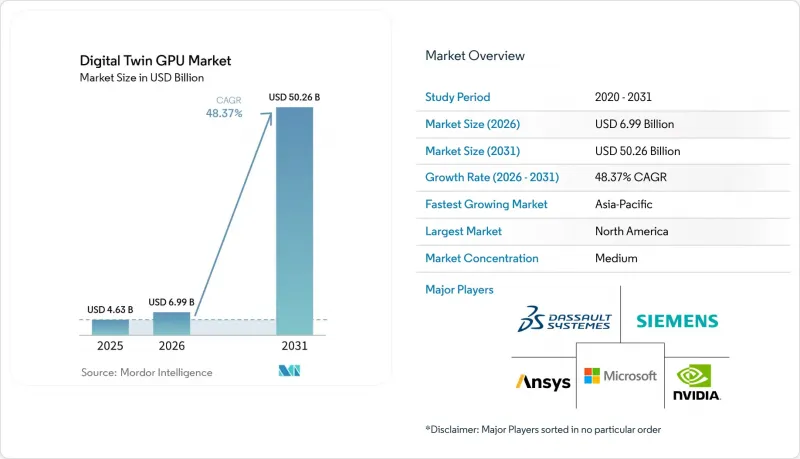
Mordor Intelligence에 의하면, 디지털 트윈용 GPU 시장 규모는 2025년에 46억 3,000만 달러, 2026년에 69억 9,000만 달러에서 2031년까지 502억 6,000만 달러에 이를 것으로 예측되며, 2026-2031년 CAGR 48.37%를 기록할 전망입니다.
본 보고서는 GPU 도입 유형(워크스테이션용 GPU 등), GPU 통합 유형(디스크리트 GPU 및 통합형/임베디드형 GPU), 도입 모델(On-Premise 등), 용도(설계, 시뮬레이션 및 엔지니어링, 실시간 모니터링 및 운영 제어 등), 최종 사용자(항공우주 및 방위 등), 지역별로 분류되어 있습니다. 시장 전망은 금액(달러) 기준으로 제시되어 있습니다.
전 세계 디지털 트윈 GPU 시장 동향 및 인사이트
산업용 AI 및 시뮬레이션을 많이 사용하는 워크로드의 급속한 확대
산업용 AI의 도입으로 인해 디지털 트윈 플랫폼의 컴퓨팅 프로파일이 변화했습니다. 이는 워크로드가 가끔 수행되는 배치 시뮬레이션이 아니라, 물리 법칙을 고려한 연속적인 파이프라인으로 실행되게 되었기 때문입니다. NVIDIA는 2025년 10월, 기가와트 규모의 AI 공장 설계 및 운영을 지원하는 'Omniverse DSX Blueprint'를 발표했습니다. 이는 디지털 트윈 환경이 많은 산업 팀이 개발 주기의 초기 단계에서 예상했던 것보다 훨씬 더 대규모의 컴퓨팅 리소스를 필요로 하는 방향으로 전환되고 있음을 보여줍니다. 2025년 6월 독일에서 유럽의 제조 이용 사례를 위해 약 10,000대의 GPU를 기반으로 구축된 산업용 AI 클라우드가 출범한 것도 이 점을 뒷받침합니다. 시뮬레이션, 로보틱스, 공장 디지털 트윈은 모두 고처리량 GPU 인프라와 밀접하게 연결되어 있습니다. 디지털 트윈 GPU 시장에서 이는 중요한 의미를 지닙니다. 시뮬레이션을 한 번 실행할 때마다 합성 데이터의 품질이 향상되고, 더 우수한 합성 데이터가 다음 사이클에서 모델 성능 향상을 뒷받침하기 때문입니다. 그 결과, 시뮬레이션 수요, AI 모델 개선, 그리고 디지털 트윈의 정확도가 GPU 수요를 더욱 끌어올리는 자기 강화적인 투자 패턴이 형성되고 있습니다. 이것이 바로 디지털 트윈용 GPU 시장이 단순한 하드웨어 교체 주기가 시사하는 것보다 훨씬 빠르게 확대되고 있는 가장 명확한 이유 중 하나입니다.
제조업에서 GPU 가속형 디지털 트윈 워크플로우의 확산
제조업 운영자는 GPU를 활용한 시뮬레이션을 일상적인 생산 계획에 통합하고 있으며, 이를 통해 디지털 트윈은 엔지니어링 지원 도구에서 공장의 의사결정을 뒷받침하는 운영 체제로 변모하고 있습니다. 지멘스는 2026년 1월, NVIDIA Omniverse 라이브러리를 탑재한 ‘Digital Twin Composer’를 발표했습니다. 이 발표에서는 생산 계획 및 설비 변경 검증을 위해 물리적 수준에서 높은 정밀도를 갖춘 플랜트 규모의 디지털 트윈이 강조되었습니다. 또한 지멘스와 엔비디아는 2026년 1월, 산업용 AI 운영 체제를 중심으로 협력을 확대하고, 지멘스의 전체 시뮬레이션 포트폴리오에 걸쳐 GPU 가속화를 완료하겠다고 약속했습니다. 이미 주요 산업 그룹을 중심으로 고객들의 조기 관심이 확인되고 있습니다. 디지털 트윈 GPU 시장에서 제조업은 최종 사용자 점유율이 가장 높을 뿐만 아니라, 향후 다른 분야로 확대될 GPU 네이티브 시뮬레이션 워크플로우에 있어 가장 초기 단계의 대규모 실증의 장으로도 기능하고 있습니다. 이러한 변화는 소프트웨어 포트폴리오가 CPU 우선 환경에서 적응하는 방식이 아니라, GPU 네이티브 경로를 중심으로 재구축되고 있다는 점에서도 드러납니다. 또한 이것이 디지털 트윈 GPU 시장이 공장 계획, 처리량 최적화 및 생산 라인 재설계 프로그램에서 지속적으로 심화되고 있는 이유이기도 합니다.
대용량 메모리를 탑재한 GPU 인프라와 냉각에 드는 높은 비용
시뮬레이션을 많이 사용하는 워크로드를 위해 설계된 대용량 메모리 탑재 GPU는 많은 사업자에게 여전히 고가이며, 특히 렌더링, AI 추론 및 실시간 센서 융합을 동시에 지원해야 하는 도입 환경에서는 이러한 경향이 두드러집니다. 비용 부담은 칩 가격을 훨씬 뛰어넘어 확대되고 있습니다. 디지털 트윈을 지속적으로 실행하려면 특수한 냉각 시스템, 고대역폭 상호 연결, 그리고 많은 시설에서 당초 예상하지 못했던 전력 인프라도 필요하기 때문입니다. AWS는 2026년 6월, NVIDIA RTX PRO 4500 Blackwell Server Edition GPU를 탑재한 Amazon EC2 G7 인스턴스의 일반 제공을 시작했습니다. 이 서비스는 상당한 성능 향상을 보여주었지만, 하이엔드 GPU 활용에는 여전히 규모 확대와 명확한 워크로드 경제성이 필수적이라는 점도 부각시켰습니다. 디지털 트윈용 GPU 시장에서 열 관리는 특히 심각한 장벽으로 작용하고 있습니다. 이는 지속적인 시뮬레이션이 더 짧은 시간의 버스트 추론 패턴과는 다른 냉각 프로파일을 생성하기 때문입니다. 그 결과, 중소규모 제조업체나 자산 운용 사업자는 기존 데이터센터용량과 유연한 클라우드 예산을 보유한 대기업에 비해 도입 과정이 험난한 상황에 처해 있습니다. 리스, 공유 풀 및 ‘as-a-service’형 옵션이 이러한 워크로드 패턴에 더 적절하게 부합하게 될 때까지는 비용이 디지털 트윈용 GPU 시장에 있어 큰 걸림돌로 남아 있을 것입니다.
부문 분석
2025년, 데이터센터용 GPU는 이 부문의 47.14%를 차지하고 있으며, 최대 규모의 시뮬레이션 워크로드는 여전히 중앙 집중식이고 대용량 메모리와 높은 대역폭을 갖춘 인프라가 필요하기 때문에 디지털 트윈 GPU 시장 규모의 중심적인 위치를 계속 차지하고 있습니다. 이러한 환경은 생산 규모의 공기역학 모델링, 대규모 모델 훈련, 생성형 트윈 설계 및 합성 데이터 생성에서 여전히 최적의 장소로 남아 있습니다. 워크스테이션용 GPU는 모델이 보다 광범위한 운영 환경으로 이전되기 전에, 대화형 탐색, 검증 및 시각적 검토를 수행하기 위한 로컬 연산 능력이 필요한 엔지니어와 시뮬레이션 팀에 계속해서 활용되고 있습니다. 엣지 및 임베디드용 GPU는 2031년까지 연평균 성장률(CAGR) 48.99%로 확대될 것으로 예상되며, 이는 실시간 자산 모니터링 및 운영 추론이 기계, 차량, 공장 현장의 시스템에 점점 더 가까워지고 있음을 반영합니다. 따라서 디지털 트윈 GPU 시장은 ‘승자 독식’형 도입 패턴이 아닌 계층형 아키텍처로 발전하고 있습니다.
또한, 이 부문에서는 특히 현지에서의 의사결정 속도가 중요한 공장이나 자산 집약형 시설에서 중앙 집중형 인프라에 대한 지출에서 분산형 운영 기술(OT)에 대한 지출로 예산이 이동하는 추세가 나타나고 있습니다. 디지털 트윈 GPU 업계에서 이러한 변화가 가장 두드러지게 나타나는 분야는 엔터프라이즈 플랫폼 수준뿐만 아니라 기계 및 자산 수준에서의 연산 효율을 평가하는 자동차, 반도체, 스마트 인프라 프로그램입니다. SK텔레콤은 2026년 6월, NVIDIA Omniverse 라이브러리를 활용하여 SK하이닉스의 반도체 팹 디지털 트윈을 구축했습니다. 이는 중앙 집중형 팹 시뮬레이션과 분산형 데이터 스트림이 동일한 아키텍처 내에서 처리되는 사례가 증가하고 있음을 보여줍니다. 데이터센터용 GPU는 여전히 최대 규모의 생산 환경의 핵심을 담당하고 있지만, 많은 운영 팀이 상황이 실시간으로 변화하는 현장에서 바로 추론 및 모니터링을 수행하고자 함에 따라 엣지에서의 도입이 확대되고 있습니다. 이러한 균형으로 인해 예측 기간 동안 디지털 트윈 GPU 시장 전체에서 집중형 및 분산형 GPU 수요가 모두 활발하게 유지될 전망입니다.
2025년에는 디스크리트 GPU가 이 부문의 75.33%를 차지하며, 디지털 트윈 GPU 시장 규모에서 주도적인 위치를 확립했습니다. 이는 고충실도 시뮬레이션과 실시간 3D 렌더링이 여전히 메모리 용량과 병렬 연산 밀도에 의존하기 때문입니다. 이러한 워크로드에는 물리 연산을 많이 사용하는 시뮬레이션, 저지연 시각화, 그리고 지연에 대한 허용 범위가 좁은 상태에서 실행해야 하는 운영 모델 등이 포함됩니다. 통합형 및 임베디드형 GPU는 2031년까지 연평균 성장률(CAGR) 49.04%를 나타낼 것으로 예측되며, 이는 산업용 엣지 디바이스, 내환경성 모듈 및 전용으로 설계된 자동화 하드웨어 내 GPU 기능의 채택이 확대되고 있음을 반영합니다. 디지털 트윈용 GPU 시장에서 이러한 변화가 가장 두드러지게 나타나는 곳은 규제 대상 또는 기밀성이 높은 산업 환경에서 로컬 데이터 처리 및 On-Premise 추론을 우선시하는 지역입니다. 따라서 현재로서는 디스크리트 GPU가 지배적인 위치를 유지하고 있는 반면, 예측 기간 동안 임베디드 GPU의 성장 궤도는 더욱 견고해질 전망입니다.
이 부문에서경쟁 구도는 소프트웨어의 성숙도에도 기반을 두고 있습니다. 이는 많은 시뮬레이션 라이브러리가 우선 디스크리트 GPU 아키텍처에 맞추어 최적화되어 왔기 때문입니다. NVIDIA의 CUDA-X, PhysicsNeMo 및 Omniverse 라이브러리는 도입 기반을 지속적으로 강화하고 있으며, 하이엔드 디지털 트윈 실행에서 디스크리트 GPU가 주도적인 역할을 수행하도록 뒷받침하고 있습니다. 한편, ABB Robotics는 NVIDIA Omniverse를 기반으로 한 ‘RobotStudio HyperReality’를 개발하여 2026년 하반기 출시를 예정하고 있습니다. 이 플랫폼은 가상 및 물리적 동작 간에 99%의 상관관계가 있는 것으로 보고되어, 임베디드 시뮬레이션의 정확도가 더욱 향상될 것임을 시사합니다. 이는 디지털 트윈 GPU 업계에서 중요한 의미를 지닙니다. 에지에 배치된 시스템이 더 이상 저충실도 시각화나 제한적인 추론 작업에 그치지 않기 때문입니다. 임베디드 소프트웨어 스택의 진화에 따라, 더 많은 모니터링 및 로컬 최적화 워크로드가 현실감을 지나치게 저해하지 않으면서 중앙 집중식 컴퓨팅에서 이전될 수 있게 될 것입니다. 이를 통해 디지털 트윈 GPU 시장에는 두 가지 길이 열리게 되며, 디스크리트 GPU가 성능의 핵심을 계속 담당하는 한편, 임베디드 GPU가 대응 가능한 영역을 확대해 나갈 것입니다.
지역별 분석
2025년, 북미는 디지털 트윈 GPU 시장 규모의 36.16%를 차지하며 선두 자리를 유지했습니다. 이는 해당 지역이 GPU 플랫폼 개발, 하이퍼스케일러 인프라, 그리고 산업용 소프트웨어 벤더의 풍부한 기반을 모두 갖추고 있기 때문입니다. 미국은 시뮬레이션 빈도가 높고 계산 리소스 예산이 확보된 자동차, 항공우주, 반도체, 방위 분야에서의 도입을 통해 이러한 입지를 공고히 하고 있습니다. 캐나다와 멕시코는 Tier 1 수준에서 디지털 트윈 워크플로를 꾸준히 통합하고 있는 자동차 제조 네트워크 및 공급망을 통해 지역 기반을 강화하고 있습니다. AWS는 AWS 리전 전체에 100만 대 이상의 NVIDIA GPU를 배포할 계획을 통해 이 입지를 더욱 확대했습니다. 초기에는 산업 사용자들이 버스트 워크로드를 위해 접근할 수 있는 미국의 주요 리전에 집중적으로 도입이 이루어졌습니다. 또한, 마이크로소프트는 2026년 3월에 ‘Azure Physical AI Toolchain’을 오픈소스로 공개했으며, 이를 통해 북미의 사업자들은 물리적으로 정확한 클라우드 연결형 트윈을 구현하기 위한 보다 표준화된 경로를 확보할 수 있게 되었습니다.
유럽은 산업 기반이 견고하고, 규제 환경이 많은 사업자에게 관리형 도입 모델을 장려하고 있기 때문에 디지털 트윈용 GPU 시장에서 여전히 중요한 위치를 차지하고 있습니다. 독일은 2025년 6월에 발표된 산업용 AI 클라우드와 지멘스가 AI 기반 적응형 제조의 청사진으로 에어랑겐을 활용하고 있는 점에 힘입어, 시장 활동에서 두드러진 점유율을 차지하고 있습니다. 영국과 프랑스는 여전히 2차적인 성장 거점이며, 그 수요는 엔지니어링 서비스, 항공우주, 방위 시뮬레이션과 관련되어 있습니다. 이 지역 전체에서 사이버 보안 및 데이터 상주 요건은 순수한 수요와 마찬가지로 도입 시기와 구조를 좌우하고 있습니다.
아시아태평양은 2031년까지 연평균 성장률(CAGR) 49.07%로 확대될 것으로 예측되며, 디지털 트윈 GPU 시장에서 가장 빠르게 성장하는 지역 블록이 될 것입니다. 한국과 대만의 반도체 팹 디지털화, 중국·일본·인도의 스마트 제조 프로그램, 그리고 AI 인프라에 대한 투자 확대의 물결이 모두 수요를 끌어올리고 있습니다. 2026년 6월, SK텔레콤과 SK하이닉스는 NVIDIA Omniverse 라이브러리를 활용한 팹 전용 디지털 트윈을 시연하며, 반도체 제조 업무가 이 지역에서 가장 높은 계산 부하를 요구하는 도입 분야 중 하나로 자리 잡고 있음을 보여주었습니다. 또한 2026년 6월, 마이크론과 MetAI도 NVIDIA Omniverse 상에서 시뮬레이션이 가능한 팹 트윈을 추진하며, 고적층 제조 환경이 이 지역의 성장 동력을 형성하고 있음을 뒷받침하는 또 다른 증거가 되었습니다. 중국은 국내 AI 인프라와 산업 자동화를 통해 규모를 확대하고 있으며, 일본은 로봇 공학과 정밀 제조가 주도적인 역할을 하고, 한국은 반도체 및 배터리 생산을 핵심으로 삼고 있습니다. 인도는 IT 주도형 통합 역량을 통해 부상하고 있는 반면, 남미, 중동 및 아프리카는 에너지 및 유틸리티을 중심으로 한 초기 수요를 기반으로 소규모 기반에서 지속적으로 확장하고 있습니다.
기타 혜택:
- 엑셀 형식 시장 예측(ME) 시트
- 3개월간의 애널리스트 지원
자주 묻는 질문
목차
제1장 서론
제2장 조사 방법
제3장 주요 요약
제4장 시장 구도
제5장 시장 규모와 성장 예측
제6장 경쟁 구도
제7장 시장 기회와 향후 전망
KTH 26.08.06According to Mordor Intelligence, the digital twin GPU market size is projected to be USD 4.63 billion in 2025, USD 6.99 billion in 2026, and reach USD 50.26 billion by 2031, growing at a CAGR of 48.37% from 2026 to 2031.
This report is Segmented by GPU Deployment Type (Workstation GPUs, and More), GPU Integration Type (Discrete GPUs, and Integrated / Embedded GPUs), Deployment Model (On-Premises, and More), Application (Design, Simulation and Engineering, Real-Time Monitoring and Operations Control, and More), End User (Aerospace and Defense, More), and Geography. The Market Forecasts are Provided in Terms of Value (USD).
Global Digital Twin GPU Market Trends and Insights
Rapid Expansion Of Industrial AI And Simulation-Heavy Workloads
Industrial AI deployments have changed the compute profile of digital twin platforms because workloads now run as continuous, physics-aware pipelines instead of occasional batch simulations. NVIDIA introduced the Omniverse DSX Blueprint in October 2025 to support the design and operation of gigawatt-scale AI factories, which showed that digital twin environments are moving into far larger compute footprints than many industrial teams planned for earlier in the cycle. The June 2025 launch of an industrial AI cloud in Germany, built around 10,000 GPUs for European manufacturing use cases, reinforced the same point, with simulation, robotics, and factory digital twins all tied to high-throughput GPU infrastructure. In the digital twin GPU market, that matters because each additional simulation pass improves synthetic data quality, and better synthetic data supports stronger model performance in the next cycle. The result is a self-reinforcing investment pattern in which simulation demand, AI model refinement, and twin fidelity continue to pull GPU demand higher. This is one of the clearest reasons the digital twin GPU market is expanding faster than a simple hardware replacement cycle would suggest.
Rising Adoption Of GPU-Accelerated Digital Twin Workflows In Manufacturing
Manufacturing operators are embedding GPU-backed simulation into day-to-day production planning, which shifts digital twins from engineering support tools into operating systems for factory decisions. Siemens introduced Digital Twin Composer in January 2026 with NVIDIA Omniverse libraries, and the launch highlighted plant-scale twins with physics-level accuracy for production planning and facility change validation. Siemens and NVIDIA also expanded their partnership in January 2026 around an industrial AI operating system, with a commitment to complete GPU acceleration across Siemens' simulation portfolio and with early customer interest already visible across large industrial groups. In the digital twin GPU market, manufacturing does more than contribute the largest end-user share, because it also acts as the earliest large-scale proving ground for GPU-native simulation workflows that later spread into other sectors. This shift is visible in the way software portfolios are being rebuilt around GPU-native paths rather than adapted from CPU-first environments. It also explains why the digital twin GPU market continues to deepen inside factory planning, throughput optimization, and line redesign programs.
High Cost Of High-Memory GPU Infrastructure And Cooling
High-memory GPUs designed for simulation-heavy workloads remain expensive for many operators, especially when those deployments must support rendering, AI inference, and live sensor fusion at the same time. The cost burden extends well beyond the chip, because sustained twin execution also requires specialized cooling, high-bandwidth interconnects, and power infrastructure that many facilities were not designed to carry. AWS made Amazon EC2 G7 instances generally available in June 2026 with NVIDIA RTX PRO 4500 Blackwell Server Edition GPUs, and the offering showed strong performance gains, but it also underlined that high-end GPU access still requires scale and clear workload economics. In the digital twin GPU market, thermal management is a particularly serious barrier because continuous simulation creates a cooling profile that differs from narrower burst inference patterns. Smaller manufacturers and asset operators therefore face a harder adoption path than large enterprises with existing data center capacity or flexible cloud budgets. Until leasing, shared pools, and as-a-service options align better with this workload pattern, cost will remain a meaningful brake on the digital twin GPU market.
Other drivers and restraints analyzed in the detailed report include:
- Need For Faster Virtual Commissioning And Design Iteration Cycles
- Growing Use Of Real-Time Physics-Based Rendering And 3D Visualization
- Interoperability Gaps Across PLM, CAE, IoT, And Twin Platforms
For complete list of drivers and restraints, kindly check the Table Of Contents.
Segment Analysis
Data center GPUs held 47.14% of this segment in 2025, which kept them at the center of the digital twin GPU market size because the largest simulation workloads still require centralized, high-memory, high-bandwidth infrastructure. Those environments remain the preferred location for aerodynamic modeling, large model training, generative twin design, and synthetic data generation at production scale. Workstation GPUs continue to serve engineers and simulation teams that need local compute for interactive exploration, validation, and visual review before a model is moved into broader production environments. Edge and embedded GPUs are projected to expand at a 48.99% CAGR through 2031, which reflects the way real-time asset monitoring and operational inference are moving closer to machines, vehicles, and plant-floor systems. The digital twin GPU market is therefore developing as a layered architecture rather than a winner-take-all deployment pattern.
The same segment is also showing a budget shift from centralized infrastructure spending toward distributed operational technology spending, especially in factories and asset-heavy facilities where local decision speed matters. In the digital twin GPU industry, that shift is most visible in automotive, semiconductor, and smart infrastructure programs that evaluate compute return at the machine or asset level instead of only at the enterprise platform level. SK Telecom applied NVIDIA Omniverse libraries to build digital twins of SK Hynix semiconductor fabs in June 2026, which illustrated how centralized fab simulation and distributed data streams are increasingly being handled in the same architecture. Data center GPUs still anchor the largest production environments, but edge deployments are expanding because many operating teams now want inference and monitoring at the point where conditions change in real time. This balance is likely to keep both centralized and distributed GPU demand active across the digital twin GPU market through the forecast period.
Discrete GPUs accounted for 75.33% of the segment in 2025, which gave them the leading position in the digital twin GPU market size because high-fidelity simulation and live 3D rendering still depend on memory capacity and parallel compute density. Those workloads include physics-heavy simulation, low-latency visualization, and operational models that must run without wide tolerance for delay. Integrated and embedded GPUs are projected to grow at a 49.04% CAGR through 2031, which reflects stronger adoption of GPU capability inside industrial edge devices, ruggedized modules, and purpose-built automation hardware. The digital twin GPU market is seeing this shift most clearly in jurisdictions that are prioritizing local data handling and on-premises inferencing for regulated or sensitive industrial environments. That keeps discrete GPUs dominant today while giving embedded options a stronger growth path through the forecast period.
The competitive logic in this segment also rests on software maturity, because many simulation libraries have been optimized first for discrete GPU architectures. NVIDIA's CUDA-X, PhysicsNeMo, and Omniverse libraries continue to reinforce that installed base, which supports the leading role of discrete GPUs in high-end twin execution. At the same time, ABB Robotics built RobotStudio HyperReality on NVIDIA Omniverse with availability planned for the second half of 2026, and the platform points to stronger embedded simulation fidelity with reported 99% correlation between virtual and physical behavior. In the digital twin GPU industry, that matters because edge-resident systems are no longer limited to low-fidelity visualization or narrow inferencing tasks. As embedded software stacks improve, more monitoring and localized optimization workloads can move away from centralized compute without losing too much realism. This leaves the digital twin GPU market with a dual path in which discrete GPUs retain the performance center while embedded GPUs extend the addressable footprint.
Complete Report Scope:
- By GPU Deployment Type
- Workstation GPUs
- Data Center GPUs
- Edge and Embedded GPUs
- By GPU Integration Type
- Discrete GPUs
- Integrated / Embedded GPUs
- By Deployment Model
- On-Premises
- Cloud
- Hybrid
- By Application
- Design, Simulation and Engineering
- Virtual Commissioning and Factory Planning
- Predictive Maintenance and Asset Optimization
- Real-Time Monitoring and Operations Control
- Robotics and Autonomous Systems
- 3D Visualization, Rendering and Immersive Collaboration
- By End User
- Manufacturing
- Automotive and Transportation
- Aerospace and Defense
- Energy and Utilities
- Oil and Gas
- Healthcare and Life Sciences
- IT and Telecom
- Smart Infrastructure and Buildings
- By Geography
- North America
- United States
- Canada
- Mexico
- Europe
- Germany
- United Kingdom
- France
- Rest of Europe
- Asia-Pacific
- China
- Japan
- South Korea
- India
- Rest of Asia-Pacific
- Rest of the World
- North America
Geography Analysis
North America held 36.16% of the digital twin GPU market size in 2025, which kept it in the lead because the region combines GPU platform development, hyperscaler infrastructure, and a deep base of industrial software vendors. The United States anchors this position through adoption across automotive, aerospace, semiconductor, and defense environments where simulation intensity is high and compute budgets are established. Canada and Mexico support regional depth through automotive manufacturing networks and supply chains that are steadily integrating digital twin workflows at the tier-1 level. AWS expanded this position further through its plan to deploy more than 1 million NVIDIA GPUs across AWS regions, with early concentration in major U.S. regions that industrial users can access for burst workloads. Microsoft also open-sourced its Azure Physical AI Toolchain in March 2026, which gave North American operators a more standardized route to physically accurate cloud-connected twins.
Europe remains a major part of the digital twin GPU market because its industrial base is strong and its regulatory environment is pushing many operators toward controlled deployment models. Germany accounts for a disproportionate share of activity, supported by the industrial AI cloud announced in June 2025 and by Siemens' use of Erlangen as a blueprint for AI-driven adaptive manufacturing. The United Kingdom and France remain secondary growth pockets, with demand linked to engineering services, aerospace, and defense simulation. Across the region, cybersecurity and data residency requirements are shaping the timing and structure of deployments as much as raw demand is shaping them.
Asia-Pacific is projected to advance at a 49.07% CAGR through 2031, which makes it the fastest-growing regional block in the digital twin GPU market. Semiconductor fab digitalization in South Korea and Taiwan, smart manufacturing programs in China, Japan, and India, and a broader wave of AI infrastructure spending are all pushing demand higher. SK Telecom and SK Hynix demonstrated fab-focused digital twins with NVIDIA Omniverse libraries in June 2026, which showed how semiconductor operations are becoming one of the most compute-intensive adopters in the region. Micron and MetAI also advanced simulation-ready fab twins on NVIDIA Omniverse in June 2026, adding more evidence that high-value manufacturing environments are shaping regional momentum. China is scaling through domestic AI infrastructure and industrial automation, Japan is driven by robotics and precision manufacturing, and South Korea is anchored by semiconductor and battery production. India is emerging through IT-led integration capability, while South America and Middle East and Africa are expanding from a smaller base with early demand centered on energy and utilities.
- NVIDIA Corporation
- Siemens AG
- Dassault Systemes SE
- Ansys, Inc.
- Microsoft Corporation
- Amazon Web Services, Inc.
- Oracle Corporation
- IBM Corporation
- Autodesk, Inc.
- PTC Inc.
- Hexagon AB
- Bentley Systems, Incorporated
- Altair Engineering Inc.
- Cadence Design Systems, Inc.
- Synopsys, Inc.
- SAP SE
- Rockwell Automation, Inc.
- Schneider Electric SE
- AVEVA Group Limited
- General Electric Company
- Honeywell International Inc.
Additional Benefits:
- The market estimate (ME) sheet in Excel format
- 3 months of analyst support
TABLE OF CONTENTS
1 INTRODUCTION
- 1.1 Study Assumptions and Market Definition
- 1.2 Scope of the Study
2 RESEARCH METHODOLOGY
3 EXECUTIVE SUMMARY
4 MARKET LANDSCAPE
- 4.1 Market Overview
- 4.2 Market Drivers
- 4.2.1 Rapid Expansion of Industrial AI and Simulation-Heavy Workloads
- 4.2.2 Rising Adoption of GPU-Accelerated Digital Twin Workflows in Manufacturing
- 4.2.3 Need for Faster Virtual Commissioning and Design Iteration Cycles
- 4.2.4 Growing Use of Real-Time Physics-Based Rendering and 3D Visualization
- 4.2.5 Shift Toward Cloud and Hybrid GPU Infrastructure for Twin Execution
- 4.2.6 Rising Demand for Edge AI Inference in Connected Asset Environments
- 4.3 Market Restraints
- 4.3.1 High Cost of High-Memory GPU Infrastructure and Cooling
- 4.3.2 Interoperability Gaps Across PLM, CAE, IoT, and Twin Platforms
- 4.3.3 Cybersecurity and Data Sovereignty Concerns in Connected Twin Environments
- 4.3.4 Shortage of Domain Talent for Physics-Based Model Calibration
- 4.4 Impact of Macroeconomic Factors on the Market
- 4.5 Market Positioning Analysis
- 4.6 Regulatory Landscape
- 4.7 Technological Outlook
- 4.8 Porter's Five Forces Analysis
- 4.8.1 Bargaining Power of Suppliers
- 4.8.2 Bargaining Power of Buyers
- 4.8.3 Threat of New Entrants
- 4.8.4 Threat of Substitutes
- 4.8.5 Intensity of Competitive Rivalry
- 4.9 Market Pricing Analysis
- 4.10 Installed Base and Workload Migration Analysis
- 4.11 Patent and Innovation Landscape
5 MARKET SIZE AND GROWTH FORECASTS (VALUE)
- 5.1 By GPU Deployment Type
- 5.1.1 Workstation GPUs
- 5.1.2 Data Center GPUs
- 5.1.3 Edge and Embedded GPUs
- 5.2 By GPU Integration Type
- 5.2.1 Discrete GPUs
- 5.2.2 Integrated / Embedded GPUs
- 5.3 By Deployment Model
- 5.3.1 On-Premises
- 5.3.2 Cloud
- 5.3.3 Hybrid
- 5.4 By Application
- 5.4.1 Design, Simulation and Engineering
- 5.4.2 Virtual Commissioning and Factory Planning
- 5.4.3 Predictive Maintenance and Asset Optimization
- 5.4.4 Real-Time Monitoring and Operations Control
- 5.4.5 Robotics and Autonomous Systems
- 5.4.6 3D Visualization, Rendering and Immersive Collaboration
- 5.5 By End User
- 5.5.1 Manufacturing
- 5.5.2 Automotive and Transportation
- 5.5.3 Aerospace and Defense
- 5.5.4 Energy and Utilities
- 5.5.5 Oil and Gas
- 5.5.6 Healthcare and Life Sciences
- 5.5.7 IT and Telecom
- 5.5.8 Smart Infrastructure and Buildings
- 5.6 By Geography
- 5.6.1 North America
- 5.6.1.1 United States
- 5.6.1.2 Canada
- 5.6.1.3 Mexico
- 5.6.2 Europe
- 5.6.2.1 Germany
- 5.6.2.2 United Kingdom
- 5.6.2.3 France
- 5.6.2.4 Rest of Europe
- 5.6.3 Asia-Pacific
- 5.6.3.1 China
- 5.6.3.2 Japan
- 5.6.3.3 South Korea
- 5.6.3.4 India
- 5.6.3.5 Rest of Asia-Pacific
- 5.6.4 Rest of the World
- 5.6.1 North America
6 COMPETITIVE LANDSCAPE
- 6.1 Market Concentration
- 6.2 Strategic Moves
- 6.3 Market Share Analysis
- 6.4 Company Profiles (includes Global Level Overview, Market Level Overview, Core Segments, Financials as available, Strategic Information, Market Rank/Share, Products and Services, Recent Developments)
- 6.4.1 NVIDIA Corporation
- 6.4.2 Siemens AG
- 6.4.3 Dassault Systemes SE
- 6.4.4 Ansys, Inc.
- 6.4.5 Microsoft Corporation
- 6.4.6 Amazon Web Services, Inc.
- 6.4.7 Oracle Corporation
- 6.4.8 IBM Corporation
- 6.4.9 Autodesk, Inc.
- 6.4.10 PTC Inc.
- 6.4.11 Hexagon AB
- 6.4.12 Bentley Systems, Incorporated
- 6.4.13 Altair Engineering Inc.
- 6.4.14 Cadence Design Systems, Inc.
- 6.4.15 Synopsys, Inc.
- 6.4.16 SAP SE
- 6.4.17 Rockwell Automation, Inc.
- 6.4.18 Schneider Electric SE
- 6.4.19 AVEVA Group Limited
- 6.4.20 General Electric Company
- 6.4.21 Honeywell International Inc.
7 MARKET OPPORTUNITIES AND FUTURE OUTLOOK
- 7.1 White-Space and Unmet-Need Assessment


