

|
시장보고서
상품코드
2097306
엣지 AI 가속기 : 시장 점유율 분석, 업계 동향 및 통계, 성장 예측(2025-2030년)Edge AI Accelerators - Market Share Analysis, Industry Trends & Statistics, Growth Forecasts (2025 - 2030) |
||||||
 Mordor Intelligence
Mordor Intelligence에 의하면, 엣지 AI 가속기 시장 규모는 2024년에 74억 5,000만 달러에 이르고, CAGR 31%로 확대되어 2030년까지 357억 5,000만 달러에 이를 것으로 예측됩니다.
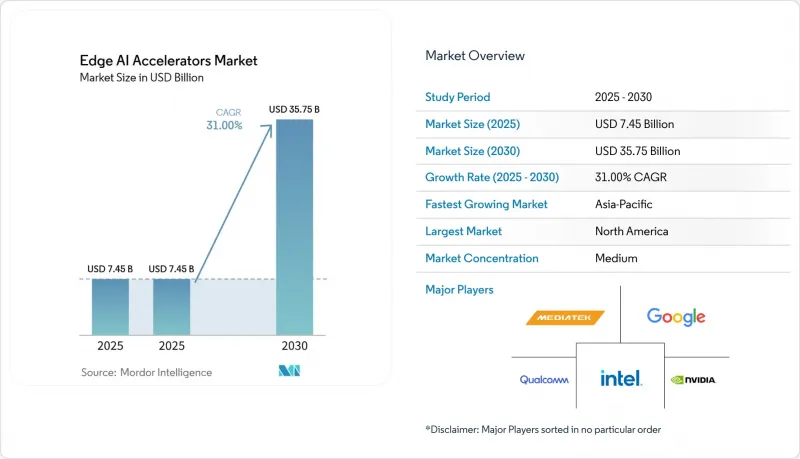
본 보고서는 하드웨어 유형별(ASIC, GPU, FPGA 등), 소비 전력 범위별(1W 미만, 1-3W, 기타), 폼 팩터별(시스템 온 칩, 모듈/보드, PCIe/엣지 카드, USB/스틱형 가속기), 용도별(컴퓨터 비전, 음성·자연어 처리(NLP) 등), 최종 사용자 산업별(소비자 가전, 자동차 등), 지역별로 분류되어 있습니다. 시장 전망은 시장 규모(달러)로 제시되어 있습니다.
세계의 엣지 AI 가속기 시장 동향 및 인사이트
스마트 카메라 및 IoT 기기의 보급
공장, 교통 시스템, 소매점에서의 지능형 카메라 대량 도입으로 인해 추론 처리가 엣지 측으로 이동하고 있습니다. 소니의 IMX500은 이미지 센서 내에 DSP를 내장하고 있어 프레임을 로컬에서 분석할 수 있으며, 네트워크 트래픽을 최대 90%까지 줄이고 의사결정 지연 시간을 10밀리초 미만으로 단축합니다. 마이크나 mm파 레이더가 동일한 엣지 보드에 탑재되는 사례가 증가하고 있으며, 가속기는 5-10W를 초과하지 않는 범위 내에서 비전, 오디오, 시계열 워크로드를 동시에 처리할 수 있어야 합니다.
데이터 개인정보 보호 규제가 온디바이스 추론을 촉진
EU AI법은 HIPAA나 GDPR(EU 개인정보보호규정)과 마찬가지로 환자 데이터, 금융 데이터, 국방 관련 데이터를 On-Premise에 보관할 것을 의무화하고 있습니다. 엣지에 최적화된 실리콘을 통해 병원 영상진단실, 은행 지점, 지자체 감시 네트워크는 알고리즘의 정교함을 저해하지 않으면서도 이러한 규정을 준수할 수 있게 됩니다. EdgeRunner AI는 대규모 언어 모델을 로컬에서 미세 조정하는 에어갭형 어시스턴트를 제공하여, 클라우드 노출을 차단하고 기밀 워크로드에 대한 제로 트러스트 요건을 충족합니다.
분산된 하드웨어·소프트웨어 생태계로 인해 통합 주기가 장기화
엣지 AI 가속기 시장은 CUDA, OpenVINO, TVM 및 벤더별 SDK에 API가 분산되어 있다는 과제에 직면해 있습니다. USB 메모리에서 개념 증명(PoC)을 시작하는 기업들은 메자닌 카드로 전환할 때 수개월에 걸친 코드 재작성을 감수해야 하는 경우가 많습니다. 통일된 벤치마크 기준의 부재는 ROI 승인을 복잡하게 만들고, 특히 엔지니어링 인력이 제한적인 중견 시장 OEM 기업에서 대량 발주를 지연시키고 있습니다. 벤더 간 ONNX 호환성은 개선되고 있지만, 디바이스 수준의 파워 게이팅 전략에는 여전히 수작업에 의한 커널 미세 조정이 필요하며, 이로 인해 고객은 단일 공급업체의 로드맵에 얽매이게 됩니다.
부문 분석
2024년, ASIC 디바이스는 엣지 AI 가속기 시장에서 47.2%의 점유율을 차지했으며, 범용 연산에서 TOPS/와트 기준 4-7배의 성능 향상을 가져오는 도메인 특화형 로직으로의 전환이 확인되었습니다. 설계가 3nm 공정으로 전환되고, SRAM의 근접성으로 인해 DRAM 페치 페널티가 대폭 감소함에 따라, 이 부문은 2030년까지 연평균 성장률(CAGR) 25.4%를 나타낼 것으로 전망됩니다. GPU는 소프트웨어 우선 프로토타이핑 분야에서 여전히 필수적이지만, 결정론적 지연 시간을 실현하는 추론 전용 코어에 양산 주도권을 넘겨주고 있습니다. FPGA는 재구성 가능성이 단가를 상회하는 항공우주 분야에서 틈새 시장 지위를 유지하고 있습니다. Intel Loihi 2와 같은 뉴로모픽 칩은 제약 만족 워크로드를 CPU에 비해 37배 적은 에너지로 실행합니다.
성능 밀도 측면에서는 감시용 NVR, 스마트 팩토리의 PLC, 그리고 차량 내 운전자 모니터링 분야에서 ASIC이 우위를 점하고 있습니다. 한편, 뇌를 모방한 실리콘에 기반한 엣지 AI 가속기 시장 규모는 이벤트 구동형 스파이크 네트워크가 신호 도착 시에만 발화하여 유휴 전류를 마이크로와트 단위까지 줄일 수 있다는 점에 힘입어 연평균 성장률(CAGR) 34%가 예상됩니다. ASIC 로드맵에서는 시스템 검증을 간소화하기 위해 보안 요소(Secure Element) 및 LPDDR-in-package의 통합이 점점 더 진행되고 있습니다. 자동차 업계의 Tier 1 공급업체들이 수년에 걸친 공급 계약을 체결함에 따라, 생산량 보장을 통해 팹은 마스크 수준에서 기능 안전 인증을 신속하게 진행할 인센티브를 얻고 있습니다.
2024년, 5-10W 대역은 엣지 AI 가속기 시장 규모의 38.1%를 차지하며, 팬이 없는 DIN 레일 컨트롤러나 가로등 기둥에 설치되는 컴퓨터 비전 노드에 채택되었습니다. 1W 미만 카테고리의 출하 대수는 2030년까지 연평균 성장률(CAGR) 28.7%로 확대될 전망이며, 코인형 배터리 방식의 웨어러블 단말기, 타이어 공기압 센서, 스마트 잠금장치 등이 상시 가동형 지능 기능을 추가함에 따라 출하 대수의 4분의 1 가까이 달할 것으로 예측됩니다.
뉴로모픽 칩과 메모리 내 처리(PIM) 칩은 이벤트 구동형 로직과 아날로그 연산을 활용하여 리프레시 주기를 단축함으로써, 이러한 초저전력화 추세를 주도하고 있습니다. PIMIC의 'Listen VL130'은 MAC 연산을 SRAM 내부에서 처리함으로써 DSP의 부하를 경감시키고, 디스크리트 MPU-DSP 조합에 비해 전력 소비를 10분의 1로 줄였습니다. 1-3W의 NPU에서 작동하는 엣지 최적화 BMS 알고리즘을 통해 전동 스쿠터의 배터리 주행 거리가 12% 연장되었습니다. 10W를 초과하는 높은 전력 소비 요구 사항은 랙 마운트형 통신 엣지 클러스터에서 여전히 존재하며, 이곳에서는 완전한 정밀도의 생성 모델에 100 TOPS 이상이 필요하고 AC 전원 공급 라인을 이용할 수 있습니다.
지역별 분석
실리콘밸리의 자동차 연구소 및 하이퍼스케일러의 연구개발 센터 내 얼리 어답터 생태계 덕분에, 2024년 매출의 40%를 북미가 차지했습니다. 제로 트러스트 및 국산 실리콘 조달에 관한 국방 지침으로 인해, 정부 계약은 더욱 국내 공급업체에 집중되고 있습니다.
아시아태평양의 연평균 성장률(CAGR) 29.88%는 정부 보조금과, 노드 미세화와 거의 보조를 맞추어 스마트폰, 스쿠터, CCTV 카메라를 AI 지원 모델로 전환시키는 수직 통합형 ODM 기업들에 의해 주도되고 있습니다. TSMC는 이미 전 세계 파운드리 시장의 62%를 장악하고 있으며, 엣지 ASIC 스타트업을 대상으로 3nm 웨이퍼의 안정적인 공급을 보장하고 있습니다. 한편, Socionext와 같은 일본의 팹리스 벤더는 현지 자동차 OEM 수요를 활용하여 지역 클러스터 형성을 추진하고 있습니다.
유럽에서는 GDPR(EU 개인정보보호규정) 및 AI 법이 기밀 데이터에 대한 온디바이스 추론을 의무화하고 있어, 생산량보다 규정 준수가 더 중요시되고 있습니다. 독일, 프랑스, 스웨덴의 자동차 제조업체들은 추적 가능성과 기능 안전성 증명을 보장하기 위해 ASIC 설계를 앞당겨 진행하고 있습니다. 중동에서는 엣지 AI 교통 카메라를 도입해 침수된 도로를 우회하도록 차량을 유도함으로써, 귀중한 수자원을 절약하려는 노력이 시작되고 있습니다. 남미에서는 불안정한 농촌 지역의 네트워크 환경에 대응하기 위해 오프라인 상태에서 작물의 스트레스 수준을 추정하는 스마트 농업용 드론의 실증 실험이 진행되고 있으며, 엣지 AI 가속기 시장의 발자취가 서서히 넓어지고 있습니다.
기타 혜택 :
- 엑셀 형식 시장 예측(ME) 시트
- 3개월간의 애널리스트 지원
자주 묻는 질문
목차
제1장 서론
제2장 조사 방법
제3장 주요 요약
제4장 시장 구도
제5장 시장 규모 및 성장 예측
제6장 경쟁 구도
제7장 시장 기회 및 향후 전망
KTH 26.08.10According to Mordor Intelligence, the edge AI accelerators market size stood at USD 7.45 billion in 2024 and is projected to register a 31% CAGR, lifting the value to USD 35.75 billion by 2030.
This report is Segmented by Hardware Type (ASIC, GPU, FPGA, and More), Power Consumption Envelope (Less Than 1W, 1-3W, and More), Form Factor (System-On-Chip, Module/Board, PCIe/Edge Card, USB/Stick Accelerator), Application (Computer Vision, Speech and NLP, and More), End-User Industry (Consumer Electronics, Automotive, and More), and Geography. The Market Forecasts are Provided in Terms of Value (USD).
Global Edge AI Accelerators Market Trends and Insights
Proliferation of Smart Cameras and IoT Devices
Mass deployment of intelligent cameras in factories, traffic systems, and retail spaces is pushing inference to the edge. Sony's IMX500 embeds a DSP inside the image sensor so frames are interpreted locally, slashing network traffic by up to 90% and shrinking decision latency below 10 ms. Multimodal references are rising as microphones and mm-wave radars piggyback on the same edge board, forcing accelerators to juggle vision, audio, and time-series workloads without exceeding 5-10 W.
Data-Privacy Regulations Driving On-Device Inference
The EU AI Act joins HIPAA and GDPR in demanding that patient, financial, and defense data stay on-premise. Edge-optimized silicon lets hospital imaging suites, bank branches, and municipal surveillance networks comply without sacrificing algorithmic sophistication. EdgeRunner AI ships air-gapped assistants that fine-tune large language models locally, eliminating cloud exposure and meeting zero-trust mandates for classified workloads.
Fragmented Hardware-Software Ecosystem Lengthens Integration Cycles
The Edge AI Accelerators market wrestles with APIs split across CUDA, OpenVINO, TVM, and vendor-specific SDKs. Enterprises spinning up proofs of concept on a USB stick often face multi-month rewrites when migrating to a mezzanine card. Absence of uniform benchmarking complicates ROI sign-off, delaying volume orders, especially for mid-market OEMs with lean engineering staffs. Cross-vendor ONNX compliance is improving, yet device-level power-gating tactics still require hand-tuned kernels that lock customers into single-supplier roadmaps.
Other drivers and restraints analyzed in the detailed report include:
- Falling USD/TOPS and Improved Performance-Per-Watt of Edge ASICs
- Edge-Native Foundation Models for Multimodal AI
- Thermal Management Limits in Fan-Less Designs
For complete list of drivers and restraints, kindly check the Table Of Contents.
Segment Analysis
ASIC devices captured 47.2% Edge AI Accelerators market share in 2024, confirming a pivot from general-purpose compute toward domain-tuned logic that drives 4-7X gains in TOPS-per-watt. The segment promises a 25.4% CAGR to 2030 as design starts migrate to 3 nm where SRAM proximity slashes DRAM fetch penalties. GPUs remain vital in software-first prototyping venues, yet they cede volume deployments to inference-only cores that deliver deterministic latency. FPGAs keep a niche in aerospace where reconfigurability outweighs unit cost. Neuromorphic chips such as Intel Loihi 2 run constraint-satisfaction workloads at 37X lower energy than CPUs.
Performance-densities favor ASICs for surveillance NVRs, smart-factory PLCs, and in-cab driver monitoring. Meanwhile, the Edge AI Accelerators market size attached to brain-inspired silicon forecasts a 34% CAGR because event-driven spiking networks fire only when a signal arrives, trimming idle current to microwatts. ASIC roadmaps increasingly bundle secure elements and LPDDR-in-package to simplify system validation. As automotive Tier 1s lock multi-year supply agreements, volume guarantees give fabs the incentive to fast-track functional-safety certification at the mask level.
The 5-10 W bracket held 38.1% of Edge AI Accelerators market size in 2024, serving fanless DIN-rail controllers and city-pole computer-vision nodes. Shipments within the <1 W category are projected to expand 28.7% CAGR through 2030, reaching nearly one-quarter of unit volume as coin-cell wearables, tire-pressure sensors, and smart locks add always-on intelligence.
Neuromorphic and processing-in-memory chips headline this ultra-low-power wave, using event-based logic and analog compute to shed refresh cycles. PIMIC's Listen VL130 reduces DSP workloads by routing MAC operations inside SRAM, cutting power 10X over discrete MPU-DSP combos. Edge-optimized BMS algorithms running on 1-3 W NPUs now prolong e-scooter battery range by 12%. Higher envelopes above 10 W persist in rack-mount telco edge clusters where full-precision generative models need >100 TOPS and AC feed lines are available.
Complete Report Scope:
- By Hardware Type
- ASIC
- GPU
- FPGA
- VPU / NPU
- Heterogeneous SoC
- By Power Consumption Envelope
- Less Than 1 W
- 1-3 W
- 3-5 W
- 5-10 W
- 10-20 W
- More Than 20 W
- By Form Factor
- System-on-Chip
- Module / Board
- PCIe / Edge Card
- USB / Stick Accelerator
- By Application
- Computer Vision
- Speech and Natural-Language Processing
- Predictive Maintenance / Anomaly Detection
- Autonomous Navigation and Control
- Sensor Fusion and Data Aggregation
- By End-User Industry
- Consumer Electronics and Wearables
- Automotive and Transportation
- Industrial and Manufacturing
- Smart Cities and Public Safety
- Healthcare and Life Sciences
- Aerospace and Defense
- Agriculture
- By Geography
- North America
- United States
- Canada
- Mexico
- South America
- Brazil
- Argentina
- Chile
- Rest of South America
- Europe
- Germany
- United Kingdom
- France
- Italy
- Spain
- Russia
- Rest of Europe
- Asia-Pacific
- China
- Japan
- South Korea
- India
- ASEAN
- Australia and New Zealand
- Rest of Asia-Pacific
- Middle East and Africa
- Middle East
- Saudi Arabia
- UAE
- Turkey
- Israel
- Rest of Middle East
- Africa
- South Africa
- Nigeria
- Egypt
- Rest of Africa
- Middle East
- North America
Geography Analysis
North America generated 40% of 2024 revenue thanks to early adopter ecosystems in Silicon Valley automotive labs and hyperscaler R&D centers. Defense directives on zero-trust and on-shore silicon sourcing further lock government contracts into domestic suppliers.
Asia-Pacific's 29.88% CAGR is propelled by state grants and vertically integrated ODMs that migrate smartphones, scooters, and CCTV cameras into AI-enabled variants nearly in lock-step with node shrinks. TSMC already controls 62% global foundry share, underwriting a stable supply of 3 nm wafers for edge ASIC startups while Japanese fabless vendors like Socionext leverage local automotive OEM demand to seed regional clusters.
Europe emphasizes compliance over volume, with GDPR and the AI Act mandating on-device inference for sensitive data. Automakers in Germany, France, and Sweden are frontloading ASIC design to guarantee traceability and functional-safety proofs. Emerging deployments in the Middle East use edge AI traffic cameras to conserve scarce water by routing vehicles away from flooded roads. South America pilots smart-agriculture drones that infer crop stress offline to accommodate patchy rural networks, gradually widening the Edge AI Accelerators market footprint.
- NVIDIA Corporation
- Intel Corporation
- Qualcomm Technologies Inc.
- Google LLC
- MediaTek Inc.
- Advanced Micro Devices (AMD)
- NXP Semiconductors N.V.
- Samsung Electronics Co. Ltd.
- Arm Ltd.
- Huawei Technologies Co. Ltd.
- Texas Instruments Inc.
- Lattice Semiconductor Corp.
- Hailo Technologies Ltd.
- Mythic Inc.
- Blaize Inc.
- BrainChip Holdings Ltd.
- Sima.AI
- Esperanto Technologies
- Tenstorrent Inc.
- Horizon Robotics
- EdgeQ Inc.
- Graphcore Ltd.
Additional Benefits:
- The market estimate (ME) sheet in Excel format
- 3 months of analyst support
TABLE OF CONTENTS
1 INTRODUCTION
- 1.1 Study Assumptions and Market Definition
- 1.2 Scope of the Study
2 RESEARCH METHODOLOGY
3 EXECUTIVE SUMMARY
4 MARKET LANDSCAPE
- 4.1 Market Overview
- 4.2 Market Drivers
- 4.2.1 Proliferation of smart cameras and IoT devices
- 4.2.2 Data-privacy regulations driving on-device inference
- 4.2.3 Falling USD/TOPS and improved performance-per-watt of edge ASICs
- 4.2.4 Bandwidth and latency constraints in autonomous systems
- 4.2.5 Emergence of TinyML frameworks on micro-controllers
- 4.2.6 Edge-native foundation models for multimodal AI
- 4.3 Market Restraints
- 4.3.1 Fragmented h/w-s/w ecosystem lengthens integration cycles
- 4.3.2 Thermal management limits in fan-less designs
- 4.3.3 Higher unit economics vs. cloud GPU at scale
- 4.3.4 Lack of standardized on-device AI benchmarks
- 4.4 Technological Outlook
- 4.5 Value Chain Analysis
- 4.6 Regulatory Landscape
- 4.7 Porters Five Forces Analysis
- 4.7.1 Threat of New Entrants
- 4.7.2 Bargaining Power of Suppliers
- 4.7.3 Bargaining Power of Buyers
- 4.7.4 Threat of Substitutes
- 4.7.5 Competitive Rivalry
5 MARKET SIZE AND GROWTH FORECASTS (VALUE)
- 5.1 By Hardware Type
- 5.1.1 ASIC
- 5.1.2 GPU
- 5.1.3 FPGA
- 5.1.4 VPU / NPU
- 5.1.5 Heterogeneous SoC
- 5.2 By Power Consumption Envelope
- 5.2.1 Less Than 1 W
- 5.2.2 1-3 W
- 5.2.3 3-5 W
- 5.2.4 5-10 W
- 5.2.5 10-20 W
- 5.2.6 More Than 20 W
- 5.3 By Form Factor
- 5.3.1 System-on-Chip
- 5.3.2 Module / Board
- 5.3.3 PCIe / Edge Card
- 5.3.4 USB / Stick Accelerator
- 5.4 By Application
- 5.4.1 Computer Vision
- 5.4.2 Speech and Natural-Language Processing
- 5.4.3 Predictive Maintenance / Anomaly Detection
- 5.4.4 Autonomous Navigation and Control
- 5.4.5 Sensor Fusion and Data Aggregation
- 5.5 By End-User Industry
- 5.5.1 Consumer Electronics and Wearables
- 5.5.2 Automotive and Transportation
- 5.5.3 Industrial and Manufacturing
- 5.5.4 Smart Cities and Public Safety
- 5.5.5 Healthcare and Life Sciences
- 5.5.6 Aerospace and Defense
- 5.5.7 Agriculture
- 5.6 By Geography
- 5.6.1 North America
- 5.6.1.1 United States
- 5.6.1.2 Canada
- 5.6.1.3 Mexico
- 5.6.2 South America
- 5.6.2.1 Brazil
- 5.6.2.2 Argentina
- 5.6.2.3 Chile
- 5.6.2.4 Rest of South America
- 5.6.3 Europe
- 5.6.3.1 Germany
- 5.6.3.2 United Kingdom
- 5.6.3.3 France
- 5.6.3.4 Italy
- 5.6.3.5 Spain
- 5.6.3.6 Russia
- 5.6.3.7 Rest of Europe
- 5.6.4 Asia-Pacific
- 5.6.4.1 China
- 5.6.4.2 Japan
- 5.6.4.3 South Korea
- 5.6.4.4 India
- 5.6.4.5 ASEAN
- 5.6.4.6 Australia and New Zealand
- 5.6.4.7 Rest of Asia-Pacific
- 5.6.5 Middle East and Africa
- 5.6.5.1 Middle East
- 5.6.5.1.1 Saudi Arabia
- 5.6.5.1.2 UAE
- 5.6.5.1.3 Turkey
- 5.6.5.1.4 Israel
- 5.6.5.1.5 Rest of Middle East
- 5.6.5.2 Africa
- 5.6.5.2.1 South Africa
- 5.6.5.2.2 Nigeria
- 5.6.5.2.3 Egypt
- 5.6.5.2.4 Rest of Africa
- 5.6.5.1 Middle East
- 5.6.1 North America
6 COMPETITIVE LANDSCAPE
- 6.1 Market Concentration
- 6.2 Strategic Moves
- 6.3 Market Share Analysis
- 6.4 Company Profiles (includes Global Level Overview, Market Level Overview, Core Segments, Financials as available, Strategic Information, Market Rank/Share, Products and Services, Recent Developments)
- 6.4.1 NVIDIA Corporation
- 6.4.2 Intel Corporation
- 6.4.3 Qualcomm Technologies Inc.
- 6.4.4 Google LLC
- 6.4.5 MediaTek Inc.
- 6.4.6 Advanced Micro Devices (AMD)
- 6.4.7 NXP Semiconductors N.V.
- 6.4.8 Samsung Electronics Co. Ltd.
- 6.4.9 Arm Ltd.
- 6.4.10 Huawei Technologies Co. Ltd.
- 6.4.11 Texas Instruments Inc.
- 6.4.12 Lattice Semiconductor Corp.
- 6.4.13 Hailo Technologies Ltd.
- 6.4.14 Mythic Inc.
- 6.4.15 Blaize Inc.
- 6.4.16 BrainChip Holdings Ltd.
- 6.4.17 Sima.ai
- 6.4.18 Esperanto Technologies
- 6.4.19 Tenstorrent Inc.
- 6.4.20 Horizon Robotics
- 6.4.21 EdgeQ Inc.
- 6.4.22 Graphcore Ltd.
7 MARKET OPPORTUNITIES AND FUTURE OUTLOOK
- 7.1 White-space and Unmet-Need Assessment


