|
시장보고서
상품코드
2097423
감자 수확 기계 : 시장 점유율 분석, 업계 동향 및 통계, 성장 예측(2026-2031년)Potato Harvesting Machinery - Market Share Analysis, Industry Trends & Statistics, Growth Forecasts (2026 - 2031) |
||||||
 Mordor Intelligence
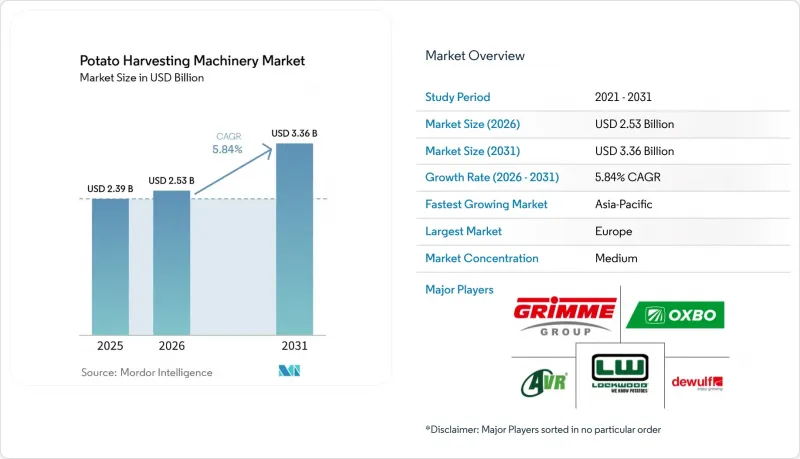
Mordor Intelligence에 의하면, 감자 수확 기계 시장은 2025년에 23억 9,000만 달러 규모로 평가되었습니다. 2026년 25억 3,000만 달러에서 2031년까지 33억 6,000만 달러로 성장하여 2026년부터 2031년에 걸쳐 CAGR 5.84%를 나타낼 것으로 예측됩니다.
본 보고서는 기계 유형(자주식 수확기, 견인식 수확기 등), 자동화 수준(기존 수확기, 자동 수확기 등), 농장 규모(소규모 농장, 중규모 농장 등) 및 지역(북미, 남미, 유럽, 아시아태평양, 중동 및 아프리카)별로 분류되어 있습니다. 시장 전망은 금액(달러) 기준으로 제시되어 있습니다.
세계의 감자 수확 기계 시장 동향 및 인사이트
농업 인력 부족 및 계절별 임금 상승
농업 인건비 상승은 기계화 시스템의 투자 회수 기간을 단축시킴으로써 감자 수확 기계 시장의 성장을 가속하고 있습니다. 미국 농무부 국립농업통계국(NARS) 보고서에 따르면, 2024년 7월부터 10월까지 농장 근로자의 평균 시급은 18.42달러였습니다. 미국 농무부 경제조업체국(EBS)의 예측에 따르면, 2025년에는 인건비가 더욱 상승할 것으로 예상되어 생산자에 대한 압박은 점점 더 커지고 있습니다. 2024 회계연도 H-2A 임시 농업 비자 승인 건수는 38만 5,000건에 달했으나, 계절 노동력 공급 부족은 여전히 지속되고 있습니다. 노동 집약적이고 시기를 놓쳐서는 안 되는 감자 재배 분야에서 이러한 추세로 인해, 특히 대규모 재배의 경우 수작업 수확이 현실적으로 불가능해짐에 따라 생산자들은 기계화된 수확 시스템으로의 전환을 피할 수 없게 되었습니다.
정밀 수확과 스마트 기계의 업그레이드
생산자들이 데이터 기반의 효율화와 제어에 주력하는 가운데, 정밀 기능은 이제 감자 수확 기계 시장의 핵심이 되었습니다. 미국 정부감사원(GAO)의 2024년 1월 조사 보고서에 따르면, GPS 기반 자동 조향 및 수확량 모니터링이 널리 채택되고 있으며, 2024년 대두 재배 면적에서 가이드 시스템 사용의 53%를 자동 조향이 차지하는 것으로 나타났습니다. 이러한 변화를 반영하여 GRIMME 그룹은 2025년 4월, 2열식 VARITRON 시리즈를 강화했습니다. 이 시리즈에는 CCI 1200 터미널, 최대 13대의 카메라를 지원하는 SmartView 비디오 기능, 그리고 옵션으로 제공되는 수확량 매핑 기능이 탑재되어 있습니다. 이러한 혁신은 농업 데이터와 기계 데이터의 통합이 점점 더 중요해지고 있음을 보여주며, 수확 시즌을 넘어 시장의 가치를 확대되고 있습니다. 가공업체, 금융 기관, 자재 공급업체가 정보에 기반한 의사결정을 내릴 수 있도록 함으로써, 감자 수확 기계 시장은 공급망 전반에 걸쳐 효율성과 장기적인 운영상의 이점을 촉진하고 있습니다.
높은 초기 도입 비용과 긴 투자 회수 기간
감자 수확 기계의 높은 초기 투자 비용은 시장 성장을 현저히 제한하고 있습니다. 이는 고급 기종의 가격이 많은 생산자의 재정 능력을 초과하는 경우가 많기 때문입니다. 예를 들어, 유럽의 주요 제조업체가 생산하는 신형 4열 자가주행 기계의 가격은 40만 유로(43만 2,000달러)를 초과하여, 경작 면적이 제한적인 농장이나 계획 기간이 짧은 농장에게는 감당하기 어려운 수준입니다. 2024년 1월 미국 정부감사원(GAO)이 실시한 조사에서는 높은 도입 비용이 중소규모 농장의 정밀 농업 도입을 저해하고 있다는 점이 강조되었으며, 이 과제는 고성능 감자 수확 기계에도 마찬가지로 적용됩니다. 한 시즌당 수확 면적이 100-150헥타르 미만인 농장의 경우, 10-15년에 달하는 투자 회수 기간은 대부분의 경우 생산자의 재정 능력을 초과합니다. 도급업체, 협동조합 및 도급 서비스가 부분적인 해결책을 제공하고는 있지만, 이용 가능성에 편차가 있어 특히 신흥 지역에서 시장 성장이 계속해서 제한되고 있으며, 높은 초기 비용이 여전히 고질적인 과제임을 여실히 보여주고 있습니다.
부문 분석
2025년에는 자가 주행식 수확기가 감자 수확 기계 시장 규모의 49.0%라는 최대 점유율을 차지하며 시장을 주도했습니다. 이러한 우위는 높은 처리량과 한 번의 통과로 수확을 실현하는 능력에서 비롯되며, 속도, 분리 품질, 벙커 관리를 단일 플랫폼에서 필요로 하는 상업 농장 및 도급업자의 요구를 충족시킵니다. 트랙터에 대한 의존도를 없애줌으로써, 이러한 기계는 특히 수확 기간이 짧은 경우에 매우 중요한 굴착 속도, 줄기와 잎의 분리, 적재량을 작업자가 정밀하게 제어할 수 있게 해줍니다.
견인식 수확기는 2026년부터 2031년까지 연평균 성장률(CAGR) 6.5%를 기록하며 가장 빠르게 성장하는 기종이 될 것으로 예측됩니다. 'Potato Europe 2025'에서 전시된 AVR BV사의 'Spirit 9200i VW'와 같은 혁신적인 제품은 Varioweb 모듈 및 ISOBUS 지원과 같은 첨단 기술이 얼마나 비용 효율적인 플랫폼에 통합되어 있는지를 보여줍니다. 한편, 아시아태평양, 남미, 아프리카의 소규모 농장에서는 마운트식 수확기가 여전히 중요한 역할을 수행하고 있으며, 수작업이나 반기계화 시스템에서 벗어나기 위한 수단으로 활용되고 있습니다.
지역별 분석
2025년 감자 수확 기계 시장에서 유럽은 35.0%를 차지하며 최대 점유율을 기록했습니다. 독일, 프랑스, 네덜란드, 영국 등의 국가들은 대규모 상업용 감자 재배, 견실한 가공 산업, 그리고 확립된 유통업체 네트워크를 통해 이러한 수요를 주도하고 있습니다. 유엔 식량농업기구(FAO)의 데이터에 따르면, 2024년 유럽에서는 400만 헥타르의 재배 면적에서 1억 100만 메트르톤의 감자가 생산되었으며, 수확 면적이 감소했음에도 불구하고 2023년 대비 수확량이 2.03% 증가했습니다. 이는 생산성과 정밀성에 대한 집중이 강조되고 있음을 보여줍니다. 이 지역의 성장은 장비 교체 주기와 커넥티드 기술, 적응형 세척 기술 등 첨단 시스템의 도입과 관련이 있습니다.
아시아태평양은 감자 수확 기계 시장에서 가장 빠르게 성장하는 지역 부문으로, 2026년부터 2031년까지 연평균 성장률(CAGR) 6.8%로 성장할 것으로 예측됩니다. 2024년에는 중국과 인도가 전 세계 감자 생산에 크게 기여하며 기계화 수확을 위한 탄탄한 기반을 마련했습니다. 최대 생산국인 중국은 내몽골 및 광둥성 등의 지역에서 다열식 자가주행 시스템에 대한 수요를 주도하고 있습니다. 반면, 미국, 캐나다, 독일, 네덜란드, 프랑스, 벨기에를 포함한 주요 유럽 국가 등 선진국에서는 첨단 기술, 자동화, 효율적인 품질 관리 시스템을 통해 훨씬 더 높은 가공 수준을 달성하고 있습니다. 일본과 호주는 높은 인건비와 확립된 유통업체 네트워크를 바탕으로 프리미엄 부문을 형성하며, 해당 지역의 전반적인 성장을 보완하고 있습니다.
아이다호주, 워싱턴주, 프린스에드워드섬에 주요 농업 지역을 보유한 북미에서는 가공업체들의 엄격한 품질 기준으로 인해 완만한 성장이 예상됩니다. 남미에서는 브라질과 아르헨티나 등 국가에서 가공에 대한 투자 확대와 농지 규모 확장에 힘입어 성장이 나타나고 있습니다. 중동에서는 튀르키예와 사우디아라비아가 현대화 프로그램을 통해 기계화를 추진하고 있는 반면, 아프리카에서는 자금 조달 제한이나 딜러 네트워크의 불균형과 같은 과제에 직면해 있습니다. 그러나 남아프리카공화국과 이집트에서는 상업적 농업 활동이 활발해지고 있습니다. 2025년 9월에는 GRIMME 그룹이 케이프타운에 지사를 개설하여 남부 아프리카 생산자에 대한 지원을 강화하겠다는 주목할 만한 움직임이 있었습니다. 각 지역을 막론하고 시장의 성장은 진화하는 농업 수요에 부응하기 위한 생산성, 기계화 및 첨단 수확 기술에 대한 공통된 집중을 통해 상호 연관되어 있습니다.
기타 혜택 :
- 엑셀 형식 시장 예측(ME) 시트
- 3개월간의 애널리스트 지원
자주 묻는 질문
목차
제1장 서론
제2장 조사 방법
제3장 주요 요약
제4장 시장 구도
제5장 시장 규모 및 성장 예측
제6장 경쟁 구도
제7장 시장 기회 및 향후 전망
KTH 26.08.05According to Mordor Intelligence, the potato harvesting machinery market is valued at USD 2.39 billion in 2025 and is anticipated to grow from USD 2.53 billion in 2026 to USD 3.36 billion by 2031, registering a CAGR of 5.84% through 2026-2031.
This report is Segmented by Machine Type (Self-Propelled Harvesters, Trailed Harvesters, and More), by Automation Level (Conventional Harvesters, Automated Harvesters, and More), by Farm Scale (Small Farms, Medium Farms, and More), and by Geography (North America, South America, Europe, Asia-Pacific, Middle East, and Africa). The Market Forecasts are Provided in Terms of Value (USD).
Global Potato Harvesting Machinery Market Trends and Insights
Farm Labor Scarcity and Rising Seasonal Wages
Rising farm labor costs are driving the growth of the potato harvesting machinery market by shortening the payback period for mechanized systems. The United States Department of Agriculture National Agricultural Statistics Service reported that average field worker wages from July to October 2024 were USD 18.42 per hour. With labor expenses projected to rise further in 2025, as per the United States Department of Agriculture Economic Research Service, the pressure on growers continues to intensify. Despite H-2A temporary agricultural visa certifications reaching 385,000 in fiscal 2024, the seasonal labor supply gap persists. In labor-intensive and time-sensitive potato operations, these trends are compelling growers to transition to mechanized harvesting systems, particularly as manual methods become impractical at larger scales.
Precision Harvesting and Smart-Machine Upgrades
Precision features are now central to the potato harvesting machinery market as growers focus on data-driven efficiency and control. A January 2024 review by the United States Government Accountability Office reported that GPS-supported autosteer and yield monitoring were widely adopted, with automated steering accounting for 53% of guidance system use on soybean crop acreage in 2024. Reflecting this shift, GRIMME Group enhanced its two-row VARITRON series in April 2025 with the CCI 1200 terminal, SmartView video support for up to 13 cameras, and optional yield mapping. These innovations underscore the growing importance of integrated agronomic and machine data, extending the market's value beyond the harvest season. By enabling informed decisions for processors, lenders, and input suppliers, the potato harvesting machinery market is driving efficiency and long-term operational benefits across the supply chain.
High Upfront Machine Cost and Long Payback
The high capital cost of potato harvesting machinery significantly limits market growth, as premium equipment often exceeds many growers' financial capacity. For example, new four-row self-propelled machines from leading European manufacturers are priced above EUR 400,000 (USD 432,000), making them inaccessible for farms with limited acreage or shorter planning horizons. A January 2024 review by the United States Government Accountability Office emphasized that high acquisition costs hinder the adoption of precision agriculture on small and medium farms, a challenge equally applicable to premium potato harvesters. For farms harvesting less than 100 to 150 hectares per season, payback periods of 10 to 15 years often exceed growers' financial capabilities. While contractors, cooperatives, and custom hiring services offer partial solutions, their uneven availability continues to restrict market growth, particularly in emerging regions, underscoring the persistent challenge of high upfront costs.
Other drivers and restraints analyzed in the detailed report include:
- Processed-Potato Demand Raising Harvest Quality Requirements
- Mechanization Subsidies and Modernization Programs
- Skilled Operator and Service-Network Shortages
For complete list of drivers and restraints, kindly check the Table Of Contents.
Segment Analysis
Self-propelled harvesters led, holding the largest 49.0% share of the potato harvesting machinery market size in 2025. Their dominance stems from their ability to deliver high-throughput, single-pass harvesting, meeting the needs of commercial farms and contractors that require speed, separation quality, and bunker management in a single platform. By eliminating tractor dependency, these machines provide operators with precise control over digging speed, haulm separation, and loading flow, especially critical during narrow harvest windows.
Trailed harvesters are projected to be the fastest-growing machine type, with a 6.5% CAGR over 2026-2031. Innovations such as AVR BV's Spirit 9200i VW, showcased at Potato Europe 2025, demonstrate how advanced technologies, such as the Varioweb module and ISOBUS compatibility, are being integrated into cost-effective platforms. At the same time, mounted harvesters remain significant for smaller farms in Asia-Pacific, South America, and Africa, serving as a transitional option from manual or semi-mechanized systems.
Complete Report Scope:
- By Machine Type
- Self-propelled harvesters
- Trailed harvesters
- Mounted harvesters
- By Automation Level
- Conventional harvesters
- Automated harvesters
- GPS-enabled and connected harvesters
- By Farm Scale
- Small farms
- Medium farms
- Large commercial farms
- By Geography
- North America
- United States
- Canada
- Mexico
- Rest of North America
- South America
- Brazil
- Argentina
- Rest of South America
- Europe
- Germany
- France
- United Kingdom
- Netherlands
- Russia
- Rest of Europe
- Asia-Pacific
- China
- India
- Japan
- Australia
- Rest of Asia-Pacific
- Middle East
- Turkey
- Saudi Arabia
- Rest of Middle East
- Africa
- South Africa
- Egypt
- Rest of Africa
- North America
Geography Analysis
Europe held the largest share, accounting for 35.0% of the potato harvesting machinery market in 2025. Countries such as Germany, France, the Netherlands, and the United Kingdom drive this demand through extensive commercial potato farming, robust processing, and established dealer networks. Food and Agriculture Organization (FAO) data indicates Europe produced 101 million metric tons of potatoes from 4.0 million hectares in 2024, with a 2.03% yield increase from 2023 despite reduced harvested areas, highlighting a focus on productivity and precision. The region's growth is linked to replacement cycles and the adoption of advanced systems, such as connected and adaptable cleaning technologies.
Asia-Pacific is the fastest regional segment in the potato harvesting machinery market and is projected to expand at 6.8% CAGR during 2026-2031. In 2024, China and India significantly contributed to global potato production, creating a large base for mechanized harvesting. China, the largest producer, drives demand for multi-row self-propelled systems in regions such as Inner Mongolia and Yunnan. In comparison, developed countries such as the United States, Canada, and key European nations, including Germany, the Netherlands, France, and Belgium, achieve much higher processing levels due to advanced technologies, automation, and efficient quality control systems. Japan and Australia represent the premium segment due to high labor costs and established dealer networks, complementing the region's overall growth.
North America, with significant farming regions in Idaho, Washington, and Prince Edward Island, is anticipated to witness moderate growth due to strict processor-quality standards. In South America, countries such as Brazil and Argentina are experiencing growth driven by increased processing investments and larger field scales. In the Middle East, Turkey and Saudi Arabia promote mechanization through modernization programs, while Africa faces challenges such as limited financing and uneven dealer networks. However, South Africa and Egypt show stronger commercial farming activity. A notable development in September 2025 saw GRIMME Group opening a branch in Cape Town, enhancing support for southern African growers. Across regions, the market's growth is interconnected by a shared focus on productivity, mechanization, and advanced harvesting technologies to meet evolving agricultural demands.
- GRIMME Group
- Dewulf Group
- AVR BV
- Lockwood Manufacturing
- Oxbo
- Allan Equipment Manufacturing Ltd.
- ROPA Fahrzeug- und Maschinenbau GmbH
- Standen Engineering Ltd.
- Advanced Farm Equipment LLC
- Unia Sp. z o.o.
- VSS Machinebouw B.V.
- Kujawska Fabryka Maszyn Rolniczych Sp. z o.o.
- J.J. Broch, S.L.
- Bomet Sp. z o.o.
- Shandong Transce Agricultural Machinery Technology Co., Ltd.
Additional Benefits:
- The market estimate (ME) sheet in Excel format
- 3 months of analyst support
TABLE OF CONTENTS
1 Introduction
- 1.1 Study Assumptions and Market Definition
- 1.2 Scope of the Study
2 Research Methodology
3 Executive Summary
4 Market Landscape
- 4.1 Market Overview
- 4.2 Market Drivers
- 4.2.1 Farm labor scarcity and rising seasonal wages
- 4.2.2 Precision harvesting and smart-machine upgrades
- 4.2.3 Processed-potato demand raising harvest quality requirements
- 4.2.4 Mechanization subsidies and modernization programs
- 4.2.5 Processor contract penalties for bruising and foreign material
- 4.2.6 Weather-compressed harvest windows favoring high-capacity machines
- 4.3 Market Restraints
- 4.3.1 High upfront machine cost and long payback
- 4.3.2 Skilled operator and service-network shortages
- 4.3.3 Soil variability and tuber bruise sensitivity
- 4.3.4 Seasonal utilization limiting fleet economics
- 4.4 Regulatory Landscape
- 4.5 Technological Outlook
- 4.6 Porter's Five Forces
- 4.6.1 Threat of new entrants
- 4.6.2 Bargaining power of suppliers
- 4.6.3 Bargaining power of buyers
- 4.6.4 Threat of substitutes
- 4.6.5 Intensity of competitive rivalry
5 Market Size and Growth Forecasts (Value)
- 5.1 By Machine Type
- 5.1.1 Self-propelled harvesters
- 5.1.2 Trailed harvesters
- 5.1.3 Mounted harvesters
- 5.2 By Automation Level
- 5.2.1 Conventional harvesters
- 5.2.2 Automated harvesters
- 5.2.3 GPS-enabled and connected harvesters
- 5.3 By Farm Scale
- 5.3.1 Small farms
- 5.3.2 Medium farms
- 5.3.3 Large commercial farms
- 5.4 By Geography
- 5.4.1 North America
- 5.4.1.1 United States
- 5.4.1.2 Canada
- 5.4.1.3 Mexico
- 5.4.1.4 Rest of North America
- 5.4.2 South America
- 5.4.2.1 Brazil
- 5.4.2.2 Argentina
- 5.4.2.3 Rest of South America
- 5.4.3 Europe
- 5.4.3.1 Germany
- 5.4.3.2 France
- 5.4.3.3 United Kingdom
- 5.4.3.4 Netherlands
- 5.4.3.5 Russia
- 5.4.3.6 Rest of Europe
- 5.4.4 Asia-Pacific
- 5.4.4.1 China
- 5.4.4.2 India
- 5.4.4.3 Japan
- 5.4.4.4 Australia
- 5.4.4.5 Rest of Asia-Pacific
- 5.4.5 Middle East
- 5.4.5.1 Turkey
- 5.4.5.2 Saudi Arabia
- 5.4.5.3 Rest of Middle East
- 5.4.6 Africa
- 5.4.6.1 South Africa
- 5.4.6.2 Egypt
- 5.4.6.3 Rest of Africa
- 5.4.1 North America
6 Competitive Landscape
- 6.1 Market Concentration
- 6.2 Strategic Moves
- 6.3 Market Share Analysis
- 6.4 Company Profiles (Includes Global Level Overview, Market Level Overview, Core Segments, Financials as Available, Strategic Information, Market Rank/Share for Key Companies, Products and Services, and Recent Developments)
- 6.4.1 GRIMME Group
- 6.4.2 Dewulf Group
- 6.4.3 AVR BV
- 6.4.4 Lockwood Manufacturing
- 6.4.5 Oxbo
- 6.4.6 Allan Equipment Manufacturing Ltd.
- 6.4.7 ROPA Fahrzeug- und Maschinenbau GmbH
- 6.4.8 Standen Engineering Ltd.
- 6.4.9 Advanced Farm Equipment LLC
- 6.4.10 Unia Sp. z o.o.
- 6.4.11 VSS Machinebouw B.V.
- 6.4.12 Kujawska Fabryka Maszyn Rolniczych Sp. z o.o.
- 6.4.13 J.J. Broch, S.L.
- 6.4.14 Bomet Sp. z o.o.
- 6.4.15 Shandong Transce Agricultural Machinery Technology Co., Ltd.