|
시장보고서
상품코드
2113730
수확 기계 : 시장 점유율 분석, 업계 동향 및 통계, 성장 예측(2026-2031년)Harvesting Machinery - Market Share Analysis, Industry Trends & Statistics, Growth Forecasts (2026 - 2031) |
||||||
 Mordor Intelligence
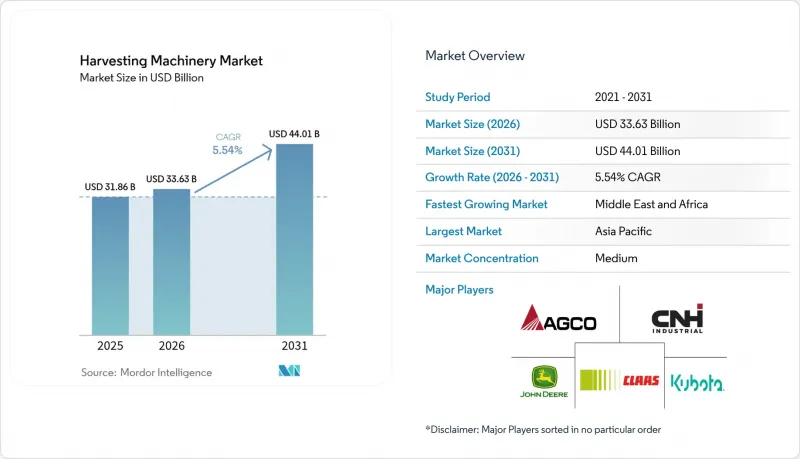
Mordor Intelligence에 의하면, 수확 기계 시장 규모는 2025년에 318억 6,000만 달러로 평가되었습니다. 2026년 336억 3,000만 달러에서 2031년까지 440억 1,000만 달러에 이를 것으로 예상되며, 예측 기간(2026-2031년) CAGR은 5.54%를 나타낼 전망입니다.
본 보고서는 기계 유형(콤바인, 사료용 수확기 등), 동력원(디젤, 하이브리드/전기), 작물 유형(곡물, 사료작물 등), 지역(북미, 유럽, 남미 등)별로 분류되어 있습니다. 시장 전망은 금액(달러) 및 수량(대수)의 관점에서 제시되어 있습니다.
세계의 수확 기계 시장 동향 및 인사이트
대용량 콤바인에 대한 수요 증가
중국과 인도에서는 대규모 농업 클러스터가 등장하고, 정책 입안자들이 현대적인 설비에 대한 보조금을 투입하고 있어 기계 수확이 탄력을 받고 있습니다. 처리 능력이 뛰어난 콤바인으로 광범위한 작물을 수확함으로써 수확 후 손실을 줄이고, 곡물의 품질을 향상시키며, 파종 주기 간의 전환 시간을 단축할 수 있습니다. 이러한 규모, 기술, 정책의 시너지 효과로 인해 중기적으로는 해당 지역이 콤바인 업그레이드 분야에서 선도적인 위치를 유지할 것으로 전망됩니다.
개발도상국의 기계화를 가속화하는 정부의 인센티브
공적 보조금, 세금 환급, 이자 지원 대출이 특히 아프리카와 남미 일부 지역에서 수확 기계 시장을 재편하고 있습니다. 각국의 기계화 로드맵에서는 수확기가 트랙터와 함께 우선순위로 지정되어 있으며, 수확 후 손실 감소 및 식량 안보 목표 달성에 필수적인 요소로 간주되고 있습니다. 일부 국가에서는 보조금을 국내 조립 조건과 연계하여, 세계 브랜드에 대해 노크다운(KD) 시설 설립이나 애프터서비스 지원을 위한 현지 파트너와의 제휴를 촉진하고 있습니다.
높은 초기 비용과 소규모 농가의 소득 수준 간 격차
최신 콤바인의 가격은 30만-50만 달러에 달하며, 이 금액은 대부분의 소규모 농가에게는 감당하기 어려운 수준입니다. 아프리카와 남아시아의 토지 소유 분할은 기계 이용률을 저하시키고 투자 회수 기간을 장기화시키고 있습니다. 심각한 자금 조달 어려움은 기술 도입 격차를 확대하고, 연비나 곡물 품질 면에서 성능이 떨어지며 노후화되어 배출량이 많은 기계의 유통 시장을 지속시키고 있습니다.
부문 분석
2025년에는 콤바인이 수확 기계 시장 전체의 64.40%를 차지하며 가장 큰 수익을 창출했습니다. 센싱 모듈과 자동화 패키지의 지속적인 개선을 통해, 현재 작업자는 탈곡, 선별, 세척 조정의 대부분을 소프트웨어에 맡길 수 있게 되었으며, 이를 통해 처리 능력이 향상되는 동시에 연료도 절약되고 있습니다. 이러한 높은 비용 대비 효과는 노동력 부족에 직면한 상업 농장의 교체 수요를 견인하고 있습니다. 수작업 수확에 따른 수확량 감소 위험이 높아지고 있는 데다, 건강 및 안전 관련 규제가 더해지면서, 이 지역에서는 자가주행형 사탕수수 수확기 도입이 더욱 타당해지고 있습니다.
대조적으로, 사탕수수 수확기의 생산량은 적지만, 브라질, 인도, 태국에서 기계화된 사탕수수 재배 면적이 확대됨에 따라 2031년까지 연평균 성장률(CAGR) 7.20%를 나타낼 것으로 예측됩니다. 수작업 수확에 따른 수확량 감소 위험이 높아지고 있는 데다, 노동 안전 및 보건 규제가 더해지면서, 이 지역에서는 자가 주행식 사탕수수 수확기의 도입이 더욱 촉진될 전망입니다. 각 제조업체는 좁은 줄간격, 가파른 경사면, 습한 토양에 대응할 수 있는 사탕수수용 모델을 개발하고 있으며, 빌렛 길이의 균일성 및 추출 팬의 회전수를 보고하는 텔레매틱스 기능을 통합하고 있습니다. 이러한 작물에 특화된 개선 사항이 프리미엄 가격 책정을 뒷받침하고 있습니다. 젖소 사료의 품질에 필수적인 사료용 수확기는 작업자가 절단 길이를 정밀하게 제어할 수 있는 모델이나 사일리지용 접종제 살포 장치를 갖춘 모델로 업그레이드됨에 따라 한 자릿수 중반대의 성장세를 유지하고 있습니다.
지역별 분석
아시아태평양은 수확 기계 시장의 44.60%를 차지하고 있으며 2031년까지 세계 평균을 상회하는 성장률을 지속하고 있습니다. 중국의 농지 급속한 집약화와 인도의 도급 수확용 차량 증가가 지속적인 차량 교체를 촉진하고 있습니다. 중국에서는 각 성의 보조금 제도를 통해 대상 기계 비용의 최대 30%가 환급되므로, 국가의 수확량 향상 목표에 부합하는 정밀 안내 기능을 갖춘 모델로의 기술 선택이 촉진되고 있습니다.
중동 및 아프리카는 2026년부터 2031년에 걸쳐 연평균 성장률(CAGR) 7.62%를 기록하며 가장 빠르게 성장하고 있는 지역입니다. 각국 정부는 곡물의 자급자족을 확보하고, 소규모 농가 시스템에서 20%를 넘기도 하는 수확 후 손실을 줄이기 위해 기계화를 우선시하고 있습니다. 부품에 대한 수입 관세 면제와 협동조합의 수확기 대열에 대한 신용 보증은 규모의 경제 효과를 활용하기 위한 것입니다. 중동은 여전히 신흥 지역이며, 제어 환경 농업이나 정부 지원에 의한 사막 농업에서는 온실 재배 토마토, 잎채소, 대추야자용 전용 수확기가 필요합니다. 투자 우대 조치와 자유무역지대의 물류 체제를 통해 다국적 기업이 지역 유통 거점을 설립하도록 장려되고 있으며, 리드타임 단축과 부품 공급 체제 정비가 추진되고 있습니다.
북미와 유럽은 합쳐서 전 세계 매출의 4분의 1을 차지하고 있지만, 업데이트 동향에는 차이가 보입니다. 북미의 생산자들은 기존 차량 군에 자율 주행 기능이나 커넥티비티를 통합하는 데 주력하고 있으며, 자산의 수명을 연장하면서 고도의 기능을 제공하는 사후 장착 키트에 대한 수요가 높아지고 있습니다. 반면, 유럽에서는 엄격한 배기가스 규제와 공동농업정책(CAP)에 따른 인센티브에 힘입어 하이브리드차와 전기차의 도입이 가속화되고 있습니다.
기타 혜택 :
- 엑셀 형식 시장 예측(ME) 시트
- 3개월간의 애널리스트 지원
자주 묻는 질문
목차
제1장 서론
제2장 조사 방법
제3장 주요 요약
제4장 시장 구도
제5장 시장 규모 및 성장 예측
제6장 경쟁 구도
제7장 시장 기회 및 향후 전망
KTH 26.08.26According to Mordor Intelligence, the harvesting machinery market size was valued at USD 31.86 billion in 2025 and estimated to grow from USD 33.63 billion in 2026 to reach USD 44.01 billion by 2031, at a CAGR of 5.54% during the forecast period (2026-2031).
This report is Segmented by Machinery Type (Combine Harvester, Forage Harvester, and More), by Power Source (Diesel and Hybrid/Electric), by Crop Type (Grains and Cereals, Forage Crops, and More), and by Geography (North America, Europe, South America, and More). The Market Forecasts are Provided in Terms of Value (USD) and Volume (Units).
Global Harvesting Machinery Market Trends and Insights
Rising Demand for High-Capacity Combine Harvesters
Mechanical harvesting is gaining momentum across China and India as larger farm clusters emerge and policymakers channel subsidies toward modern equipment. Broad-acre crops harvested with high throughput combine lower post-harvest losses, improve grain quality, and shorten turnaround times between planting cycles. This confluence of scale, technology, and policy is projected to maintain the region's leadership in combined upgrades through the medium term.
Government Incentives Accelerating Mechanization in Developing Economies
Public-sector grants, tax rebates, and subsidized loans are reshaping the harvesting machinery market, particularly in Africa and parts of South America. National mechanization roadmaps now prioritize harvesters alongside tractors, viewing them as essential to post-harvest loss reduction and food-security targets. Several countries are linking subsidies to domestic assembly conditions, nudging global brands to establish knock-down facilities and engage local partners for after-sales support.
High Upfront Cost Versus Small-Farm Income Levels
Modern combines can cost between USD 300,000 and USD 500,000, a figure beyond the reach of most smallholders. Fragmented land holdings in Africa and South Asia dilute machinery utilization rates and elongate payback periods. Acute financing gaps widen technology adoption divides and sustain a secondary market for aging, high-emission machines that underperform on fuel and grain quality.
Other drivers and restraints analyzed in the detailed report include:
- Labor Scarcity and Wage Inflation are Pushing Automation
- Integration of Precision Agriculture and Telematics into Harvesters
- Limited Dealer and Service Networks in Africa and the Middle East
For complete list of drivers and restraints, kindly check the Table Of Contents.
Segment Analysis
Combine harvesters generated the highest revenue in 2025, accounting for 64.40% of the harvesting machinery market. Continuous improvements in sensing modules and automation packages now enable operators to delegate most threshing, separation, and cleaning adjustments to software, which raises throughput while conserving fuel. The cost-benefit proposition drives replacement demand among commercial farms facing tighter labor markets. Rising yield penalties from manual cutting, plus health and safety rules, strengthen the case for self-propelled cane machines in these regions.
In contrast, sugar-cane harvesters, though smaller in volume, are forecast to post a 7.20% CAGR to 2031 as Brazil, India, and Thailand expand the acreage under mechanized cane. Rising yield penalties from manual cutting, plus health and safety rules, strengthen the case for self-propelled cane machines in these regions. Manufacturers tailor sugar-cane models for narrow-row layouts, steep slopes, and wetter soils, integrating telematics that report billet length uniformity and extractor-fan speed. Such crop-specific refinements support premium pricing. Forage harvesters, essential for dairy ration quality, maintain mid-single-digit growth as operators upgrade to models with precision chop length control and silage-inoculant applicators.
Complete Report Scope:
- By Machinery Type
- Combine Harvesters
- Forage Harvesters
- Other Harvesters (Sugarcane Harvesters, Potato Harvesters, Beet Harvesters, Cotton Harvesters, etc.)
- By Power Source
- Diesel
- Hybrid/Electric
- By Crop Type
- Grains and Cereals
- Forage Crops
- Horticultural Crops
- Speciality Crops (Sugarcane, Cotton, and Others)
- By Geography
- North America
- United States
- Canada
- Mexico
- Rest of North America
- Europe
- Germany
- United Kingdom
- France
- Spain
- Russia
- Rest of Europe
- Asia-Pacific
- China
- India
- Japan
- Rest of Asia-Pacific
- South America
- Brazil
- Argentina
- Rest of South America
- Middle East and Africa
- Saudi Arabia
- UAE
- Turkey
- South Africa
- Rest of Middle East and Africa
- North America
Geography Analysis
Asia-Pacific anchors 44.60% of the harvesting machinery market and continues to outpace global averages through 2031. Rapid consolidation of cropland in China and growing contract-harvesting fleets in India stimulate continual fleet renewal. Provincial subsidies in China reimburse up to 30% of eligible machine costs, influencing technology choices toward models with precision guidance that aligns with national yield-improvement targets.
The Middle East and Africa is the fastest-growing region at an 7.62% CAGR between 2026 and 2031. Governments prioritize mechanization to secure grain self-sufficiency and reduce post-harvest losses that can exceed 20% in smallholder systems. Import-duty waivers on components and credit guarantees for cooperative fleets aim to leverage scale effects. The Middle East remains an emerging locale where controlled-environment agriculture and government-backed desert farming require specialized harvesters for greenhouse tomatoes, leafy greens, and date palms. Investment incentives and free-zone logistics encourage multinational brands to position regional distribution hubs, closing lead-time gaps and fostering parts availability.
North America and Europe contribute a combined quarter of global sales but differ in replacement dynamics. North American growers focus on integrating autonomy and connectivity into existing fleets, leading to a rise in retrofit kits that extend asset life while delivering advanced functionality. Europe, guided by stringent emissions rules and Common Agricultural Policy incentives, accelerates the adoption of hybrid and electric units.
- Deere & Company
- CNH Industrial N.V.
- AGCO Corporation
- CLAAS KGaA mbH
- Kubota Corporation
- Mahindra & Mahindra Ltd.
- Yanmar Co., Ltd.
- SDF Group (Same Deutz-Fahr)
- Tractors & Farm Equipment Ltd.
Additional Benefits:
- The market estimate (ME) sheet in Excel format
- 3 months of analyst support
TABLE OF CONTENTS
1 Introduction
- 1.1 Study Assumptions and Market Definition
- 1.2 Scope of the Study
2 Research Methodology
3 Executive Summary
4 Market Landscape
- 4.1 Market Overview
- 4.2 Market Drivers
- 4.2.1 Rising demand for high-capacity combine harvesters
- 4.2.2 Government incentives accelerating mechanization in developing economies
- 4.2.3 Labor scarcity and wage inflation are pushing automation
- 4.2.4 Expansion of contract-harvesting business models
- 4.2.5 Integration of precision agriculture and telematics in harvesters
- 4.2.6 OEM financing and leasing programmes easing capital expenditures burden
- 4.3 Market Restraints
- 4.3.1 High upfront cost versus small-farm income levels
- 4.3.2 Volatility in commodity prices dampening machinery purchases
- 4.3.3 Limited dealer and service networks in Africa and the Middle East
- 4.3.4 Environmental concerns over diesel emissions
- 4.4 Porter's Five Forces Analysis
- 4.4.1 Threat of New Entrants
- 4.4.2 Bargaining Power of Buyers
- 4.4.3 Bargaining Power of Suppliers
- 4.4.4 Threat of Substitutes
- 4.4.5 Intensity of Competitive Rivalry
5 Market Size and Growth Forecasts (Value and Volume)
- 5.1 By Machinery Type
- 5.1.1 Combine Harvesters
- 5.1.2 Forage Harvesters
- 5.1.3 Other Harvesters (Sugarcane Harvesters, Potato Harvesters, Beet Harvesters, Cotton Harvesters, etc.)
- 5.2 By Power Source
- 5.2.1 Diesel
- 5.2.2 Hybrid/Electric
- 5.3 By Crop Type
- 5.3.1 Grains and Cereals
- 5.3.2 Forage Crops
- 5.3.3 Horticultural Crops
- 5.3.4 Speciality Crops (Sugarcane, Cotton, and Others)
- 5.4 By Geography
- 5.4.1 North America
- 5.4.1.1 United States
- 5.4.1.2 Canada
- 5.4.1.3 Mexico
- 5.4.1.4 Rest of North America
- 5.4.2 Europe
- 5.4.2.1 Germany
- 5.4.2.2 United Kingdom
- 5.4.2.3 France
- 5.4.2.4 Spain
- 5.4.2.5 Russia
- 5.4.2.6 Rest of Europe
- 5.4.3 Asia-Pacific
- 5.4.3.1 China
- 5.4.3.2 India
- 5.4.3.3 Japan
- 5.4.3.4 Rest of Asia-Pacific
- 5.4.4 South America
- 5.4.4.1 Brazil
- 5.4.4.2 Argentina
- 5.4.4.3 Rest of South America
- 5.4.5 Middle East and Africa
- 5.4.5.1 Saudi Arabia
- 5.4.5.2 UAE
- 5.4.5.3 Turkey
- 5.4.5.4 South Africa
- 5.4.5.5 Rest of Middle East and Africa
- 5.4.1 North America
6 Competitive Landscape
- 6.1 Market Concentration
- 6.2 Market Share Analysis
- 6.3 Company Profiles (includes Global Level Overview, Market Level Overview, Core Segments, Financials as available, Strategic Information, Market Rank/Share, Products and Services, Recent Developments)
- 6.3.1 Deere & Company
- 6.3.2 CNH Industrial N.V.
- 6.3.3 AGCO Corporation
- 6.3.4 CLAAS KGaA mbH
- 6.3.5 Kubota Corporation
- 6.3.6 Mahindra & Mahindra Ltd.
- 6.3.7 Yanmar Co., Ltd.
- 6.3.8 SDF Group (Same Deutz-Fahr)
- 6.3.9 Tractors & Farm Equipment Ltd.