
|
시장보고서
상품코드
2097430
프랑스의 AI 기반 에너지 관리 소프트웨어 : 시장 점유율 분석, 업계 동향과 통계, 성장 예측(2026-2031년)France AI-powered Energy Management Software - Market Share Analysis, Industry Trends & Statistics, Growth Forecasts (2026 - 2031) |
||||||
 Mordor Intelligence
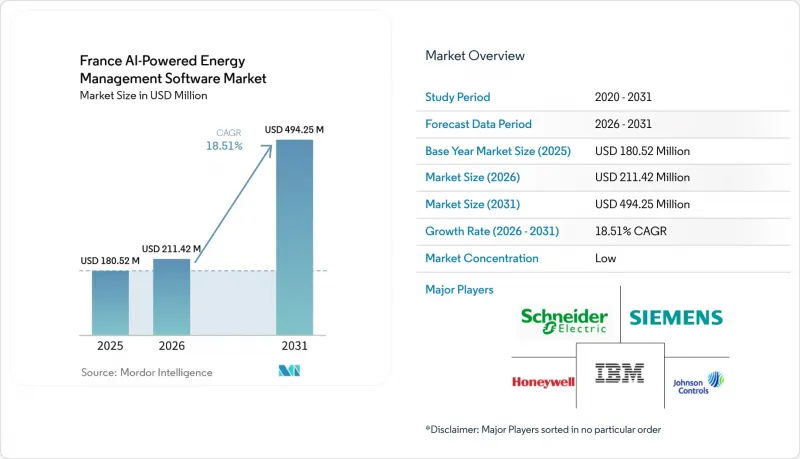
Mordor Intelligence에 의하면, 프랑스의 AI 기반 에너지 관리 소프트웨어 시장 규모는 2025년 1억 8,052만 달러에서 2026년에는 2억 1,142만 달러로 확대되고, 2031년까지 4억 9,425만 달러에 이를 것으로 예상되며, 2026-2031년 CAGR 18.51%를 기록할 전망입니다.
본 보고서는 구성 요소(소프트웨어 및 서비스), 도입 형태(클라우드 기반, On-Premise형, 하이브리드형), 용도(에너지 소비 및 수요 최적화, 자산 성능 및 예측 유지보수 등), 최종 사용자(유틸리티, 상업용 건물, 산업 시설, 주택)별로 분류되어 있습니다. 시장 전망은 금액(달러)으로 표시되어 있습니다.
프랑스 AI 기반 에너지 관리 소프트웨어 시장 동향 및 인사이트
상업 및 산업 시설의 전력 비용 상승 압력
2026년 1월 1일 ARENH 메커니즘이 만료됨에 따라, 규제된 원자력 가격 상한선이 'versement nucleaire universel(VNU)' 모델로 대체되었습니다. 이로 인해 프랑스의 상업 및 산업용 전력 구매자에게는 더 이상 고정된 공급량이나 가격 보장이 제공되지 않게 되었습니다. 에너지 규제 위원회(Commission de Regulation de l'Energie)는 2026년부터 2028년까지의 기간에 대해, 2026년 1유로(1.14달러)의 요율을 기준으로, 원자력 발전 비용을 60.3유로/MWh(68.14달러/MWh)로 설정했습니다. 한편, 2026년 도매 베이스로드 가격은 조달 비용이 시장 상황에 좌우되는 범위 내에서 안정적으로 유지되고 있습니다. ' '타리프 베르(Tarif Vert)' 제도에 가입한 250kVA를 초과하는 대규모 산업 시설공급 비용은 0.12-0.15유로/kWh(세금 제외, 0.136-0.170달러/kWh)가 되며, 또한 2026년 소비세율이 26. 58유로/MWh(30.41달러/MWh)인 점을 감안할 때, 20 GWh 규모의 시설에서는 피크 부하 최적화를 실시하기 전 단계에서 연간 53만 1,600유로(60만 708달러)의 세금 부담이 발생하게 됩니다. 이러한 비용 구조로 인해, AI를 활용한 피크 시프트 스케줄링은 현장 수준에서 회피 가능한 전력 비용 절감에 있어 직접적이고 측정 가능한 역할을 수행합니다. 프랑스의 AI 기반 에너지 관리 소프트웨어 시장에서는 규제에 따른 최저가 폐지로 인해 피크 수요 회피 효과가 단순한 효율화 이점에서 상업 구매자에게 확실한 재무적 수익으로 변화했습니다. 이러한 변화로 인해 평가 주기가 단축되었습니다. 이는 구매자들이 스케줄링, 예측 및 부하 조정을 단순한 선택적 지속가능성 기능이 아닌 조달 도구로 취급하게 되었기 때문입니다.
EU 건축물 에너지 성능 규정 준수 기한이 소프트웨어 도입을 가속화
개정된 EPBD(에너지 성능에 관한 건축물 지침)는 2024년 5월 28일에 발효되었으며, 회원국들에게 2026년 5월 29일까지 이를 국내법에 반영할 것을 의무화하고 있습니다. 여기에는 2030년까지 에너지 성능이 가장 낮은 비주거용 건물의 16%, 2033년까지 26%를 대상으로 하는 최저 에너지 성능 기준이 포함되어 있습니다. 또한, 프랑스는 2025년 4월 30일 법률 제2025-391호를 통해 EU 에너지 효율 지침을 국내법에 반영했습니다. 이에 따라 공공 부문 건물에 대해 연간 3%의 개보수 요건이 추가되었으며, 주요 사업자에 대한 감사 의무가 강화되었습니다. 유럽위원회는 2025년 6월 30일, 위임 규정, 이행 규정, 그리고 최소 에너지 성능 기준 및 스마트 레디니스 지표에 관한 지침을 포함한 이행 지원 패키지를 발표했습니다. 프랑스의 OPERAT 플랫폼은 2023년부터 EMS 소프트웨어와의 직접 API 연동을 지원하고 있으며, 이를 통해 연례 보고를 건물 운영자에게 정기적인 소프트웨어 통합의 기회로 전환하고 있습니다. 프랑스의 AI 기반 에너지 관리 소프트웨어 시장에서 OPERAT와 연동된 각 신고 주기마다 보고 워크플로가 건물 운영에 통합됨에 따라 전환 비용이 증가합니다. 이로 인해 규정을 준수하는 보고 모듈을 조기에 제공한 벤더는 2031년까지 지속적인 우위를 확보할 수 있습니다. 보고, 감사, 최적화 도구가 동일한 프로세스 체인에 통합되면 이를 배제하기 어려워지기 때문입니다.
기존 건물 및 산업용 제어 시스템과의 통합 복잡성
프랑스의 AI 기반 에너지 관리 소프트웨어 시장에서 주요 장벽 중 하나는 최신 AI 도구를 Modbus, BACnet, DNP3, OPC-UA와 같은 구형 프로토콜로 여전히 작동하는 레거시 BMS, DCS, SCADA 시스템과 연결해야 한다는 점입니다. 레거시 설비에는 대개 최신 API 계층이 부족하기 때문에 소프트웨어 도입은 여전히 프로토콜 매핑, 미들웨어 작업, 그리고 현장별 통합 로직부터 시작해야 합니다. 지멘스는 실용적인 브라운필드 전환 경로를 중심으로 자율형 빌딩 관리 소프트웨어의 배포를 계속하고 있습니다. 이는 프랑스의 도입 사례 대부분이 완전한 교체가 아닌 하이브리드 아키텍처를 여전히 필요로 하고 있다는 사실을 반영한 것입니다. 또한, 대규모 산업계 구매자는 타사 시스템 통합사업자를 필요로 하는 경우가 많기 때문에 조달 프로세스가 지연되고 프로젝트 비용이 증가할 뿐만 아니라, 책임 소재가 더 많은 관계자에게 분산되어 버립니다. 조사 결과에 따르면, 기존 시설(브라운필드)의 경우 통합에 소요되는 오버헤드가 프로젝트 총 예산의 40-60%를 차지할 가능성이 있으며, 이로 인해 입찰 단계에서 투자 회수 가능성에 대한 근거가 약화되고 있습니다. 따라서 미들웨어나 사전 인증된 어댑터, 혹은 빌딩 제어 분야에서 확고한 파트너십을 보유한 벤더들은 프랑스 화학, 자동차, 금속 산업의 프로젝트에 참여하며 뚜렷한 상업적 우위를 점하고 있습니다.
부문 분석
2025년에는 소프트웨어가 시장의 69.85%를 차지했으며, 프랑스의 AI 기반 에너지 관리 소프트웨어 시장에서도 69.85%의 점유율을 유지했습니다. 이는 구매자들이 여전히 데이터 수집, AI 분석, 보고서 작성, 탈탄소화 계획을 단일 인터페이스에 통합한 플랫폼부터 도입을 시작하기 때문입니다. METRON의 소프트웨어 계층은 30개국 이상에 걸친 250개의 산업 시설을 포함해 전 세계 25,000곳 이상의 거점에 도입되어 있으며, 이는 확립된 분석 플랫폼이 지닌 규모의 우위를 보여줍니다. METRON 모델을 기반으로 하는 ‘Dalkia Analytics’ 역시 EDF 그룹의 광범위한 서비스 네트워크와 결합함으로써 소프트웨어가 어떻게 유통력을 높이는지를 보여주고 있습니다. 프랑스 AI 활용형 에너지 관리 소프트웨어 시장에서 규정 준수 관련 소프트웨어는 여전히 높은 정착률을 보이고 있습니다. 이는 OPERAT, BEGES, CSRD 워크플로우와 연동된 보고서 작성 모듈이 일단 도입되면 교체하기 어렵기 때문입니다. 이러한 높은 정착률은 이미 프랑스 및 EU의 보고 요건에 맞추어 현지화를 완료한 벤더들에게 프리미엄 가격 책정과 고객 이탈률 감소를 뒷받침하는 요인이 되고 있습니다.
서비스는 가장 빠르게 성장하는 분야이며, 프랑스의 AI 기반 에너지 관리 소프트웨어 시장에서 서비스 규모는 구매자들이 라이선스 구매에서 지속적인 성과 제공으로 전환함에 따라 2026년부터 2031년까지 연평균 성장률(CAGR) 19.23%로 확대될 것으로 예측됩니다. 2026년 2월 하네웰이 타타 컨설팅 서비스(TCS)와 체결한 제휴는 각 벤더가 AI 플랫폼과 통합 및 컨설팅 기능을 결합하여 대규모 건물 및 산업 환경에서 IT와 OT의 융합을 지원하고 있는 실제 사례를 보여줍니다. METRON과 다르키아는 유럽 8개국 60곳의 산업 시설을 대상으로 한 'Decarb Fast Track' 프로그램에서 250건 이상의 탈탄소화 프로젝트를 파악했으며, 그 잠재적 CO2 감축량은 19만 톤에 달한다고 보고했습니다. 또한, 현재 진행 중인 100건 이상의 프로젝트를 통해 이미 6만 톤의 CO2 배출을 방지하고 있습니다. 이러한 결과는 프랑스의 구매자들이 대시보드나 알림뿐만 아니라 도입 지원, 측정값 검증, 운영상의 후속 조치를 점점 더 요구하고 있는 이유를 보여줍니다. 따라서 프랑스의 AI 기반 에너지 관리 소프트웨어 시장은 제품의 기능성뿐만 아니라 서비스의 충실도가 계약 갱신률을 좌우하는 단계에 접어들었습니다.
2025년에는 클라우드 기반 도입이 66.41%의 점유율을 차지하며, 프랑스 AI 기반 에너지 관리 소프트웨어 시장의 66.41%를 차지했습니다. 이는 상업시설 운영자나 중규모 시설 관리자들이 여전히 SaaS의 신속성과 도입 부담의 경감을 중시하기 때문입니다. 프랑스의 AI 활용형 에너지 관리 소프트웨어 시장에서는 OT(운영 기술) 격리 요건이 높지 않은 구매자층 사이에서 여전히 클라우드를 선호하는 경향이 뚜렷합니다. 하이브리드 도입은 연평균 성장률(CAGR) 20.34%로 가장 빠르게 성장하고 있는 도입 형태입니다. 이는 규제 대상인 많은 산업 사용자들이 데이터를 선택적으로 클라우드로 업로드하기 전에 로컬에서 처리가 필요하기 때문입니다. 엄격한 사이버 보안 및 사업 연속성 규정을 준수하며 업무를 수행하는 산업 사업자들은 로컬 데이터 처리를 아키텍처상의 선호도라기보다는 규정 준수 요건으로 간주하고 있습니다. On-Premise 도입은 원자력 관련 하청업체, 화학 제조업체, 송전망 인프라 사업자 등 보다 제한된 그룹에서 여전히 중요하며, 이러한 분야에서는 격리된 네트워크가 여전히 조달 결정을 좌우하고 있습니다.
하이브리드 배포는 2031년까지 연평균 성장률(CAGR) 20.34%를 나타낼 것으로 예측되며, 이는 시장이 클라우드를 떠나는 것이 아니라 현장의 실제 제약 사항을 해결하기 위한 엣지-클라우드 혼합 아키텍처로 전환되고 있음을 보여줍니다. 슈나이더 일렉트릭은 2025년 11월, 에너지, 전력, 빌딩 시스템을 통합하는 설계를 채택한 ‘EcoStruxure Foresight Operation’을 발표하며, 엔지니어링 업무 소요 시간을 40% 단축하는 동시에 운영 효율을 50% 향상시킬 것이라고 주장했습니다. 지멘스 역시 스마트 빌딩에서 자율형 빌딩으로의 전환을 둘러싼 빌딩 소프트웨어 전략을 지속적으로 제시하며, 인프라의 급격한 교체보다는 기존 설비(브라운필드)에 대응하는 디지털 레이어의 필요성을 강조했습니다. 이러한 움직임은 특히 건물이나 플랜트에 구형 제어 인프라가 도입된 경우, 주요 벤더들이 현재 프랑스에서 하이브리드 아키텍처를 핵심 제품 요건으로 삼고 있음을 보여줍니다. 분석의 깊이를 해치지 않으면서 OT의 격차를 메울 수 있는 벤더는 2031년까지 규제 대상인 대형 고객사들 사이에서 더욱 견고한 입지를 확립하게 될 것입니다.
기타 혜택:
- 엑셀 형식 시장 예측(ME) 시트
- 3개월간의 애널리스트 지원
자주 묻는 질문
목차
제1장 서론
제2장 조사 방법
제3장 주요 요약
제4장 시장 구도
제5장 시장 규모와 성장 예측
제6장 경쟁 구도
제7장 시장 기회와 향후 전망
KTH 26.08.06According to Mordor Intelligence, the France AI-powered energy management software market size is expected to increase from USD 180.52 million in 2025 to USD 211.42 million in 2026 and reach USD 494.25 million by 2031, growing at a CAGR of 18.51% over 2026-2031.
This report is Segmented by Component (Software and Services), Deployment Mode (Cloud-Based, On-Premises, and Hybrid), Application (Energy Consumption and Demand Optimization, Asset Performance and Predictive Maintenance, and More), and End User (Utilities, Commercial Buildings, Industrial Facilities, and Residential). The Market Forecasts are Provided in Terms of Value (USD).
France AI-powered Energy Management Software Market Trends and Insights
Rising Electricity Cost Pressure Across Commercial And Industrial Sites
The January 1, 2026, expiry of the ARENH mechanism replaced a regulated nuclear price ceiling with the versement nucleaire universel model, which no longer provides a fixed volume or price guarantee for commercial and industrial electricity buyers in France. The Commission de Regulation de l'Energie set nuclear production costs at EUR 60.3/MWh (USD 68.14/MWh) at the 2026 EUR 1 (USD 1.14) rate for the 2026-2028 period, while wholesale baseload prices in 2026 have stabilized within a band that keeps procurement costs exposed to market conditions. Large industrial sites on Tarif Vert, above 250 kVA, face supply costs of EUR 0.12 to EUR 0.15/kWh HT (USD 0.136 to USD 0.170/kWh), and the 2026 accise rate of EUR 26.58/MWh (USD 30.41/MWh)means that a 20 GWh site carries EUR 531,600 (USD 600,708) in annual tax burden before any peak-load optimization. This cost structure gives AI-driven peak-shift scheduling a direct, measurable role in reducing avoidable electricity costs at the site level. In the France AI-powered Energy Management Software Market, the removal of a regulated floor has changed avoided peak demand from a soft efficiency benefit into a hard financial return for commercial buyers. That change has shortened evaluation cycles because buyers now treat scheduling, forecasting, and load orchestration as procurement tools rather than optional sustainability add-ons.
EU Building Performance Compliance Deadlines Accelerating Software Adoption
The revised EPBD entered into force on May 28, 2024, and requires member states to transpose it by May 29, 2026, with minimum energy performance standards that target the 16% worst-performing non-residential buildings by 2030 and the 26% worst-performing by 2033. France also transposed the EU Energy Efficiency Directive through Law No. 2025-391 of April 30, 2025, which added a 3% annual renovation requirement for public-sector buildings and tightened audit obligations for major operators. The European Commission released an implementation support package on June 30, 2025, including a delegated regulation, an implementing regulation, and guidance on minimum energy performance standards and the Smart Readiness Indicator. France's OPERAT platform has supported direct API connections for EMS software since 2023, turning annual reporting into a recurring software integration point for building operators. In the France AI-powered Energy Management Software Market, each OPERAT-linked declaration cycle deepens switching costs because the reporting workflow becomes embedded in building operations. That gives early vendors with compliant reporting modules a durable advantage through 2031 because removal becomes harder once reporting, audit, and optimization tools sit in the same process chain.
Integration Complexity With Legacy Building And Industrial Control Systems
A major barrier in the France AI-powered Energy Management Software Market is the need to connect modern AI tools with legacy BMS, DCS, and SCADA systems that still operate on older protocols such as Modbus, BACnet, DNP3, and OPC-UA. Legacy estates often lack modern API layers, which means software deployments still start with protocol mapping, middleware work, and site-specific integration logic. Siemens has continued to position its autonomous building software around practical brownfield transition paths, reflecting the fact that much of the French installed base still needs hybrid architectures rather than full replacement. Procurement also slows because large industrial buyers often require third-party system integrators, which raises project costs and spreads accountability across more parties. The input indicates that integration overhead can absorb 40-60% of total project budgets in brownfield cases, which weakens the payback case at the bid stage. Vendors with middleware, pre-certified adapters, or established building controls partnerships therefore enter French chemicals, automotive, and metals projects with a clear commercial edge.
Other drivers and restraints analyzed in the detailed report include:
- AI-Enabled Peak Load Forecasting Reducing Grid And Site-Level Penalty Exposure
- Edge AI And Meter Data Granularity Improving Real-Time Optimization
- Data Quality, Meter Coverage, and Interoperability Constraints
For complete list of drivers and restraints, kindly check the Table Of Contents.
Segment Analysis
Software captured 69.85% of the market in 2025, and it held 69.85% of the France AI-powered Energy Management Software Market share because buyers still start with platforms that combine data ingestion, AI analytics, reporting, and decarbonization planning in a single interface. METRON's software layer is deployed on more than 25,000 sites globally, including 250 industrial sites across more than 30 countries, which shows the scale advantage of established analytics platforms. The Dalkia Analytics, powered by the METRON model, also shows how software gains distribution strength when paired with EDF Group's large service network. In the France AI-powered Energy Management Software Market, compliance-linked software remains sticky because reporting modules tied to OPERAT, BEGES, and CSRD workflows are hard to replace once they are embedded. That stickiness supports premium pricing and lower churn for vendors that already localize around French and EU reporting requirements.
Services are the fastest-growing component, and the France AI-powered Energy Management Software Market size for services is projected to expand at a 19.23% CAGR between 2026 and 2031 as buyers move beyond license purchase into continuous performance delivery. Honeywell's February 2026 partnership with Tata Consultancy Services shows how vendors are combining AI platforms with integration and consulting capabilities to support IT-OT convergence in large building and industrial environments. METRON and Dalkia reported that their Decarb Fast Track program across 60 industrial sites in 8 European countries identified more than 250 decarbonization projects with potential savings of 190,000 tonnes of CO2, while more than 100 ongoing projects had already avoided 60,000 tonnes of CO2. Those results show why French buyers increasingly want implementation support, measurement validation, and operational follow-through, not only dashboards and alerts. The France AI-powered Energy Management Software Market is therefore entering a phase where service depth can shape renewal rates as much as product functionality.
Cloud-based deployment held a 66.41% share in 2025, accounting for 66.41% of the France AI-powered Energy Management Software Market, as commercial property operators and medium-sized facility managers still favor SaaS speed and lower setup burden. The France AI-powered Energy Management Software Market still shows a strong preference for the cloud among buyer groups that do not have high OT isolation requirements. Hybrid deployment is the fastest-growing mode, with a 20.34% CAGR, because many regulated industrial users need local processing before selectively uploading data to the cloud. Industrial operators working under strict cybersecurity and operational continuity rules treat local data handling as a compliance need rather than an architectural preference. On-premises deployment remains relevant for a narrower group, including nuclear subcontractors, chemical manufacturers, and grid infrastructure operators, where isolated networks still shape procurement decisions.
Hybrid deployment is projected to grow at a 20.34% CAGR through 2031, indicating that the market is not moving away from the cloud but toward mixed edge-cloud architectures that address real site constraints. Schneider Electric introduced EcoStruxure Foresight Operation in November 2025 with a design that unifies energy, power, and building systems and claims a 40% reduction in engineering workflow time, together with a 50% improvement in operational efficiency. Siemens also continued to present its building software strategy around the shift from smart to autonomous buildings, underscoring the need for brownfield-friendly digital layers rather than abrupt infrastructure replacement. These moves show that major vendors now treat hybrid architecture as a core product requirement in France, especially when buildings and plants carry older control infrastructure. The vendor that closes the OT gap without reducing analytics depth will hold a stronger position in large regulated accounts through 2031.
Complete Report Scope:
- By Component
- Software
- Services
- By Deployment Mode
- Cloud-Based
- On-Premises
- Hybrid
- By Application
- Energy Consumption and Demand Optimization
- Asset Performance and Predictive Maintenance
- Smart Grid and Distributed Energy Resource (DER) Management
- Renewable Energy Forecasting and Integration
- Energy Trading, Pricing and Market Intelligence
- By End User
- Utilities
- Commercial Buildings
- Industrial Facilities
- Residential Buildings
List of Companies Covered in this Report:
- Deepki
- METRON
- BeeBryte
- Energisme
- SpinalCom
- Ubiant
- Advizeo by Setec
- Wattics Ltd.
- DEXMA Sensors, S.L.
- Grid4C Ltd.
- Bidgely, Inc.
- AutoGrid Systems, Inc.
- Innowatts, Inc.
- GridPoint, Inc.
- EnergyCAP, LLC
- Uplight, Inc.
- EnergyHub, LLC
- Verdigris Technologies, Inc.
- Measurabl, Inc.
- Prescinto Technologies Private Limited
- C3.AI, Inc.
- IBM Corporation
- Schneider Electric SE
- Siemens AG
- Honeywell International Inc.
- Johnson Controls International plc
Additional Benefits:
- The market estimate (ME) sheet in Excel format
- 3 months of analyst support
TABLE OF CONTENTS
1 INTRODUCTION
- 1.1 Study Assumptions and Market Definition
- 1.2 Scope of the Study
2 RESEARCH METHODOLOGY
3 EXECUTIVE SUMMARY
4 MARKET LANDSCAPE
- 4.1 Market Overview
- 4.2 Market Drivers
- 4.2.1 Rising Electricity Cost Pressure Across Commercial and Industrial Sites
- 4.2.2 EU Building Performance Compliance Deadlines Accelerating Software Adoption
- 4.2.3 AI-Enabled Peak Load Forecasting Reducing Grid and Site-Level Penalty Exposure
- 4.2.4 Edge AI and Meter Data Granularity Improving Real-Time Optimization
- 4.2.5 Scope 3 and Carbon Reporting Automation Increasing Demand for Energy Intelligence
- 4.2.6 Retrofit-Led Digitization of Existing Building Portfolios
- 4.3 Market Restraints
- 4.3.1 Integration Complexity With Legacy Building and Industrial Control Systems
- 4.3.2 Data Quality, Meter Coverage, and Interoperability Constraints
- 4.3.3 Cybersecurity, Data Sovereignty, and OT Risk Concerns
- 4.3.4 Payback Sensitivity in Small Sites and Fragmented Facility Portfolios
- 4.4 Industry Value Chain Analysis
- 4.5 Regulatory Landscape
- 4.6 Technological Outlook
- 4.7 Porter's Five Forces Analysis
- 4.7.1 Threat of New Entrants
- 4.7.2 Bargaining Power of Buyers
- 4.7.3 Bargaining Power of Suppliers
- 4.7.4 Threat of Substitutes
- 4.7.5 Competitive Rivalry
- 4.8 Impact of Macroeconomic Factors on the Market
5 MARKET SIZE AND GROWTH FORECASTS (VALUE)
- 5.1 By Component
- 5.1.1 Software
- 5.1.2 Services
- 5.2 By Deployment Mode
- 5.2.1 Cloud-Based
- 5.2.2 On-Premises
- 5.2.3 Hybrid
- 5.3 By Application
- 5.3.1 Energy Consumption and Demand Optimization
- 5.3.2 Asset Performance and Predictive Maintenance
- 5.3.3 Smart Grid and Distributed Energy Resource (DER) Management
- 5.3.4 Renewable Energy Forecasting and Integration
- 5.3.5 Energy Trading, Pricing and Market Intelligence
- 5.4 By End User
- 5.4.1 Utilities
- 5.4.2 Commercial Buildings
- 5.4.3 Industrial Facilities
- 5.4.4 Residential Buildings
6 COMPETITIVE LANDSCAPE
- 6.1 Market Concentration
- 6.2 Strategic Moves
- 6.3 Market Share Analysis
- 6.4 Company Profiles (includes Global Level Overview, Market Level Overview, Core Segments, Financials as available, Strategic Information, Market Rank/Share, Products and Services, Recent Developments)
- 6.4.1 Deepki
- 6.4.2 METRON
- 6.4.3 BeeBryte
- 6.4.4 Energisme
- 6.4.5 SpinalCom
- 6.4.6 Ubiant
- 6.4.7 Advizeo by Setec
- 6.4.8 Wattics Ltd.
- 6.4.9 DEXMA Sensors, S.L.
- 6.4.10 Grid4C Ltd.
- 6.4.11 Bidgely, Inc.
- 6.4.12 AutoGrid Systems, Inc.
- 6.4.13 Innowatts, Inc.
- 6.4.14 GridPoint, Inc.
- 6.4.15 EnergyCAP, LLC
- 6.4.16 Uplight, Inc.
- 6.4.17 EnergyHub, LLC
- 6.4.18 Verdigris Technologies, Inc.
- 6.4.19 Measurabl, Inc.
- 6.4.20 Prescinto Technologies Private Limited
- 6.4.21 C3.ai, Inc.
- 6.4.22 IBM Corporation
- 6.4.23 Schneider Electric SE
- 6.4.24 Siemens AG
- 6.4.25 Honeywell International Inc.
- 6.4.26 Johnson Controls International plc
7 MARKET OPPORTUNITIES AND FUTURE OUTLOOK
- 7.1 White-Space and Unmet-Need Assessment