
|
시장보고서
상품코드
2099132
헬스케어용 ITSM 시장 : 시장 점유율 분석, 업계 동향 및 통계, 성장 예측(2026-2031년)ITSM In Healthcare - Market Share Analysis, Industry Trends & Statistics, Growth Forecasts (2026 - 2031) |
||||||
 Mordor Intelligence
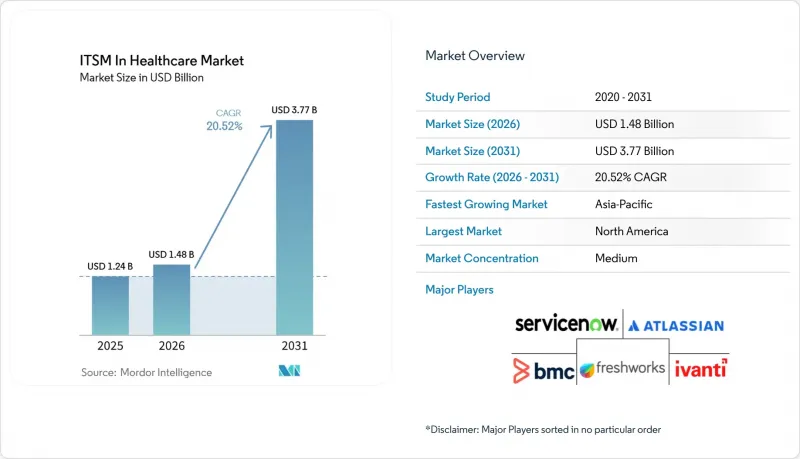
Mordor Intelligence에 의하면, 헬스케어용 ITSM 시장 규모는 2025년 12억 4,000만 달러로 평가되었고, 2026년 14억 8,000만 달러에서 2031년까지 37억 7,000만 달러로 확대될 것으로 예측되며, 2026-2031년 연평균 복합 성장률(CAGR)은 20.52%를 나타낼 전망입니다.
본 보고서는 컴포넌트별(솔루션 및 서비스), 배포 방식별(클라우드, 온프레미스, 하이브리드), 용도별(서비스 데스크 및 인시던트 관리, 자산 및 구성 관리, 변경 및 릴리스 관리 등), 기업 규모별(대기업 및 중소기업(SME)), 지역별로 분류되어 있습니다. 시장 전망은 금액(달러) 기준으로 제시되어 있습니다.
세계의 헬스케어용 ITSM 시장 동향 및 인사이트
전자건강기록(EHR) 워크플로우의 복잡화
EHR 플랫폼은 현재 독립된 기록 시스템이 아닌 통합 허브로 기능하고 있으며, 이러한 변화로 인해 헬스케어 ITSM 시장 내에서는 새로운 서비스 의존 관계가 끊임없이 추가되고 있습니다. 의료기기, 원격 의료 도구, ID 시스템, 청구 플랫폼, 영상 진단 환경과의 각 연결은 지원 팀이 모니터링하고 해결해야 할 새로운 장애 발생 지점을 만들어냅니다. 이로 인해 라우팅 오류, 접근 문제 또는 인터페이스 장애가 단순한 행정적 생산성뿐만 아니라 임상 업무에도 영향을 미칠 수 있으므로, 서비스 계층 자체의 중요성이 더욱 높아지고 있습니다. ONC는 2025년 7월, USCDI 버전 6을 통해 데이터 교환 프레임워크를 다시 확장했습니다. 이에 따라 시스템 간 교환을 위한 새로운 표준화 요소가 추가되면서 의료 IT 팀의 거버넌스 업무 부담이 커졌습니다. 그 결과, 헬스케어용 ITSM은 더 대규모이고 상호 연결성이 높은 디지털 케어 환경을 관리해야 할 필요성으로 인해 그 중요성이 커지고 있습니다.
원격 의료 및 원격 케어의 확대
원격의료의 보급으로 인해 헬스케어용 ITSM의 지원 부담은 변화했습니다. 이는 치료가 일반 IT 직원의 근무 시간을 훨씬 초과하여 지속되기 시작했기 때문입니다. 온라인 진료, 원격 모니터링, 분산형 액세스 포인트 증가에 따라 서비스 팀이 가동 상태를 유지해야 하는 기기, 포털, 사용자 ID의 수도 증가하고 있습니다. CMS는 2026년 의사 보수 일정에 따라 원격 환자 모니터링 청구 및 문서화 관련 규정을 간소화했습니다. 이를 통해 외래 및 만성 질환 관리 현장에서 커넥티드 케어 도구의 보다 광범위한 도입이 촉진되고 있습니다. 또한 HHS는 음성 전용 서비스 및 연방 공인 보건 센터(FQHC)에 대한 원격 거점 자격 요건 확대 등, 원격의료와 관련된 주요 유연성 조치를 2027년 12월 31일까지 연장했습니다. 이는 헬스케어용 ITSM 시장이 단일 포털의 장애나 접속 오류가 여러 거점에 걸쳐 있는 환자에게 동시에 영향을 미칠 수 있는 진료 모델에 대응하고 있음을 의미합니다.
의료 제공업체 및 보험사의 IT 현대화에 대한 예산 제약
현대화의 필요성이 명백한 경우에도, 예산 제약은 헬스케어 ITSM 시장에 여전히 현실적인 장벽으로 남아 있습니다. 많은 의료 서비스 제공업체는 여전히 인시던트 및 요청 모듈부터 도입을 시작하고, 자산 관리, 변경 관리, 지식 관리와 같은 더 광범위한 기능의 도입을 뒤로 미루는 등 단계적으로 도입을 진행하고 있습니다. 이러한 접근 방식은 단기적인 지출 억제에는 도움이 되지만, 플랫폼 전체의 도입을 지연시키고 공급업체의 수익 창출 주기를 장기화시키는 결과로 이어집니다. 사이버 보안, 인프라 갱신, 임상 소프트웨어 프로젝트가 동일한 자금원에서 충당되는 경우, 이러한 압박은 더욱 커집니다. 그 결과, 헬스케어용 ITSM 시장은 전체 제품군을 일괄 교체하기보다는 단계적인 도입을 통해 성장하는 경우가 많습니다.
부문 분석
2025년, 솔루션은 헬스케어용 ITSM 시장 점유율의 68.10%를 차지했습니다. 이는 의료 워크플로우, 감사 추적, 통합 커넥터가 이미 내장된 소프트웨어 플랫폼에 대한 강력한 수요를 반영한 것입니다. 대규모 의료 시스템에서는 임상 및 관리 환경이 광범위하게 펼쳐져 있어, 단편화된 단일 기능 도구로는 관리가 어렵기 때문에 이러한 플랫폼이 선호되고 있습니다. 이러한 주도적 지위는 구매자들이 인시던트, 서비스 요청, 장치 가시성 및 워크플로우에 대한 설명 책임과 관련된 거버넌스 프레임워크를 점점 더 요구하고 있음을 보여줍니다. 헬스케어용 ITSM 시장에서 이러한 추세는 고객이 핵심 프로세스를 처음부터 구축할 필요 없이, 미리 설정된 기능을 제공할 수 있는 벤더를 뒷받침하고 있습니다.
서비스 부문은 2031년까지 연평균 성장률(CAGR) 19.10%로 확대될 것으로 예상되며, 이는 동일 시장 내 또 다른 성장 부문의 존재를 시사합니다. 많은 의료 기관에서 내부 팀이 수많은 디지털 우선 과제에 매달려 있기 때문에 설정, 최적화, 도입 순서 결정 및 도입 후 지원에 대해 외부 지원을 요청하는 사례가 증가하고 있습니다. 이는 플랫폼 라이선싱은 가능하지만 워크플로우나 지식 컨텐츠를 독자적으로 지속적으로 조정할 수 없는 의료 제공업체에게 특히 중요한 과제입니다. 앞으로 자동화 및 AI 기반 기능 증가에 따라 플랫폼의 복잡성이 높아짐에 따라, 헬스케어용 ITSM 시장에서 서비스의 중요성은 더욱 커질 것으로 예측됩니다.
2025년에는 클라우드가 78.35%의 점유율을 차지했으며, 헬스케어용 ITSM 시장 내 도입 수요의 중심으로서 확고한 입지를 다졌습니다. 여러 거점을 보유한 의료기관 그룹의 경우, 각 거점에서 개별적인 릴리스 관리 부담을 지지 않고도 병원, 진료소, 원격의료 환경, 제휴 시설을 아우를 수 있는 단일 서비스 환경이 큰 이점이 됩니다. 또한, 클라우드를 통한 제공은 분산된 의료 네트워크 전체에서 AI 도구 및 워크플로우의 업데이트, 셀프 서비스를 통한 변경 사항의 신속한 배포도 지원합니다. 이를 통해 확장성과 거버넌스를 단일 운영 모델로 실현하고자 하는 많은 의료 고객에게 클라우드는 사실상 기본 선택지가 되고 있습니다.
또한, 클라우드 시장은 2031년까지 연평균 성장률(CAGR) 18.78%를 나타낼 것으로 예측되며, 의료 기관이 서비스 운영을 현대화하는 과정에서 그 주도적 지위를 더욱 공고히 하고 있습니다. 반면, 데이터의 소재지, 주권적 관리, 혹은 격리된 임상 네트워크 등이 아키텍처 선택을 좌우하는 상황에서는 온프레미스나 하이브리드 모델도 여전히 중요한 역할을 수행하고 있습니다. Ivanti가 2026년 1월에 발표한 'Sovereign Edition EU for Neurons'에 따르면, 각 벤더들은 보다 강력한 감사 가능성 및 위치 제어가 요구되는 규제 환경을 위해 설계된 제품에서 여전히 가치를 발견하고 있는 것으로 나타났습니다. 따라서 클라우드가 계속해서 주도적인 위치를 차지하고 있다고는 하지만, 헬스케어용 ITSM 시장은 완전히 통일된 도입 모델로 전환되고 있는 것은 아닙니다.
지역별 분석
2025년, 북미는 헬스케어용 ITSM 시장 점유율의 46.10%를 차지했으며, 계속해서 최대 지역 기여자로서의 지위를 유지했습니다. 이 지역은 성숙한 기업 소프트웨어 조달 체계, 대규모 통합 의료 제공 네트워크, 그리고 구조화된 서비스 관리에 명확한 운영 목표를 부여하는 규정 준수 환경의 혜택을 받고 있습니다. 2025년 7월 ONC가 발표한 USCDI 버전 6에서는 표준화된 교환 요소가 확충되었으며, 거버넌스 요구 사항이 내부 IT에만 국한되지 않고 연결된 용도 환경으로 더욱 확대되었습니다. 이러한 배경이 미국 및 캐나다 전역의 헬스케어용 ITSM 시장을 지속적으로 뒷받침하고 있습니다.
아시아태평양은 2031년까지 연평균 성장률(CAGR) 19.45%를 나타낼 것으로 예측되며, 헬스케어용 ITSM 시장 규모 측면에서 가장 빠르게 확대되는 지역 부문이 될 전망입니다. 일본은 기반 인프라 정비 주기를 진행 중이며, 2026년 5월 후지쯔와 IBM 재팬이 발표한 의료 분야 소버린 클라우드 제휴는 지역 의료 시스템이 더 대규모의 서비스 관리 도입에 필요한 클라우드 기반을 구축하고 있음을 보여줍니다. 인도는 독자적인 길을 개척하고 있으며, 정부 주도의 디지털 헬스 프로그램을 통해 공공 및 민간 의료 현장을 불문하고 전자 차트, 포털, 연계 워크플로우의 첫 도입이 추진되고 있습니다. 중국에서는 사이버 보안 요건과 병원 현대화 기준에 따라 거버넌스가 철저히 적용된 운영 지원의 필요성이 높아지면서 추가적인 수요가 발생하고 있습니다. 이러한 각국의 동향을 종합해 보면, 아시아태평양이 의료 서비스 관리의 미래 목표 시장을 확대하고 있는 이유가 명확해집니다.
유럽은 병원의 현대화가 현지 규정 준수, 현지화 및 전환 요구와 병행하여 진행되고 있기 때문에 보다 신중한 입장을 취하고 있습니다. 이 지역에서도 여전히 의미 있는 도입이 진행되고 있으며, Matrix42나 KIX Service Software와 같은 전문 벤더들은 도입의 적합성이 중요한 상황에서 현지 중심의 플랫폼이 의료 분야에서 확고한 입지를 다질 수 있음을 입증하고 있습니다. 남미에서는 도입이 아직 초기 단계에 있지만, 브라질과 아르헨티나가 주요 성장 거점으로 부상하고 있으며, 민간 병원 그룹들이 임상 IT 관리 도구에 대한 투자를 확대되고 있습니다. 중동 및 아프리카에서는 걸프 국가들의 스마트 병원 프로그램과 원격의료 주도형 의료 제공 모델에 힘입어, 공공 의료 기관 및 파트너 지원형 의료 환경 모두에서 클라우드 기반 서비스 관리에 대한 초기 수요가 발생하고 있습니다.
기타 혜택 :
- 엑셀 형식 시장 예측(ME) 시트
- 3개월간의 애널리스트 지원
자주 묻는 질문
목차
제1장 서론
제2장 조사 방법
제3장 주요 요약
제4장 시장 구도
제5장 시장 규모 및 성장 예측
제6장 경쟁 구도
제7장 시장 기회 및 향후 전망
AJYAccording to Mordor Intelligence, the ITSM in healthcare market size is projected to expand from USD 1.24 billion in 2025 and USD 1.48 billion in 2026 to USD 3.77 billion by 2031, registering a CAGR of 20.52% between 2026 to 2031.
This report is Segmented by Component (Solutions and Services), Deployment (Cloud, On-Premise, and Hybrid), Application (Service Desk and Incident Management, Asset and Configuration Management, Change and Release Management, and More), Enterprise Size (Large Enterprises and Small and Mid-Size Enterprises (SME)), and Geography. The Market Forecasts are Provided in Terms of Value (USD).
Global ITSM In Healthcare Market Trends and Insights
Rising Electronic Health Record Workflow Complexity
EHR platforms now operate as integration hubs rather than stand-alone record systems, and that shift keeps adding new service dependencies inside the ITSM in healthcare market. Each connection to medical devices, telehealth tools, identity systems, billing platforms, and imaging environments creates new failure points that support teams must monitor and resolve. This makes the service layer itself more critical, because a routing error, access issue, or failed interface can affect clinical work rather than only office productivity. ONC expanded the data exchange framework again in July 2025 through USCDI Version 6, which added new standardized elements for cross-system exchange and widened the governance workload for healthcare IT teams. As a result, the ITSM in healthcare market is gaining from the need to manage larger and more connected digital care environments.
Telehealth and Remote Care Expansion
Telehealth has changed the support burden in the ITSM in healthcare market because care now continues well outside normal IT staffing hours. Virtual visits, remote monitoring, and distributed access points increase the number of devices, portals, and user identities that service teams must keep available. CMS simplified remote patient monitoring billing and documentation rules in the 2026 Physician Fee Schedule, which supports wider deployment of connected care tools across ambulatory and chronic care settings. HHS also extended core telehealth flexibilities through December 31, 2027, including audio-only services and broader distant-site eligibility for Federally Qualified Health Centers. That means the ITSM in healthcare market is serving a care model where one portal failure or access error can affect patients across multiple locations at the same time.
Budget Constraints in Provider and Payer IT Modernization
Budget discipline remains a real limit on the ITSM in healthcare market, even when the need for modernization is clear. Many providers still phase deployments over time, starting with incident and request modules and delaying broader capabilities such as asset, change, and knowledge management. That approach helps control near-term spending, but it also slows full platform adoption and stretches vendor revenue across longer cycles. The pressure is sharper when cybersecurity, infrastructure refresh, and clinical software projects are drawing from the same funding pool. As a result, the ITSM in healthcare market often grows through staged adoption rather than full-suite replacement.
Other drivers and restraints analyzed in the detailed report include:
- Cybersecurity and Ransomware Pressure on Clinical Operations
- Need for Faster IT Incident Resolution in Patient-Critical Environments
- Integration Complexity With Legacy Hospital Systems
For complete list of drivers and restraints, kindly check the Table Of Contents.
Segment Analysis
Solutions held 68.10% of the ITSM in healthcare market share in 2025, which reflected the strong preference for software platforms that already include healthcare workflows, audit trails, and integration connectors. Large health systems have favored these platforms because their clinical and administrative environments are too broad to manage through fragmented point tools. The lead position also shows that buyers increasingly want a governed framework for incidents, service requests, device visibility, and workflow accountability. In the ITSM in healthcare market, that preference supports vendors that can offer pre-configured functionality without requiring customers to build core processes from scratch.
Services are projected to expand at a 19.10% CAGR through 2031, which points to a different growth layer inside the same market. More healthcare organizations now want outside help with configuration, optimization, rollout sequencing, and post-deployment support because internal teams are stretched across many digital priorities. This is especially relevant for providers that can license a platform but cannot continuously tune workflows or knowledge content on their own. Over time, the ITSM in healthcare market is likely to see services gain importance as platform complexity rises with more automation and AI-based functions.
Cloud captured 78.35% share in 2025, which made it the clear center of deployment demand in the ITSM in healthcare market. Multi-site provider groups benefit from a single service environment that can cover hospitals, clinics, remote care settings, and partner locations without carrying local release management burdens at every site. Cloud delivery also supports faster rollout of AI tools, workflow updates, and self-service changes across distributed care networks. This has made the cloud the practical default for many healthcare customers who want scalability and governance in one operating model.
Cloud is also expected to grow at an 18.78% CAGR through 2031, which reinforces its lead as healthcare organizations modernize service operations. At the same time, on-premise and hybrid models remain relevant where data residency, sovereign control, or isolated clinical networks shape architecture choices. Ivanti's January 2026 Sovereign Edition EU for Neurons showed that vendors still see value in products designed for regulated environments that require stronger auditability and location control. Because of that, the ITSM in healthcare market is not moving toward a fully uniform deployment model, even though cloud continues to lead.
Complete Report Scope:
- By Component
- Solutions
- Services
- By Deployment
- Cloud
- On-premise
- Hybrid
- By Application
- Service Desk and Incident Management
- Asset and Configuration Management
- Change and Release Management
- Service Request Management
- Knowledge Management
- Other Applications
- By Enterprise Size
- Large Enterprises
- Small and Mid-size Enterprises (SME)
- By Geography
- North America
- United States
- Canada
- Mexico
- South America
- Brazil
- Argentina
- Rest of South America
- Europe
- Germany
- United Kingdom
- France
- Russia
- Spain
- Rest of Europe
- Asia-Pacific
- China
- Japan
- India
- South Korea
- Southeast Asia
- Rest of Asia-Pacific
- Middle East and Africa
- Middle East
- Saudi Arabia
- United Arab Emirates
- Turkey
- Rest of Middle East
- Africa
- South Africa
- Nigeria
- Egypt
- Rest of Africa
- Middle East
- North America
Geography Analysis
North America held 46.10% of the ITSM in healthcare market share in 2025, which kept it as the largest regional contributor. The region benefits from mature enterprise software procurement, large integrated delivery networks, and a compliance environment that gives structured service management a clear operational purpose. ONC's July 2025 USCDI Version 6 release expanded standardized exchange elements, which pushed governance needs further into connected application environments rather than keeping them inside internal IT alone. That backdrop continues to support the ITSM in healthcare market across the United States and Canada.
Asia-Pacific is projected to grow at a 19.45% CAGR through 2031, making it the fastest-expanding regional segment in the ITSM in healthcare market size mix. Japan is moving through a foundational infrastructure cycle, and the May 2026 healthcare sovereign cloud collaboration between Fujitsu and IBM Japan showed that local health systems are building the cloud base needed for larger service management deployments. India is creating a different path, with government-led digital health programs driving first-time adoption of records, portals, and connected workflows across public and private care settings. China adds another layer of demand through cybersecurity requirements and hospital modernization standards that increase the need for governed operational support. Taken together, these country patterns show why Asia-Pacific is widening the future addressable base for healthcare service management.
Europe occupies a more measured position because hospital modernization is advancing alongside local compliance, localization, and migration demands. The region still shows meaningful adoption, and specialist vendors such as Matrix42 and KIX Service Software demonstrate that locally focused platforms can build durable healthcare positions where implementation fit matters. South America remains earlier in adoption, with Brazil and Argentina representing the main growth pockets as private hospital groups invest in clinical IT management tools. In the Middle East and Africa, Gulf smart hospital programs and telehealth-led delivery models are creating early demand for cloud-based service management in both public and partner-supported care settings.
- ServiceNow, Inc.
- BMC Software, Inc.
- Atlassian Corporation Plc
- Ivanti, Inc.
- Freshworks Inc.
- 4me (Xurrent)
- IBM Corporation
- ManageEngine
- Nexthink
- SolarWinds Corporation
- EasyVista, Inc.
- TOPdesk Nederland B.V.
- Matrix42 AG
- SysAid Technologies Ltd.
- Aisera, Inc.
- Zendesk, Inc.
- IFS AB
- InvGate S.A.
- Halo Service Desk
- SymphonyAI
Additional Benefits:
- The market estimate (ME) sheet in Excel format
- 3 months of analyst support
TABLE OF CONTENTS
1 INTRODUCTION
- 1.1 Study Assumptions and Market Definition
- 1.2 Scope of the Study
2 RESEARCH METHODOLOGY
3 EXECUTIVE SUMMARY
4 MARKET LANDSCAPE
- 4.1 Market Overview
- 4.2 Market Drivers
- 4.2.1 Rising Electronic Health Record Workflow Complexity
- 4.2.2 Telehealth and Remote Care Expansion
- 4.2.3 Cybersecurity and Ransomware Pressure on Clinical Operations
- 4.2.4 Need for Faster IT Incident Resolution in Patient-Critical Environments
- 4.2.5 Interoperability Demands Across EHR, Medical Devices, and Identity Systems
- 4.2.6 AI-Assisted Service Automation for Clinical Support Teams
- 4.3 Market Restraints
- 4.3.1 Budget Constraints in Provider and Payer IT Modernization
- 4.3.2 Integration Complexity With Legacy Hospital Systems
- 4.3.3 Regulatory and Data Privacy Compliance Burden
- 4.3.4 Change Resistance Among Clinicians and Biomedical Teams
- 4.4 Industry Value Chain Analysis
- 4.5 Regulatory Landscape
- 4.6 Technological Outlook
- 4.7 Porter's Five Forces Analysis
- 4.7.1 Bargaining Power of Suppliers
- 4.7.2 Bargaining Power of Buyers
- 4.7.3 Threat of New Entrants
- 4.7.4 Threat of Substitutes
- 4.7.5 Intensity of Competitive Rivalry
- 4.8 Impact of Macroeconomic Factors on the Market
5 MARKET SIZE AND GROWTH FORECASTS (VALUES)
- 5.1 By Component
- 5.1.1 Solutions
- 5.1.2 Services
- 5.2 By Deployment
- 5.2.1 Cloud
- 5.2.2 On-premise
- 5.2.3 Hybrid
- 5.3 By Application
- 5.3.1 Service Desk and Incident Management
- 5.3.2 Asset and Configuration Management
- 5.3.3 Change and Release Management
- 5.3.4 Service Request Management
- 5.3.5 Knowledge Management
- 5.3.6 Other Applications
- 5.4 By Enterprise Size
- 5.4.1 Large Enterprises
- 5.4.2 Small and Mid-size Enterprises (SME)
- 5.5 By Geography
- 5.5.1 North America
- 5.5.1.1 United States
- 5.5.1.2 Canada
- 5.5.1.3 Mexico
- 5.5.2 South America
- 5.5.2.1 Brazil
- 5.5.2.2 Argentina
- 5.5.2.3 Rest of South America
- 5.5.3 Europe
- 5.5.3.1 Germany
- 5.5.3.2 United Kingdom
- 5.5.3.3 France
- 5.5.3.4 Russia
- 5.5.3.5 Spain
- 5.5.3.6 Rest of Europe
- 5.5.4 Asia-Pacific
- 5.5.4.1 China
- 5.5.4.2 Japan
- 5.5.4.3 India
- 5.5.4.4 South Korea
- 5.5.4.5 Southeast Asia
- 5.5.4.6 Rest of Asia-Pacific
- 5.5.5 Middle East and Africa
- 5.5.5.1 Middle East
- 5.5.5.1.1 Saudi Arabia
- 5.5.5.1.2 United Arab Emirates
- 5.5.5.1.3 Turkey
- 5.5.5.1.4 Rest of Middle East
- 5.5.5.2 Africa
- 5.5.5.2.1 South Africa
- 5.5.5.2.2 Nigeria
- 5.5.5.2.3 Egypt
- 5.5.5.2.4 Rest of Africa
- 5.5.5.1 Middle East
- 5.5.1 North America
6 COMPETITIVE LANDSCAPE
- 6.1 Market Concentration
- 6.2 Strategic Moves
- 6.3 Market Share Analysis
- 6.4 Company Profiles (includes Global Level Overview, Market Level Overview, Core Segments, Financials as available, Strategic Information, Market Rank/Share, Products and Services, Recent Developments)
- 6.4.1 ServiceNow, Inc.
- 6.4.2 BMC Software, Inc.
- 6.4.3 Atlassian Corporation Plc
- 6.4.4 Ivanti, Inc.
- 6.4.5 Freshworks Inc.
- 6.4.6 4me (Xurrent)
- 6.4.7 IBM Corporation
- 6.4.8 ManageEngine
- 6.4.9 Nexthink
- 6.4.10 SolarWinds Corporation
- 6.4.11 EasyVista, Inc.
- 6.4.12 TOPdesk Nederland B.V.
- 6.4.13 Matrix42 AG
- 6.4.14 SysAid Technologies Ltd.
- 6.4.15 Aisera, Inc.
- 6.4.16 Zendesk, Inc.
- 6.4.17 IFS AB
- 6.4.18 InvGate S.A.
- 6.4.19 Halo Service Desk
- 6.4.20 SymphonyAI
7 MARKET OPPORTUNITIES AND FUTURE OUTLOOK
- 7.1 White-Space and Unmet-Need Assessment