
|
시장보고서
상품코드
2099147
인도의 ITSM 시장 : 점유율 분석, 업계 동향 및 통계, 성장 예측(2026-2031년)India ITSM - Market Share Analysis, Industry Trends & Statistics, Growth Forecasts (2026 - 2031) |
||||||
 Mordor Intelligence
Mordor Intelligence에 의하면, 인도 ITSM 시장 규모는 2025년에 5억 2,000만 달러였고, 2026년부터 2031년까지 CAGR 24.08%로 확대되어 2031년에는 19억 1,000만 달러에 이를 것으로 예측됩니다.
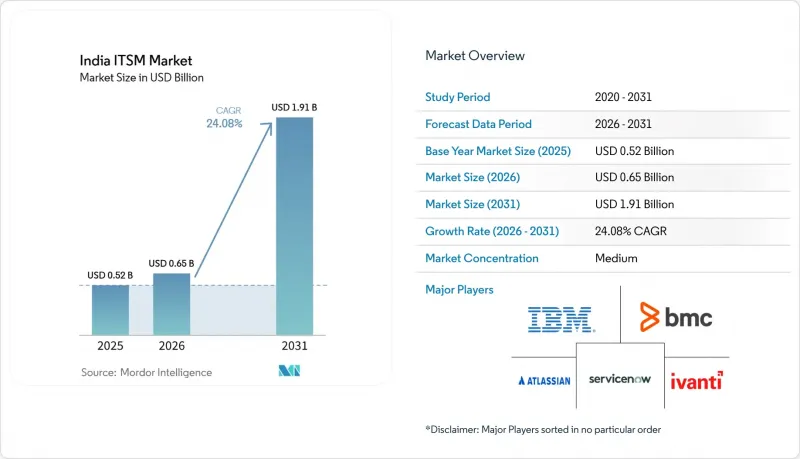
본 보고서는 구성 요소(솔루션 및 서비스), 배포 방식(클라우드, On-Premise, 하이브리드), 용도(서비스 데스크 및 인시던트 관리, 자산 및 구성 관리 등), 최종 사용 산업(은행, 금융서비스 및 보험(BFSI), 제조업 등), 기업 규모(대기업, 중소기업)별로 분류되어 있습니다. 시장 전망은 금액(달러) 기준으로 제시되어 있습니다.
인도 ITSM 시장 동향 및 인사이트
AI를 활용한 서비스 운영으로의 전환이 제공 모델을 재구축
인도의 ITSM 시장은 규칙 기반의 서비스 대응에서 수작업 부담을 대폭 줄이면서 인시던트를 식별, 라우팅, 해결할 수 있는 AI 주도형 서비스 운영으로 전환되고 있습니다. Freshworks의 보고서에 따르면, AI를 활용한 ITSM 팀은 티켓 해결 시간을 76.6% 단축하고 최초 대응 시간을 41.1% 개선한 반면, 인도의 고객 만족도는 2024년부터 2025년까지 97.4%에서 97.83%로 상승했습니다. 이러한 변화에 따라 서비스 데스크 팀의 역할도 변화하고 있습니다. 기초적인 티켓 처리는 점점 더 자동화되는 반면, 인간 직원은 예외 처리, 지식 관리, 그리고 더 복잡한 지원 업무에 집중하게 되었습니다. 아틀라시안은 실행 계획을 수립하고, 연동된 시스템 전반에 걸쳐 조치를 실행하며, 사용자를 다른 도구로 전환시키지 않고도 Jira Service Management 내에서 요청을 종결할 수 있는 워크플로우인 ‘Rovo Service Agent’를 발표했습니다. 인도의 ITSM 시장에서 이러한 기능은 중요합니다. 기업들은 더 이상 티켓 기록이나 보고서 작성만을 목적으로 한 플랫폼을 구매하지 않기 때문입니다. 기업들은 가동 중인 운영 환경 내에서 자율적인 조치를 지원하고, 문제 감지부터 해결까지의 프로세스를 단축할 수 있는 플랫폼을 점점 더 많이 선택하고 있습니다.
GCC 표준화가 전사적 ITSM 통합을 촉진
인도의 ITSM 시장은 해당 국가 내 세계 역량 센터의 규모와 성숙도에 의해서도 뒷받침되고 있습니다. 2024년 현재, 인도에는 약 2,975개의 세계 역량 센터가 존재하며, 이러한 센터들이 제품 개발, AI, 사이버 보안, 엔지니어링 업무를 더욱 담당하게 됨에 따라, 이 기반이 창출하는 가치는 2029 회계연도까지 지속적으로 상승할 것으로 예측됩니다. 이러한 센터에서는 분산된 팀 간에 표준화된 서비스 프로세스가 요구되고 있으며, 이에 따라 거버넌스, 워크플로우의 일관성, 그리고 세계 서비스 규칙을 지원할 수 있는 ITIL 준수 플랫폼에 대한 수요가 증가하고 있습니다. 이러한 영향은 센터 자체에 그치지 않고, 공급업체와 서비스 파트너 역시 더 대규모의 서비스 제공 생태계 내에서 업무를 수행하기 위해 상호 호환 가능한 서비스 관행을 필요로 하는 경우가 많기 때문에 파급 효과는 더욱 확대되고 있습니다. 『경제 조사 2025-26』에서는 GCC의 확장이 주요 대도시권을 넘어 2급 및 3급 도시로 확대되고 있으며, 이로 인해 기업용 IT 서비스 수요의 지리적 기반이 확대되고 있다는 점도 지적하고 있습니다. 수요는 소프트웨어 업데이트 주기뿐만 아니라 기업용 서비스 제공의 사업 전개 범위 확대와도 연결되어 있으므로, 이는 장기적으로 인도의 ITSM 시장을 지탱하는 요인이 될 것입니다.
레거시 시스템 마이그레이션의 복잡성과 전환 비용이 마이그레이션 속도를 제약
인도의 ITSM 시장에는 여전히 레거시 환경의 도입 기반이 다수 존재하며, 이것이 플랫폼의 전면적인 교체 속도를 제한하고 있습니다. 많은 대기업과 정부 기관은 수년에 걸쳐 워크플로 규칙, 승인 로직, 서비스 카탈로그가 통합된 고도로 맞춤화된 서비스 시스템을 계속 운영하고 있습니다. 이로 인해 마이그레이션은 어려워집니다. 구매자는 티켓 데이터를 이전할 뿐만 아니라, 서비스 중단 없이 비즈니스에 필수적인 운영 로직을 유지하려 하기 때문입니다. 또한 공공 부문이나 정부 기관에서는 승인 주기가 길어지는 경향이 있어, 새로운 플랫폼의 검증이나 교체 결정이 최종 확정되기까지 시간이 오래 걸립니다. 이로 인해, 설령 새로운 플랫폼이 기술적으로 우수하더라도 일부 고객의 경우 마이그레이션 리스크가 기능 업그레이드의 이점을 상회할 가능성이 있어, 인도 ITSM 시장의 성장은 둔화되고 있습니다. 따라서 마이그레이션 도구, 단계적 마이그레이션 기법, 리스크가 낮은 도입 모델을 제공하는 벤더는 복잡한 고객 환경에서의 교체 프로젝트를 수주할 가능성이 높아집니다.
부문 분석
2025년, 솔루션은 인도 ITSM 시장 점유율의 63.72%를 차지했습니다. 이는 구매자들이 여전히 서비스 데스크, 자산, 변경, 지식 워크플로우를 통합할 수 있는 핵심 플랫폼에 지출의 대부분을 할당하고 있음을 보여줍니다. 이러한 경향은 거버넌스 격차를 초래하는 분산된 도구보다 통합된 환경을 선호하는 대기업 및 GCC 주도 기업들의 경향을 반영합니다. 인도 ITSM 시장을 선도하는 각 플랫폼 벤더들은 이러한 추세를 활용하여 멀티모듈 제품군을 장기적인 고객 관계의 기본 진입점으로 자리매김하고 있습니다. 이러한 접근 방식을 통해 벤더들은 시간이 지남에 따라 계정 가치를 확대할 여지도 얻게 됩니다. 이는 기반 플랫폼이 확립되면 전면적인 교체 논의를 거치지 않고도 인접 기능을 추가할 수 있기 때문입니다. 인도의 ITSM 업계에서 이는 단일 운영 모델 하에서 광범위한 워크플로를 지원하고, 대규모 사용자 기반 전반에 걸쳐 정책의 일관성을 유지할 수 있는 기업에 유리하게 작용합니다.
서비스 시장은 2031년까지 연평균 성장률(CAGR) 26.31%로 확대될 것으로 예측되며, 이는 인도 ITSM 시장에서 소프트웨어 단독보다 도입, 최적화 및 관리형 운영 분야의 성장 속도가 더 빠르다는 것을 보여줍니다. AI 지원 플랫폼의 경우, 약속된 이점을 실현하기 전에 워크플로우 설계, 데이터 준비, 프로세스 조정 및 변경 관리가 필요하기 때문에 구매자들은 외부 지원을 점점 더 필요로 하고 있습니다. 이에 따라 인도에 본사를 둔 시스템 통합사업자와 서비스 기업들은 기본적인 도입 업무에서 더 광범위한 운영 범위를 갖춘 지적 재산(IP) 주도형 관리형 ITSM 서비스로 전환하고 있습니다. 이러한 변화는 경쟁 환경도 변화시키고 있습니다. 과거에는 주로 라이선스 수익에 의존하던 벤더들도 도입 및 계약 갱신을 확보하기 위해 더욱 견고한 제공 생태계를 구축해야 할 필요에 직면하고 있기 때문입니다. 장기적으로는 이로 인해 소프트웨어가 지출의 중심을 계속 차지할 것이지만, 인도 ITSM 시장 전체에서 서비스 계층의 전략적 가치는 더욱 높아질 것으로 전망됩니다.
2025년 인도 ITSM 시장 규모 중 클라우드 도입이 59.62%를 차지하며, 구독형 제공 방식이 현재 대다수 기업 구매자에게 주류 모델로 자리 잡은 것으로 확인되었습니다. 그 주된 매력은 인프라 부담을 줄일 수 있을 뿐만 아니라, 분산된 사무실, 원격 팀, 그리고 외부에 위탁된 서비스 환경 전반에 걸쳐 신속한 표준화를 실현할 수 있다는 점에 있습니다. 이는 인도의 ITSM 시장에서 특히 중요한 의미를 지닙니다. 대규모 조직은 여러 도시나 딜리버리 센터에 걸쳐 사업을 전개하는 경우가 많아, 이에 따라 일원화된 관리의 가치가 높아지기 때문입니다. Freshworks는 2026년 4월, Freshservice ITAM에 지속적인 감지 기능과 종속성 매핑 기능을 추가함으로써 클라우드 네이티브 제안을 확대하고, SaaS 주도 플랫폼의 운영적 깊이를 강화했습니다. 기능이 점차 충실해짐에 따라, 고도로 격리된 인프라가 필요 없는 구매자들에게 있어 기존의 On-Premise 환경에 머물러야 할 이유는 점점 줄어들고 있습니다.
또한, 클라우드는 2031년까지 연평균 성장률(CAGR)이 26.15%에 달하는 가장 빠르게 성장하는 도입 부문으로, 이는 인도 ITSM 시장에서 여전히 큰 전환 여지가 남아 있음을 보여줍니다. On-Premise 환경은 국방 분야, 특정 정부 기관의 이용 사례, 그리고 여전히 엄격한 격리 요건이 적용되는 일부 중요 인프라에서 계속해서 중요한 역할을 수행하고 있습니다. 또한, 기존 데이터센터에서 클라우드 기반 서비스 제공으로 단계적으로 전환하고 있는 규제 대상 기관에게도 하이브리드 모델은 여전히 중요한 위치를 차지하고 있습니다. 인도 금융 부문에서 IBM이 규정 준수를 중시하는 입지를 구축하고 있는 것은 과거 규제 대상 부문에서의 도입을 지연시켰던 주권 및 관리에 대한 우려를 클라우드 제공업체들이 어떻게 해소해 나가고 있는지를 보여줍니다. 그 결과, 인도의 ITSM 시장에서는 클라우드의 성장이 계속해서 광범위하게 이어지는 한편, 하이브리드 환경이나 관리형 프라이빗 환경은 규모는 작지만 여전히 중요한 특정 업종에서 계속해서 중요한 역할을 수행할 것으로 보입니다.
기타 혜택:
- 엑셀 형식 시장 예측(ME) 시트
- 3개월간의 애널리스트 지원
자주 묻는 질문
목차
제1장 서론
제2장 조사 방법
제3장 주요 요약
제4장 시장 구도
제5장 시장 규모와 성장 예측
제6장 경쟁 구도
제7장 시장 기회와 향후 전망
JHSAccording to Mordor Intelligence, the India iT service management market size was USD 0.52 billion in 2025 and is forecast to reach USD 1.91 billion by 2031 at a CAGR of 24.08% over 2026-2031.
This report is Segmented by Component (Solutions and Services), Deployment (Cloud, On-Premise, and Hybrid), Application (Service Desk and Incident Management, Asset and Configuration Management, and More), End-User Industry (BFSI, Manufacturing, and More), and Enterprise Size (Large Enterprises, and Small and Medium Enterprises). The Market Forecasts are Provided in Terms of Value (USD).
India ITSM Market Trends and Insights
Shift To AI-Enabled Service Operations Reshapes Delivery Models
The India IT service management market is moving from rule-based service handling toward AI-driven service operations that can identify, route, and resolve incidents with much less manual effort. Freshworks reported that AI-enabled ITSM teams achieved a 76.6% reduction in ticket resolution time and a 41.1% improvement in first-response time, while customer satisfaction in India rose from 97.4% to 97.83% between 2024 and 2025. This shift is changing the role of service desk teams: entry-level tickets are increasingly automated, while human staff focus more on exception handling, knowledge curation, and higher-complexity support work. Atlassian presented its Rovo Service agent as a workflow that can build an execution plan, act across connected systems, and close requests inside Jira Service Management without forcing users into other tools.. That kind of capability matters in the India IT service management market because enterprises are no longer buying platforms only for ticket recording and reporting. They are increasingly selecting platforms that can support autonomous actions inside live operational environments and shorten the path from detection to closure.
GCC Standardization Drives Enterprise-Wide ITSM Consolidation
The India IT service management market is also being supported by the scale and maturity of the country's global capability center footprint. India had nearly 2,975 global capability centers in 2024, and the value created by this base is expected to continue rising through FY2029 as centers take on more product, AI, cybersecurity, and engineering work. These centers need standardized service processes across distributed teams, which pushes buyers toward ITIL-aligned platforms that can support governance, workflow consistency, and global service rules. The effect also extends beyond the centers themselves, as suppliers and service partners often need compatible service practices to operate within larger delivery ecosystems. The Economic Survey 2025-26 also noted that GCC expansion is moving beyond core metro corridors into Tier-2 and Tier-3 cities, which broadens the geographic base of enterprise IT service demand. This supports the India IT service management market over the long term because demand is tied not only to software refresh cycles but also to the widening operational footprint of enterprise service delivery.
Legacy Migration Complexity And Switching Costs Constrain Transition Velocity
The India IT service management market still carries a large installed base of legacy environments, and that limits the pace of full platform replacement. Many large enterprises and government-linked organizations continue to run heavily customized service systems, where workflow rules, approval logic, and service catalogs have been embedded over many years. That makes migration difficult because buyers are not only moving ticket data, they are also trying to preserve business-critical operating logic without service disruption. Public sector entities and state-linked institutions often face longer approval cycles as well, which extends the time needed to validate new platforms and finalize replacement decisions. This slows the India IT service management market even when new platforms are technically stronger, because transition risk can outweigh the appeal of feature upgrades for some accounts. Vendors that provide migration tooling, staged transition methods, and lower-risk onboarding models are therefore more likely to win replacement programs in complex accounts.
Other drivers and restraints analyzed in the detailed report include:
- Automation Pressure From Service Desk Volume Accelerates Platform Upgrades
- Cloud-Native ITSM Adoption Accelerates Under Hyperscaler-Led Infrastructure Expansion
- ITSM Skills Shortage Limits Deployment Velocity Across Mid-Market
For complete list of drivers and restraints, kindly check the Table Of Contents.
Segment Analysis
Solutions accounted for 63.72% of the India IT service management market share in 2025, which shows that buyers still allocate most spending toward core platforms that can centralize service desk, asset, change, and knowledge workflows. This pattern reflects the preference of large enterprises and GCC-led operations for integrated environments rather than scattered tools that create governance gaps. The leading platform vendors in the India IT service management market have used this preference to position multi-module suites as the default entry point for long-term client relationships. That approach also gives vendors more room to expand account value over time because once the base platform is established, adjacent functions can be added without a full replacement discussion. In the India IT service management industry, this favors companies that can support broad workflows under a single operating model and maintain policy consistency across large user bases.
Services are forecast to expand at a 26.31% CAGR through 2031, indicating that the faster-growing part of the India IT service management market lies in deployment, optimization, and managed execution rather than software alone. Buyers increasingly need outside support because AI-enabled platforms require workflow design, data preparation, process tuning, and change management before the promised benefits can be realized. This is why India-headquartered integrators and service firms are moving from basic implementation roles toward IP-led managed ITSM offerings with deeper operational scope. The shift is also changing competition because vendors that once depended mainly on license revenue now need stronger delivery ecosystems to protect adoption and renewals. Over time, this should keep software central to spending while still raising the strategic value of the services layer across the India IT service management market.
Cloud deployment held 59.62% of the India IT service management market size in 2025, confirming that subscription-based delivery is now the dominant model for most enterprise buyers. The main appeal is not only lower infrastructure burden, but also faster standardization across distributed offices, remote teams, and outsourced service environments. This is especially relevant in the India IT service management market because large organizations often operate across multiple cities and delivery centers, which makes centralized administration more valuable. Freshworks expanded its cloud-native proposition in April 2026 by adding continuous discovery and dependency mapping to Freshservice ITAM, thereby strengthening the operational depth of a SaaS-led platform. As feature depth improves, the rationale for staying on older on-premise environments becomes weaker for buyers who do not need highly isolated infrastructure.
Cloud is also the fastest-growing deployment segment with a 26.15% CAGR through 2031, which indicates that the India IT service management market still has substantial migration room ahead. On-premise environments remain relevant in defense, select government use cases, and parts of critical infrastructure where isolation requirements remain strong. Hybrid models also continue to matter for regulated institutions that are moving gradually from legacy data centers to cloud-based service delivery. IBM's compliance-focused positioning for India's financial sector shows how cloud providers are trying to remove sovereignty and control concerns that once slowed adoption in regulated segments. As a result, the India IT service management market is likely to see cloud growth remain broad-based, while hybrid and controlled private environments stay relevant in a smaller but still important set of verticals.
Complete Report Scope:
- By Component
- Solutions
- Services
- By Deployment
- Cloud
- On-Premise
- Hybrid
- By Application
- Service Desk and Incident Management
- Asset and Configuration Management
- Change and Release Management
- Service Request Management
- Knowledge Management
- Other ITSM Applications
- By End-User Industry
- BFSI
- Manufacturing
- Government and Public Sector
- IT and Telecommunications
- Retail and E-Commerce
- Healthcare
- Travel and Hospitality
- Other End-User Industries
- By Enterprise Size
- Large Enterprises
- Small and Mid-Sized Enterprises (SME)
List of Companies Covered in this Report:
- ServiceNow, Inc.
- IBM Corporation
- BMC Software, Inc.
- Atlassian Corporation Plc
- Ivanti, Inc.
- Freshworks Inc.
- Zoho Corporation Pvt. Ltd.
- Broadcom Inc.
- OpenText Corporation
- SolarWinds Corporation
- EasyVista SA
- SysAid Technologies Ltd.
- TOPdesk B.V.
- Hornbill Service Management Ltd.
- Xurrent
- Halo Service Solutions Ltd.
- HCL Technologies Limited
- Tata Consultancy Services Limited
- Infosys Limited
- Wipro Limited
- Tech Mahindra Limited
- LTIMindtree Limited
- Persistent Systems Limited
- Mphasis Limited
Additional Benefits:
- The market estimate (ME) sheet in Excel format
- 3 months of analyst support
TABLE OF CONTENTS
1 INTRODUCTION
- 1.1 Study Assumptions and Market Definition
- 1.2 Scope of the Study
2 RESEARCH METHODOLOGY
3 EXECUTIVE SUMMARY
4 MARKET LANDSCAPE
- 4.1 Market Overview
- 4.2 Market Drivers
- 4.2.1 Shift to AI-Enabled Service Operations
- 4.2.2 Expansion of Cloud-Native ITSM Adoption
- 4.2.3 Rising Managed Services Demand in Mid-Market Enterprises
- 4.2.4 India-Specific Data Residency and Sovereignty Requirements
- 4.2.5 Automation Pressure From High Service Desk Ticket Volumes
- 4.2.6 GCC-Led Standardization of Enterprise Service Management
- 4.3 Market Restraints
- 4.3.1 Legacy Migration Complexity and Switching Costs
- 4.3.2 Shortage of Skilled ITSM, AIOps, and Process Consulting Talent
- 4.3.3 Fragmented Tool Sprawl Across Enterprise IT Stacks
- 4.3.4 Budget Sensitivity Among Small and Mid-Sized Enterprises
- 4.4 Industry Value Chain Analysis
- 4.5 Impact of Macroeconomic Factors
- 4.6 Regulatory Landscape
- 4.7 Technological Outlook
- 4.8 Porter's Five Forces Analysis
- 4.8.1 Bargaining Power of Suppliers
- 4.8.2 Bargaining Power of Buyers
- 4.8.3 Threat of New Entrants
- 4.8.4 Threat of Substitutes
- 4.8.5 Intensity of Competitive Rivalry Analysis
5 MARKET SIZE AND GROWTH FORECASTS (VALUE)
- 5.1 By Component
- 5.1.1 Solutions
- 5.1.2 Services
- 5.2 By Deployment
- 5.2.1 Cloud
- 5.2.2 On-Premise
- 5.2.3 Hybrid
- 5.3 By Application
- 5.3.1 Service Desk and Incident Management
- 5.3.2 Asset and Configuration Management
- 5.3.3 Change and Release Management
- 5.3.4 Service Request Management
- 5.3.5 Knowledge Management
- 5.3.6 Other ITSM Applications
- 5.4 By End-User Industry
- 5.4.1 BFSI
- 5.4.2 Manufacturing
- 5.4.3 Government and Public Sector
- 5.4.4 IT and Telecommunications
- 5.4.5 Retail and E-Commerce
- 5.4.6 Healthcare
- 5.4.7 Travel and Hospitality
- 5.4.8 Other End-User Industries
- 5.5 By Enterprise Size
- 5.5.1 Large Enterprises
- 5.5.2 Small and Mid-Sized Enterprises (SME)
6 COMPETITIVE LANDSCAPE
- 6.1 Market Concentration
- 6.2 Strategic Moves
- 6.3 Market Share Analysis
- 6.4 Company Profiles (includes Global Level Overview, Market Level Overview, Core Segments, Financials as available, Strategic Information, Market Rank/Share, Products and Services, Recent Developments)
- 6.4.1 ServiceNow, Inc.
- 6.4.2 IBM Corporation
- 6.4.3 BMC Software, Inc.
- 6.4.4 Atlassian Corporation Plc
- 6.4.5 Ivanti, Inc.
- 6.4.6 Freshworks Inc.
- 6.4.7 Zoho Corporation Pvt. Ltd.
- 6.4.8 Broadcom Inc.
- 6.4.9 OpenText Corporation
- 6.4.10 SolarWinds Corporation
- 6.4.11 EasyVista SA
- 6.4.12 SysAid Technologies Ltd.
- 6.4.13 TOPdesk B.V.
- 6.4.14 Hornbill Service Management Ltd.
- 6.4.15 Xurrent
- 6.4.16 Halo Service Solutions Ltd.
- 6.4.17 HCL Technologies Limited
- 6.4.18 Tata Consultancy Services Limited
- 6.4.19 Infosys Limited
- 6.4.20 Wipro Limited
- 6.4.21 Tech Mahindra Limited
- 6.4.22 LTIMindtree Limited
- 6.4.23 Persistent Systems Limited
- 6.4.24 Mphasis Limited
7 MARKET OPPORTUNITIES AND FUTURE OUTLOOK
- 7.1 White-Space and Unmet-Need Assessment