

|
시장보고서
상품코드
2119005
OTT 셋톱박스 : 시장 점유율 분석, 업계 동향 및 통계, 성장 예측(2026-2031년)OTT Set-Top Box - Market Share Analysis, Industry Trends & Statistics, Growth Forecasts (2026 - 2031) |
||||||
 Mordor Intelligence
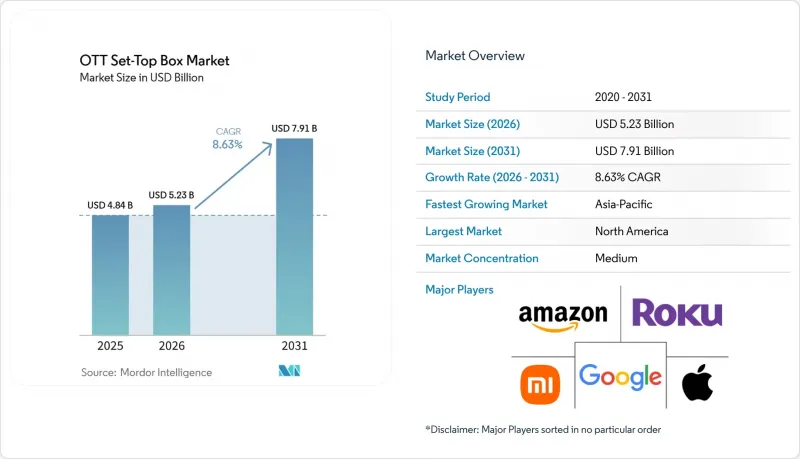
Mordor Intelligence에 의하면, OTT 셋톱박스 시장 규모는 2025년에 48억 4,000만 달러로 평가되었습니다. 2026년 52억 3,000만 달러에서 2031년까지 79억 1,000만 달러에 이를 것으로 예상되며, 예측 기간(2026-2031년) CAGR은 8.63%를 나타낼 전망입니다.
본 보고서는 제품 유형(IP/OTT 전용 셋톱박스, 하이브리드 방송·OTT 셋톱박스), 운영 체제 및 플랫폼(Android TV 및 Google TV, RDK, 독자 개발 소비자 플랫폼 등), 판매 채널(소매, 통신 사업자, 광대역, 유료 TV 사업자 등), 지역(북미, 남미 등)별로 분류되어 있습니다. 시장 예측은 금액(미 달러) 기준으로 제시되어 있습니다.
세계의 OTT 셋톱박스 시장 동향 및 인사이트
‘코드 커팅’과 유연한 스트리밍 통합으로의 전환
기존 유료 TV에서 이탈하는 현상이 OTT 셋톱박스 시장의 하드웨어 교체 수요를 견인하고 있습니다. VAB의 예측에 따르면, 2026년 말까지 미국에서 8,070만 가구가 ‘코드 커터’ 또는 ‘코드 네버’가 되어 유료 TV 가입자 수를 사상 처음으로 추월할 것으로 전망됩니다. 여러 구독 서비스를 관리하는 가구는 자사의 광고나 콘텐츠 배치를 우선시하는 TV 제조업체의 인터페이스보다는 중립적인 발견(discovery) 계층을 원할 가능성이 있습니다. 이러한 수요의 상충은 서비스, 검색, 결제를 단일 경험으로 통합할 수 있는 독립적인 기기 플랫폼을 뒷받침하고 있습니다. 어그리게이션이 가입자의 지출과 일상적인 시청 선택에 영향을 미칠 만큼 충분히 신뢰를 얻게 된다면, OTT 셋톱박스 시장은 그 혜택을 누리게 될 것입니다.
고품질 OTT 전송을 가능하게 하는 광섬유 및 5G 고정 무선 네트워크의 확대
네트워크 용량은 높은 비트레이트의 스트리밍에 필수적인 요건이기 때문에 광섬유 및 고정 무선 액세스의 보급 확대는 OTT 셋톱박스 시장의 잠재 고객 기반을 확대합니다. 에릭슨의 보고서에 따르면, 2026년 6월 기준으로 고정 무선 접속 서비스 제공업체의 71%가 5G를 통해 서비스를 제공했으며, 394개 사업자가 5G 고정 무선 서비스를 상용화하고 있었습니다. 이 회사는 2031년까지 전 세계 고정 무선 가입자 수가 3억 5,000만 명에 달할 것으로 예측했습니다. 2026년 1분기, 모바일 및 고정 무선 네트워크 트래픽은 전년 동기 대비 22% 증가했으며, 그 증가분의 대부분은 인도와 북미에서 비롯되었습니다. 고정 무선은 광섬유 설치가 경제적으로 타당하지 않은 인구 밀도가 낮은 교외 및 농촌 지역에도 서비스를 제공할 수 있습니다. 이러한 가구는 위성 방송 직접 수신(DTH)이나 DSL 장비에서 4K 서비스를 지원할 수 있는 IP 기반 기기로 업그레이드할 가능성이 있습니다.
스마트 TV의 보급으로 전용 OTT 하드웨어에 대한 수요 감소
스마트 TV의 보급으로 인해 기본적인 스트리밍용 동글이나 보급형 OTT 셋톱박스에 대한 수요가 감소하고 있습니다. 250달러 미만의 보급형 모델에는 Android TV의 기본 기능이 탑재되어 있어, 가정이 TV를 교체할 때 별도의 기기를 준비할 필요가 없어졌습니다. 2019년 이후 ‘Shield TV’의 하드웨어 개편이 이루어지지 않은 점은 저가형 스마트 TV가 동등한 OS 기능을 제공하는 상황에서 프리미엄 안드로이드 TV 박스의 판매가 얼마나 어려운지를 보여줍니다. 독립형 기기의 가장 유력한 이용 사례는 여전히 가정 전체의 IoT 제어, 60fps 돌비 비전(Dolby Vision), 그리고 더 높은 성능의 처리 능력과 연결성을 필요로 할 수 있는 프리미엄 스포츠 중계의 집약입니다. TV에 내장된 칩셋은 대중용 패널에서 반드시 이러한 기능을 우선시하지는 않습니다. 그 결과, 스마트 TV로의 대체가 미치는 영향은 프리미엄 통신사용 기기보다는 오히려 중급형 기기에 가장 큰 압박을 가하고 있습니다.
부문별 분석
2025년, IP/OTT 전용 기기는 OTT 셋톱박스 시장 규모의 62.15%를 차지했으며, 2031년까지 연평균 성장률(CAGR) 9.21%를 나타낼 것으로 예측됩니다. 이는 가장 크고 가장 빠르게 성장하는 제품 카테고리이며, 서유럽 및 남미에서 풀 IP로의 전환이 가속화되고 있음을 시사합니다. DVB-T2, DVB-S2 및 ISDB-T 튜너를 제거함으로써 제조업체는 AV1 디코딩, 하드웨어 DRM 및 Wi-Fi 6E를 위해 실리콘 생산 능력을 전환할 수 있습니다. 이러한 설계를 통해 OTT 셋톱박스 시장은 비슷한 가격대에서 통합형 TV 소프트웨어와 경쟁할 수 있는 명확한 길을 확보할 수 있습니다. 또한, 방송 기능과 IP 기능을 동일한 케이스 내에서 장기간 유지해야 할 필요성도 줄어듭니다.
Skyworth와 Amlogic은 IBC 2025에서 제스처 제어 및 피트니스 용도의 엣지 AI와 카메라 기능을 갖춘 6nm 공정 시스템 온 칩(SoC)이 탑재된 4K Android TV 사업자용 기기를 발표했습니다. 이러한 기능들은 하이브리드 방송 섀시보다 IP 전용 설계에 더 적합합니다. 하이브리드 기기는 북미 지방, 남유럽, 브라질의 TV 3.0 전환 지역 등 지상파 또는 위성 방송의 연속성이 요구되는 지역에서는 여전히 중요하게 여겨지고 있습니다. 대규모 사업자들은 무선 업데이트를 지원하는 클라우드 관리형 IP 기기를 채택하고 있지만, 클라우드 용량이 제한된 지역 사업자들은 신호 연속성을 유지하기 위해 여전히 하이브리드 기기를 사용하고 있습니다. 미국의 내비게이션 규정은 상호 운용 가능한 고객 기기를 지원하며, 폐쇄적인 레거시 설계보다 인증된 플랫폼을 우선시하고 있습니다.
지역별 분석
2025년, 북미는 전 세계 OTT 셋톱박스 시장 점유율의 43.58%를 차지했습니다. 이는 높은 판매 가격, 확고한 스트리밍 플랫폼, 그리고 대규모 ‘코드 커팅’ 인구 덕분에 가능했습니다. Roku의 2025년 연차 보고서에 따르면, 매출은 47억 4,000만 달러, 순이익은 8,840만 달러, 자유 현금 흐름은 사상 최고치를 기록했으며, 이 지역을 선도하는 플랫폼은 단말기 이익률이 아닌 플랫폼 수익화에 의해 견인되고 있음을 보여줍니다. 폭스(Fox)는 2026년 6월, 규제 당국의 승인을 조건으로 로쿠(Roku)를 220억 달러에 인수하겠다는 제안을 발표했으며, 2027년 상반기에 거래가 완료될 전망입니다. 이 제안이 실현되면, 로쿠(Roku)사의 커넥티드 TV 플랫폼이 투비(Tubi) 및 폭스(Fox)사의 콘텐츠와 통합되어, 아마존 파이어 TV(Amazon Fire TV), 구글 TV(Google TV), 애플 TV(Apple TV)와의 경쟁이 격화될 것입니다. 캐나다에서는 광대역에 기반한 성숙한 OTT 기반이 확립되어 있지만, 멕시코에서는 광섬유가 지방 도시로 확대됨에 따라 DTH(직접 수신형) 위성 방송에서 IPTV 및 광대역 서비스로의 전환이 진행되고 있습니다.
아시아태평양은 2031년까지 연평균 성장률(CAGR)이 9.06%에 달하고, 가장 빠르게 성장하는 지역이 될 것으로 예측됩니다. 인도에서는 JioFiber의 확대와 Airtel Xstream의 번들 서비스를 통해,각 가정이 기존의 직접 수신형(DTH) 기기에서 IP 지원 스트리밍 기기로 전환하고 있으며, 인도의 광대역 가입자 수는 2025년 7억 명에서 2030년까지 11억 명 이상으로 증가할 것으로 예측됩니다. 중국은 가장 많은 IPTV 가입자 수를 보유하고 있으며, 2030년까지 5억-5억 5,000만 가구에 달할 것으로 예측되지만, MIIT(산업정보화부)의 인증 및 GB 하드웨어 규격으로 인해 수요는 국내 벤더와 스트리밍 서비스 쪽으로 향하고 있습니다. 동남아시아는 급속히 성장하고 있는 지역이며, 2026년 5월 ‘MyIPTV4K’에 대한 단속은 인증된 단말기가 불법 복제 방지 대책에 기여할 수 있음을 보여줍니다. 이러한 요인들로 인해 아시아태평양은 OTT 셋톱박스 시장에 있어 중요한 성장 지역이 되고 있습니다.
유럽에서는 Android TV Operator Tier 및 RDK 도입을 통해 현대화가 진행되고 있으며, 2026년 1월 노르웨이에서 Telenor가 ‘T-We Boks III’를 출시한 것은 노르웨이, 스웨덴, 핀란드에 걸친 북유럽 전역의 서비스 확대를 위한 기반을 마련하고 있습니다. 남미에서는 브라질이 디지털 전환을 지속하는 가운데 판매 대수가 완만하게 증가하고 있으며, 2026년 5월에는 ZTE와 Claro가 울트라 HD 동영상, 음성 제어, Wi-Fi, 로컬 스트리밍 접속 기능을 갖춘 4K 울트라 HD IP 셋톱박스 ‘Z4KW6’를 출시했습니다. 중동 및 아프리카는 시장 규모가 여전히 작지만, 사우디아라비아가 FTTH(Fiber-to-the-Home)를 확대하고 통신 사업자들이 IPTV 지원 기기를 도입함에 따라 시장이 발전하고 있습니다. OTT 셋톱박스 시장은 스트리밍 가입자 증가에 따라, 관리형 동영상 전송을 지원하는 기기에 대한 수요가 높은 이 지역에서 성장이 예상됩니다.
기타 혜택 :
- 엑셀 형식 시장 예측(ME) 시트
- 3개월간의 애널리스트 지원
자주 묻는 질문
목차
제1장 서론
제2장 조사 방법
제3장 개요
제4장 시장 구도
제5장 시장 규모 및 성장 예측
제6장 경쟁 구도
제7장 시장 기회 및 향후 전망
KTH 26.09.02According to Mordor Intelligence, the OTT set-Top box market size was valued at USD 4.84 billion in 2025 and is estimated to grow from USD 5.23 billion in 2026 to reach USD 7.91 billion by 2031, at a CAGR of 8.63% during the forecast period (2026-2031).
This report is Segmented by Product Type (IP/OTT-Only Set-Top Boxes, and Hybrid Broadcast-OTT Set-Top Boxes), Operating System and Platform (Android TV and Google TV, RDK, Proprietary Consumer Platforms, and More), Distribution Channel (Retail, Telecom, Broadband, and Pay-TV Operators, and More), and Geography (North America, South America, and More). The Market Forecasts are Provided in Terms of Value (USD).
Global OTT Set-Top Box Market Trends and Insights
Cord-Cutting and Migration to Flexible Streaming Aggregation
The shift away from traditional pay television is driving demand for hardware replacements in the OTT set-top box market. The VAB projected that 80.7 million U.S. households would be cord-cutters or cord-nevers by the end of 2026, exceeding pay-TV subscribers for the first time. Households that manage multiple subscriptions can seek a neutral discovery layer instead of a television-maker interface that also prioritizes its own advertising and content arrangements. That tension supports independent device platforms that can combine services, search, and billing into a single experience. The OTT set-top box market can benefit when aggregation is trusted enough to influence subscriber spending and daily viewing choices.
Fiber and 5G Fixed Wireless Expansion Enabling High-Quality OTT Delivery
Network capacity is a basic requirement for high-bitrate streaming, so broader fiber and fixed wireless access expand the addressable base for the OTT set-top box market. Ericsson reported that 71% of fixed wireless access service providers delivered services over 5G in June 2026, and that 394 operators had commercially launched 5G fixed wireless services. The company expects global fixed wireless subscriptions to reach 350 million by 2031. Mobile and fixed wireless network traffic rose 22% year over year in the first quarter of 2026, with India and North America providing much of the increase. Fixed wireless can reach lower-density suburban and rural locations where fiber deployment is less economical. Those households may upgrade from satellite direct-to-home or DSL equipment to IP-based devices that can support 4K services.
Smart Televisions Reducing the Need for Dedicated OTT Hardware
Smart television adoption reduces demand for basic streaming dongles and entry-level OTT set-top boxes. Native Android TV features are included in entry-level panels priced below USD 250, eliminating the need for a separate device when households replace their television. The lack of a Shield TV hardware refresh since 2019 shows the difficulty of selling a premium Android television box when a lower-priced smart television provides comparable operating system functions. The strongest standalone use cases remain whole-home IoT control, Dolby Vision at 60 frames per second, and premium sports aggregation that may require more capable processing and connectivity. Integrated television chipsets do not always prioritize these functions in mass-market panels. As a result, smart television substitution places the greatest pressure on mid-range devices rather than on premium operator equipment.
Other drivers and restraints analyzed in the detailed report include:
- Growth of FAST and Hybrid Live-TV Experiences
- 4K, HDR, Dolby Audio, and Premium Sports Streaming Upgrades
- Long Device Replacement Cycles and Retail Price Erosion
For complete list of drivers and restraints, kindly check the Table Of Contents.
Segment Analysis
IP/OTT-only equipment accounted for 62.15% of the OTT set-top box market size in 2025 and is projected to grow at a 9.21% CAGR through 2031. It was both the largest and fastest-growing product category, suggesting faster full-IP migration in Western Europe and South America. Removing DVB-T2, DVB-S2, and ISDB-T tuners lets manufacturers direct silicon capacity toward AV1 decoding, hardware DRM, and Wi-Fi 6E. This design gives the OTT set-top box market a clearer way to compete with integrated television software at similar prices. It also reduces the need to maintain broadcast and IP functions in the same chassis for long periods.
Skyworth and Amlogic presented a 6 nm system-on-chip 4K Android TV Operator Tier device at IBC 2025 with edge AI and camera functions for gesture control and fitness applications. These functions fit an IP-only design more readily than a hybrid broadcast chassis. Hybrid devices remain relevant where terrestrial or satellite continuity is required, including rural North America, Southern Europe, and Brazil's TV 3.0 transition areas. Larger operators use cloud-managed IP devices that support over-the-air updates, while regional operators with limited cloud capacity retain hybrid equipment to maintain signal continuity. U.S. navigation rules support interoperable customer equipment and favor certified platforms over more closed legacy designs.
Complete Report Scope:
- By Product Type
- IP/OTT-Only Set-Top Boxes
- Hybrid Broadcast-OTT Set-Top Boxes
- By Operating System and Platform
- Android TV and Google TV
- RDK
- Proprietary Consumer Platforms
- Other Operating System and Platforms
- By Distribution Channel
- Retail
- Telecom, Broadband, and Pay-TV Operators
- Distributors and Systems Integrators
- By Geography
- North America
- United States
- Canada
- Mexico
- South America
- Brazil
- Argentina
- Chile
- Rest of South America
- Europe
- Germany
- United Kingdom
- France
- Italy
- Spain
- Rest of Europe
- Asia-Pacific
- China
- Japan
- India
- South Korea
- Australia
- Rest of Asia-Pacific
- Middle East
- Saudi Arabia
- United Arab Emirates
- Qatar
- Rest of Middle East
- Africa
- South Africa
- Egypt
- Nigeria
- Rest of Africa
- North America
Geography Analysis
North America accounted for 43.58% of the global OTT set-top box market share in 2025, supported by higher selling prices, established streaming platforms, and a large cord-cutting population. Roku's 2025 annual report recorded USD 4.74 billion in revenue, USD 88.4 million in net income, and record free cash flow, showing that platform monetization rather than device margin drives leading regional platforms. Fox announced a proposed USD 22 billion acquisition of Roku in June 2026, subject to regulatory approval and expected to close in the first half of 2027. The proposal would combine Roku's connected television platform with Tubi and Fox content, increasing competition with Amazon Fire TV, Google TV, and Apple TV. Canada has a mature OTT base supported by broadband, while Mexico is shifting from direct-to-home satellite to IPTV and broadband services as fiber expands into secondary cities.
Asia-Pacific is projected to be the fastest-growing region, with a 9.06% CAGR through 2031. India's JioFiber expansion and Airtel Xstream bundles are moving households from legacy direct-to-home equipment toward IP-capable streaming devices, while the country's broadband subscriber base is projected to grow from 700 million in 2025 to more than 1.1 billion by 2030. China has the largest IPTV subscriber base and is projected to reach 500-550 million households by 2030, although MIIT certification and GB hardware standards steer demand toward domestic vendors and streaming services. Southeast Asia is a FAST growth area, and enforcement against MyIPTV4K in May 2026 indicates that certified devices can support anti-piracy efforts. These factors make Asia-Pacific an important expansion area for the OTT set-top box market.
Europe is modernizing through Android TV Operator Tier and RDK deployments, with Telenor's January 2026 T-We Boks III launch in Norway forming a basis for a Nordic service across Norway, Sweden, and Finland. South America is recording moderate volume growth as Brazil continues its digital transition, and ZTE and Claro launched the 4K Ultra HD IP STB Z4KW6 with Ultra HD video, voice control, Wi-Fi, and local streaming access in May 2026. Middle East and Africa remains smaller in value but is developing as Saudi Arabia expands fiber-to-the-home and operators deploy IPTV-ready equipment. The OTT set-top box market can gain in these regions where streaming subscriber growth requires a device that supports managed video delivery.
- Roku, Inc.
- Amazon.com, Inc.
- Apple Inc.
- Google LLC
- Samsung Electronics Co., Ltd.
- Vantiva SA
- SAGEMCOM Broadband SAS
- Skyworth Digital Technology Co., Ltd.
- Huawei Technologies Co., Ltd.
- ZTE Corporation
- Humax Co., Ltd.
- CommScope Holding Company, Inc.
- Kaonmedia Co., Ltd.
- Shenzhen SDMC Technology Co., Ltd.
- Xiaomi Corporation
- Comcast Corporation
- Netgem SA
- Vestel Elektronik Sanayi ve Ticaret A.S.
Additional Benefits:
- The market estimate (ME) sheet in Excel format
- 3 months of analyst support
TABLE OF CONTENTS
1 INTRODUCTION
- 1.1 Study Assumptions and Market Definition
- 1.2 Scope of The Study
2 RESEARCH METHODOLOGY
3 EXECUTIVE SUMMARY
4 MARKET LANDSCAPE
- 4.1 Market Overview
- 4.2 Market Drivers
- 4.2.1 Cord-Cutting and Migration to Flexible Streaming Aggregation
- 4.2.2 Fiber and 5G Fixed Wireless Expansion Enabling High-Quality OTT Delivery
- 4.2.3 Growth of FAST and Hybrid Live-TV Experiences
- 4.2.4 4K, HDR, Dolby Audio, and Premium Sports Streaming Upgrades
- 4.2.5 Operator Adoption of Android TV, RDK, and Cloud-Managed CPE
- 4.2.6 Smart-Home Hub Convergence Creating New Utility for the TV Screen
- 4.3 Market Restraints
- 4.3.1 Smart TVs Reducing the Need for Dedicated OTT Hardware
- 4.3.2 Long Device Replacement Cycles and Retail Price Erosion
- 4.3.3 Content Rights, DRM, and Certification Complexity Across Markets
- 4.3.4 Grey-Market IPTV Boxes and Cybersecurity-Driven Trust Deficits
- 4.4 Industry Value Chain Analysis
- 4.5 Regulatory Landscape
- 4.6 Technological Outlook
- 4.7 Porter's Five Forces Analysis
- 4.7.1 Bargaining Power of Buyers
- 4.7.2 Bargaining Power of Suppliers
- 4.7.3 Threat of New Entrants
- 4.7.4 Threat of Substitutes
- 4.7.5 Intensity of Competitive Rivalry
- 4.8 Impact of Macroeconomic Factors on the Market
5 MARKET SIZE AND GROWTH FORECASTS (VALUE)
- 5.1 By Product Type
- 5.1.1 IP/OTT-Only Set-Top Boxes
- 5.1.2 Hybrid Broadcast-OTT Set-Top Boxes
- 5.2 By Operating System and Platform
- 5.2.1 Android TV and Google TV
- 5.2.2 RDK
- 5.2.3 Proprietary Consumer Platforms
- 5.2.4 Other Operating System and Platforms
- 5.3 By Distribution Channel
- 5.3.1 Retail
- 5.3.2 Telecom, Broadband, and Pay-TV Operators
- 5.3.3 Distributors and Systems Integrators
- 5.4 By Geography
- 5.4.1 North America
- 5.4.1.1 United States
- 5.4.1.2 Canada
- 5.4.1.3 Mexico
- 5.4.2 South America
- 5.4.2.1 Brazil
- 5.4.2.2 Argentina
- 5.4.2.3 Chile
- 5.4.2.4 Rest of South America
- 5.4.3 Europe
- 5.4.3.1 Germany
- 5.4.3.2 United Kingdom
- 5.4.3.3 France
- 5.4.3.4 Italy
- 5.4.3.5 Spain
- 5.4.3.6 Rest of Europe
- 5.4.4 Asia-Pacific
- 5.4.4.1 China
- 5.4.4.2 Japan
- 5.4.4.3 India
- 5.4.4.4 South Korea
- 5.4.4.5 Australia
- 5.4.4.6 Rest of Asia-Pacific
- 5.4.5 Middle East
- 5.4.5.1 Saudi Arabia
- 5.4.5.2 United Arab Emirates
- 5.4.5.3 Qatar
- 5.4.5.4 Rest of Middle East
- 5.4.6 Africa
- 5.4.6.1 South Africa
- 5.4.6.2 Egypt
- 5.4.6.3 Nigeria
- 5.4.6.4 Rest of Africa
- 5.4.1 North America
6 COMPETITIVE LANDSCAPE
- 6.1 Market Concentration
- 6.2 Strategic Moves
- 6.3 Vendor Positioning Analysis
- 6.4 Company Profiles (includes Global Level Overview, Market Level Overview, Core Segments, Financials as available, Strategic Information, Market Rank/Share, Products and Services, Recent Developments)
- 6.4.1 Roku, Inc.
- 6.4.2 Amazon.com, Inc.
- 6.4.3 Apple Inc.
- 6.4.4 Google LLC
- 6.4.5 Samsung Electronics Co., Ltd.
- 6.4.6 Vantiva SA
- 6.4.7 SAGEMCOM Broadband SAS
- 6.4.8 Skyworth Digital Technology Co., Ltd.
- 6.4.9 Huawei Technologies Co., Ltd.
- 6.4.10 ZTE Corporation
- 6.4.11 Humax Co., Ltd.
- 6.4.12 CommScope Holding Company, Inc.
- 6.4.13 Kaonmedia Co., Ltd.
- 6.4.14 Shenzhen SDMC Technology Co., Ltd.
- 6.4.15 Xiaomi Corporation
- 6.4.16 Comcast Corporation
- 6.4.17 Netgem SA
- 6.4.18 Vestel Elektronik Sanayi ve Ticaret A.S.
7 MARKET OPPORTUNITIES AND FUTURE OUTLOOK
- 7.1 White-Space and Unmet-Need Assessment


