|
시장보고서
상품코드
2119361
러스트 스톱 윤활제 에어로졸 : 시장 점유율 분석, 업계 동향 및 통계, 성장 예측(2026-2031년)Rust Stop Lubricants Aerosol - Market Share Analysis, Industry Trends & Statistics, Growth Forecasts (2026 - 2031) |
||||||
 Mordor Intelligence
Mordor Intelligence에 의하면, 러스트 스톱 윤활제 에어로졸 시장 규모는 2025년에 4억 2,845만 달러로 평가되었습니다. 2026년 4억 5,137만 달러에서 2031년까지 5억 9,357만 달러로 달하며 2026년부터 2031년에 걸쳐 CAGR 5.63%를 기록할 전망입니다.
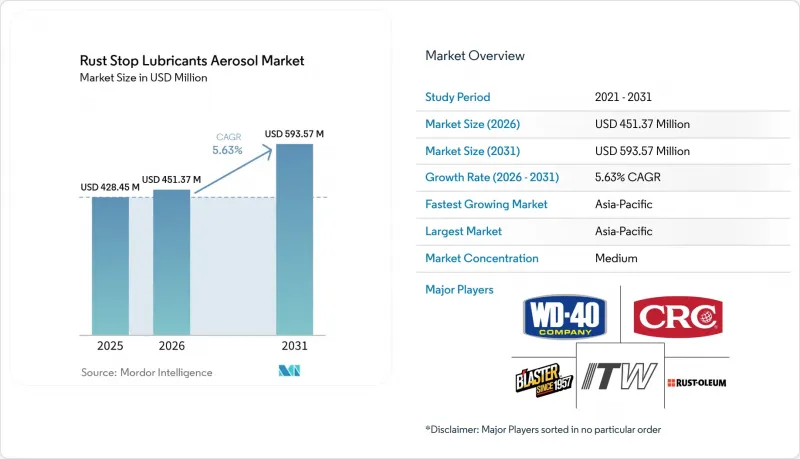
본 보고서는 제품 유형(다목적 윤활제, 침투성 윤활제 등), 최종 사용자 산업(자동차, 산업 제조 등), 지역(아시아태평양, 북미, 유럽, 남미, 중동 및 아프리카)별로 분류되어 있습니다. 시장 예측은 금액(미 달러)으로 표시되어 있습니다.
세계의 러스트 스톱 윤활제 에어로졸 시장 동향 및 인사이트
예방 정비 프로그램이 에어로졸 윤활제 수요 기반을 확대
예방 정비에서는 고장으로 인해 정상적인 운영이 방해받기 전에 정기적인 윤활 및 부식 방지 작업이 이루어지기 때문에 에어로졸 윤활제에 대한 지속적인 수요를 창출합니다. 미국 교통부는 부식과 관련된 고장이 교통 인프라 유지 관리 비용의 25%를 차지한다고 지적하고 있으며, 부식 방지는 실용적인 유지 관리상의 우선 순위가 되고 있습니다. 상태 모니터링 프로그램은 설비 문제가 심각한 고장으로 발전하기 전 초기 단계에서 이를 식별하므로, 에어로졸식 스팟 윤활은 설비 운영자에게 실용적인 대응책이 됩니다. 이러한 프로그램은 예기치 못한 가동 중지 시간을 최소화하고, 피할 수 있는 업무 중단을 줄이며, 윤활 및 부식 방지용 소모품의 정기적인 조달을 촉진하는 유지보수 관행을 지원합니다. 러스트 스톱 윤활제 에어로졸 시장은 대규모 수리보다 소규모의 빈번한 개입을 중시하는 프로그램의 혜택을 받고 있으며, 특히 설비의 가동률이 유지보수 의사결정의 지침이 되는 시설에서 이러한 경향이 두드러집니다.
자동차 및 산업 분야의 수리 활동이 높은 소비 빈도를 뒷받침하고 있습니다.
자동차 수리는 정기 점검 시 노후 차량에 부식 처리나 윤활제 도포가 필요하기 때문에 지속적인 수요원이 되고 있습니다. 러스트 스톱 윤활제 에어로졸 시장은 독립 정비 공장, 차량 함대 정비 거점 및 서비스 부문에서 부식된 체결 부품, 접합부,경첩, 체인 링크, 파이프 이음쇠 등에 대한 작업에 의해 뒷받침되고 있습니다. 산업 분야의 설비 갱신에 따라 기계 개조, 로봇 설비, 정밀 조립 라인, 컨베이어 시스템 등을 통해 윤활이 필요한 부분이 증가하고 있습니다. 이러한 분야는 금속 부품의 안정적인 작동과 보호가 필요하기 때문에 에어로졸 소모품에 대해 폭넓은 유지보수 기회를 제공합니다. OSHA(미국 직업안전보건청)의 안전 기준과 EPA(미국 환경보호청)의 배출 규제는 문서화된 정비 절차를 권장하고 있으며, 이에 따라 시설의 일상적인 유지보수는 더욱 공식적이고 추적 가능한 형태로 이루어지고 있습니다. 이러한 상황으로 인해 비정기적인 대규모 유지보수 프로젝트뿐만 아니라, 계획적인 작업을 위한 러스트 스톱 윤활제 에어로졸 제품의 빈번한 구매가 촉진되고 있습니다.
VOC, 가연성 및 화학 물질 규제에 대응하는 비용이 배합 제조업체의 이익률을 압박하고 있습니다.
북미 및 유럽의 에어로졸 윤활제 제조업체들은 배합, 시험, 보고 및 문서화 비용을 상승시키는 규제에 직면해 있습니다. 미국 환경보호청(EPA)은 2025년 1월 ‘에어로졸 코팅에 관한 국가 VOC 배출 기준’ 개정안을 최종 확정하고, 이후 준수 기한을 2027년 1월 17일까지 연장했습니다. 캘리포니아주는 독자적인 VOC 요건을 유지하고 있어, 여러 관할 구역에서 기어용, 체인용, 침투성 윤활제를 판매하는 공급업체들에게 추가적인 규정 준수 부담을 주고 있습니다. 성분 변경에는 재시험, 안전 데이터 시트(SDS) 업데이트, 제품 등록, 소매업체용 문서 작성, 그리고 변화하는 화학 물질 및 위험성 정보 전달 요건에 대한 대응이 필요할 수 있습니다. 소규모 제조업체의 경우, 규제 전문가 수가 적고 조사 능력도 제한적이며, 고정된 규정 준수 비용을 광범위한 제품 포트폴리오에 분산시키는 능력도 제한적이기 때문에 이러한 요건을 충족하기 어려울 수 있습니다. 따라서 러스트 스톱 윤활제 에어로졸 시장에서는 규정 준수 업무를 감당하면서도 전문가와 일반 소비자에게 신뢰할 수 있는 제품을 지속적으로 공급할 수 있는 공급업체가 유리한 입지를 차지할 가능성이 있습니다.
부문 분석
2025년, 침투성 윤활제는 고착된 체결 부품, 체인 링크, 배관 이음매 등에 대한 정비 공장의 정기적인 사용에 힘입어 러스트 스톱 윤활제 에어로졸 시장 점유율의 43.28%를 차지했습니다. 재구매는 모든 지역의 자동차 수리 및 MRO 채널에서 확고하게 자리 잡은 구매 습관을 반영합니다. 방청 및 특수 윤활제는 선박, 재생 에너지, 실외 인프라 용도에서 사용자가 장시간 지속되는 보호막을 지정하고 있기 때문에 2031년까지 연평균 성장률(CAGR) 6.48%를 나타낼 것으로 예측됩니다. ‘FUCHS CEPLATTYN 300 SPRAY’는 풍력 터빈 기어 톱니용 건식 필름 에어로졸로, 습식 그리스가 부적합한 고부하 및 분진에 노출된 환경에서 수요를 여실히 보여줍니다. 특수 용도용 러스트 스톱 윤활제 에어로졸 시장은 유지보수 팀이 특정 가동 조건에 맞추어 제품을 선정할 때 이점을 얻고 있습니다.
다목적 윤활제는 안정적인 입지를 유지하고 있으며, WD-40 멀티유스 제품과 같은 브랜드에 있어 여전히 핵심적인 위치를 차지하고 있습니다. WD-40사는 해당 카테고리가 성숙기에 접어들었음에도 불구하고, 2025 회계연도에 해당 제품의 순매출이 4억 7,796만 달러에 달했다고 보고했습니다. ‘기타’ 카테고리에는 전자기기 조립 및 식품 가공 환경에서 사용되는 실리콘계, 드라이 필름 및 부식 방지 윤활제가 포함됩니다. EU 에코라벨 기준과 NSF 인터내셔널(NSF)의 H1 및 H2 등록은 지속가능성이나 식품 접촉 조건이 중요한 상황에서 제품 선택을 뒷받침하고 있습니다. CRC 인더스트리즈는 2025년, 식물성 오일을 기반으로 세라믹을 배합한 에어로졸 제품 ‘Bio-Based Power Lube’를 출시했습니다. 이 제품은 경제협력개발기구(OECD)의 301B 생분해성 기준을 준수하며, 러스트 스톱 윤활제 에어로졸 업계의 혁신에 대한 노력을 보여줍니다.
지역별 분석
2025년, 아시아태평양은 러스트 스톱 윤활제 에어로졸 시장 점유율의 36.50%를 차지했으며, 2031년까지 지역별 가장 높은 연평균 성장률(CAGR) 6.87%를 나타낼 것으로 전망됩니다. 중국은 거대한 제조 거점을 통해 생산을 뒷받침하고 있는 반면, 인도는 철도 확장, 건설 기계 유지보수, 그리고 발전 중인 자동차 애프터마켓을 통해 수요를 창출하고 있습니다. 일본과 한국은 정밀 제조 용도에 적합한 드라이 필름형 및 특수 에어로졸 수요에 기여하고 있습니다. 인도의 산업 회랑 및 물류 네트워크에 대한 인프라 투자로 인해 설비 도입이 증가하고, 이에 따른 유지보수 수요가 발생하고 있습니다. 이 지역 시장 규모는 확립된 자동차 및 제조 클러스터와 확대되는 수리 네트워크에 의해 더욱 뒷받침되고 있습니다.
북미와 유럽은 프리미엄 배합 제품 및 규제 주도형 제품 변경에 있어 중요한 시장입니다. 미국 환경보호청(EPA)의 에어로졸 코팅 규제 준수 기한은 2027년 1월로 정해져 있어, 이에 따라 공급업체들은 반응성이 낮은 배합 제품 개발 및 관련 문서 준비를 진행하고 있습니다. 북미의 자동차 및 항공우주 산업 클러스터는 공식적인 유지보수 관행에 부합하는 특수 제품에 대한 수요를 뒷받침하고 있습니다. 독일에서는 2025년 에어로졸 제품 생산량이 2024년의 9억 3,200만 개에서 9억 3,400만 개로 증가했으며, 부식 방지 코팅은 2025년에 3%의 성장을 기록했습니다.
남미에서는 농업 관련 장비, 해양 석유 및 가스, 건설 유지보수를 통해 추가적인 생산량이 창출되고 있습니다. 브라질에서는 2025년 상반기에 소비자 구매력이 하락함에 따라 에어로졸 캔 출하량이 감소했으나, 산업용 유지보수 제품에 대한 수요는 소비자 신뢰도에 의한 직접적인 영향을 비교적 덜 받았습니다. 중동 및 아프리카는 석유 및 가스 유지보수 활동과 홍해 및 걸프 회랑을 통한 해양 사업으로부터 혜택을 받고 있습니다. 사우디아라비아와 남아프리카공화국에서는 엔지니어링 도급업체들이 유지보수·수리·운영(MRO) 조달 체계를 구축함으로써 지역 수요를 뒷받침하고 있습니다. B'laster사는 2025년 Repco사를 통해 호주 및 뉴질랜드에 진출함으로써, 북미 브랜드가 태평양 지역의 정비 공장 네트워크에 대한 접근성을 확대하고 있는 사례를 보여주었습니다. 러스트 스톱 윤활제 에어로졸 시장은 국가별로 수리 관행, 환경 노출 상황, 유통망의 커버 범위가 다르기 때문에 지역별로 다양한 특징을 유지하고 있습니다.
기타 혜택 :
- 엑셀 형식 시장 예측(ME) 시트
- 3개월간의 애널리스트 지원
자주 묻는 질문
목차
제1장 서론
제2장 조사 방법
제3장 주요 요약
제4장 시장 구도
제5장 시장 규모 및 성장 예측
제6장 경쟁 구도
제7장 시장 기회 및 향후 전망
KTH 26.09.10According to Mordor Intelligence, the rust stop lubricants aerosol market size is estimated at USD 428.45 million in 2025 and is estimated to grow from USD 451.37 million in 2026 to USD 593.57 million by 2031, at a CAGR of 5.63% during the forecast period (2026-2031).
This report is Segmented by Product Type (Multi-Purpose Lubricants, Penetrating Lubricants, and More), End-User Industry (Automotive, Industrial Manufacturing, and More), and Geography (Asia-Pacific, North America, Europe, South America, and Middle-East and Africa). The Market Forecasts are Provided in Terms of Value (USD).
Global Rust Stop Lubricants Aerosol Market Trends and Insights
Preventive Maintenance Programs Extend the Demand Base for Aerosol Lubricants
Preventive maintenance creates recurring demand for aerosol lubricants because scheduled lubrication and corrosion-control work occurs before failures disrupt normal operations. The U.S. Department of Transportation has linked corrosion-related failures to 25% of transportation infrastructure maintenance costs, making corrosion protection a practical maintenance priority. Condition-monitoring programs identify equipment issues at an early stage, before they develop into major failures, making aerosol spot lubrication a practical response for equipment operators. These programs support maintenance practices that limit unplanned downtime, reduce avoidable disruption, and encourage regular procurement of lubrication and corrosion-control consumables. The rust stop lubricants aerosol market benefits from programs that favor small, frequent interventions over large repair events, particularly in facilities where equipment availability guides maintenance decisions.
Automotive and Industrial Repair Activity Sustains High-Frequency Consumption
Automotive repair is a recurring source of demand because older vehicles require corrosion treatment and lubricant application during routine service. The rust stop lubricants aerosol market is supported by work on corroded fasteners, joints, hinges, chain links, and pipe fittings in independent workshops, fleet maintenance locations, and service departments. Industrial upgrades add lubrication points through machine retrofits, robotic equipment, precision assembly lines, and conveyor systems that require reliable movement and protection of metal components, providing a broad maintenance setting for aerosol consumables. OSHA safety practices and EPA emissions requirements encourage documented service procedures, which make routine facility maintenance more formal and traceable. These conditions support frequent purchases of rust stop lubricant aerosol products for planned work rather than only for infrequent bulk maintenance projects.
VOC, Flammability, and Chemical Compliance Costs Compress Formulator Margins
Aerosol lubricant producers in North America and Europe face regulations that raise formulation, testing, reporting, and documentation costs. The Environmental Protection Agency (EPA) finalized amendments to the National VOC Emission Standards for Aerosol Coatings in January 2025 and later extended the compliance date to January 17, 2027. California maintains separate VOC requirements, adding another layer of compliance for gear, chain, and penetrant lubricant suppliers selling across multiple jurisdictions. Reformulation can require retesting, updated safety data sheets, product registrations, retailer documentation, and alignment with changing chemical and hazard communication requirements. Smaller producers may find these requirements difficult to meet due to fewer regulatory specialists, less research capacity, and a limited ability to spread fixed compliance costs across a broad portfolio. The rust-stop lubricant aerosol market may therefore favor suppliers that can absorb compliance work while maintaining reliable products available to professional and retail customers.
Other drivers and restraints analyzed in the detailed report include:
- Multifunctional Penetrant-Lubricant Performance Reshapes Buyer Criteria
- E-Commerce and Digital Procurement Accelerate Access and Buyer Power
- Raw Material and Propellant Volatility Undermines Forward Planning
For complete list of drivers and restraints, kindly check the Table Of Contents.
Segment Analysis
Penetrating lubricants accounted for 43.28% of the rust stop lubricants aerosol market share in 2025, supported by regular workshop use for seized fasteners, chain links, and pipe fittings. Repeat sales reflect established buying habits in automotive repair and MRO channels across all regions. Rust prevention and specialty lubricants are projected to grow at a 6.48% CAGR through 2031, as users specify long-dwell protective films in marine, renewable energy, and outdoor infrastructure applications. FUCHS CEPLATTYN 300 SPRAY is a dry-film aerosol for wind-turbine gear teeth and illustrates demand in high-load, dust-exposed settings where wet greases are unsuitable. The rust stop lubricant aerosol market for specialized uses benefits when maintenance teams select products for specific operating conditions.
Multi-purpose lubricants retain a stable role and remain central to brands such as WD-40 Multi-Use Product. WD-40 Company reported USD 477.96 million in net sales for the product in fiscal year 2025, despite category maturity. The other category includes silicone-based, dry-film, and corrosion-inhibiting lubricants that serve electronics assembly and food processing environments. EU Ecolabel criteria and NSF International (NSF) H1 and H2 registrations support product selection where sustainability and food-contact conditions are relevant. CRC Industries introduced Bio-Based Power Lube in 2025 as a vegetable oil-based, ceramic-fortified aerosol with Organisation for Economic Co-operation and Development (OECD) 301B biodegradability compliance, illustrating the innovation focus within the rust stop lubricants aerosol industry.
Complete Report Scope:
- By Product Type
- Multi-Purpose Lubricants
- Penetrating Lubricants
- Rust Prevention and Specialty Lubricants
- Others (Silicone-Based, Dry Film, Corrosion Inhibitor Lubricants)
- By End-User Industry
- Automotive
- Industrial Manufacturing
- Maintenance, Repair and Operations (MRO)
- Others (Marine, Aerospace, Construction Equipment, Agriculture, Household and DIY)
- By Geography
- Asia-Pacific
- China
- India
- Japan
- South Korea
- Rest of Asia-Pacific
- North America
- United States
- Canada
- Mexico
- Europe
- Germany
- United Kingdom
- France
- Italy
- Rest of Europe
- South America
- Brazil
- Argentina
- Rest of South America
- Middle-East and Africa
- Saudi Arabia
- South Africa
- Rest of Middle-East and Africa
- Asia-Pacific
Geography Analysis
Asia-Pacific accounted for 36.50% of the rust stop lubricants aerosol market share in 2025 and is expected to post the fastest regional CAGR of 6.87% through 2031. China supports output through its large manufacturing base, while India adds demand from rail expansion, construction equipment maintenance, and a developing automotive aftermarket. Japan and South Korea contribute to demand for dry-film and specialty aerosols suited to precision manufacturing applications. Infrastructure investment in industrial corridors and logistics networks in India is increasing equipment deployment and creating subsequent maintenance needs. The regional market size is further supported by established vehicle and manufacturing clusters and expanding repair networks.
North America and Europe are important markets for premium formulations and regulatory-driven product changes. The Environmental Protection Agency (EPA) aerosol coatings rule has a January 2027 compliance date, prompting suppliers to develop lower-reactivity formulations and prepare related documentation. North American automotive and aerospace clusters support demand for specialty products aligned with formal maintenance practices. Germany produced 934 million aerosol units in 2025, up from 932 million in 2024, and corrosion-protection coatings posted 3% growth in 2025.
South America provides additional output through agribusiness equipment, offshore oil and gas, and construction maintenance. Brazil recorded weaker aerosol can deliveries in the first half of 2025 as consumer purchasing power declined, while demand for industrial maintenance products was less directly affected by consumer confidence. The Middle-East and Africa benefit from oil and gas maintenance activity and maritime operations through the Red Sea and Gulf corridors. Saudi Arabia and South Africa support regional demand as engineering contractors formalize Maintenance, Repair, and Operations (MRO) procurement. B'laster expanded into Australia and New Zealand through Repco in 2025, demonstrating how North American brands are broadening access to Pacific workshop networks. The rust stop lubricants aerosol market retains a varied regional profile, as repair practices, environmental exposure, and distribution coverage differ across countries.
- 3M
- American Polywater Corporation
- B'laster LLC
- Cortec Corporation
- CRC Industries
- Exxon Mobil Corporation
- FUCHS
- Illinois Tool Works Inc.
- Kano Laboratories LLC
- Lubrication Engineers
- Rust-Oleum Corporation
- Shell plc
- TotalEnergies
- WD-40 Company
- Zep Inc.
Additional Benefits:
- The market estimate (ME) sheet in Excel format
- 3 months of analyst support
TABLE OF CONTENTS
1 Introduction
- 1.1 Study Assumptions and Market Definition
- 1.2 Scope of the Study
2 Research Methodology
3 Executive Summary
4 Market Landscape
- 4.1 Market Overview
- 4.2 Market Drivers
- 4.2.1 Preventive Maintenance for Aging Equipment
- 4.2.2 Expansion of Automotive and Industrial Repair Activity
- 4.2.3 Demand for Multifunctional Penetrant-Lubricant Performance
- 4.2.4 Growth of E-Commerce and Digital Procurement
- 4.2.5 Corrosion Protection in Harsh Marine, Coastal, and Outdoor Environments
- 4.2.6 Low-VOC, Bio-Based, and Safer Formulation Innovation
- 4.3 Market Restraints
- 4.3.1 VOC, Flammability, and Chemical Compliance Costs
- 4.3.2 Volatile Base Oil, Solvent, Additive, and Propellant Costs
- 4.3.3 Aerosol Transport, Storage, and Disposal Constraints
- 4.3.4 Substitution by Non-Aerosol, Coating, and Mechanical Repair Methods
- 4.4 Value Chain Analysis
- 4.5 Porter's Five Forces Analysis
- 4.5.1 Threat of New Entrants
- 4.5.2 Bargaining Power of Suppliers
- 4.5.3 Bargaining Power of Buyers
- 4.5.4 Threat of Substitutes
- 4.5.5 Competitive Rivalry
5 Market Size and Growth Forecasts (Value)
- 5.1 By Product Type
- 5.1.1 Multi-Purpose Lubricants
- 5.1.2 Penetrating Lubricants
- 5.1.3 Rust Prevention and Specialty Lubricants
- 5.1.4 Others (Silicone-Based, Dry Film, Corrosion Inhibitor Lubricants)
- 5.2 By End-User Industry
- 5.2.1 Automotive
- 5.2.2 Industrial Manufacturing
- 5.2.3 Maintenance, Repair and Operations (MRO)
- 5.2.4 Others (Marine, Aerospace, Construction Equipment, Agriculture, Household and DIY)
- 5.3 By Geography
- 5.3.1 Asia-Pacific
- 5.3.1.1 China
- 5.3.1.2 India
- 5.3.1.3 Japan
- 5.3.1.4 South Korea
- 5.3.1.5 Rest of Asia-Pacific
- 5.3.2 North America
- 5.3.2.1 United States
- 5.3.2.2 Canada
- 5.3.2.3 Mexico
- 5.3.3 Europe
- 5.3.3.1 Germany
- 5.3.3.2 United Kingdom
- 5.3.3.3 France
- 5.3.3.4 Italy
- 5.3.3.5 Rest of Europe
- 5.3.4 South America
- 5.3.4.1 Brazil
- 5.3.4.2 Argentina
- 5.3.4.3 Rest of South America
- 5.3.5 Middle-East and Africa
- 5.3.5.1 Saudi Arabia
- 5.3.5.2 South Africa
- 5.3.5.3 Rest of Middle-East and Africa
- 5.3.1 Asia-Pacific
6 Competitive Landscape
- 6.1 Market Concentration
- 6.2 Strategic Moves
- 6.3 Market Share (%)/Ranking Analysis
- 6.4 Company Profiles (includes Global Overview, Market Overview, Core Segments, Financials as available, Strategic Information, Products and Services, and Recent Developments)
- 6.4.1 3M
- 6.4.2 American Polywater Corporation
- 6.4.3 B'laster LLC
- 6.4.4 Cortec Corporation
- 6.4.5 CRC Industries
- 6.4.6 Exxon Mobil Corporation
- 6.4.7 FUCHS
- 6.4.8 Illinois Tool Works Inc.
- 6.4.9 Kano Laboratories LLC
- 6.4.10 Lubrication Engineers
- 6.4.11 Rust-Oleum Corporation
- 6.4.12 Shell plc
- 6.4.13 TotalEnergies
- 6.4.14 WD-40 Company
- 6.4.15 Zep Inc.
7 Market Opportunities and Future Outlook
- 7.1 White-Space and Unmet-Need Assessment