

|
시장보고서
상품코드
2121508
남미의 초음파 장비 : 시장 점유율 분석, 업계 동향과 통계, 성장 예측(2026-2031년)South America Ultrasound Devices - Market Share Analysis, Industry Trends & Statistics, Growth Forecasts (2026 - 2031) |
||||||
 Mordor Intelligence
Mordor Intelligence에 의하면, 남미의 초음파 장비 시장 규모는 2025년에 5억 1,357만 달러로 평가되었고, 2026년 5억 2,913만 달러에서 2031년까지 6억 1,429만 달러에 이를 것으로 추정되며, 예측 기간(2026-2031년) CAGR은 3.03%를 기록할 전망입니다.
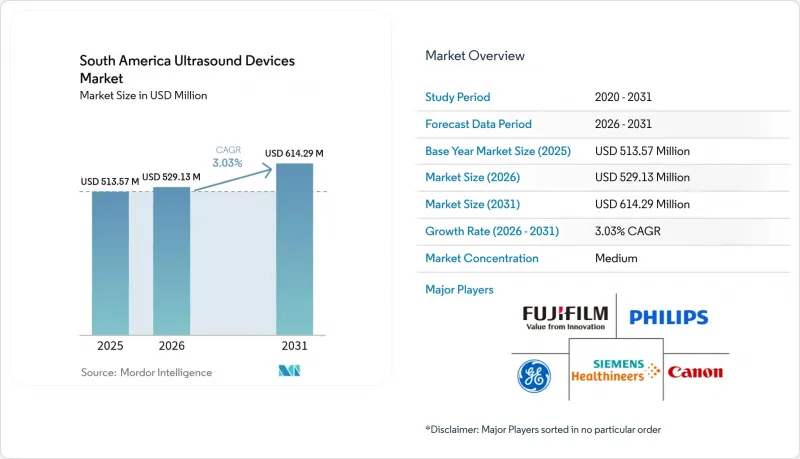
본 보고서는 용도(마취과, 순환기내과, 산부인과 등), 기술(2D 초음파 영상 진단 등), 휴대성(고정형 시스템 등), 최종 사용자(병원·외과 센터 등), 지역(브라질, 아르헨티나, 칠레, 콜롬비아 및 기타 남미)별로 분류되어 있습니다. 시장 전망은 금액(달러) 기준으로 제시되어 있습니다.
남미의 초음파 장비 시장 동향 및 인사이트
영상 진단에 대한 보험 적용 범위 확대가 초음파 장비 보급을 촉진
보험 보상 범위의 확장으로 환자의 본인 부담금이 경감되고 의료기관의 경영 기반도 뒷받침됨에 따라, 남미의 초음파 장비 시장은 강화되고 있습니다. 브라질의 국민건강보험에서는 현재 조직 파쇄 요법에 대해 평균 1만 7,500달러를 보상하고 있으며, 이로 인해 병원이 고급 HIFU 시스템을 도입하는 움직임이 촉진되고 있습니다. 아르헨티나에서는 예방 검진에 경동맥 및 대퇴동맥 초음파 검사가 추가되었으며, 무증상 성인의 51%에서 경동맥 플라크가 확인됨에 따라 조기 발견의 중요성이 부각되었습니다. 콜롬비아에서는 원격 초음파 진단에 대한 원격의료 보험 적용이 확대되었으며, 산부인과 분야에서 86%의 의료기관이 ICT를 활용하고 있어 클라우드 연결형 프로브에 대한 수요를 뒷받침하고 있습니다. 이러한 정책 전환으로 인해 공급업체들은 자사의 제품 포트폴리오를 보험 적용 대상 검사 항목에 맞추려는 인센티브가 더욱 강화되고 있습니다. 충실한 보험 적용은 자금이 제한된 공적 의료 제도에서 사업을 영위하는 의료기관의 이익률에 가해지는 압박을 더욱 완화하고 있습니다.
비감염성 질환의 부담 증가가 심장·복부 초음파 검사 수요를 견인
비감염성 질환은 여전히 이 지역에서 가장 큰 사망 원인이며, 정기적인 영상 진단의 필요성을 높이고 있습니다. 콜롬비아에서는 2024년에 11만 7,620건의 신규 암 사례가 기록되었으며, 종양의 병기 분류 및 시술 가이드를 목적으로 한 실시간 초음파 검사의 도입이 가속화되고 있습니다. 아르헨티나의 혈관 초음파 검사 결과, 검사를 받은 성인의 절반 이상에서 무증상 경동맥 플라크가 검출되어 동맥경화가 서서히 진행되고 있음을 시사하고 있습니다. 브라질의 고령 인구는 2070년까지 37.8%를 나타낼 것으로 예측되며, 평균 수명은 83.9세까지 늘어날 가능성이 있어 만성 질환 관리 업무는 더욱 확대될 전망입니다. 지속적인 영상 진단은 특히 심장, 복부, 혈관 평가에서 적시적인 중재를 뒷받침하는 기반이 됩니다. 그 결과, 병원에서는 초음파 진단 장비 도입 대수를 늘리고 있는 반면, 외래 진료 센터에서는 정기적인 경과 관찰을 위해 휴대용 장비 도입에 주력하고 있습니다.
장기화·다양화되는 규제 승인 절차
의료기기 제조업체들은 제품 출시를 지연시키는 불균일하고 종종 장기화되는 승인 체계에 직면해 있습니다. 브라질의 ANVISA는 클래스 III 및 클래스 IV 시스템에 대해 완전 등록 및 브라질판 우수 제조 기준(GMP) 인증 취득을 의무화하고 있으며, 이로 인해 승인까지의 기간이 5-6개월 연장됩니다. 2024년 규정에서는 해외 승인을 근거로 삼는 것이 허용되지만, 인접 국가들 간에 문서 제출 요건이 일치하지 않아 여전히 규정 준수 비용 증가를 초래하고 있습니다. 이러한 제약으로 인해 소규모 혁신 기업 시장 진입이 저해되고 최신 기능에 대한 접근이 지연되면서, 남미 초음파 진단 기기 시장의 경쟁이 둔화되고 있습니다.
부문 분석
방사선 진단 분야는 다학제적 진단에서 필수적인 역할을 수행하고 있으며, AI를 활용한 측정 도구의 통합이 진행되고 있는 것을 배경으로, 2025년에는 26.46%의 점유율을 차지하며 남미 초음파 진단기기 시장에서 여전히 주도적인 위치를 유지했습니다. 남미의 방사선과용 초음파 진단 기기 시장 규모는 장기 라벨링을 자동화하는 지멘스의 ‘Acuson Sequoia 3.5’에서 볼 수 있듯이, 워크플로우 효율화에 힘입어 성장했습니다. 순환기과 및 산부인과는 선별 검사 증가로 여전히 큰 시장 규모를 유지하고 있는 반면, 중환자 치료 분야에서는 신속한 트라이아지를 위해 POC(Point-of-Care) 스캔이 활용되고 있습니다.
마취과 분야는 2031년까지 연평균 성장률(CAGR) 4.82%를 나타낼 것으로 예측되며, 이는 각 적응증 분야 중 가장 빠른 성장세를 보이고 있습니다. 초음파 유도 신경 차단의 보급 확대에 따라 시술 성공률과 환자 예후가 개선되고 있습니다. 또한, Mindray사의 국소 마취 교육 시리즈는 임상의의 숙련도를 높이고 있습니다. 현재 병원 조달 팀은 휴대용 프로브를 수술실용 카트와 세트로 구매하는 경향을 보이고 있으며, 이러한 추세는 지속되고 있습니다. 수술 건수 증가와 환자 안전 프로토콜의 강화로 인해, 남미의 초음파 장비 시장에서 마취학 분야의 기여도는 앞으로도 계속 확대될 전망입니다.
3D/4D 기술 분야는 태아 평가 및 종양학 병기 분류에 필수적인 뛰어난 입체 해상도를 바탕으로, 2025년에는 남미 초음파 장비 시장 점유율의 46.88%를 차지했습니다. GE Voluson Signature 20과 같은 AI 탑재 플랫폼은 임신 중기 검사에 소요되는 시간을 40% 단축하여 효율성 향상을 두드러지게 보여주고 있습니다. 기존의 2D는 AI를 통한 영상 최적화를 통해 여전히 중요한 역할을 수행하고 있는 반면, 도플러는 심혈관계 평가를 뒷받침하고 있습니다.
HIFU 시스템은 비침습적 종양 절제술의 성공에 힘입어 2031년까지 연평균 성장률(CAGR) 5.02%를 기록하며, 각 기술 중 가장 빠른 성장세를 보일 것으로 예측됩니다. 전 세계적으로 300건이 넘는 간암 히스토트리프시 사례가 임상적 수용도가 높음을 보여주고 있습니다. 전립선 및 자궁근종 치료로의 확대에 따라 적응증이 넓어지면서, 치료용 플랫폼 분야에서 남미 초음파 장비 시장 규모 확대에 더욱 탄력을 줄 것입니다.
기타 혜택:
- 엑셀 형식 시장 예측(ME) 시트
- 3개월간의 애널리스트 지원
자주 묻는 질문
목차
제1장 서론
제2장 조사 방법
제3장 주요 요약
제4장 시장 구도
제5장 시장 규모와 성장 예측
제6장 경쟁 구도
제7장 시장 기회와 향후 전망
LSH 26.09.09According to Mordor Intelligence, the South America ultrasound devices market size was valued at USD 513.57 million in 2025 and estimated to grow from USD 529.13 million in 2026 to reach USD 614.29 million by 2031, at a CAGR of 3.03% during the forecast period (2026-2031).
This report is Segmented by Application (Anesthesiology, Cardiology, Gynecology/Obstetrics, and More), Technology (2D Ultrasound Imaging, and More), Portability (Stationary Systems, and More), End User (Hospitals & Surgical Centers, and More), and Geography (Brazil, Argentina, Chile, Colombia, and Rest of South America). The Market Forecasts are Provided in Terms of Value (USD).
South America Ultrasound Devices Market Trends and Insights
Expansion of Imaging Reimbursement Boosting Ultrasound Adoption
Broader reimbursement schemes are strengthening the South America ultrasound devices market by lowering out-of-pocket costs for patients and supporting provider economics. Brazil's Medicare now reimburses an average USD 17,500 for histotripsy therapy, encouraging hospitals to procure high-end HIFU systems. Argentina added carotid and femoral ultrasound to preventive screening, revealing carotid plaques in 51% of asymptomatic adults, which underscores early detection value. Colombia extended telemedicine reimbursement to remote ultrasound interpretation, with 86% of facilities using ICTs for maternal care, fueling demand for cloud-connected probes. These policy shifts reinforce supplier incentives to align product portfolios with reimbursed procedures. Healthy reimbursement further alleviates margin pressure for providers operating in cash-limited public systems.
Escalating Non-Communicable Disease Burden Driving Demand for Cardiac & Abdominal Ultrasound
Non-communicable diseases remain the largest mortality contributor in the region and elevate routine imaging needs. Colombia recorded 117,620 new cancer cases in 2024, accelerating uptake of real-time ultrasound for tumor staging and guidance. Vascular ultrasound studies in Argentina detected subclinical carotid plaques in more than half of tested adults, signifying a silent surge in atherosclerosis. Brazil's elderly population is set to reach 37.8% by 2070, and life expectancy could climb to 83.9 years, broadening chronic disease management workloads. Continuous imaging underpins timely intervention, particularly for cardiac, abdominal, and vascular assessments. Consequently, hospitals are enlarging their ultrasound fleets while outpatient centers focus on portable devices for routine follow-up.
Prolonged & Divergent Regulatory Approval Processes
Medical device firms face heterogeneous and often lengthy approval frameworks that slow product launches. Brazil's ANVISA requires Class III and Class IV systems to obtain full registration and Brazil-Good Manufacturing Practice certificates, extending timelines by 5-6 months. Although 2024 regulations permit reliance on foreign approvals, discordant documentation rules across neighboring countries still impose added compliance cost. The constraint curbs initial market entrance for smaller innovators and prolongs access to the latest features, dampening the competitive intensity within the South America ultrasound devices market.
Other drivers and restraints analyzed in the detailed report include:
- Adoption of AI-Enabled & Wireless Ultrasound Solutions Enhancing Workflow Efficiency
- Government and Private Funding for R&D in Ultrasound Imaging
- Limited Availability of Certified Sonographers and Radiologists in Secondary Cities
For complete list of drivers and restraints, kindly check the Table Of Contents.
Segment Analysis
Radiology upheld supremacy in the South America ultrasound devices market with 26.46% share in 2025, backed by its integral role in multi-specialty diagnostics and the growing integration of AI-powered measurement tools. The South America ultrasound devices market size for radiology benefited from faster workflow, as seen with Siemens Acuson Sequoia 3.5 that automates organ labeling. Cardiology and gynecology/obstetrics remain sizable due to heightened screening, while critical care leverages point-of-care scanning for rapid triage.
Anesthesiology is projected to log a 4.82% CAGR through 2031, marking the quickest rise among applications. Wider uptake of ultrasound-guided nerve blocks improves procedural success and patient outcomes; Mindray's regional anesthesia education series strengthens clinician proficiency. Hospital procurement teams now bundle portable probes with operating-room carts, sustaining momentum. Rising surgical volumes and enhanced patient safety protocols will continue to propel anesthesiology's contribution to the South America ultrasound devices market.
The 3D/4D technology tier captured 46.88% of the South America ultrasound devices market share in 2025, driven by superior volumetric clarity essential for fetal assessments and oncology staging. AI-enabled platforms like GE Voluson Signature 20 shorten second-trimester exams by 40%, underscoring efficiency gains. Conventional 2D remains relevant through AI-enhanced image optimisation, while Doppler supports cardiovascular evaluation.
HIFU systems will record a 5.02% CAGR to 2031, the fastest among technologies, buoyed by non-invasive tumor ablation success. Liver cancer histotripsy cases surpassing 300 globally demonstrate clinical acceptance. Expansion into prostate and uterine fibroid therapy will widen indications, adding momentum to the South America ultrasound devices market size growth for therapeutic platforms.
Complete Report Scope:
- By Application
- Anesthesiology
- Cardiology
- Gynecology / Obstetrics
- Musculoskeletal
- Radiology
- Critical Care
- Other Applications
- By Technology
- 2D Ultrasound Imaging
- 3D & 4D Ultrasound Imaging
- Doppler Imaging
- High-intensity Focused Ultrasound (HIFU)
- Other Technologies
- By Portability
- Stationary Systems
- Portable Cart-based Systems
- Handheld / Wireless Systems
- By End User
- Hospitals & Surgical Centers
- Diagnostic Imaging Centers
- Ambulatory Care & Emergency Centers
- Other End Users
- By Country
- Brazil
- Argentina
- Chile
- Colombia
- Rest of South America
List of Companies Covered in this Report:
- GE HealthCare Technologies Inc.
- Siemens Healthineers
- Koninklijke Philips
- FUJIFILM
- Canon
- Mindray Bio-Medical Electronics Co., Ltd.
- Samsung Group
- Hitachi, Ltd. (Healthcare Solutions)
- Hologic
- Esaote
- Konica Minolta
- Clarius Mobile Health Corp.
- Butterfly Network, Inc.
- Terason (Teratech Corp.)
- Shimadzu
- Telemed Medical Systems
- EDAN Instruments Inc.
- Vinno Technology Co. Ltd.
- Landwind Medical
- ContextVision AB
Additional Benefits:
- The market estimate (ME) sheet in Excel format
- 3 months of analyst support
TABLE OF CONTENTS
1 Introduction
- 1.1 Study Assumptions & Market Definition
- 1.2 Scope of the Study
2 Research Methodology
3 Executive Summary
4 Market Landscape
- 4.1 Market Overview
- 4.2 Market Drivers
- 4.2.1 Expansion of Imaging Reimbursement Boosting Ultrasound Adoption
- 4.2.2 Escalating Non-Communicable Disease Burden Driving Demand for Cardiac & Abdominal Ultrasound
- 4.2.3 Adoption of AI-Enabled & Wireless Ultrasound Solutions Enhancing Workflow Efficiency
- 4.2.4 Government and Private Funding for R&D in Ultrasound Imaging
- 4.2.5 Rising Cancer Incidence Driving Demand for Radiation-Free Imaging
- 4.2.6 Growth in Portable & Telemedicine-Integrated Ultrasound Devices
- 4.3 Market Restraints
- 4.3.1 Prolonged & Divergent Regulatory Approval Processes
- 4.3.2 Limited Availability of Certified Sonographers and Radiologists in Secondary Cities
- 4.3.3 High Equipment Costs & Maintenance Burden
- 4.3.4 Limited Access in Remote & Underserved Regions
- 4.4 Regulatory Landscape
- 4.5 Technological Outlook
- 4.6 Porter's Five Forces Analysis
- 4.6.1 Threat of New Entrants
- 4.6.2 Bargaining Power of Buyers
- 4.6.3 Bargaining Power of Suppliers
- 4.6.4 Threat of Substitute Products
- 4.6.5 Intensity of Competitive Rivalry
5 Market Size & Growth Forecasts (Value in USD)
- 5.1 By Application
- 5.1.1 Anesthesiology
- 5.1.2 Cardiology
- 5.1.3 Gynecology / Obstetrics
- 5.1.4 Musculoskeletal
- 5.1.5 Radiology
- 5.1.6 Critical Care
- 5.1.7 Other Applications
- 5.2 By Technology
- 5.2.1 2D Ultrasound Imaging
- 5.2.2 3D & 4D Ultrasound Imaging
- 5.2.3 Doppler Imaging
- 5.2.4 High-intensity Focused Ultrasound (HIFU)
- 5.2.5 Other Technologies
- 5.3 By Portability
- 5.3.1 Stationary Systems
- 5.3.2 Portable Cart-based Systems
- 5.3.3 Handheld / Wireless Systems
- 5.4 By End User
- 5.4.1 Hospitals & Surgical Centers
- 5.4.2 Diagnostic Imaging Centers
- 5.4.3 Ambulatory Care & Emergency Centers
- 5.4.4 Other End Users
- 5.5 By Country
- 5.5.1 Brazil
- 5.5.2 Argentina
- 5.5.3 Chile
- 5.5.4 Colombia
- 5.5.5 Rest of South America
6 Competitive Landscape
- 6.1 Market Concentration
- 6.2 Market Share Analysis
- 6.3 Company Profiles (includes Global level Overview, Market level overview, Core Segments, Financials as available, Strategic Information, Market Rank/Share for key companies, Products & Services, and Recent Developments)
- 6.3.1 GE HealthCare Technologies Inc.
- 6.3.2 Siemens Healthineers AG
- 6.3.3 Koninklijke Philips N.V.
- 6.3.4 FUJIFILM Holdings Corporation
- 6.3.5 Canon Medical Systems Corporation
- 6.3.6 Mindray Bio-Medical Electronics Co., Ltd.
- 6.3.7 Samsung Medison Co., Ltd.
- 6.3.8 Hitachi, Ltd. (Healthcare Solutions)
- 6.3.9 Hologic, Inc.
- 6.3.10 Esaote SpA
- 6.3.11 Konica Minolta, Inc.
- 6.3.12 Clarius Mobile Health Corp.
- 6.3.13 Butterfly Network, Inc.
- 6.3.14 Terason (Teratech Corp.)
- 6.3.15 Shimadzu Corp.
- 6.3.16 Telemed Medical Systems
- 6.3.17 EDAN Instruments Inc.
- 6.3.18 Vinno Technology Co. Ltd.
- 6.3.19 Landwind Medical
- 6.3.20 ContextVision AB
7 Market Opportunities & Future Outlook
- 7.1 White-space & Unmet-need Assessment


