

|
시장보고서
상품코드
2125419
프랑스의 초음파 기기 시장 : 시장 점유율 분석, 업계 동향 및 통계, 성장 예측(2026-2031년)France Ultrasound Devices - Market Share Analysis, Industry Trends & Statistics, Growth Forecasts (2026 - 2031) |
||||||
 Mordor Intelligence
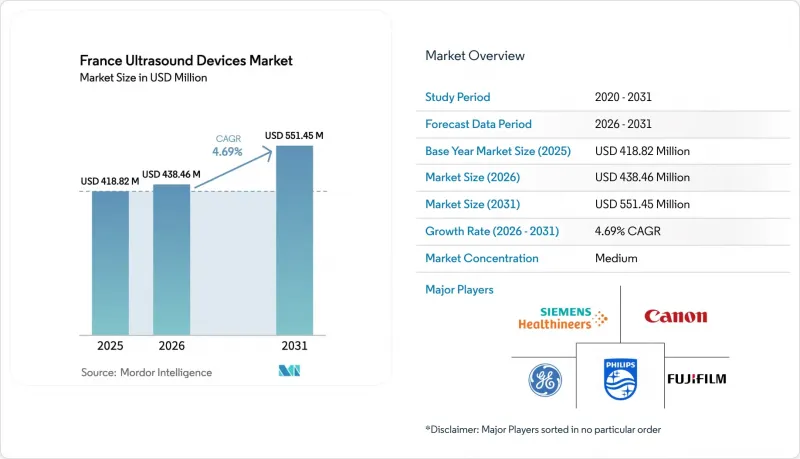
Mordor Intelligence에 의하면, 프랑스의 초음파 기기 시장 규모는 2025년 4억 1,882만 달러로 평가되었고, 2026년에는 4억 3,846만 달러로 추정되고, 2026-2031년 CAGR 4.69%로 성장을 지속할 전망이며, 2031년까지 5억 5,145만 달러에 이를 것으로 예측됩니다.
본 보고서는 용도별(마취과, 순환기과, 산부인과, 근골격계, 방사선과 등), 기술별(2D 초음파 영상 진단, 3D 및 4D 초음파 영상 진단, 도플러 영상 진단 등), 휴대성별(고정형 시스템 등), 최종 사용자별(병원, 진단센터 등)로 분류되어 있습니다. 시장 예측은 금액(달러) 기준으로 제시되어 있습니다.
프랑스의 초음파 기기 시장 동향 및 인사이트
고령화와 만성 질환의 부담
65세 이상 주민의 비율은 2025년에 21.8%를 나타낼 것으로 예측되며, 평균 수명의 연장으로 인해 비이온화 방사선 영상 진단에 의존하는 심혈관계 및 근골격계 사례 수가 증가하고 있습니다. 일반 개업의들이 재입원을 억제하기 위해 만성 질환 관리 경로에 초음파 진단을 도입함에 따라, 지역 진료소에서의 심초음파 검사 건수는 계속 증가하고 있습니다. 또한, 동일한 인구 구성층에서 퇴행성 관절염에 대한 치료 개입이 증가하고 있어 말초 관절 평가 수요도 확대되고 있습니다. 의사 수는 전년 대비 1.7% 증가했으나, 대도시권 이외 지역에서는 전문의 진료를 받을 기회가 여전히 제한적이어서, 1차 진료에서 ‘게이트키퍼’로서의 초음파 검사의 가치가 높아지고 있습니다. 이러한 인구 통계학적 현실은 간헐적인 예산 긴축을 상쇄하는 장기적인 성장 요인의 기반이 되고 있습니다.
응급실에서의 포인트 오브 케어 초음파 검사의 급속한 보급
프랑스의 병원에서는 응급실(ED)에서 초음파 검사의 활용 기회가 확대되어, 병상에서의 영상 진단이 임상 표준으로 확립되었습니다. 전향적 연구에 따르면, 현장 초음파(POCUS)는 응급실 내원자의 82%에서 진단 판단을, 47%의 사례에서 치료 계획을 변경시켰으며, 지속적인 도입을 뒷받침하는 설득력 있는 근거가 구축되었습니다. 전국응급의학회는 지도 하에 스캔을 실시해야 한다는 이정표를 의무화하는 역량 프레임워크를 설정하여, 지역에 관계없이 균일한 기술 개발을 보장하고 있습니다. 프랑스 국방군의 현장 조사에 따르면 이 기술의 높은 적응성이 부각되었으며, 훈련을 받지 않은 간호사의 96%가 전투 지원을 위한 지도를 받고자 하는 의향이 있다고 보고했습니다. 이러한 연구 결과를 종합해 보면, 프랑스의 초음파 진단 기기 시장이 응급 부문의 엄격한 대응 시간을 충족하는 소형 배터리 구동형 스캐너로 계속 전환되고 있는 이유를 설명할 수 있습니다.
EU MDR 재인증에 따른 비용 및 지연
2028년을 향한 기한이 다가오는 가운데, 각 제조업체는 기술 파일 감사 범위의 확대, 시판 후 조사, 그리고 인증 기관의 수수료 급등과 같은 과제에 직면해 있습니다. 전담 규제 대응 인력을 보유하지 않은 소규모 공급업체의 경우 부담이 특히 크며, 제품 리콜 위험이 높아지고 병원의 조달 선택지가 좁아질 우려가 있습니다. 프랑스 GMED의 심사 대기 시간이 길어짐에 따라 구매 주기가 연장되고 있으며, 병원들은 장비 교체를 보류하고 자산의 수명을 연장하는 경향을 보이고 있어, 이로 인해 단기적인 시장 침투가 억제되고 있습니다.
부문 분석
중환자 치료 분야의 용도는 연평균 성장률(CAGR) 6.02%로 성장하고 있으며, 이러한 속도로 인해 프랑스 초음파 진단 기기 시장에서 가장 역동적인 부문으로서의 입지를 확고히 하고 있습니다. 중환자 치료 의사들은 병상 옆에서 환자를 평가할 때 휴대용 스캐너를 점점 더 선호하고 있으며, 이로 인해 패혈증의 평균 진단 시간이 18분 단축되었습니다. 한편, 방사선과는 대규모 학술 의료 센터에서 여전히 영상 진단의 핵심을 담당하고 있어 2025년 매출의 35.05%를 계속 차지한 것으로 평가되었습니다. 순환기 분야의 성장은 삼성의 소니오(Sonio) 인수 이후 도입된 AI 기반 태아 및 성인용 초음파 검사 프로토콜과 연동되어 있습니다. 대조적으로, 산부인과 하위 부문은 2024년 출생 수가 66만 3,000명으로 감소함에 따라 역풍에 직면해 있습니다. 관절 치환술 건수 증가를 배경으로 근골격계 수요가 증가하고 있으며, 혈관 평가 분야에서는 만성 정맥 질환 치료를 위한 HIFU 가이드라인이 활용되고 있습니다. 이러한 동향들이 어우러져 다양한 최종 사용자 기반을 뒷받침하는 균형 잡힌 수요 구조가 유지되고 있습니다.
중환자 치료 분야에서는 응급실(ED)의 POCUS 프로그램으로 인해 대상 환자 수가 더욱 확대됨에 따라, 카트형 및 휴대용 플랫폼에 대한 지속적인 자본 유입이 확보되고 있습니다. 병원들은 박출률을 자동으로 측정하는 AI 기반 워크플로우 도구에 투자하고 있으며, 이를 통해 검사 결과의 편차가 감소하고 만성 심부전 환자군을 효과적으로 관리할 수 있게 되었습니다.
HIFU는 전립선암 연구에서 3년 후 구제 치료가 필요 없는 생존율이 90%로 보고됨에 따라 연평균 5.56%의 성장이 예상됩니다. 2025년에는 3D 및 4D 영상 기술이 39.41%의 점유율을 유지할 것으로 보이며, 카테터를 이용한 시술에서는 4D 퓨전 가이던스의 채택이 점점 더 확대되고 있습니다. 소프트웨어 업그레이드가 가능한 개방형 아키텍처 스캐너 덕분에 병원들은 콘솔을 전면 교체할 필요가 없어져 기존 브랜드에 대한 충성도를 유지하고 있습니다.
프랑스 초음파 진단 기기 시장에서 3D 및 4D 시스템의 점유율은 2031년까지 지배적인 위치를 유지할 것으로 예상되지만, HIFU 시술에 대한 보험 적용 범위 확대는 시장 침투가 가속화될 것임을 시사합니다. 포커스드 울트라사운드 재단(Focused Ultrasound Foundation)은 전 세계적으로 171개의 유효한 적응증을 등록하고 있으며, 종양학, 혈관, 미용 분야가 임상 파이프라인의 다양화를 주도하고 있습니다. 이러한 폭넓은 치료 용도로 인해, 장비 설치 후에도 장기간에 걸쳐 일회용 소모품 및 서비스 계약에 대한 하류 수요가 확보됩니다.
기타 혜택 :
- 엑셀 형식 시장 예측(ME) 시트
- 3개월간의 애널리스트 지원
자주 묻는 질문
목차
제1장 서론
제2장 조사 방법
제3장 주요 요약
제4장 시장 구도
제5장 시장 규모 및 성장 예측
제6장 경쟁 구도
제7장 시장 기회 및 향후 전망
AJY 26.09.15According to Mordor Intelligence, the France ultrasound devices market size is expected to grow from USD 418.82 million in 2025 to USD 438.46 million in 2026 and is forecast to reach USD 551.45 million by 2031 at 4.69% CAGR over 2026-2031.
This report is Segmented by Application (Anesthesiology, Cardiology, Gynecology/Obstetrics, Musculoskeletal, Radiology, and More), Technology (2D Ultrasound Imaging, 3D & 4D Ultrasound Imaging, Doppler Imaging, and More), Portability (Stationary Systems, and More), and End User (Hospitals, Diagnostic Centers, and More). The Market Forecasts are Provided in Terms of Value (USD).
France Ultrasound Devices Market Trends and Insights
Aging Population & Chronic Disease Burden
The share of residents aged 65 and above reached 21.8% in 2025, and higher life expectancy has pushed cardiovascular and musculoskeletal case loads that rely on non-ionizing imaging. Echocardiography volumes continue to grow in community clinics as general practitioners incorporate ultrasound into chronic-care pathways to limit hospital readmissions. Peripheral joint evaluation needs also expand because the same demographic supports a rise in osteoarthritis interventions. Although physician numbers rose 1.7% year-on-year, specialist appointments remain scarce outside metropolitan areas, amplifying ultrasound's value as a gatekeeper modality in primary care. This demographic reality anchors a long-term driver that offsets intermittent budget tightening.
Rapid Adoption of Point-of-Care Ultrasound in Emergency Departments
French hospitals increased emergency-department (ED) ultrasound availability, validating bedside imaging as a clinical standard. Prospective studies show point-of-care ultrasound (POCUS) alters diagnostic decisions in 82% of ED visits and therapeutic plans in 47% of cases, building a compelling evidence base for continued procurement. The national emergency-medicine society has set competency frameworks that mandate supervised scanning milestones, ensuring uniform skill development across regions. Field research by French defense forces underscores the technique's adaptability, with untrained nurses reporting 96% willingness to pursue instruction for combat support. Together, these findings explain why the France ultrasound devices market continues to pivot toward compact, battery-operated scanners that meet tight ED turnaround times.
EU MDR Re-Certification Costs & Delays
Manufacturers contend with expanded technical-file audits, post-market surveillance, and rising notified-body fees as deadlines move toward 2028. The burden is acute for smaller suppliers that lack dedicated regulatory staff, raising the risk of product withdrawal and tightening hospital supply options. French GMED's queue times elongate purchasing cycles, driving hospitals to extend asset life instead of refreshing fleets, which suppresses near-term market uptake.
Other drivers and restraints analyzed in the detailed report include:
- Continuous Upgrades in 2D/3D/4D & AI-Enabled Imaging
- Government Push to Reduce Radiation Exposure
- High Capital & Maintenance Costs of Advanced Systems
For complete list of drivers and restraints, kindly check the Table Of Contents.
Segment Analysis
Critical care applications grew at a 6.02% CAGR, a pace that positions them as the most dynamic slice of the France ultrasound devices market. Intensivists increasingly favor handheld scanners for bedside evaluations that shorten average sepsis diagnosis time by 18 minutes. At the same time, radiology retains 35.05% of 2025 revenue because it remains the central imaging gatekeeper in large academic centers. Cardiology growth aligns with AI-enhanced fetal and adult echo protocols introduced after Samsung's Sonio buyout. Conversely, the gynecology/obstetrics sub-segment faces headwinds from the decline to 663,000 births in 2024. Musculoskeletal demand rises on the back of arthroplasty volume growth, and vascular assessments exploit HIFU guidance for chronic venous disease therapy. Together these dynamics maintain a balanced demand structure that underpins a diverse end-user base.
Critical care's larger addressable patient turnover, amplified by ED POCUS programs, ensures persistent capital flow into cart-based and portable platforms. Hospitals invest in AI-driven workflow tools that auto-measure ejection fraction, reducing exam variability and catering to the chronic heart-failure cohort.
HIFU is projected to grow 5.56% annually, benefiting from prostate-cancer studies reporting 90% salvage-free survival at three years. While 3D & 4D imaging maintained a 39.41% share in 2025, catheter-based procedures increasingly incorporate 4D fusion guidance. Open-architecture scanners capable of software upgrades allow hospitals to avoid complete console replacement, sustaining loyalty to incumbent brands.
The France ultrasound devices market share for 3D & 4D systems is expected to remain dominant through 2031, yet HIFU's procedural reimbursement expansions hint at accelerating penetration. The Focused Ultrasound Foundation logs 171 active indications globally, with oncology, vascular, and aesthetics driving clinical pipeline diversification. That breadth of therapeutic application secures downstream demand for disposables and service contracts long after equipment installation.
Complete Report Scope:
- By Application
- Anesthesiology
- Cardiology
- Gynecology / Obstetrics
- Musculoskeletal
- Radiology
- Critical Care
- Urology
- Vascular
- Other Applications
- By Technology
- 2D Ultrasound Imaging
- 3D & 4D Ultrasound Imaging
- Doppler Imaging
- High-Intensity Focused Ultrasound
- Other Technologies
- By Portability
- Stationary Systems
- Portable Cart-based Systems
- Hand-held / Pocket Devices
- By End User
- Hospitals
- Diagnostic Centers
- Ambulatory Surgical Centers
- Other End Users
List of Companies Covered in this Report:
- Canon
- GE Healthcare
- Koninklijke Philips
- Siemens Healthineers
- Mindray
- FUJIFILM
- Samsung Group
- Esaote
- SonoScape Medical Corp.
- Hologic
- Hitachi
- Alpinion Medical Systems
- Butterfly Network Inc.
- Supersonic Imagine SA
- Analogic
- Terason Corporation
- Clarius Mobile Health
- Fujifilm Sonosite Inc.
- Shenzhen Lifotronic Technology
Additional Benefits:
- The market estimate (ME) sheet in Excel format
- 3 months of analyst support
TABLE OF CONTENTS
1 Introduction
- 1.1 Study Assumptions & Market Definition
- 1.2 Scope of the Study
2 Research Methodology
3 Executive Summary
4 Market Landscape
- 4.1 Market Overview
- 4.2 Market Drivers
- 4.2.1 Aging Population & Chronic Disease Burden
- 4.2.2 Rapid Adoption of Point-of-Care Ultrasound in Emergency Departments
- 4.2.3 Continuous Upgrades in 2D/3D/4D & AI-Enabled Imaging
- 4.2.4 Government Push to Reduce Radiation Exposure
- 4.2.5 Expansion of Tele-Ultrasound Reimbursement for Rural Care
- 4.2.6 GP Ultrasound Training Initiatives Broadening Primary Care Use
- 4.3 Market Restraints
- 4.3.1 EU MDR Re-Certification Costs & Delays
- 4.3.2 High Capital & Maintenance Costs of Advanced Systems
- 4.3.3 Shortage of Certified Sonographers in Provincial Hospitals
- 4.3.4 Purchasing Group Consolidation Squeezing Vendor Margins
- 4.4 Regulatory Landscape
- 4.5 Technological Outlook
- 4.6 Porter's Five Forces Analysis
- 4.6.1 Threat of New Entrants
- 4.6.2 Bargaining Power of Buyers
- 4.6.3 Bargaining Power of Suppliers
- 4.6.4 Threat of Substitute Products
- 4.6.5 Intensity of Competitive Rivalry
5 Market Size & Growth Forecasts (Value & Volume)
- 5.1 By Application
- 5.1.1 Anesthesiology
- 5.1.2 Cardiology
- 5.1.3 Gynecology / Obstetrics
- 5.1.4 Musculoskeletal
- 5.1.5 Radiology
- 5.1.6 Critical Care
- 5.1.7 Urology
- 5.1.8 Vascular
- 5.1.9 Other Applications
- 5.2 By Technology
- 5.2.1 2D Ultrasound Imaging
- 5.2.2 3D & 4D Ultrasound Imaging
- 5.2.3 Doppler Imaging
- 5.2.4 High-Intensity Focused Ultrasound
- 5.2.5 Other Technologies
- 5.3 By Portability
- 5.3.1 Stationary Systems
- 5.3.2 Portable Cart-based Systems
- 5.3.3 Hand-held / Pocket Devices
- 5.4 By End User
- 5.4.1 Hospitals
- 5.4.2 Diagnostic Centers
- 5.4.3 Ambulatory Surgical Centers
- 5.4.4 Other End Users
6 Competitive Landscape
- 6.1 Market Concentration
- 6.2 Market Share Analysis
- 6.3 Company Profiles (includes Global Level Overview, Market Level Overview, Core Segments, Financials as Available, Strategic Information, Market Rank/Share for Key Companies, Products & Services, and Recent Developments)
- 6.3.1 Canon Medical Systems Corporation
- 6.3.2 GE HealthCare
- 6.3.3 Koninklijke Philips N.V.
- 6.3.4 Siemens Healthineers AG
- 6.3.5 Mindray Medical International Ltd.
- 6.3.6 Fujifilm Holdings Corporation
- 6.3.7 Samsung Electronics Co. Ltd.
- 6.3.8 Esaote SpA
- 6.3.9 SonoScape Medical Corp.
- 6.3.10 Hologic Inc.
- 6.3.11 Hitachi Ltd.
- 6.3.12 Alpinion Medical Systems
- 6.3.13 Butterfly Network Inc.
- 6.3.14 Supersonic Imagine SA
- 6.3.15 Analogic Corporation
- 6.3.16 Terason Corporation
- 6.3.17 Clarius Mobile Health
- 6.3.18 Fujifilm Sonosite Inc.
- 6.3.19 Shenzhen Lifotronic Technology
7 Market Opportunities & Future Outlook
- 7.1 White-space & Unmet-Need Assessment


