

|
시장보고서
상품코드
2123413
영국의 시설 관리 시장 : 점유율 분석, 업계 동향과 통계, 성장 예측(2026-2031년)United Kingdom (UK) Facility Management - Market Share Analysis, Industry Trends & Statistics, Growth Forecasts (2026 - 2031) |
||||||
 Mordor Intelligence
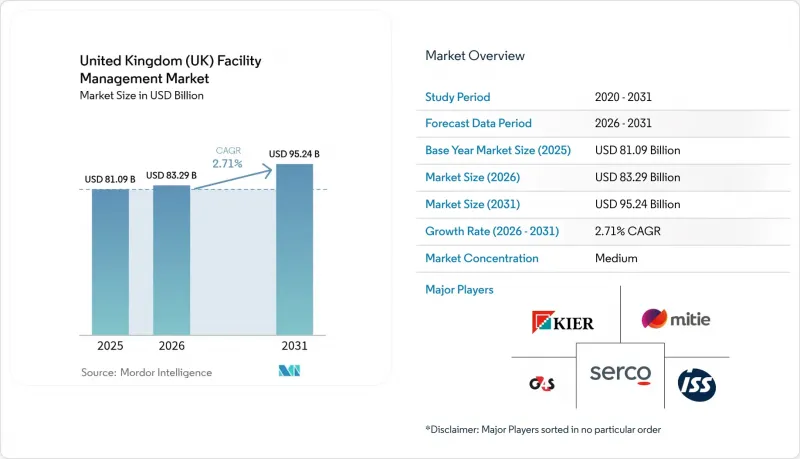
Mordor Intelligence에 의하면, 영국 시설 관리 시장 규모는 2025년에 810억 9,000만 달러로 평가되었고 2026년 832억 9,000만 달러에서 2031년까지 952억 4,000만 달러에 이를 것으로 예측되며, 예측 기간(2026-2031년) CAGR은 2.71%를 나타낼 전망입니다.
본 보고서는 서비스 유형(하드 서비스, 소프트 서비스), 제공 형태(사내 대응, 외부 위탁), 최종 사용자 산업(상업, 호스피탈리티, 공공·인프라, 의료, 산업·공정, 기타 최종 사용자 산업)별로 분류되어 있습니다. 시장 예측은 금액(달러) 기준으로 제시되어 있습니다.
영국(UK) 시설 관리 시장 동향 및 인사이트
기술 통합(IoT, AI, 자동화)
AI를 활용한 빌딩 관리 플랫폼은 서비스 제공 방식을 재정의하고 있습니다. 예를 들어, 지적재산청은 디지털 작업 지시 포털을 도입한 결과, 유지보수 대응 시간을 14일에서 수 초로 단축했습니다. 스마트 센서가 점유 현황, 온도, 공기질의 실시간 데이터를 전송함으로써, 서비스 제공업체는 사후 대응형 유지보수에서 예측 유지보수로 전환할 수 있을 뿐만 아니라, 에너지 소비를 줄이고 직원의 쾌적성을 향상시킬 수 있습니다. CBRE가 하이퍼스케일 데이터센터 시설 관리 시장에 진출한 것은 24시간 분석적 모니터링이 요구되는 부문에서 높은 수익률의 가능성을 부각시키고 있습니다. 의료 및 교육 분야의 고객은 규정 준수 요건에 따라 지속적인 환경 모니터링이 의무화되어 있기 때문에 도입을 주도하고 있습니다. 디지털 대시보드가 소프트 서비스와 하드 서비스를 통합함에 따라, 제공업체는 청소, 보안, 사무 지원, 자산 유지보수를 데이터 기반의 계약으로 패키지화하여 프리미엄 가격을 실현하고 있습니다.
상업용 부동산의 급속한 확장
영국 왕립 공인 감정사 협회(RICS)의 데이터에 따르면, 2025년 1분기에 임차인 수요가 플러스로 전환되어 런던 중심부의 프라임 오피스 임대료는 연간 5% 가까이 상승할 것으로 예측됩니다. 산업용 자산은 전자상거래와 니어쇼어링을 원동력으로 투자자 수요가 순 증가율 +18%를 기록하며 가장 강력한 투자 의향을 보이고 있습니다. 신규 개발이 증가함에 따라 시운전, 라이프사이클 자산 관리 및 지속적인 규정 준수 감사에 대한 수요가 높아지고 있습니다. 개발사와 조기에 제휴한 시설 관리자는 가동 첫날부터 ESG 대시보드가 통합된 스마트 대응 빌딩을 통해 수년에 걸친 수익원을 확보할 수 있습니다. 마찬가지로, 물류 분야의 성장도 처리 능력이 높은 창고를 대상으로 재고 추적 기술, 도크 관리 및 첨단 소방 설비 유지보수를 결합한 맞춤형 FM 패키지를 견인하고 있습니다.
인력 부족과 기술 격차
호텔, 청소, 케이터링 부문에서는 브렉시트 이후 13만 2,000건의 인력 부족이 발생하여 FM 인력 체계에 부담이 가중되고 있습니다. 2025년 이민 백서에서는 숙련 노동자 비자 요건이 RQF 레벨 6으로 상향 조정되어, FM 초급 직종에서 외국인 직원 채용이 제한되고 있습니다. 2005년 이후 고용주의 교육 투자액은 28% 감소했으며, 건물에 첨단 디지털 시스템이 도입되기 시작한 바로 이 시기에 기술 부족 현상이 발생하고 있습니다. 기업 측은 리더십과 기술 역량 강화에 중점을 둔 Samsic사의 JPC가 제공하는 12개 모듈로 구성된 ‘Next Gen’ 프로그램과 같은 감독자 양성 프로그램으로 대응하고 있습니다. 그럼에도 불구하고 높은 이직률과 노동력의 고령화가 계속해서 이 부문의 역량을 제한하고 있습니다.
부문 분석
2025년, 하드 서비스는 영국 시설 관리 시장 점유율의 60.12%를 차지하고 있으며, 그 배경에는 NHS의 116억 파운드(31억 9,000만 달러)에 달하는 미처리 유지보수 건과 EPC(에너지 성능 인증서) 개정을 위한 엄격한 기한이 있습니다. 영국 시설 관리 시장에서 하드 서비스 계약 규모는 확대될 전망입니다. 이는 상업용 부동산의 28%가 여전히 EPC 평가에서 D 등급 이하로 평가받고 있어, 기계·전기·배관(MEP) 개보수를 가속화할 수밖에 없는 상황이기 때문입니다. MEP(기계·전기·배관) 및 HVAC(난방·환기·공조) 부문은 2035년까지 47%-62%의 배출량 감축을 의무화하는 넷제로(Net Zero)를 향한 규제 조치의 혜택을 받고 있습니다. 자산의 디지털화로 인해 예측 유지보수 분석에 대한 수요가 더욱 높아지고 있으며, 서비스 제공업체는 규정 준수 보고 요건을 충족하면서 자산 고장 발생 전에 개입할 수 있게 됩니다.
소프트 서비스는 현재 규모는 작지만, 병원 수준의 청소 기준 및 직장 환경 혁신에 힘입어 2031년까지 연평균 성장률(CAGR) 2.78%를 나타낼 것으로 예측됩니다. 감염 방지 규정의 강화로 인해 로봇을 이용한 소독 시스템 및 센서를 활용한 위생 관리 프로토콜에 대한 수요가 증가하고 있습니다. 코워킹 스페이스 운영자들은 스마트한 출입 관리를 필요로 하고 있으며, 이는 보안 서비스의 현대화를 촉진하고 있습니다. 글렌펠 화재 이후 법규제에 따른 방화 안전 대책 강화로 인해, 통합형 경보 테스트 및 대피 계획 수립 서비스에 대한 수요가 증가하고 있습니다. 이러한 요인들이 복합적으로 작용함에 따라, 서비스 제공업체의 제공 내용은 소프트 서비스의 탁월성과 데이터 기반의 규정 준수를 융합한 종합적인 패키지로 전환되고 있습니다.
기타 혜택:
- 엑셀 형식 시장 예측(ME) 시트
- 3개월간의 애널리스트 지원
자주 묻는 질문
목차
제1장 서론
제2장 조사 방법
제3장 주요 요약
제4장 시장 구도
제5장 시장 규모와 성장 예측
제6장 경쟁 구도
제7장 시장 기회와 향후 전망
JHS 26.09.07According to Mordor Intelligence, the United Kingdom facility management market size was valued at USD 81.09 billion in 2025 and estimated to grow from USD 83.29 billion in 2026 to reach USD 95.24 billion by 2031, at a CAGR of 2.71% during the forecast period (2026-2031).
This report is Segmented by Service Type (Hard Services, Soft Services), Offering Type (In-House, Outsourced), End-User Industry (Commercial, Hospitality, Institutional and Public Infrastructure, Healthcare, Industrial and Process, Other End-User Industries). The Market Forecasts are Provided in Terms of Value (USD).
United Kingdom (UK) Facility Management Market Trends and Insights
Technology Integration (IoT, AI, Automation)
AI-driven building-management platforms are redefining service delivery, with the Intellectual Property Office cutting maintenance response times from 14 days to seconds after launching a digital work-order portal. Smart sensors relay live occupancy, temperature, and air-quality data, letting providers shift from reactive to predictive maintenance while lowering energy use and elevating employee comfort. CBRE's entry into hyperscale data-center facilities management underscores the high-margin potential in segments that demand 24-hour analytical monitoring. Healthcare and education clients lead adoption because compliance regimes mandate continuous environmental monitoring. As digital dashboards merge soft and hard services, providers package cleaning, security, office support, and asset maintenance into data-rich contracts that command price premiums.
Rapid Commercial Real Estate Expansion
Royal Institution of Chartered Surveyors data show occupier demand turned positive in Q1 2025, and prime office rents in Central London are projected to rise nearly 5% in the year. Industrial assets register the strongest investment appetite, with an +18% net balance in investor demand, propelled by e-commerce and near-shoring. New developments increase demand for commissioning, lifecycle asset management, and ongoing compliance auditing. Facility managers partnering early with developers secure multi-year revenue streams in smart-ready buildings that integrate ESG dashboards from day one. Logistics growth similarly drives tailored FM packages that combine inventory tracking technologies, dock management, and advanced fire-suppression maintenance for high-throughput warehouses.
Labor Shortages and Skill Gaps
Hospitality, cleaning, and catering units face 132,000 job vacancies post-Brexit, straining FM rosters. The 2025 Immigration White Paper raises the Skilled Worker visa threshold to RQF Level 6, curtailing access to international staff for entry-level FM roles. Employer training investment has fallen 28% since 2005, creating a skills deficit just as buildings adopt sophisticated digital systems. Firms counteract with supervisor academies such as JPC by Samsic's 12-module Next Gen programme focusing on leadership and technical upskilling. Nonetheless, high turnover and an aging workforce continue to limit sector capacity.
Other drivers and restraints analyzed in the detailed report include:
- Increasing Outsourcing Trend
- Rising Focus on Workplace Experience and Employee Well-being
- Margin Pressure from Rising Operational Costs
For complete list of drivers and restraints, kindly check the Table Of Contents.
Segment Analysis
Hard services held 60.12% of United Kingdom facility management market share in 2025, anchored by the NHS's GBP 11.6 billion (USD 3.19 billion) maintenance backlog and stringent EPC upgrade timelines. The United Kingdom facility management market size for hard-service contracts is poised to expand as 28% of commercial properties still rate D or lower on EPC scale, forcing accelerated mechanical, electrical, and plumbing overhauls. MEP and HVAC segments benefit from regulatory pathways to net-zero that mandate 47%-62% emissions cuts by 2035. Asset digitization further lifts demand for predictive-maintenance analytics, letting providers intervene before asset failure while meeting compliance reporting needs.
Soft services, while smaller today, are forecast to grow 2.78% CAGR through 2031, propelled by hospital-grade cleaning standards and workplace-experience innovations. Heightened infection-control rules elevate the premium for robotic disinfection systems and sensor-verified hygiene protocols. Co-working operators require smart access control, driving security-service modernization. Fire-safety upgrades tied to post-Grenfell legislation amplify demand for integrated alarm testing and evacuation-planning services. Together, these forces shift provider offerings toward comprehensive packages that merge soft-service excellence with data-backed compliance.
Complete Report Scope:
- By Service Type
- Hard Services
- Asset Management
- MEP and HVAC Services
- Fire Systems and Safety
- Other Hard FM Services
- Soft Services
- Office Support and Security
- Cleaning Services
- Catering Services
- Other Soft FM Services
- Hard Services
- By Offering Type
- In-house
- Outsourced
- Single FM
- Bundled FM
- Integrated FM
- By End-user Industry
- Commercial (IT and Telecom, Retail and Warehouses, etc.)
- Hospitality (Hotels, Eateries, Large-scale Restaurants)
- Institutional and Public Infrastructure (Govt, Education, Transportation)
- Healthcare (Public and Private Facilities)
- Industrial and Process (Manufacturing, Energy, Mining)
- Other End-user Industries (Multi-housing, Entertainment, Sports and Leisure)
List of Companies Covered in this Report:
- ISS UK
- Mitie Group PLC
- Serco Group PLC
- Kier Group PLC
- G4S Facilities Management UK Limited
- Sodexo Facilities Management Services
- Compass Group
- Equans
- VINCI Facilities Limited
- Aramark Facilities Services
- Andron Facilities Management
- CSM Facilities Management Group
- Orton Group
- Global Facilities.
- BGIS
Additional Benefits:
- The market estimate (ME) sheet in Excel format
- 3 months of analyst support
TABLE OF CONTENTS
1 INTRODUCTION
- 1.1 Study Assumptions and Market Definition
- 1.2 Scope of the Study
2 RESEARCH METHODOLOGY
3 EXECUTIVE SUMMARY
4 MARKET LANDSCAPE
- 4.1 Market Overview
- 4.1.1 Current Occupancy Rates
- 4.1.2 Profitability Rates of Major FM Players
- 4.1.3 Workforce Indicators - Labor Participation
- 4.1.4 Facility Management Market Share (%), by Service Type
- 4.1.5 Facility Management Market Share (%), by Hard Services
- 4.1.6 Facility Management Market Share (%), by Soft Services
- 4.1.7 Urbanization and Population Growth in Major Metros
- 4.1.8 Sector Investment Priorities in United Kingdom's Infrastructure Pipeline
- 4.1.9 Regulatory Drivers Specific to Labour and Safety Standards
- 4.2 Market Drivers
- 4.2.1 Rapid Commercial Real Estate Expansion
- 4.2.2 Technology Integration (IoT, AI, Automation)
- 4.2.3 Increasing Outsourcing Trend
- 4.2.4 Rising Focus on Workplace Experience and Employee Well-being
- 4.2.5 Stringent Energy-Efficiency and Net-Zero Regulations
- 4.2.6 Rise of Flexible Workspaces Requiring Agile FM Contracts
- 4.3 Market Restraints
- 4.3.1 Labor Shortages and Skill Gaps
- 4.3.2 Margin Pressure from Rising Operational Costs
- 4.3.3 Fragmented Supplier Ecosystem Hindering Service Standardization
- 4.3.4 Data-Security Concerns in Smart Building Systems
- 4.4 Value Chain Analysis
- 4.5 PESTEL Analysis
- 4.6 Regulatory and Legislative Framework for Market Entrants
- 4.7 Impact of Macroeconomic Indicators on FM Demand
- 4.8 Porter's Five Forces Analysis
- 4.8.1 Bargaining Power of Suppliers
- 4.8.2 Bargaining Power of Buyers
- 4.8.3 Threat of New Entrants
- 4.8.4 Threat of Substitute Services
- 4.8.5 Intensity of Competitive Rivalry
- 4.9 Investment and Funding Analysis
5 MARKET SIZE AND GROWTH FORECASTS (VALUE)
- 5.1 By Service Type
- 5.1.1 Hard Services
- 5.1.1.1 Asset Management
- 5.1.1.2 MEP and HVAC Services
- 5.1.1.3 Fire Systems and Safety
- 5.1.1.4 Other Hard FM Services
- 5.1.2 Soft Services
- 5.1.2.1 Office Support and Security
- 5.1.2.2 Cleaning Services
- 5.1.2.3 Catering Services
- 5.1.2.4 Other Soft FM Services
- 5.1.1 Hard Services
- 5.2 By Offering Type
- 5.2.1 In-house
- 5.2.2 Outsourced
- 5.2.2.1 Single FM
- 5.2.2.2 Bundled FM
- 5.2.2.3 Integrated FM
- 5.3 By End-user Industry
- 5.3.1 Commercial (IT and Telecom, Retail and Warehouses, etc.)
- 5.3.2 Hospitality (Hotels, Eateries, Large-scale Restaurants)
- 5.3.3 Institutional and Public Infrastructure (Govt, Education, Transportation)
- 5.3.4 Healthcare (Public and Private Facilities)
- 5.3.5 Industrial and Process (Manufacturing, Energy, Mining)
- 5.3.6 Other End-user Industries (Multi-housing, Entertainment, Sports and Leisure)
6 COMPETITIVE LANDSCAPE
- 6.1 Market Concentration
- 6.2 Strategic Moves and Partnerships
- 6.3 Market Share Analysis
- 6.4 Company Profiles (includes Global level Overview, Market level overview, Core Segments, Financials as available, Strategic Information, Market Rank/Share for key companies, Products and Services, and Recent Developments)
- 6.4.1 ISS UK
- 6.4.2 Mitie Group PLC
- 6.4.3 Serco Group PLC
- 6.4.4 Kier Group PLC
- 6.4.5 G4S Facilities Management UK Limited
- 6.4.6 Sodexo Facilities Management Services
- 6.4.7 Compass Group
- 6.4.8 Equans
- 6.4.9 VINCI Facilities Limited
- 6.4.10 Aramark Facilities Services
- 6.4.11 Andron Facilities Management
- 6.4.12 CSM Facilities Management Group
- 6.4.13 Orton Group
- 6.4.14 Global Facilities.
- 6.4.15 BGIS
7 MARKET OPPORTUNITIES AND FUTURE OUTLOOK
- 7.1 White-space and Unmet-Need Assessment
- 7.2 Technology-led Integrated FM (IoT, BMS, AI-based Predictive Maintenance)
- 7.3 ESG-compliant FM Solutions Demand
- 7.4 Future Service-Model Shifts (Outcome-based Contracts)


