
|
시장보고서
상품코드
2125476
인도네시아의 중고차 금융 시장 : 점유율 분석, 업계 동향과 통계, 성장 예측(2026-2031년)Indonesia Used Car Financing - Market Share Analysis, Industry Trends & Statistics, Growth Forecasts (2026 - 2031) |
||||||
 Mordor Intelligence
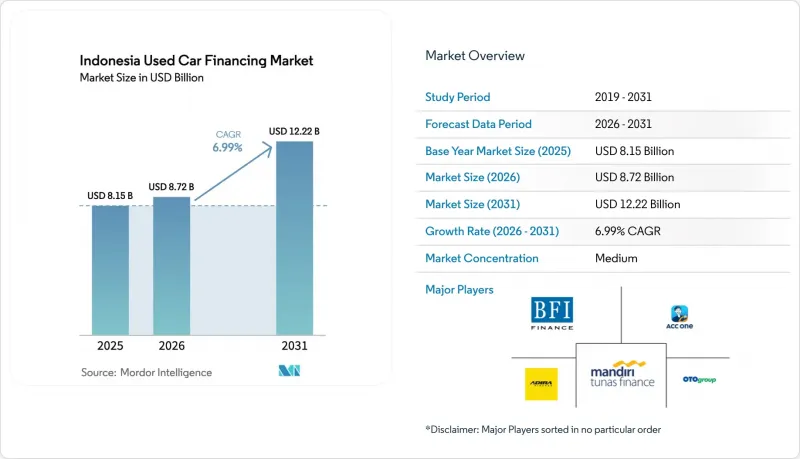
Mordor Intelligence에 의하면, 인도네시아 중고차 금융 시장 규모는 2025년 81억 5,000만 달러, 2026년 87억 2,000만 달러에서 2031년까지 122억 2,000만 달러로 확대되어 2026년부터 2031년까지 CAGR 6.99%를 나타낼 것으로 예측됩니다.
본 보고서는 차종(해치백, 세단 등), 대출 제공업체(자동차 제조업체 계열 금융사, 상업은행 등), 대출 기간(24개월 이하, 25-48개월, 기타), 차량 연식(3년 이하, 4-7년, 기타), 주(자카르타, 서자바 등)별로 분류되어 있습니다. 시장 예측은 금액(달러)으로 제시되어 있습니다.
인도네시아 중고차 금융 시장 동향 및 인사이트
높은 금리를 배경으로 신차에서 중고차로 수요가 꾸준히 전환되고 있음
2024년 중고차 판매 대수는 180만 대에 달한 반면, 신차 등록 대수는 88만 9,680대에 그쳤습니다. 이는 명목 임금 상승률이 자동차 가격 인플레이션을 따라가지 못함에 따라, 비용 요인에 의한 대체 수요가 발생하고 있음을 반영합니다. 2024년 9월, 인도네시아 중앙은행은 정책 금리를 동결했습니다. 그 결과, 많은 가정이 여전히 고액의 자동차 대출 상환에 직면했습니다. 이러한 상황으로 인해 구매 후 3년이 경과한 다목적 차량(MPV)의 가격 경쟁력이 더욱 높아졌으며,월상환액은 신차에 비해 대폭 낮아졌습니다. 이에 대응하여 각 멀티파이낸스 업체들은 신속하게 대응하여 포트폴리오를 조정했습니다. 특히 BFI 파이낸스의 경우 2024년에 쇼룸 관련 매출채권이 현저히 증가하여, 조직화된 소매 채널에서 수요가 강세를 보이고 있음을 뒷받침하고 있습니다. 구매력 저하의 영향을 상쇄하고 대출 실행 흐름을 유지하기 위해 각 대출 기관은 대출 기간을 통상 기간을 초과하여 연장하기 시작했으며, 이러한 경향은 해마다 강해지고 있습니다. 그러나 이 전략에는 신용 위험에 대한 노출 확대라는 측면도 수반됩니다. 전반적으로 이러한 동향은 ‘합리적인 가격’이라는 과제가 인도네시아 중고차 금융 시장으로의 자금 유입을 견인하는 주요 요인임을 여실히 보여주고 있습니다.
멀티파이낸스 및 은행 대출 포트폴리오에서 중고차 부문으로의 확대
2024년 6월까지, 신차 수요 감소에 대응하여 대출 기관들이 수익성이 높은 중고차 부문으로 초점을 전환함에 따라 자동차 대출 총 실행액은 큰 폭 증가를 보였습니다. 2025년 10월 아디라 파이낸스가 만다라 멀티파이낸스와 합병함에 따라, 방대한 사용자 기반과 광범위한 서비스 거점을 갖춘 플랫폼이 탄생했고, 사업 전개 지역이 대폭 확대되었습니다. 마찬가지로, BCA 파이낸스도 2024년 9월 중고차 전문 부문을 합리화하고 리스크 관리 시스템을 통합하는 한편, 대출 처리 비용을 대폭 절감했습니다. 중고차 금융은 자산 위험에 대한 인식이 높기 때문에 스프레드가 넓어지는 경향이 있지만, 소유자가 3-4년마다 신형 모델로 교체하는 신속한 재구매로 인해 그 위험은 상쇄되고 있습니다. 그 결과, 대출 기관이 부도 위험을 경감하기 위해 보다 엄격한 평가 조치를 도입하고 있음에도 불구하고, 인도네시아 중고차 금융 시장은 여전히 견조한 기관 투자자의 자본을 유치하고 있습니다.
뿌리 깊은 신뢰 문제와 주행거리계 조작 문제
업계 조사에 따르면, 거래되는 차량의 약 4분의 1에서 주행거리 조작이 이루어지고 있으며, 이로 인해 잔존 가치가 부풀려져 차주와 대출 기관 양측 모두에게 예상치 못한 수리비 부담이 발생하고, 담보 가치가 훼손되고 있습니다. 전국 단위의 차량 이력 대장이 존재하지 않기 때문에 대출 기관은 수작업 검사에 의존할 수밖에 없으며, 이는 승인 기간의 장기화와 운영비 증가를 초래하고 있습니다. POJK 46/2024에서는 보다 엄격한 감정 기준과 차용인의 신원 확인이 의무화되어 있으나, 지역에 따라 시행 상황이 제각각이어서 비공식 딜러가 심사를 회피할 수 있게 되어 신뢰성 부족 문제가 지속되고 있습니다. 일부 멀티파이낸스 기업이 시범 도입하고 있는 블록체인 등록 시스템은 위조가 불가능한 정비 기록 확립을 목표로 하고 있으나, 부처 간 데이터 공유가 필요합니다. 적용 범위가 전국적으로 확대되기 전까지는 신뢰 부족이 신규 고객 확보를 방해하여 인도네시아 중고차 금융 시장의 성장을 둔화시킬 것입니다.
부문 분석
2025년 대출 실행액 중 다목적차(MPV)가 44.15%를 차지하고 있으며, 이는 인도네시아 인구 구성을 주도하는 대가족에게 적합한 차종임을 여실히 보여줍니다. 컴팩트 SUV는 8.45%의 연평균 성장률(CAGR)로 다른 모든 카테고리를 앞지르고 있는데, 이는 야망 있는 중산층 구매자들이 높은 최저 지상고와 프리미엄 이미지에 매력을 느껴 동급 세단보다 높은 재판매 프리미엄을 지불하는 경향이 있기 때문입니다. 금융기관은 일반적으로 3년이 경과한 MPV나 SUV에 대해 유동성이 높고 담보 가치의 추이를 예측하기 쉽다는 점을 고려하여 최대 80%의 LTV(대출 대 평가액 비율)를 적용하고 있습니다. 이에 따라, 이러한 부문와 관련된 인도네시아 금융 시장 규모는 예측 기간 동안 견조한 추세를 보일 것으로 전망됩니다.
자동차 제조업체들이 수익성이 낮은 소형차 생산을 단계적으로 중단하고 있어, 세단과 해치백 시장 점유율은 축소되는 추세입니다. 라이드셰어용 차량은 여전히 세단 수요를 지탱하고 있지만, 개인 소유자들은 지위가 높고 더 안전한 차체 구조를 갖춘 크로스오버 차량으로 전환하고 있습니다. 대출 상품의 경우 현재 대출 기간 상한에 차이가 있습니다. SUV는 72개월의 대출 기간이 적용되는 반면, 구형 해치백은 감가상각률이 높기 때문에 대부분의 경우 48개월이 상한선으로 정해집니다. 이러한 신용 심사상의 미묘한 차이가 인도네시아 금융 시장에서 부문 간의 격차를 더욱 심화시키고 있습니다.
저비용 예금과 교차 판매 역량을 바탕으로, 상업 은행은 2025년 대출 실행액에서 70.25%라는 압도적인 점유율을 확보하며 인도네시아 중고차 금융 시장에서 지배력을 확고히 다졌습니다. 그러나 P2P(Peer-to-Peer) 및 핀테크 플랫폼은 실시간 심사 결정과 기존 신용 평가 시스템에서는 심사를 통과하지 못했던 신청자도 수용할 수 있는 대안적인 신용 분석을 제공함으로써 연평균 성장률(CAGR) 9.75%로 성장을 이어가고 있습니다. 비은행계 멀티파이낸스 기업들은 이 두 극단 사이에 위치하며, 자동차에 대한 깊은 지식과 적절한 디지털화를 융합하고 있지만, 자금 조달 스프레드는 양측으로부터 압박을 받고 있습니다.
파트너십 모델이 급속히 확대되고 있습니다. BCA 파이낸스의 앱은 현재 주요 마켓플레이스에 통합되어 있으며, 예금 자금을 통한 가격 책정을 유지하면서도 순수 핀테크 기업과의 편의성 격차를 해소하고 있습니다. 규정 40/2024에 따라 P2P 대출 업체는 복합 신용등급 최저 기준 3 이상, 납입 자본의 50%에 해당하는 자기자본을 유지할 의무가 있으며, 이로 인해 진입 장벽이 높아지고 업계 재편이 촉진되고 있습니다. 따라서 디지털 대출 업체와 중견 은행 간의 합작 투자는 인도네시아 금융 시장에서 사업 규모를 확대하기 위한 중요한 경로가 될 것입니다.
기타 혜택:
- 엑셀 형식 시장 예측(ME) 시트
- 3개월간의 애널리스트 지원
자주 묻는 질문
목차
제1장 서론
제2장 조사 방법
제3장 주요 요약
제4장 시장 구도
제5장 시장 규모와 성장 예측
제6장 경쟁 구도
제7장 시장 기회와 향후 전망
JHS 26.09.11According to Mordor Intelligence, the indonesian used car financing market size is projected to expand from USD 8.15 billion in 2025, USD 8.72 billion in 2026, to USD 12.22 billion by 2031, registering a 6.99% CAGR from 2026 to 2031.
This report is Segmented by Vehicle Type (Hatchback, Sedan, and More), Financing Provider (Captive OEM Finance, Commercial Banks, and More), Financing Tenor (<=24 Months, 25-48 Months, and More), Vehicle Age (<=3 Years Old, 4-7 Years Old, and More), and Province (Jakarta, West Java, and More). The Market Forecasts are Provided in Terms of Value (USD).
Indonesia Used Car Financing Market Trends and Insights
Robust Demand Shift from New- to Used-Cars Amid High Interest Rates
Used-car sales hit 1.8 million units in 2024 versus 889,680 new-car registrations, reflecting cost-driven substitution as nominal wage growth lags vehicle inflation . In September 2024, Bank Indonesia held its policy rate steady. As a result, many families faced auto-loan coupons that remained high. This scenario has amplified the affordability edge of three-year-old multi-purpose vehicles (MPVs), with their monthly installments being significantly lower than their brand-new counterparts. Responding swiftly, multifinance companies adjusted their portfolios. Notably, BFI Finance experienced a notable rise in showroom-linked receivables in 2024, underscoring a strong demand in organized retail channels. To counteract the effects of diminished purchasing power and sustain loan origination flows, lenders have begun extending loan tenors beyond the typical duration, showing an annual increase. However, this strategy does come with an extended credit-risk exposure. Overall, these dynamics underscore that affordability challenges are the primary drivers steering flows into Indonesia's used car financing market.
Expansion of Multi-Finance and Bank Loan Portfolios into Used-Cars
By June 2024, total motor-vehicle disbursements saw significant growth as lenders shifted focus to higher-yield pre-owned segments, responding to a dip in new-car demand. Adira Finance's merger with Mandala Multifinance in October 2025 birthed a platform with a substantial user base and extensive service points, significantly broadening its geographic footprint. In a similar vein, BCA Finance, in September 2024, streamlined its used-car specialist arm, harmonizing risk systems and slashing loan processing costs. While used-car financing commands wider spreads due to heightened asset risk perceptions, this is balanced by swift repeat purchases, with owners upgrading to newer models every three to four years. As a result, the Indonesian used car financing market continues to attract robust institutional capital, even as lenders implement stricter valuation measures to mitigate default risks.
Persistent Trust and Odometer Fraud Issues
Industry surveys reveal mileage manipulation in roughly one quarter of traded units, inflating residual values and saddling both borrowers and lenders with unexpected repair bills that erode collateral cover. The absence of a nationwide vehicle-history ledger forces lenders to rely on manual inspections that extend approval times and increase operating expenditure. While POJK 46/2024 mandates stronger appraisal standards and borrower verification, uneven regional enforcement allows informal dealers to bypass scrutiny, perpetuating credibility gaps. Blockchain registries piloted by selected multifinance firms aim to stamp immutable service records yet require cross-ministerial data sharing. Until coverage becomes universal, trust deficits will curb first-time penetration and temper Indonesia used car financing market.
Other drivers and restraints analyzed in the detailed report include:
- Digital Marketplaces Embedding Instant Loan Approvals
- Growth of Sharia-Compliant Auto Finance Products
- Elevated Lending Rates and Macro-Volatility
For complete list of drivers and restraints, kindly check the Table Of Contents.
Segment Analysis
Multi-purpose vehicles held 44.15% of 2025 financing originations, underscoring their suitability for extended families that dominate Indonesian demographics. Compact SUVs are outpacing all other categories at an 8.45% CAGR as aspirational middle-class buyers gravitate toward higher ground clearance and premium perception, often paying resale premiums above same-age sedans. Lenders typically extend up to 80% loan-to-value on three-year-old MPVs or SUVs because of strong liquidity and predictable collateral curves, ensuring that the Indonesia used car financing market size tied to these segments remains robust through the forecast window.
Sedans and hatchbacks account for a dwindling slice as OEMs phase out low-margin small cars. Ride-hailing fleets still sustain sedan demand, but private owners pivot to crossover designs with more perceived status and safer cabin structure. Loan products now differentiate tenor ceilings: SUVs can qualify for 72-month terms, whereas older hatchbacks often cap at 48 months due to steeper depreciation. These underwriting nuances reinforce segmental divergence within the Indonesian used car financing market.
Due to low-cost deposits and the ability to cross-sell, commercial banks secured a commanding 70.25% share of the 2025 origination, solidifying their dominance in Indonesia's used car financing market. Yet peer-to-peer and fintech platforms are growing at 9.75% CAGR by offering real-time decisions and alternative credit analytics that onboard applicants sidelined by legacy scorecards. Non-bank multifinance firms sit between these poles, blending deep vehicle knowledge with moderate digital enablement, although their funding spreads face a squeeze from both ends.
Partnership models are proliferating: BCA Finance's app now embeds inside leading marketplaces, closing the convenience gap with pure fintechs while preserving deposit-funded pricing. Regulation 40/2024 obliges peer-to-peer lenders to maintain a minimum composite rating of 3 and equity equivalent to 50% of paid-up capital, which raises thresholds and triggers consolidation. Joint ventures between digital lenders and mid-tier banks, therefore, become a critical route to scale inside the Indonesian used car financing market.
Complete Report Scope:
- By Vehicle Type
- Hatchback
- Sedan
- Sport Utility Vehicle (SUV)
- Multi-Purpose Vehicle (MPV)
- By Financing Provider
- Captive OEM Finance
- Commercial Banks
- Non-Bank Finance Companies
- Peer-to-Peer / Fintech Lenders
- By Financing Tenor
- Less than/Equals 24 Months
- 25 - 48 Months
- 49 - 72 Months
- Above 72 Months
- By Vehicle Age
- Less than/Equals 3 Years Old
- 4 -7 Years Old
- Above 7 Years Old
- By Province
- Jakarta
- West Java
- East Java
- Central Java
- Banten
- North Sumatra
- Other Provinces
List of Companies Covered in this Report:
- Astra Credit Companies (ACC)
- BFI Finance Indonesia
- Adira Dinamika Multi Finance
- Oto Multiartha
- Mandiri Tunas Finance
- PT Toyota Astra Financial Services
- Suzuki Finance Indonesia
- PT JACCS MPM Finance Indonesia
- BCA Finance
- Bussan Auto Finance
- Dipo Star Finance
- Batavia Prosperindo Finance
- BRI Multifinance Indonesia
- Clipan Finance Indonesia
- BNI Multifinance
- CIMB Niaga Auto Finance
- Bank Syariah Indonesia - OTO Finance
Additional Benefits:
- The market estimate (ME) sheet in Excel format
- 3 months of analyst support
TABLE OF CONTENTS
1 Introduction
- 1.1 Study Assumptions and Market Definition
- 1.2 Scope of the Study
2 Research Methodology
3 Executive Summary
4 Market Landscape
- 4.1 Market Overview
- 4.2 Market Drivers
- 4.2.1 Robust Demand Shift from New- to Used-Cars Amid High Interest Rates
- 4.2.2 Expansion of Multi-Finance and Bank Loan Portfolios into Used-Cars
- 4.2.3 Digital Marketplaces Embedding Instant Loan Approvals
- 4.2.4 Growth of Sharia-Compliant Auto Finance Products
- 4.2.5 Buy-Now-Pay-Later Down-Payment Solutions
- 4.2.6 Second-Hand Hybrid and EV Incentives Creating Niche Demand
- 4.3 Market Restraints
- 4.3.1 Persistent Trust and Odometer Fraud Issues
- 4.3.2 Elevated Lending Rates and Macro-Volatility
- 4.3.3 Rise in Collateral Fraud and Stolen-Vehicle Risk
- 4.3.4 Stricter OJK Caps on Fintech Lending Fees
- 4.4 Value / Supply-Chain Analysis
- 4.5 Regulatory and Economic Impact Analysis
- 4.6 Technological Outlook
- 4.7 Porter's Five Forces
- 4.7.1 Threat of New Entrants
- 4.7.2 Bargaining Power of Buyers
- 4.7.3 Bargaining Power of Suppliers
- 4.7.4 Threat of Substitutes
- 4.7.5 Intensity of Rivalry
5 Market Size and Growth Forecasts (Value, USD)
- 5.1 By Vehicle Type
- 5.1.1 Hatchback
- 5.1.2 Sedan
- 5.1.3 Sport Utility Vehicle (SUV)
- 5.1.4 Multi-Purpose Vehicle (MPV)
- 5.2 By Financing Provider
- 5.2.1 Captive OEM Finance
- 5.2.2 Commercial Banks
- 5.2.3 Non-Bank Finance Companies
- 5.2.4 Peer-to-Peer / Fintech Lenders
- 5.3 By Financing Tenor
- 5.3.1 Less than/Equals 24 Months
- 5.3.2 25 - 48 Months
- 5.3.3 49 - 72 Months
- 5.3.4 Above 72 Months
- 5.4 By Vehicle Age
- 5.4.1 Less than/Equals 3 Years Old
- 5.4.2 4 -7 Years Old
- 5.4.3 Above 7 Years Old
- 5.5 By Province
- 5.5.1 Jakarta
- 5.5.2 West Java
- 5.5.3 East Java
- 5.5.4 Central Java
- 5.5.5 Banten
- 5.5.6 North Sumatra
- 5.5.7 Other Provinces
6 Competitive Landscape
- 6.1 Market Concentration
- 6.2 Strategic Moves
- 6.3 Market Share Analysis
- 6.4 Company Profiles (Includes Global Level Overview, Market Level Overview, Core Segments, Financials as Available, Strategic Information, Market Rank/Share for Key Companies, Products and Services, SWOT Analysis, and Recent Developments)
- 6.4.1 Astra Credit Companies (ACC)
- 6.4.2 BFI Finance Indonesia
- 6.4.3 Adira Dinamika Multi Finance
- 6.4.4 Oto Multiartha
- 6.4.5 Mandiri Tunas Finance
- 6.4.6 PT Toyota Astra Financial Services
- 6.4.7 Suzuki Finance Indonesia
- 6.4.8 PT JACCS MPM Finance Indonesia
- 6.4.9 BCA Finance
- 6.4.10 Bussan Auto Finance
- 6.4.11 Dipo Star Finance
- 6.4.12 Batavia Prosperindo Finance
- 6.4.13 BRI Multifinance Indonesia
- 6.4.14 Clipan Finance Indonesia
- 6.4.15 BNI Multifinance
- 6.4.16 CIMB Niaga Auto Finance
- 6.4.17 Bank Syariah Indonesia - OTO Finance
7 Market Opportunities & Future Outlook
- 7.1 White-space & Unmet-Need Assessment