

|
시장보고서
상품코드
2156915
산업 점검용 UAV 사진 측량 : 시장 점유율 분석, 업계 동향과 통계, 성장 예측(2026-2031년)UAV Photogrammetry For Industrial Inspection - Market Share Analysis, Industry Trends & Statistics, Growth Forecasts (2026 - 2031) |
||||||
 Mordor Intelligence
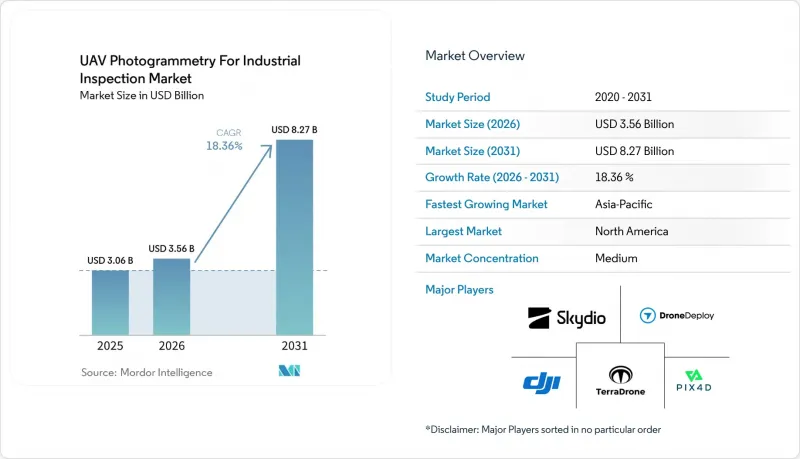
에 따르면 산업용 검사용 UAV 사진 측량 시장 규모는 2025년 30억 6,000만 달러, 2026년 35억 6,000만 달러에서 2031년까지 82억 7,000만 달러로 확대될 것으로 예측되고 있으며, 2026-2031년까지 연평균 성장률(CAGR)은 18.36%에 달할 전망입니다.
산업용 검사용 UAV 사진 측량의 세계 동향 및 인사이트
AI를 활용한 결함 탐지 및 디지털 트윈 워크플로우
AI를 통한 분류를 통해 검사 결과는 단순한 이미지 아카이브에서 유지보수 판단을 지원할 수 있는 구조화된 기록으로 변화하고 있습니다. 산업용 검사 시장내 UAV 사진측량 시장은 운영자가 결함 관측 결과를 기존 자산 관리 시스템과 연동할 수 있을 때 그 혜택을 누릴 수 있습니다. 2026년 연구에서는 캔자스주의 10개 교량을 대상으로 드론과 AI를 활용한 워크플로우를 평가하고, 자동화된 결함 계수 결과를 전국적으로 보고된 상태 평가와 대조했습니다. 또한 이 연구에서는 세분화된 결함을 3D 재구성 데이터에 통합하여 검토시 측정에 활용했습니다. DJI는 2026년 8월 FlightHub 2를 업데이트하여 ‘Copilot’을 통한 경로 생성, 변화 감지 및 자동 결함 태깅 기능을 추가했습니다. 이러한 기능을 통해 현장을 반복적으로 방문하여 검토용 비교 가능한 기록을 생성할 수 있는 워크플로우가 실현됩니다.
빈번한 상태 평가가 필요한 노후화된 산업 인프라
노후화되는 토목·산업 자산으로 인해 점검 프로그램은 더욱 빈번한 모니터링으로 전환되고 있습니다. 산업 점검용 UAV 사진측량은 정기적인 현장 방문에만 의존하지 않고, 구조물의 재현성 있는 이미지를 제공합니다. 2026년에 발표된 ASCE 연구에서는 UAV를 활용한 결함 탐지를 위한 RCO-YOLOv5 모델이 소개되었습니다. 이 모델은 보고된 현장 평가에서 평균 정확도 91.0%를 달성했습니다. 또한 기준 모델에 비해 모델 크기가 12.8% 더 작았고, 추론 속도는 6.7% 더 빨랐습니다. 이러한 기능들은 현장 환경에서 시기적절한 구조적 증거가 필요한 검사 활동을 지원합니다.
분산된 BVLOS, 공역 및 데이터 개인정보 보호 관련 규제
공역 및 개인정보 보호에 관한 요건이 지역에 따라 다르기 때문에 운영자는 모든 지역에서 단일 표준 프로그램을 사용할 수 없습니다. 이는 산업용 검사 시장에서 UAV 사진측량 기술에 있으며, 여전히 중대한 제약 요인으로 작용하고 있습니다. 연방항공청(FAA)은 2025년 8월 7일 시야 외(BVLOS) 운항에 관한 규칙안을 발표했습니다. 이 제안에서는 선형 인프라 점검 및 산업용 항공 데이터 수집을 위한 ‘파트 108’ 프레임워크가 개략적으로 설명되어 있습니다. 2026년 7월 현재, 정보규제사무국(OIRA)의 심사가 진행 중이며, 최종 규정의 공포는 빠르면 2026년 하반기가 될 전망입니다. EASA(유럽항공안전청)의 STS-01 및 STS-02 시나리오는 2026년 1월 1일부터 각국의 기존 체제를 대체하여, EU 회원국 전체에서 관련 비행에 대한 공통된 역량 요건을 확립했습니다.
부문 분석
2025년 산업용 점검용 UAV 사진측량 시장 규모 중 하드웨어가 46.73%를 차지했습니다. 이 비율은 에너지, 석유 및 가스, 광업 각 분야에서 멀티센서 탑재 기기를 도입하는 데 필요한 자본을 반영한 것입니다. 사내 비행 프로그램을 보유한 자산 소유자는 하드웨어 제어를 활용하여 개별 현장에 맞춰 기체 및 페이로드 구성을 최적화하고 있습니다. 소프트웨어는 이미지 촬영 및 처리, 보고서 작성, 클라우드 기반 검토를 연계합니다. 촬영부터 인사이트 도출까지 통합된 솔루션을 통해 현장 작업자와 엔지니어링 팀 간의 업무 인계 과정을 줄일 수 있습니다.
서비스 시장은 2031년까지 연평균 성장률(CAGR) 18.66%로 확대될 것으로 예측됩니다. 관리형 서비스는 사내 드론 함대를 구축하지 않고도 지속적인 성과를 필요로 하는 공공사업체 및 기타 자산 소유자를 대상으로 합니다. Pix4D는 2025년에 사진측량 분야에서 상당한 수익을 올렸으며, 구독 모델로의 전환에 따라 환율 변동의 영향을 제외한 기준으로 성장을 보고했습니다. DroneDeploy는 2025년에 여러 국가에 위치한 수백만 개의 산업 시설에서 수억 장의 이미지를 처리했습니다. 산업용 검사 시장에서 UAV 사진측량은 장비 제공에서 지속적인 자산 인텔리전스 서비스로 전환되고 있습니다.
2025년, 산업용 검사용 UAV 사진측량 시장에서 회전익형 UAV는 62.84%의 점유율을 차지했습니다. 수직 이륙 능력, 호버링 정밀도 및 탑재 하중의 유연성은 터빈, 탱크, 격자 타워의 검사에 적합합니다. 이러한 기체는 상세한 시각적 조사가 필요한 복잡한 자산 주변에서의 운용에 탁월합니다. 또한 이륙 공간이 제한된 장소에서도 그 운용 특성은 실용적입니다. 산업용 검사용 UAV 사진측량 시장에서 짧은 비행 시간은 장거리 통로 검사시 여전히 제약 요인으로 남아 있습니다.
하이브리드 VTOL형 UAV는 2031년까지 연평균 성장률(CAGR) 18.78%로 확대될 것으로 예측됩니다. 이 기체의 비행 지속 시간은 장거리 운용시 회전익기의 비용이 치솟기 쉬운 송전선 및 파이프라인 점검에 적합합니다. 한편, 고정익형 UAV는 대규모 노천 광산, 태양광발전소, 연안 조사 분야에서 여전히 우위를 유지하고 있습니다. Drone Volt사는 프랑스 전역의 통신 기지국을 지원하기 위해 Phoenix Tower International사와 계약을 체결했습니다. 기업용 프로그램에서는 자산의 배치 상황에 따라 이 세 가지 기종을 서로 보완하는 역할로 활용할 수 있습니다.
지역별 분석
2025년, 북미는 산업용 검사용 UAV 사진측량 시장의 31.82% 점유율을 차지했습니다. 대규모 공공사업용 기체 군과 정평이 나 있는 관리형 서비스 제공업체가 이 지역의 수요를 지원하고 있습니다. 제안된 FAA 파트 108 프레임워크가 최종 확정되어 규정 준수 부담이 완화된다면, 산업용 검사용 UAV 사진 측량 시장은 혜택을 볼 가능성이 있습니다. FCC는 2025년 12월, DJI 및 Autel Robotics를 ‘대상 리스트’에 추가했습니다. Skydio는 2026년 4월, 35억 달러 규모의 5년간 ‘SkyForge’ 제조 계획을 발표했으며, 2,000명 이상의 제조 관련 일자리 창출을 목표로 하고 있습니다.
아시아태평양은 2031년까지 연평균 성장률(CAGR) 19.11%로 확대될 것으로 예측됩니다. 태양광 및 풍력발전의 신규 도입, 항만 투자, 해상 개발, 그리고 지역내 드론 제조가 산업용 검사용 드론 사진 측량 시장의 수요를 지원하고 있습니다. 중국은 DJI의 기업 생태계를 통해 대규모 도입 실적을 보유하고 있습니다. 인도의 ‘생산 연계형 인센티브(PLI)’ 제도 및 민간 항공 정책의 개정은 ideaForge Technology와 같은 국내 공급업체를 지원해 왔습니다. 일본은 석유화학, 조선, 원자력 시설 분야에서 전문적인 업무를 수행하고 있습니다. 유럽의 EASA(유럽항공안전청) 시나리오는 국경을 초월한 프로그램 설계에 있으며, 보다 예측 가능한 기반을 제공하고 있습니다.
중동 및 아프리카에서는 석유화학 및 공공사업 분야에서 새로운 수요가 발생하고 있습니다. 사우디아라비아와 UAE는 디지털 전환의 우선순위와 연계된 통합 검사 프로그램을 통해 도입을 주도하고 있습니다. Terra Drone사는 2025년에 사우디 아람코의 공급 지역내 파이프라인 감시 계약을 수주했습니다. 남아프리카의 광업 사업과 나이지리아의 인프라 수요는 접근이 어려운 지역에서의 추가적인 활용 사례를 제공하고 있습니다. 다양한 공역 규제로 인해 걸프 국가 이외의 지역에서의 도입은 제한되고 있습니다.
기타 혜택:
- 엑셀 형식의 시장 예측(ME) 시트
- 3개월간의 애널리스트 지원
자주 묻는 질문
목차
제1장 서론
- 조사 전제조건과 시장 정의
- 조사 범위
제2장 조사 방법
제3장 개요
제4장 시장 구도
- 시장 개요
- 거시경제 요인이 시장에 미치는 영향
- 시장 성장 촉진요인
- 시장 성장 억제요인
- 업계 밸류체인 분석
- 규제 상황
- 기술 전망
- Porter's Five Forces 분석
제5장 시장 규모와 성장 예측
- 컴포넌트별
- 검사 플랫폼별
- 검사 능력별
- 최종사용자 산업별
- 지역별
- 북미
- 미국
- 캐나다
- 멕시코
- 남미
- 브라질
- 아르헨티나
- 기타 남미 국가
- 유럽
- 독일
- 영국
- 프랑스
- 이탈리아
- 스페인
- 기타 유럽 국가
- 아시아태평양
- 중국
- 일본
- 인도
- 한국
- ASEAN
- 기타 아시아태평양 국가
- 중동 및 아프리카
- 중동
- 사우디아라비아
- 아랍에미리트
- 튀르키예
- 기타 중동 국가
- 아프리카
- 남아프리카공화국
- 나이지리아
- 기타 아프리카 국가
- 중동
- 북미
제6장 경쟁 구도
- 시장 집중도
- 전략적 동향
- 시장 점유율 분석
- 기업 개요
- Baker Hughes Company, including Waygate Technologies
- MISTRAS Group, Inc.
- Intertek Group plc
- Eddyfi Technologies Inc.
- Evident Corporation
- General Electric Company
- Cognex Corporation
- KEYENCE CORPORATION
- Hexagon AB
- Teledyne Technologies Incorporated
- Boston Dynamics, Inc.
- ANYbotics AG
- Flyability SA
- Skydio, Inc.
- Terra Drone Corporation
- DroneDeploy, Inc.
- Gecko Robotics, Inc.
- Percepto Ltd.
- Invert Robotics Limited
- Oceaneering International, Inc.
- Deep Trekker Inc.
- Subsea 7 S.A.
- KUKA AG
- FARO Technologies, Inc.
- Basler AG
제7장 시장 기회와 향후 전망
KSA 26.10.29According to Mordor Intelligence, the UAV photogrammetry for industrial inspection market size is projected to expand from USD 3.06 billion in 2025 and USD 3.56 billion in 2026 to USD 8.27 billion by 2031, registering a CAGR of 18.36% between 2026 to 2031.
Global UAV Photogrammetry For Industrial Inspection Market Trends and Insights
AI-Enabled Defect Detection and Digital Twin Workflows
AI classification is changing inspection outputs from image archives into structured records that can support maintenance decisions. The UAV photogrammetry for the industrial inspection market benefits when operators can connect defect observations with existing asset systems. A 2026 study assessed a drone and AI workflow across 10 bridges in Kansas and aligned automated defect counts with nationally reported condition ratings. The work also placed segmented defects into 3D reconstructions for measurement during review. DJI updated FlightHub 2 in August 2026 with Copilot route generation, change detection, and automatic defect tagging. These features support a workflow in which repeated site visits can produce comparable records for review.
Aging Industrial Infrastructure Requiring Frequent Condition Assessment
Deteriorating civil and industrial assets are moving inspection programs toward more frequent monitoring. UAV photogrammetry for industrial inspection provides repeatable views of structures without relying only on periodic site visits. An ASCE study published in 2026 introduced the RCO-YOLOv5 model for UAV-based defect detection. The model achieved 91.0% mean average precision in the reported field assessment. It also had a 12.8% smaller model size and 6.7% faster inference than its baseline. These capabilities support inspection activity where timely structural evidence is needed under field conditions.
Fragmented BVLOS, Airspace, and Data-Privacy Rules
Different airspace and privacy requirements can prevent operators from using one standard program across all locations. This remains a material constraint for the UAV photogrammetry for industrial inspection market. The Federal Aviation Administration issued a proposed rule for beyond visual line of sight operations on August 7, 2025. The proposal outlines a Part 108 framework for linear infrastructure inspection and industrial aerial data gathering. It was under Office of Information and Regulatory Affairs review in July 2026, with a final rule expected no earlier than late 2026. EASA's STS-01 and STS-02 scenarios replaced national frameworks on January 1, 2026, establishing common competency requirements for relevant flights across EU member states.
Other drivers and restraints analyzed in the detailed report include:
- Expansion of Renewable Energy and Linear Energy Infrastructure
- Safer Remote Inspection of Hazardous and Inaccessible Assets
- Battery Endurance and Payload Trade-Offs
For complete list of drivers and restraints, kindly check the Table Of Contents.
Segment Analysis
Hardware accounted for 46.73% of the UAV photogrammetry for industrial inspection market size in 2025. This position reflected the capital needed to deploy multi-sensor aircraft across energy, oil and gas, and mining fleets. Asset owners with internal flight programs use hardware control to tailor aircraft and payload configuration to individual sites. Software connects image capture with processing, reporting, and cloud-based review. Integrated capture-to-insight offerings can reduce handoffs between field crews and engineering teams.
Services are projected to expand at an 18.66% CAGR through 2031. Managed offerings address utility and other asset owners that need recurring outcomes without building internal fleets. Pix4D generated substantial photogrammetry revenue in 2025 and reported constant-currency expansion as it shifted toward subscriptions. DroneDeploy processed hundreds of millions of images in 2025 across millions of industrial sites in numerous countries. The UAV photogrammetry for the industrial inspection market is shifting from equipment provision toward recurring asset intelligence services.
Rotary-wing UAVs held 62.84% of the UAV photogrammetry for industrial inspection market share in 2025. Their vertical takeoff capability, hover precision, and payload flexibility suit turbine, tank, and lattice-tower inspection. These aircraft work well around complex assets that require close visual coverage. Their operating profile is also practical where launch space is limited. In the UAV photogrammetry for industrial inspection market, shorter endurance remains a constraint on long corridor inspections.
Hybrid VTOL UAVs are projected to expand at an 18.78% CAGR through 2031. Their endurance suits transmission lines and pipelines where rotary-wing costs can rise over long distances. Fixed-wing UAVs retain an advantage for large open-pit mines, solar farms, and coastal surveys. Drone Volt signed a contract with Phoenix Tower International to support telecommunications sites across France. Enterprise programs can use all three aircraft types in complementary roles based on asset topology.
Complete Report Scope:
- By Component
- Hardware
- Software
- Services
- By Inspection Platform
- Aerial Inspection Systems
- Ground Inspection Robots
- Underwater and Subsea Inspection Systems
- Fixed/Stationary Remote Inspection Systems
- By Inspection Capability
- Visual and Video Inspection
- Thermal and Infrared Inspection
- 3D/LiDAR and Spatial Inspection
- NDT and Subsurface Inspection
- Acoustic and Vibration Inspection
- Multimodal Fusion Inspection
- By End-User Industry
- Industrial Manufacturing
- Oil and Gas
- Energy and Utilities
- Infrastructure and Construction
- Transportation and Marine
- Aerospace and Defense
- Mining and Metals
- Government and Public Safety
- Inspection, Testing and Certification Service Providers
- Other End-User Industries
- By Geography
- North America
- United States
- Canada
- Mexico
- South America
- Brazil
- Argentina
- Rest of South America
- Europe
- Germany
- United Kingdom
- France
- Italy
- Spain
- Rest of Europe
- Asia-Pacific
- China
- Japan
- India
- South Korea
- ASEAN
- Rest of Asia-Pacific
- Middle East and Africa
- Middle East
- Saudi Arabia
- United Arab Emirates
- Turkey
- Rest of the Middle East
- Africa
- South Africa
- Nigeria
- Rest of Africa
- Middle East
- North America
Geography Analysis
North America held 31.82% of the UAV photogrammetry for industrial inspection market share in 2025. Large utility fleets and established managed-service providers support regional demand. The UAV photogrammetry for the industrial inspection market could benefit if the proposed FAA Part 108 framework reduces compliance burdens after it is finalized. The FCC added DJI and Autel Robotics to its Covered List in December 2025. Skydio announced a USD 3.5 billion, 5-year SkyForge manufacturing commitment in April 2026, targeting more than 2,000 manufacturing jobs.
Asia-Pacific is projected to expand at a 19.11% CAGR through 2031. Solar and wind additions, port investment, offshore development, and regional UAV manufacturing support demand in the UAV photogrammetry for industrial inspection market. China has a large installed base through DJI's enterprise ecosystem. India's Production Linked Incentive scheme and civil aviation policy updates have supported domestic suppliers such as ideaForge Technology. Japan contributes specialized work in petrochemicals, shipbuilding, and nuclear facilities. Europe's EASA scenarios offer a more predictable basis for cross-border program design.
The Middle East and Africa has emerging demand in petrochemicals and utilities. Saudi Arabia and the UAE lead adoption through centralized inspection programs linked to digital transformation priorities. Terra Drone secured a pipeline surveillance contract in the Saudi Aramco supply region in 2025. South Africa's mining operations and Nigeria's infrastructure needs offer further use cases where access is difficult. Different airspace rules limit adoption outside the Gulf states.
- Baker Hughes Company, including Waygate Technologies
- MISTRAS Group, Inc.
- Intertek Group plc
- Eddyfi Technologies Inc.
- Evident Corporation
- General Electric Company
- Cognex Corporation
- KEYENCE CORPORATION
- Hexagon AB
- Teledyne Technologies Incorporated
- Boston Dynamics, Inc.
- ANYbotics AG
- Flyability SA
- Skydio, Inc.
- Terra Drone Corporation
- DroneDeploy, Inc.
- Gecko Robotics, Inc.
- Percepto Ltd.
- Invert Robotics Limited
- Oceaneering International, Inc.
- Deep Trekker Inc.
- Subsea 7 S.A.
- KUKA AG
- FARO Technologies, Inc.
- Basler AG
Additional Benefits:
- The market estimate (ME) sheet in Excel format
- 3 months of analyst support
TABLE OF CONTENTS
1 INTRODUCTION
- 1.1 Study Assumptions and Market Definition
- 1.2 Scope of the Study
2 RESEARCH METHODOLOGY
3 EXECUTIVE SUMMARY
4 MARKET LANDSCAPE
- 4.1 Market Overview
- 4.2 Impact of Macroeconomic Factors on the Market
- 4.3 Market Drivers
- 4.3.1 Increasing Safety Demand for Hazardous and Inaccessible Inspections
- 4.3.2 Expansion of Predictive Maintenance and Asset Integrity Programs
- 4.3.3 Rising Adoption of AI, Robotics, and Digital Twin Workflows
- 4.3.4 Aging Infrastructure and Stricter Quality and Compliance Requirements
- 4.3.5 Sensor-Fusion Advantage in Detecting Surface, Subsurface, and Geometric Defects
- 4.3.6 Inspection Data Scarcity for Multimodal Model Training
- 4.4 Market Restraints
- 4.4.1 High Initial System and Brownfield Retrofit Costs
- 4.4.2 Integration, Interoperability, and Data-Governance Complexity
- 4.4.3 Limited Bandwidth, Battery Endurance, and Payload Capacity in Remote Sites
- 4.4.4 Unclear Liability for AI-Generated Inspection Decisions
- 4.5 Industry Value Chain Analysis
- 4.6 Regulatory Landscape
- 4.7 Technological Outlook
- 4.8 Porter's Five Forces Analysis
- 4.8.1 Bargaining Power of Suppliers
- 4.8.2 Bargaining Power of Buyers
- 4.8.3 Threat of New Entrants
- 4.8.4 Threat of Substitutes
- 4.8.5 Competitive Rivalry
5 MARKET SIZE AND GROWTH FORECASTS (VALUE)
- 5.1 By Component
- 5.1.1 Hardware
- 5.1.2 Software
- 5.1.3 Services
- 5.2 By Inspection Platform
- 5.2.1 Aerial Inspection Systems
- 5.2.2 Ground Inspection Robots
- 5.2.3 Underwater and Subsea Inspection Systems
- 5.2.4 Fixed/Stationary Remote Inspection Systems
- 5.3 By Inspection Capability
- 5.3.1 Visual and Video Inspection
- 5.3.2 Thermal and Infrared Inspection
- 5.3.3 3D/LiDAR and Spatial Inspection
- 5.3.4 NDT and Subsurface Inspection
- 5.3.5 Acoustic and Vibration Inspection
- 5.3.6 Multimodal Fusion Inspection
- 5.4 By End-User Industry
- 5.4.1 Industrial Manufacturing
- 5.4.2 Oil and Gas
- 5.4.3 Energy and Utilities
- 5.4.4 Infrastructure and Construction
- 5.4.5 Transportation and Marine
- 5.4.6 Aerospace and Defense
- 5.4.7 Mining and Metals
- 5.4.8 Government and Public Safety
- 5.4.9 Inspection, Testing and Certification Service Providers
- 5.4.10 Other End-User Industries
- 5.5 By Geography
- 5.5.1 North America
- 5.5.1.1 United States
- 5.5.1.2 Canada
- 5.5.1.3 Mexico
- 5.5.2 South America
- 5.5.2.1 Brazil
- 5.5.2.2 Argentina
- 5.5.2.3 Rest of South America
- 5.5.3 Europe
- 5.5.3.1 Germany
- 5.5.3.2 United Kingdom
- 5.5.3.3 France
- 5.5.3.4 Italy
- 5.5.3.5 Spain
- 5.5.3.6 Rest of Europe
- 5.5.4 Asia-Pacific
- 5.5.4.1 China
- 5.5.4.2 Japan
- 5.5.4.3 India
- 5.5.4.4 South Korea
- 5.5.4.5 ASEAN
- 5.5.4.6 Rest of Asia-Pacific
- 5.5.5 Middle East and Africa
- 5.5.5.1 Middle East
- 5.5.5.1.1 Saudi Arabia
- 5.5.5.1.2 United Arab Emirates
- 5.5.5.1.3 Turkey
- 5.5.5.1.4 Rest of the Middle East
- 5.5.5.2 Africa
- 5.5.5.2.1 South Africa
- 5.5.5.2.2 Nigeria
- 5.5.5.2.3 Rest of Africa
- 5.5.5.1 Middle East
- 5.5.1 North America
6 COMPETITIVE LANDSCAPE
- 6.1 Market Concentration
- 6.2 Strategic Moves
- 6.3 Market Share Analysis
- 6.4 Company Profiles (includes Global Level Overview, Market Level Overview, Core Segments, Financials as available, Strategic Information, Market Rank/Share, Products and Services, Recent Developments)
- 6.4.1 Baker Hughes Company, including Waygate Technologies
- 6.4.2 MISTRAS Group, Inc.
- 6.4.3 Intertek Group plc
- 6.4.4 Eddyfi Technologies Inc.
- 6.4.5 Evident Corporation
- 6.4.6 General Electric Company
- 6.4.7 Cognex Corporation
- 6.4.8 KEYENCE CORPORATION
- 6.4.9 Hexagon AB
- 6.4.10 Teledyne Technologies Incorporated
- 6.4.11 Boston Dynamics, Inc.
- 6.4.12 ANYbotics AG
- 6.4.13 Flyability SA
- 6.4.14 Skydio, Inc.
- 6.4.15 Terra Drone Corporation
- 6.4.16 DroneDeploy, Inc.
- 6.4.17 Gecko Robotics, Inc.
- 6.4.18 Percepto Ltd.
- 6.4.19 Invert Robotics Limited
- 6.4.20 Oceaneering International, Inc.
- 6.4.21 Deep Trekker Inc.
- 6.4.22 Subsea 7 S.A.
- 6.4.23 KUKA AG
- 6.4.24 FARO Technologies, Inc.
- 6.4.25 Basler AG
7 MARKET OPPORTUNITIES AND FUTURE OUTLOOK
- 7.1 White-Space and Unmet-Need Assessment


