|
시장보고서
상품코드
1683953
일본의 실내 LED 조명 : 시장 점유율 분석, 산업 동향 및 통계, 성장 예측(2025-2030년)Japan Indoor LED Lighting - Market Share Analysis, Industry Trends & Statistics, Growth Forecasts (2025 - 2030) |
||||||
 Mordor Intelligence
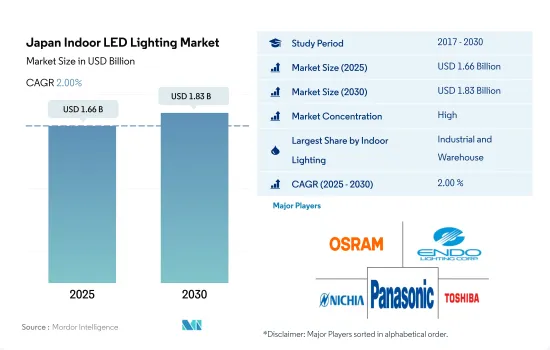
일본의 실내 LED 조명 시장 규모는 2025년에 16억 6,000만 달러가 될 것으로 추정됩니다. 2030년에는 18억 3,000만 달러에 이를 것으로 예상되며, 예측기간(2025-2030년)의 CAGR은 2.00%를 나타낼 것으로 전망됩니다.
산업 부문과 상업 사무소 수요 개척이 시장 성장을 견인
- 금액 점유율에서는 2023년에는 산업·창고 분야가 과반수를 차지하고 상업 분야가 뒤를 이었습니다. 2019년 1분기 일본 경제는 예상 이상으로 확대되었습니다. 일본의 경제 성장률은 연 1.8%였습니다. 이 때문에 산업·상업 분야를 중심으로 모든 분야에서 LED 조명 수요가 크게 늘었습니다. COVID-19 시대는 전자상거래 상품 수요를 증가시켜 주로 B2C에서 LED 조명 수요 증가로 이어졌습니다. 현재 시장 수요는 두 분야에서 증가하고 있습니다. 2022년에는 공급이 증가하고 LED의 저가격화가 진행되었습니다. 2022년 4분기 일본 상업용 부동산 가격 지수는 146.6이었고, 전년도 155.4포인트에서 하락했습니다.
- 수량 점유율에서는 상업지가 대부분을 차지한 다음 주택지가 2위를 차지하고 있습니다. 2023년 반년간 신규 공급은 2022년의 3배가 되었으며, 도쿄 도심 5구의 학년 A 오피스에서는 10년간의 과거 평균의 약 1.5배가 되었습니다. 2020년 팬데믹 발생에 따라 주택지가는 2021년 0.5% 하락했습니다. 그러나 장기적인 동향에도 불구하고 국내 대도시 지역의 주택 수요는 계속 왕성합니다. 삿포로시는 2023년에 11.8%의 성장률을 보이며 주요 주택 수요가 예상되었습니다.
- 시장 개척 측면에서 농업 및 산업용 조명 수요가 크게 증가할 것으로 예상됩니다. 면적면에서 2020년에는 일본 국토의 불과 12%밖에 농업용지가 없었습니다. 내년에는 이 수치가 더욱 감소하고 상업용 온실의 보급으로 이어지고 LED의 추가 수요에 대응할 것으로 예상됩니다.
일본의 실내 LED 조명 시장 동향
노인 증가와 인구 감소가 부동산 성장을 방해할 것으로 예상
- 일본에서는 2022년에 약 25만 3,300건의 집합 주택이 착공되었습니다. 지가 개발 착공 건수는 전년 대비 11.3% 감소했습니다. 주택의 신축은 매년 행해지고 있지만, 성장률은 저하하고 있습니다. 이 추세는 부동산 증가가 국내 LED 보급을 뒷받침한다는 것을 시사합니다. 일본의 가처분소득은 다른 개발도상국에 비해 높습니다. 예를 들어, 2022년 인도의 가처분 소득은 2301.4달러, 이어 베트남의 3716.8달러, 중국의 12,732.5달러였습니다. 일본의 1인당 소득은 2021년 12월 39,916.1달러에 비해 2022년 12월 33,911.2달러에 달했습니다. 2021년에 비해 2022년 일본의 경제 성장은 둔화되었고, 경제활동은 상품가격 상승, 공급사이드 제약, COVID-19 팬데믹의 영향으로 영향을 받아 가처분소득은 감소했습니다.
- 일본 인구는 사망자 증가와 출생률 감소로 12년 연속 감소했습니다. 2022년 인구는 1억 2,449만 명으로 전년 대비 55만 6,000명 감소했습니다. 이 감소는 향후 평균 가구 인원수가 감소하고 많은 소지자가 포화 상태가 될 것임을 시사합니다. 2017년 5월 도쿄도는 LED 전구로의 이동을 통해 가정의 에너지 절약 운동을 촉진하는 캠페인을 시작했습니다. 도민이 백열 전구 2개 이상을 가까운 가전 양판점에 지참하면, LED 전구 1개와 교환해 받을 수 있습니다. 이러한 사례는 향후 수년간 일본의 LED 조명 수요를 높일 것으로 예상됩니다.
주택·상업시설의 건설 증가, 스마트 시티 프로젝트, 정부 캠페인이 LED 조명의 사용을 촉진
- 2021년도 일본의 산업부문과 상업부문의 총 에너지 소비량은 약 7.8 엑사줄이었습니다. 같은 해 주택 부문의 에너지 소비량은 약 1.7 엑사줄이었습니다. 일본 경제는 건설 부문에 크게 의존하고 있으며 2021년도 GDP에 5.5% 기여했습니다. 중앙 신칸센의 건설과 2025년 오사카 박람회에서 계획된 다른 건물의 건설도 비슷한 영향을 미칠 것으로 추정됩니다. 5년간의 가속 전략의 일환으로 정부는 1,200억 달러 이상의 투자를 계획하고 있습니다. 건설 증가는 상업 및 주택 시장 수요를 끌어올릴 것으로 예상되며 LED 시장에 이익을 가져올 것으로 예상됩니다.
- 상업 부문의 전력 수요는 영업 시간 중(10-12시간)이 가장 높습니다. 산업 부문의 전력 사용량은 하루(24시간) 내내 변동하지 않는 경향이 있습니다. 주택 부문의 전력 수요는 약 4-6시간 변동하는 경향이 있습니다. 미네베아 미츠미라는 일본 기업이 2020년 오사카에서 스마트 LED 가로등 계획을 시작했습니다. 이 스마트 시티 프로젝트는 도로 주변 환경, 교통량, 도로 침수 등을 확인하기 위한 것입니다. 이는 일본의 LED 시장 성장에 박차를 가할 것으로 기대됩니다.
- 도쿄도는 2017년 에너지 절약을 위해 가정에서 LED 전구로의 전환을 장려하는 캠페인을 시작했습니다. 이 캠페인은 현지인에게 LED 램프의 에너지 절약 기능을 활용하도록 촉구했습니다. 이 프로그램은 국가의 전력 소비를 줄이고 LED 조명의 채택을 촉진할 것으로 기대됩니다.
일본의 실내 LED 조명 산업 개요
일본의 실내 LED 조명 시장은 상당히 통합되어 있으며 상위 5개사에서 76.64%를 차지하고 있습니다. 이 시장 주요 기업은 다음과 같습니다. ams-OSRAM AG, Endo Lighting Corporation, Nichia Corporation, Panasonic Holdings Corporation and Toshiba Corporation(알파벳순 정렬).
기타 혜택
- 엑셀 형식 시장 예측(ME) 시트
- 3개월의 애널리스트 서포트
목차
제1장 주요 요약과 주요 조사 결과
제2장 보고서 제안
제3장 소개
- 조사의 전제조건과 시장 정의
- 조사 범위
- 조사 방법
제4장 주요 산업 동향
- 인구
- 1인당 소득
- LED 총 수입량
- 조명 전력 소비량
- 가구수
- LED 보급률
- 원예 면적
- 규제 프레임워크
- 일본
- 밸류체인과 유통채널 분석
제5장 시장 세분화
- 실내 조명
- 농업용 조명
- 상업 조명
- 사무실
- 소매
- 기타
- 산업 및 창고
- 주택
제6장 경쟁 구도
- 주요 전략 동향
- 시장 점유율 분석
- 기업 상황
- 기업 프로파일(세계 수준 개요, 시장 수준 개요, 주요 사업 부문, 재무, 직원 수, 주요 정보, 시장 순위, 시장 점유율, 제품 및 서비스, 최근 동향 분석 포함)
- ams-OSRAM AG
- Endo Lighting Corporation
- EVERLIGHT ELECTRONICS CO., LTD.
- Iris Ohyama Co., Ltd.
- Lumileds Holding BV
- Nichia Corporation
- ODELIC CO., LTD
- Panasonic Holdings Corporation
- Toshiba Corporation
- Up-shine Lighting Co.,Limited
제7장 CEO에 대한 주요 전략적 질문
제8장 부록
- 세계의 개요
- 개요
- Five Forces 분석 프레임워크
- 세계의 밸류체인 분석
- 시장 역학(DROs)
- 정보원과 참고문헌
- 도표 일람
- 주요 인사이트
- 데이터 팩
- 용어집
The Japan Indoor LED Lighting Market size is estimated at 1.66 billion USD in 2025, and is expected to reach 1.83 billion USD by 2030, growing at a CAGR of 2.00% during the forecast period (2025-2030).
Increasing development in the industrial sector and commercial office demand states to drive market growth
- In terms of value share, in 2023, the industrial and warehouse segment accounts for a majority share, followed by commercial. Japan's economy expanded more than expected in the opening quarter of 2019. Japan's economy grew at an annual rate of 1.8%. This has led to a major demand for LED lighting in all sectors, mainly in the industrial and commercial segments. The COVID-19 era increased the demand for e-commerce goods, leading to more demand for LED lighting, majorly in B2C. Currently, the market demand is increasing for both sectors. In 2022, the supply increased, leading to low LED pricing. In Q4 2022, the commercial property price index for retail properties, warehouses, factories, apartment buildings, and commercial and industrial land in Japan stood at 146.6, down from 155.4 points in the previous quarter.
- In volume share, commercial accounts for the majority of the share, and then residential stands at the second spot. Over the next six months in 2023, new supply is expected to triple from 2022, at around 1.5 times higher than the 10-year historical average in Tokyo Central 5 Wards Grade A office. With the onset of the pandemic in 2020, residential land prices plunged 0.5% in 2021. However, despite the long-term trend, housing demand remained strong in the country's metropolitan areas. Sapporo is expected to have major residential demand, having an 11.8% growth rate in 2023.
- In terms of development, the market is expected to see major demand growth in agriculture and industrial lighting. In terms of area, only 12% of Japan's land was dedicated to agriculture in 2020. In the coming year, this number is expected to decrease further, leading to the penetration of commercial greenhouses, which will cater to more demand for LEDs.
Japan Indoor LED Lighting Market Trends
Increasing number of elderly people and the decreasing population are expected to hinder the growth of real estate
- In Japan, the construction of owned housing complexes began on about 253.3 thousand projects in 2022. The number of owner-occupied home development starts fell by 11.3% from the previous year. The new house construction has been happening every year, but the growth percentage has declined. This trend suggests that the increasing number of properties is expected to boost LED penetration in the country. Japan's disposable income is high compared to other developing nations. For instance, in 2022, India's disposable income was USD 2301.4, followed by Vietnam at USD 3716.8 and China at USD 12,732.5, resulting in rising spending power of individuals and more money being spent on new residential spaces. Japan's per capita income reached USD 33,911.2 in December 2022 compared to USD 39,916.1 in December 2021. Compared to 2021, disposable income declined as Japan's economic growth slowed in 2022, with economic activity being affected by high commodity prices, supply-side constraints, and the impact of the COVID-19 pandemic.
- Japan's population has declined for the 12th year in a row due to increased deaths and declining birth rates. In 2022, there were 124.49 million people, a decrease of 556,000 from the previous year. This decline suggests that the average household size is expected to decrease in the coming years, leading to a saturation point for a number of house owners. In May 2017, the Tokyo Metropolitan Government (TMG) launched a campaign to promote the energy-saving movement among households through a shift to LED bulbs. Residents of Tokyo who bring two or more incandescent bulbs to their local home appliance store will receive one LED bulb in exchange. Such instances are expected to boost the demand for LED lighting in the country in the coming years.
Rise in residential and commercial construction, smart city projects, and government campaigns promote the use of LED lights
- The combined energy consumption of Japan's industrial and commercial sectors in FY 2021 was roughly 7.8 exajoules. The residential sector consumed approximately 1.7 exajoules of energy in the same year. The Japanese economy relies heavily on the construction sector, contributing 5.5% to the country's GDP in 2021. It is estimated that the construction of the Chuo Shinkansen maglev line and other buildings planned for the Osaka World Expo 2025 will have a similar impact. As part of its five-year acceleration strategy, the government plans to invest over USD 0.12 trillion. The rise in construction is expected to boost demand in the commercial and residential markets, which is anticipated to benefit the LED market.
- Electricity demand in the commercial sector is the highest during operating business hours, which are 10-12 hours. Electricity use in the industrial sector tends not to fluctuate throughout the day (24 hours). Electricity demand in the residential sector tends to vary by about four to six hours. A Japanese company called Minebea Mitsumi launched a smart LED street lighting scheme in Osaka in 2020. The smart city project aims to check the environment around the roads, traffic volume, and flood water on the roads. This is expected to fuel the country's growing LED market.
- The Tokyo Metropolitan Government started a campaign in 2017 to encourage families to switch to LED bulbs to save energy. The campaign encouraged locals to take advantage of the energy-saving features of LED lamps. This program is expected to reduce the nation's electricity consumption and encourage the adoption of LED lighting.
Japan Indoor LED Lighting Industry Overview
The Japan Indoor LED Lighting Market is fairly consolidated, with the top five companies occupying 76.64%. The major players in this market are ams-OSRAM AG, Endo Lighting Corporation, Nichia Corporation, Panasonic Holdings Corporation and Toshiba Corporation (sorted alphabetically).
Additional Benefits:
- The market estimate (ME) sheet in Excel format
- 3 months of analyst support
TABLE OF CONTENTS
1 EXECUTIVE SUMMARY & KEY FINDINGS
2 REPORT OFFERS
3 INTRODUCTION
- 3.1 Study Assumptions & Market Definition
- 3.2 Scope of the Study
- 3.3 Research Methodology
4 KEY INDUSTRY TRENDS
- 4.1 Population
- 4.2 Per Capita Income
- 4.3 Total Import Of Leds
- 4.4 Lighting Electricity Consumption
- 4.5 # Of Households
- 4.6 Led Penetration
- 4.7 Horticulture Area
- 4.8 Regulatory Framework
- 4.8.1 Japan
- 4.9 Value Chain & Distribution Channel Analysis
5 MARKET SEGMENTATION (includes market size in Value in USD and Volume, Forecasts up to 2030 and analysis of growth prospects)
- 5.1 Indoor Lighting
- 5.1.1 Agricultural Lighting
- 5.1.2 Commercial
- 5.1.2.1 Office
- 5.1.2.2 Retail
- 5.1.2.3 Others
- 5.1.3 Industrial and Warehouse
- 5.1.4 Residential
6 COMPETITIVE LANDSCAPE
- 6.1 Key Strategic Moves
- 6.2 Market Share Analysis
- 6.3 Company Landscape
- 6.4 Company Profiles (includes Global level Overview, Market level overview, Core Business Segments, Financials, Headcount, Key Information, Market Rank, Market Share, Products and Services, and analysis of Recent Developments)
- 6.4.1 ams-OSRAM AG
- 6.4.2 Endo Lighting Corporation
- 6.4.3 EVERLIGHT ELECTRONICS CO., LTD.
- 6.4.4 Iris Ohyama Co., Ltd.
- 6.4.5 Lumileds Holding B.V.
- 6.4.6 Nichia Corporation
- 6.4.7 ODELIC CO., LTD
- 6.4.8 Panasonic Holdings Corporation
- 6.4.9 Toshiba Corporation
- 6.4.10 Up-shine Lighting Co.,Limited
7 KEY STRATEGIC QUESTIONS FOR LED CEOS
8 APPENDIX
- 8.1 Global Overview
- 8.1.1 Overview
- 8.1.2 Porter's Five Forces Framework
- 8.1.3 Global Value Chain Analysis
- 8.1.4 Market Dynamics (DROs)
- 8.2 Sources & References
- 8.3 List of Tables & Figures
- 8.4 Primary Insights
- 8.5 Data Pack
- 8.6 Glossary of Terms