

|
시장보고서
상품코드
2043984
남미의 콜드체인 물류 : 시장 점유율 분석, 산업 동향 및 통계 데이터, 성장 예측(2026-2031년)South America Cold Chain Logistics - Market Share Analysis, Industry Trends & Statistics, Growth Forecasts (2026 - 2031) |
||||||
 Mordor Intelligence
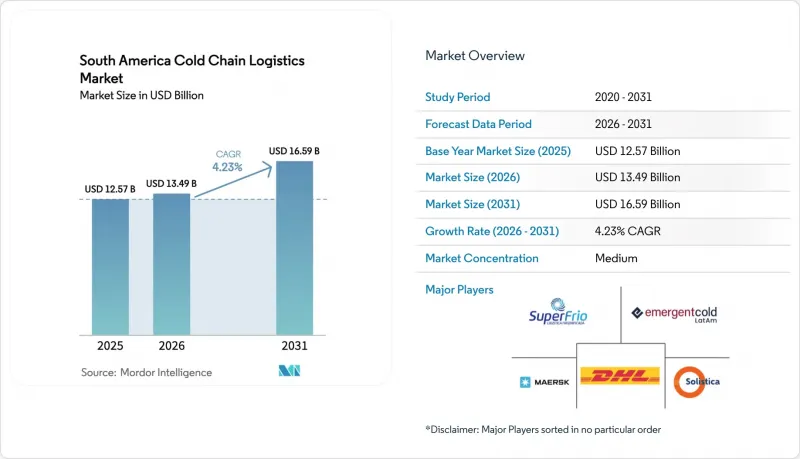
남미의 콜드체인 물류 시장 규모는 2025년 125억 7,000만 달러로 평가되었습니다. 2026년 134억 9,000만 달러에서 2031년까지 165억 9,000만 달러로 확대되며 2026년부터 2031년까지 연평균 복합 성장률(CAGR)은 4.23%를 나타낼 전망입니다.
이 시장은 전통적인 상품 수출 경로의 역할에서 바이오 의약품, 온라인 식품 소매업의 마이크로 풀필먼트, 근해에서 단백질 가공을 위한 온도 관리 허브로 전환하고 있습니다. 2026년 1월에 체결된 EU-메르코수르 잠정 무역협정에 따라 수출업체들은 삼림파괴 없는 조달 규칙을 충족하는 이력추적 시스템을 도입해야 합니다. 또한, 백신 유통 체계의 지속적인 개선으로 인해 많은 국가에서 노후화된 냉동 설비의 교체가 가속화되고 있습니다. 주요 도시(Tier-1)의 냉장창고 공실률 압박으로 인해 투자가 땅값이 저렴하고 전력망 신뢰도가 높으며 라스트 마일 거리가 짧은 2급 도시(Tier-2)로 이동하고 있습니다. 각국의 기후 변화협약에 따른 규제로 인해 자연 냉매의 채택이 증가하고 있으며, 이로 인해 초기 투자비용은 증가하지만 장기적으로 에너지 비용을 절감하고 총소유비용을 개선하는 동시에 지속가능성에 대한 노력을 강화하고 있습니다. 세계 기존 기업들이 지역 전문업체를 인수하고 자동화, IoT 모니터링 등을 도입하여 자산을 개조하고 있어 경쟁의 강도는 여전히 중간 정도에 머물러 있지만, 틈새 시장과 세심한 서비스가 요구되는 분야에서는 국내 기업들이 여전히 견고한 입지를 유지하고 있습니다.
남미의 콜드체인 물류 시장 동향 및 인사이트
가공 및 냉동식품에 대한 도시 지역 수요 증가
2025년 도시화율이 87%를 넘어서면서 1인 가구와 맞벌이 가구가 강력한 냉장 물류에 의존하는 인스턴트 식품에 대한 수요를 주도하고 있습니다. 상파울루와 산티아고에서는 냉동 메인 요리, IQF 채소, 프리미엄 아이스크림이 식료품 구매 금액의 22%를 차지하며 2023년 16%에서 증가한 것으로 나타났습니다. iFood는 170억 헤알(34억 달러)의 인프라 계획 중 30%를 15분 배송을 지원하는 온도 관리 구역에 투자하고, 창고 운영자에게 인구 밀집 지역으로부터 5km 이내로 거점을 마련하도록 요구하고 있습니다. 소매업체들은 지역 수요 변화에 따라 이동이 가능한 모듈형 냉장실을 도입하여 자산의 유휴화 리스크를 줄이고 있습니다. 칠레와 아르헨티나에서도 비슷한 추세를 보이고 있으며, 2025년에는 1인당 냉동식품 소비량이 각각 9%, 11% 증가해 지역 전체에서 모멘텀을 보였습니다.
백신 및 생물학적 제제 유통망 확대
다자간 금융기관은 2025년까지 페루, 콜롬비아, 볼리비아의 백신 물류 현대화에 미화 1억 8,000만 달러를 투자하여 한때 폐기율이 10%를 넘었던 지방 진료소의 노후화된 시설을 교체했습니다. 새로운 인프라에는 태양광 냉각기와 실시간 데이터 로거가 포함되어 있으며, 제약사들은 이를 임상시험용 의약품 운송에 재사용하여 환자 등록까지의 기간을 5-7일 단축하고 있습니다. 의약품 규제 프로토콜의 조화로 인해 브라질과 아르헨티나에서는 수입 허가 승인 기간이 90일에서 45일 미만으로 단축되어 스폰서가 -80°C의 재료를 미리 배치할 수 있게 되었습니다. 그 결과, 의약품 및 생물학적 제제는 현재 CAGR 6.94%로 가장 빠른 부문 성장을 기록하고 있으며, 이는 기존 단백질 카테고리의 성장 속도의 두 배에 달할 전망입니다.
한정된 냉장 도로 인프라와 치솟는 에너지 비용
브라질의 포장 도로 중 12%만이 '양호' 또는 '우수' 기준을 충족하고 있으며, 이로 인해 트럭의 평균 속도는 시속 45km로 제한되어 칠레의 운송에 비해 디젤 연료 소비가 20% 증가했습니다. 노면의 구멍으로 인한 진동으로 인해 압축기의 마모가 빨라져 오버홀 주기가 18개월에서 12개월로 단축되고 있습니다. 2025년 브라질 북부의 산업용 전기요금은 평균 0.52헤알/kWh(0.10달러)였지만, 잦은 정전으로 인해 시설들은 가동시간의 최대 20%를 발전기로 충당할 수밖에 없었고, 이는 수익성이 낮은 단백질 화물의 이익을 압박하고 있습니다. 아르헨티나의 지방 전력망도 마찬가지로 최대 6시간에 달하는 정전 사태를 겪었으며, 온도 완충 기능이 없는 시설의 경우 식품 부패 위험이 높아졌습니다.
부문 분석
2025년 매출에서 냉장 운송이 55.69%로 가장 큰 비중을 차지하여 남미의 콜드체인 물류 시장이 장거리 운송에서 트럭 운송에 의존하고 있음을 보여주었습니다. 그러나 냉장 철도 운송은 2031년까지 연평균 복합 성장률(CAGR) 5.54%를 기록하여 부문 내에서 가장 높은 성장률을 보이고 있습니다. 루모 로지스티카가 운영하는 마토그로소 주에서 산토스 항구까지 1,000km의 철도 노선은 콩 가공품의 운송 시간을 18시간 단축하고 톤당 배출량을 65% 감소시켜 환경적, 비용적 이점을 강조하고 있습니다. 300km 미만의 라스트 마일 구간에서는 여전히 도로 운송이 주류를 이루고 있지만, 디젤 가격의 변동으로 인해 배출 규제 지역에서는 화주들이 천연가스 트럭으로 전환하고 있습니다. 해상 냉장 운송은 기존 항로에서 안정적인 수요를 유지하는 반면, 항공 운송은 고급 수산물과 긴급한 생물학적 제제를 위한 틈새 시장에 머물러 있습니다.
사업자들이 수익원 다변화를 꾀하는 가운데, 부가가치 서비스가 증가하고 있습니다. 급속냉동, 키트화, 온도관리형 EC 풀필먼트는 일반 보관 서비스에 비해 20-30%의 할증료가 부과되는 것이 일반적입니다. 온라인 식품 시장의 침투가 진행됨에 따라 도시 내 창고에 설치된 마이크로 풀필먼트 거점이 증가하고 있으며, 빠른 피킹 및 포장 시스템과 실시간 온도 모니터링이 요구되고 있습니다. 이러한 서비스로 인한 남미의 콜드체인 물류 시장 규모는 소비자의 행동 변화와 소매업체의 당일 보충 수요에 힘입어 전체 시장 성장률을 상회하는 속도로 확대될 것으로 예측됩니다.
기타 혜택 :
- 엑셀 형식 시장 예측(ME) 시트
- 3개월간 애널리스트 지원
자주 묻는 질문
목차
제1장 서론
제2장 분석 방법
제3장 주요 요약
제4장 시장 구도
제5장 시장 규모 및 성장률 예측(금액 기준, 2026-2031년)
제6장 경쟁 구도
제7장 시장 기회와 향후 전망
KTH 26.05.29The South America cold chain logistics market size is projected to expand from USD 12.57 billion in 2025 and USD 13.49 billion in 2026 to USD 16.59 billion by 2031, registering a CAGR of 4.23% between 2026 to 2031.
The market is shifting from its historic role as a commodity-export conduit toward a temperature-controlled hub for biologics, e-grocery micro-fulfillment, and near-shored protein processing. The January 2026 EU-Mercosur interim trade agreement is spurring exporters to install traceability systems that satisfy deforestation-free sourcing rules, while ongoing vaccine-distribution upgrades have accelerated replacement of obsolete refrigeration equipment across multiple countries. Tight cold-storage vacancy in Tier-1 metros is redirecting investment to Tier-2 cities where land is cheaper, grid reliability is better, and first-mile distances are shorter. Rising adoption of natural refrigerants mandated by national Kigali Amendment regulations is lifting capital costs but lowering long-run energy spend, improving total cost of ownership, and bolstering sustainability credentials. Competitive intensity remains moderate as global incumbents buy regional specialists and retrofit assets with automation and IoT monitoring, yet domestic players still hold strong positions in niche high-touch segments.
South America Cold Chain Logistics Market Trends and Insights
Increasing Urban Demand for Processed and Frozen Food Products
Urbanization surpassed 87% in 2025, and single-person as well as dual-income households are fueling demand for convenience meals that rely on robust refrigeration logistics. Frozen entrees, IQF vegetables, and premium ice creams now occupy 22% of grocery baskets in Sao Paulo and Santiago, up from 16% in 2023. iFood earmarked 30% of its BRL 17 billion (USD 3.4 billion) infrastructure plan for temperature-controlled zones that support 15-minute delivery, forcing warehouse operators to locate within five kilometers of high-density districts. Retailers are adopting modular cold rooms that can be moved as neighborhood demand shifts, cutting stranded-asset risk. Chile and Argentina echo the trend, with per-capita frozen-food intake rising 9% and 11% respectively in 2025, signaling region-wide momentum.
Expansion of Vaccine & Biologics Distribution Networks
Multilateral lenders invested USD 180 million in 2025 to modernize vaccine logistics in Peru, Colombia, and Bolivia, replacing obsolete equipment in rural clinics where spoilage once exceeded 10%. The new infrastructure includes solar-powered coolers and real-time data loggers that pharmaceutical firms are re-deploying for investigational therapies, shaving 5-7 days off patient-enrollment timelines. Harmonized drug-regulation protocols have cut import-permit approvals from 90 days to under 45 days in Brazil and Argentina, allowing sponsors to pre-position -80 °C materials. Consequently, pharmaceuticals and biologics now post the fastest segment growth at 6.94% CAGR, doubling the pace of traditional protein categories.
Limited Refrigerated Road Infrastructure and Rising Energy Costs
Only 12% of Brazil's paved highways meet "good" or "excellent" standards, limiting average truck speeds to 45 km/h and inflating diesel burn by 20% relative to Chilean hauls. Pothole-induced vibration accelerates compressor wear, shortening overhaul intervals from 18 to 12 months. Northern Brazil's industrial-power tariff averaged BRL 0.52/kWh (USD 0.10) in 2025, and frequent outages force facilities to run generators for up to 20% of operating hours, eroding profit on low-margin protein cargos. Argentina's rural grid faces similar blackouts lasting up to six hours, raising spoilage risk in sites without sufficient thermal buffering.
Other drivers and restraints analyzed in the detailed report include:
- Government Export Incentives Requiring Temperature Compliance
- Near-Shoring of North-American Protein Sourcing to Mercosur Suppliers
- Lack of Harmonized Regulatory Standards Across Borders
For complete list of drivers and restraints, kindly check the Table Of Contents.
Segment Analysis
Refrigerated transportation captured the largest slice of 2025 revenue at 55.69%, illustrating the dependence of the South America cold chain logistics market on trucking for long hauls. Yet refrigerated rail is registering a 5.54% CAGR to 2031, the strongest within the segment. Rumo Logistica's 1,000-km rail route from Mato Grosso to the Port of Santos trims transit time by 18 hours and cuts per-ton-kilometer emissions 65% for soy derivatives, underscoring environmental and cost advantages. Road remains dominant for last-mile legs under 300 km, but diesel price volatility is nudging shippers toward natural-gas trucks in low-emission zones. Sea-based refrigerated transport holds steady on established routes, while air remains a niche for premium seafood and urgent biologics.
Value-added services are rising as operators seek margin diversity. Blast freezing, kitting, and temperature-controlled e-commerce fulfillment often command 20%-30% premiums over commodity storage. As e-grocery penetration deepens, micro-fulfillment nodes embedded inside urban warehouses are proliferating, requiring high-velocity pick-and-pack systems and real-time temperature monitoring. The South America cold chain logistics market size attributable to such services is projected to expand faster than headline growth, underpinned by shifting consumer behavior and retailer demand for same-day replenishment.
The South America Cold Chain Logistics Market Report is Segmented by Service Type (Refrigerated Storage, Refrigerated Transportation, and Value-Added Services), by Temperature Type (Chilled, Frozen, Ambient, Deep-Frozen), by Application (Fruits & Vegetables, Meat & Poultry, Fish & Seafood, Dairy & Frozen Desserts, and More), by Country (Brazil, Argentina, and More). The Market Forecasts are Provided in Terms of Value (USD).
List of Companies Covered in this Report:
- Emergent Cold LatAm
- Solistica (Traxion)
- SuperFrio Logistica Frigorificada
- Friozem Armazens Frigorificados
- DHL Supply Chain
- Maersk (Sealand Americas Cold Chain)
- Americold Realty Trust
- JSL Transportadora (Fadel Logistica Fria)
- Serbom
- TPC Logistica
- Arfrio
- Ransa Comercial S.A.
- Iceport
- Kuehne+Nagel
- CMA CGM (incl. CEVA Logistics)
- Refrio Armazens Gerais Frigorificos
- IceStar
- Brado Logistica S.A.
- AGUNSA
- CAP Logistica Frigorificada
Additional Benefits:
- The market estimate (ME) sheet in Excel format
- 3 months of analyst support
TABLE OF CONTENTS
1 Introduction
- 1.1 Study Assumptions & Market Definition
- 1.2 Scope of the Study
2 Research Methodology
3 Executive Summary
4 Market Landscape
- 4.1 Market Overview
- 4.2 Market Drivers
- 4.2.1 Increasing Urban Demand for Processed and Frozen Food Products
- 4.2.2 Expansion of Temperature-Controlled Distribution Networks for Vaccines and Biologics
- 4.2.3 Government Export Incentive Schemes Emphasizing Cold Chain Compliance
- 4.2.4 Shift Toward Nearshoring North American Protein Sourcing to Mercosur-Based Suppliers
- 4.2.5 Growth of E-Grocery Micro-Fulfillment Operations in Tier-2 Brazilian Cities
- 4.2.6 Rising Exports of Meat, Poultry, And Seafood from Mercosur Countries
- 4.3 Market Restraints
- 4.3.1 Limited Refrigerated Road Infrastructure and Rising Energy Costs
- 4.3.2 Lack of Harmonized Regulatory Standards Across Borders
- 4.3.3 Shortage of Skilled Personnel in Industrial Refrigeration Operations
- 4.3.4 Elevated Electricity Tariffs and Recurring Power Reliability Issues
- 4.4 Value / Supply-Chain Analysis
- 4.5 Regulatory Landscape
- 4.6 Technology Innovations Outlook
- 4.7 Porter's Five Forces
- 4.7.1 Threat of New Entrants
- 4.7.2 Bargaining Power of Suppliers
- 4.7.3 Bargaining Power of Buyers
- 4.7.4 Threat of Substitutes
- 4.7.5 Rivalry Among Competitors
5 Market Size & Growth Forecasts (Value, 2026-2031)
- 5.1 By Service Type
- 5.1.1 Refrigerated Storage
- 5.1.2 Refrigerated Transportation
- 5.1.2.1 Road
- 5.1.2.2 Rail
- 5.1.2.3 Sea
- 5.1.2.4 Air
- 5.1.3 Value-Added Services
- 5.2 By Temperature Type
- 5.2.1 Chilled (0-5 °C)
- 5.2.2 Frozen (-18-0 °C)
- 5.2.3 Ambient
- 5.2.4 Deep-Frozen / Ultra-Low (less than-20 °C)
- 5.3 By Application
- 5.3.1 Fruits & Vegetables
- 5.3.2 Meat & Poultry
- 5.3.3 Fish & Seafood
- 5.3.4 Dairy & Frozen Desserts
- 5.3.5 Bakery & Confectionery
- 5.3.6 Ready-to-Eat Meals
- 5.3.7 Pharmaceuticals & Biologics
- 5.3.8 Vaccines & Clinical Trial Materials
- 5.3.9 Chemicals & Specialty Materials
- 5.3.10 Other Perishables
- 5.4 By Country
- 5.4.1 Argentina
- 5.4.2 Brazil
- 5.4.3 Chile
- 5.4.4 Peru
- 5.4.5 Colombia
- 5.4.6 Rest of South America
6 Competitive Landscape
- 6.1 Market Concentration
- 6.2 Key Strategic Moves
- 6.3 Market Share Analysis
- 6.4 Company Profiles (includes Global level Overview, Market level overview, Core Segments, Financials as available, Strategic Information, Market Rank/Share for key companies, Products & Services, and Recent Developments)
- 6.4.1 Emergent Cold LatAm
- 6.4.2 Solistica (Traxion)
- 6.4.3 SuperFrio Logistica Frigorificada
- 6.4.4 Friozem Armazens Frigorificados
- 6.4.5 DHL Supply Chain
- 6.4.6 Maersk (Sealand Americas Cold Chain)
- 6.4.7 Americold Realty Trust
- 6.4.8 JSL Transportadora (Fadel Logistica Fria)
- 6.4.9 Serbom
- 6.4.10 TPC Logistica
- 6.4.11 Arfrio
- 6.4.12 Ransa Comercial S.A.
- 6.4.13 Iceport
- 6.4.14 Kuehne+Nagel
- 6.4.15 CMA CGM (incl. CEVA Logistics)
- 6.4.16 Refrio Armazens Gerais Frigorificos
- 6.4.17 IceStar
- 6.4.18 Brado Logistica S.A.
- 6.4.19 AGUNSA
- 6.4.20 CAP Logistica Frigorificada


