
|
시장보고서
상품코드
2115254
중국의 콜드체인 물류 시장 : 시장 점유율 분석, 업계 동향 및 통계, 성장 예측(2026-2031년)China Cold Chain Logistics - Market Share Analysis, Industry Trends & Statistics, Growth Forecasts (2026 - 2031) |
||||||
 Mordor Intelligence
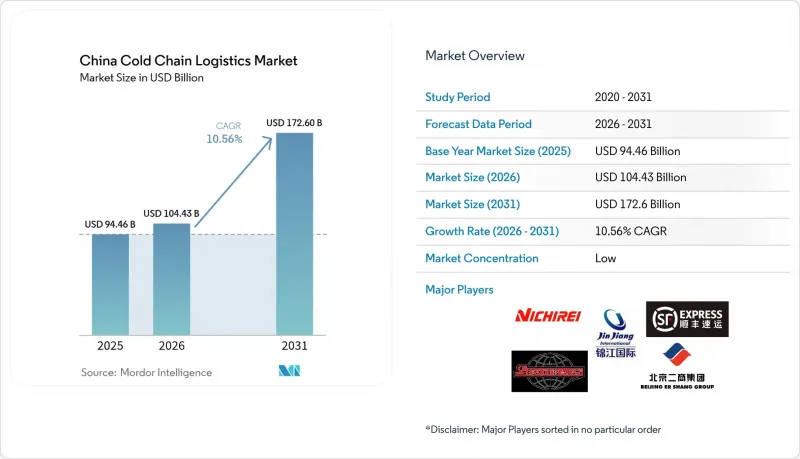
Mordor Intelligence에 의하면, 중국의 콜드체인 물류 시장 규모는 2025년 944억 6,000만 달러로 평가되었고, 2026년에는 1,044억 3,000만 달러로 추정되고, 2026-2031년 CAGR 10.56%로 성장을 지속할 전망이며, 2031년에는 1,726억 달러에 이를 것으로 예측됩니다.
본 보고서는 서비스 유형별(냉장 창고, 냉장 운송, 기타), 온도 유형별(냉장(0-5°C), 냉동(-18-0°C), 기타), 용도별(과일 및 채소, 육류·가금류, 수산물, 유제품·냉동 디저트, 기타), 지역별(중국 동부, 중국 북부, 중국 중남부, 기타)로 분류되어 있습니다. 시장 예측은 금액(달러)으로 표시되어 있습니다.
중국의 콜드체인 물류 시장 동향 및 인사이트
제14차 5개년 계획에 따른 전국적인 콜드체인 인프라가 창고 건설을 가속화
중앙 정부는 생산 지역과 도시 시장을 연결하는 콜드체인 고속도로에 막대한 자금을 투입할 계획이며, 2027년까지 과일의 냉장 유통률을 25%, 육류는 45%로 높이는 것을 목표로 하고 있습니다. 현재 허난성, 후난성, 쓰촨성의 내륙 허브는 연안 지역 허브를 능가하는 신규 취급량 점유율을 차지하고 있어, 기존 격차가 해소되고 운송 거리가 단축되고 있습니다. 이러한 인프라 구축으로 인해 이미 농산물의 부패가 감소하고 있으며, 고부가가치 작물의 재배가 촉진되고 있습니다. 이러한 움직임은 소매 채널에서 상품의 다양성을 확대하는 것입니다.
신선식품 전자상거래의 급속한 확대
JD Fresh나 Freshippo와 같은 플랫폼이 약속하는 ‘당일 배송’으로 인해, 기존 운송업체들은 도시 순환도로 내에 마이크로 풀필먼트 거점을 설치할 수밖에 없게 되었습니다. 각 거점은 일반적으로 3가지 온도대를 지원하며, 주문 확정 후 몇 분 이내에 상품을 피킹할 수 있습니다. 경로 최적화 소프트웨어를 통해 빈 주행 거리가 줄어들어, 도심 지역의 냉장 밴은 1교대당 더 많은 배송지를 돌 수 있게 되었습니다. 소비자들은 온도 관리의 신뢰성을 확인하면 구매 수량을 늘리는 경향이 있으며, 이는 플랫폼의 경쟁 우위를 더욱 강화하고 있습니다.
분산된 라스트마일 냉장 네트워크
중국 콜드체인 물류 시장 조사 데이터에 따르면, 많은 배송 회사가 단열 기능이 없는 밴을 사용하고 있어 일부 3선 도시에서는 잎채소의 부패율이 10%를 초과하고 있습니다. 보험사는 보험금 청구 시 온도 기록 제출을 점점 더 요구하고 있으며, 모니터링 장비를 갖추지 않은 운송업체의 경우 보험료 인상으로 이어지고 있습니다. 매장 간 주문을 일괄 처리하는 기술을 활용하는 신규 진출기업들이 시장 점유율을 확대하고 있어, 도시 지역에서의 물류 통합이 예상됩니다.
부문 분석
2025년, 냉장 창고는 중국 콜드체인 물류 시장 점유율의 50.32%를 차지했으며, 고정 용량에 대한 필요성을 부각시키고 있습니다. 부가가치 서비스의 성장 속도는 더 빠르며, 2031년까지의 예상 연평균 성장률(CAGR)은 11.90%로, 화주들이 라벨 재부착, 검사, 키트 구성과 같은 작업에 대해 점점 더 많은 비용을 지불하고 있음을 나타냅니다. 창고 보관과 이러한 서비스를 결합한 사업자는 평방미터당 수익을 향상시켜, 기본적인 팔레트 보관에 대한 가격 경쟁에 대한 완충 장치를 구축하고 있습니다. 또한, 통합형 모델에서는 입고부터 출하까지 상품이 단일 디지털 생태계 내에 머무르기 때문에 취급 오류도 감소합니다.
냉장 운송은 여전히 2위 카테고리를 차지하고 있으며, 주문에서 배송까지의 주기를 단축하는 전자상거래의 타임라인으로부터 계속해서 혜택을 받고 있습니다. 센서가 탑재된 트레일러는 현재 2분마다 온도 및 도어 개폐 데이터를 스트리밍으로 전송하고 있으며, 이를 통해 클레임이 감소하고 교통 체증이 발생했을 때 동적인 경로 변경이 가능해졌습니다. 이러한 업그레이드에 필요한 자금을 조달할 수 없는 소규모 운송업체는 트럭을 소유하지 않고도 가시성을 보장할 수 있는 ‘자산 경량(asset-light)’형 기술 중개업체에 계약을 빼앗길 위험이 있습니다. 따라서 업계의 흐름은 소프트웨어 플랫폼과 제휴한, 수는 적지만 규모가 큰 운송 회사로 기울고 있습니다.
기타 혜택
- 엑셀 형식 시장 예측(ME) 시트
- 3개월간의 애널리스트 지원
자주 묻는 질문
목차
제1장 서론
제2장 조사 방법
제3장 주요 요약
제4장 시장 구도
제5장 시장 규모 및 성장 예측
제6장 경쟁 구도
제7장 시장 기회 및 향후 전망
AJY 26.08.28According to Mordor Intelligence, the China cold chain logistics market size is expected to grow from USD 94.46 billion in 2025 to USD 104.43 billion in 2026 and is forecast to reach USD 172.6 billion by 2031 at 10.56% CAGR over 2026-2031.
This report is Segmented by Service Type (Refrigerated Storage, Refrigerated Transportation and More), by Temperature Type (Chilled (0-5 °C), Frozen (-18-0 °C) and More), by Application (Fruits & Vegetables, Meat & Poultry, Fish & Seafood, Dairy & Frozen Desserts and More), by Region (East China, North China, South-Central China, and More). The Market Forecasts are Provided in Terms of Value (USD).
China Cold Chain Logistics Market Trends and Insights
National Cold Chain Infrastructure under 14th FYP Accelerating Warehouse Build-out
Central government plans earmark significant capital for cold chain highways that connect production zones to city markets, targeting a 25 % chilled distribution rate for fruit and 45 % for meat by 2027. Inland hubs in Henan, Hunan, and Sichuan now account for a larger share of new cubic metres than coastal hubs, closing historical gaps and reducing transport distances. This build-out is already cutting produce spoilage and encouraging planting of higher-value crops, a development that expands product diversity in retail channels.
Rapid Expansion of Fresh E-commerce
Same-day delivery promises from platforms such as JD Fresh and Freshippo have forced traditional carriers to install micro-fulfilment nodes inside city rings. Each node typically supports three temperature bands, allowing orders to be picked within minutes of confirmation. Route-optimisation software is cutting empty kilometres, meaning urban reefer vans can run more stops per shift. Consumers respond with larger basket sizes once they trust temperature integrity, reinforcing the platform's competitive moat.
Fragmented Last-Mile Reefer Network
China Cold Chain Logistics market study data show spoilage rates for leafy greens exceed 10 % in some tier-three cities because many delivery firms use non-insulated vans. Insurance underwriters increasingly demand temperature logs for claims, leading to higher premiums for carriers without monitoring equipment. Technology-enabled entrants that pool orders across stores are winning share, foreshadowing consolidation in urban distribution.
Other drivers and restraints analyzed in the detailed report include:
- Biopharma Export Boom Driving GDP-Compliant Ultra-Low Cold Chain
- Rising Middle-Class Appetite for Imported Chilled Protein
- Shortage of Certified Refrigeration Technicians
For complete list of drivers and restraints, kindly check the Table Of Contents.
Segment Analysis
Refrigerated storage accounted for 50.32 % China Cold Chain Logistics market share in 2025, underscoring the need for fixed capacity. Growth in value-added services is faster at a forecast 11.90 % CAGR through 2031, showing that shippers increasingly pay for tasks like relabelling, inspection, and kitting. Operators that combine warehousing with these services improve their revenue per square metre, creating a buffer against price competition in basic pallet storage. Integrated models also lower handling errors because goods remain within one digital ecosystem from inbound to outbound.
Refrigerated transportation remains the second-largest category and continues to benefit from e-commerce timelines that compress order-to-delivery cycles. Sensor-equipped trailers now stream temperature and door-open data every two minutes, reducing claims and supporting dynamic route changes when traffic builds. Small hauliers unable to finance such upgrades risk losing contracts to asset-light tech intermediaries that can guarantee visibility without owning trucks. The landscape therefore tilts toward fewer but larger fleets partnered with software platforms.
Complete Report Scope:
- By Service Type
- Refrigerated Storage
- Public Warehousing
- Private Warehousing
- Refrigerated Transportation
- Road
- Rail
- Sea
- Air
- Value-Added Services
- Refrigerated Storage
- By Temperature Type
- Chilled (0-5 °C)
- Frozen (-18-0 °C)
- Ambient
- Deep-Frozen / Ultra-Low (More than -20 °C)
- By Application
- Fruits & Vegetables
- Meat & Poultry
- Fish & Seafood
- Dairy & Frozen Desserts
- Bakery & Confectionery
- Ready-to-Eat Meals
- Pharmaceuticals & Biologics
- Vaccines & Clinical Trial Materials
- Chemicals & Specialty Materials
- Other Perishables
- By Region (China)
- East China
- North China
- South-Central China
- Southwest China
- Northeast China
- Northwest China
List of Companies Covered in this Report:
- Sinotrans Ltd.
- SF Express
- JD Logistics Inc.
- Beijing Er Shang Group
- Shanghai Jin Jiang International Industrial Investment Co. Ltd.
- Nichirei Logistics Group
- China Merchants Americold Logistics (CMAC)
- CJ Rokin Logistics & Supply Chain Co. Ltd.
- HNA Cold Chain
- Shandong Gaishi International Logistics Group
- Henan Fresh Easy Supply Chain (Xianyi Holding)
- Shanghai Speed Fresh Logistics
- Chengdu Silverplow Low-temperature Logistics
- Zhenjiang Hengwei Supply Chain Management
- China International Marine Containers (CIMC)
- DHL-Sinotrans International Air Courier Ltd.
- Kerry Logistics Network Ltd.
- Lineage Logistics (China JV)
- Americold Logistics LLC
- YH Global Supply Chain Co. Ltd.*
Additional Benefits:
- The market estimate (ME) sheet in Excel format
- 3 months of analyst support
TABLE OF CONTENTS
1 Introduction
- 1.1 Study Assumptions & Market Definition
- 1.2 Scope of the Study
2 Research Methodology
3 Executive Summary
4 Market Landscape
- 4.1 Market Overview
- 4.2 Market Drivers
- 4.2.1 National Cold Chain Infrastructure under 14th FYP Accelerating Warehouse Build-out
- 4.2.2 Rapid Expansion of Fresh E-commerce (JD Fresh, Freshippo) Raising Same-day Delivery Expectations
- 4.2.3 Biopharma Export Boom Driving GDP-compliant Ultra-low Cold Chain
- 4.2.4 Rising Middle-class Appetite for Imported Chilled Meat & Seafood
- 4.2.5 Dairy-safety Modernization Programs Stimulating Temperature-controlled Milk Logistics
- 4.2.6 Energy-efficiency Subsidies for CO?/Ammonia Systems Lowering Capex Barriers
- 4.3 Market Restraints
- 4.3.1 Fragmented Last-mile Reefer Network Causing High Spoilage Rates
- 4.3.2 Shortage of Certified Industrial Refrigeration Technicians
- 4.3.3 High Electricity Tariffs & Grid Instability in Tier-3 Cold Stores
- 4.3.4 China VI Truck Emission Rule Inflating Reefer Fleet Retrofit Costs
- 4.4 Value / Supply-Chain Analysis
- 4.5 Regulatory Outlook
- 4.6 Technological Outlook
- 4.7 Spotlight on Ambient / Temperature-Controlled Storage
- 4.8 Impact of Emission Standards on Cold Chain Industry
- 4.9 Porter's Five Forces
- 4.9.1 Supplier Power
- 4.9.2 Buyer Power
- 4.9.3 Threat of New Entrants
- 4.9.4 Threat of Substitutes
- 4.9.5 Competitive Rivalry
- 4.10 Impact of Geo-Political Events
5 Market Size & Growth Forecasts (Value)
- 5.1 By Service Type
- 5.1.1 Refrigerated Storage
- 5.1.1.1 Public Warehousing
- 5.1.1.2 Private Warehousing
- 5.1.2 Refrigerated Transportation
- 5.1.2.1 Road
- 5.1.2.2 Rail
- 5.1.2.3 Sea
- 5.1.2.4 Air
- 5.1.3 Value-Added Services
- 5.1.1 Refrigerated Storage
- 5.2 By Temperature Type
- 5.2.1 Chilled (0-5 °C)
- 5.2.2 Frozen (-18-0 °C)
- 5.2.3 Ambient
- 5.2.4 Deep-Frozen / Ultra-Low (More than -20 °C)
- 5.3 By Application
- 5.3.1 Fruits & Vegetables
- 5.3.2 Meat & Poultry
- 5.3.3 Fish & Seafood
- 5.3.4 Dairy & Frozen Desserts
- 5.3.5 Bakery & Confectionery
- 5.3.6 Ready-to-Eat Meals
- 5.3.7 Pharmaceuticals & Biologics
- 5.3.8 Vaccines & Clinical Trial Materials
- 5.3.9 Chemicals & Specialty Materials
- 5.3.10 Other Perishables
- 5.4 By Region (China)
- 5.4.1 East China
- 5.4.2 North China
- 5.4.3 South-Central China
- 5.4.4 Southwest China
- 5.4.5 Northeast China
- 5.4.6 Northwest China
6 Competitive Landscape
- 6.1 Market Concentration
- 6.2 Strategic Moves
- 6.3 Market Share Analysis
- 6.4 Company Profiles (includes Global level Overview, Market level overview, Core Segments, Financials as available, Strategic Information, Market Rank/Share for key companies, Products & Services, and Recent Developments)
- 6.4.1 Sinotrans Ltd.
- 6.4.2 SF Express
- 6.4.3 JD Logistics Inc.
- 6.4.4 Beijing Er Shang Group
- 6.4.5 Shanghai Jin Jiang International Industrial Investment Co. Ltd.
- 6.4.6 Nichirei Logistics Group
- 6.4.7 China Merchants Americold Logistics (CMAC)
- 6.4.8 CJ Rokin Logistics & Supply Chain Co. Ltd.
- 6.4.9 HNA Cold Chain
- 6.4.10 Shandong Gaishi International Logistics Group
- 6.4.11 Henan Fresh Easy Supply Chain (Xianyi Holding)
- 6.4.12 Shanghai Speed Fresh Logistics
- 6.4.13 Chengdu Silverplow Low-temperature Logistics
- 6.4.14 Zhenjiang Hengwei Supply Chain Management
- 6.4.15 China International Marine Containers (CIMC)
- 6.4.16 DHL-Sinotrans International Air Courier Ltd.
- 6.4.17 Kerry Logistics Network Ltd.
- 6.4.18 Lineage Logistics (China JV)
- 6.4.19 Americold Logistics LLC
- 6.4.20 YH Global Supply Chain Co. Ltd.*