
|
시장보고서
상품코드
2115255
영국의 콜드체인 물류 시장 : 점유율 분석, 업계 동향과 통계, 성장 예측(2026-2031년)United Kingdom Cold Chain Logistics - Market Share Analysis, Industry Trends & Statistics, Growth Forecasts (2026 - 2031) |
||||||
 Mordor Intelligence
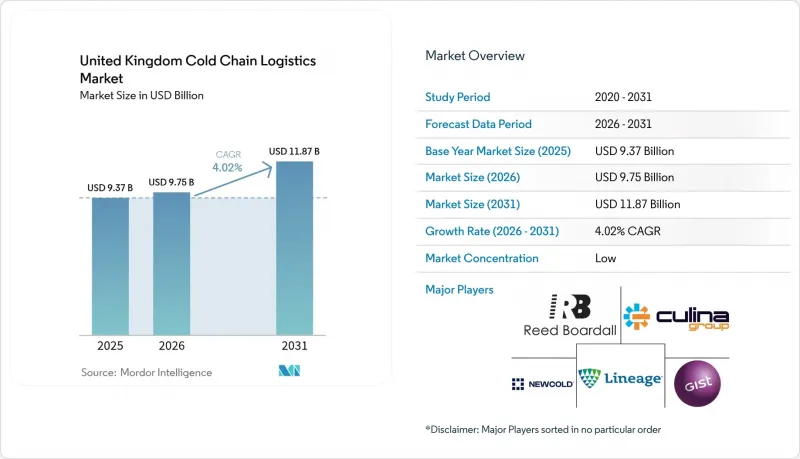
Mordor Intelligence에 의하면, 영국 콜드체인 물류 시장 규모는 2025년에 93억 7,000만 달러로 평가되었고 2026년 97억 5,000만 달러에서 2031년까지 118억 7,000만 달러에 이를 것으로 추정되고 있어 예측 기간(2026-2031년) CAGR은 4.02%를 나타낼 전망입니다.
본 보고서는 서비스 유형(냉장 창고, 냉장 운송, 부가가치 서비스), 온도 유형(냉장, 냉동, 상온, 초저온), 용도(과일 및 채소, 육류·가금류, 어류·수산물, 유제품·냉동 디저트 등)별로 분류되어 있습니다. 시장 예측은 금액(달러) 기준으로 제시되어 있습니다.
영국 콜드체인 물류 시장 동향 및 인사이트
온라인 식료품 및 밀키트 수요 급증
팬데믹 이후의 구매 습관으로 인해 온라인 식료품 보급률은 두 자릿수 대에 안착했습니다. 대형 소매업체들은 물류망을 확대하고, 기존 슈퍼마켓 내 ‘다크 스토어’로의 전환을 통해 자본 집약도를 낮추면서도 신속한 주문 이행을 유지했습니다. 냉동 식품 전문 기업이 개설한 50만 제곱피트 규모의 창고와 같은 전용 허브는 라스트 마일 냉장 배송을 효율화하고 있습니다. 센서를 활용한 재고 모니터링 플랫폼은 정확도를 더욱 높이고 폐기물을 최소화함으로써, 영국 콜드체인 물류 시장에서 서비스 이용 확대를 뒷받침하고 있습니다.
의약품 및 생명공학 수출 확대
생명과학 분야의 혁신에 대한 정부의 10억 파운드(13억 달러) 지원과 온도 관리 항공 화물량의 22%라는 지속적인 증가는 수출의 호기를 부각시키고 있습니다. 폴리스티렌을 사용하지 않고도 2-8℃ 또는 초저온 조건을 36시간 동안 유지할 수 있는 첨단 포장 기술 덕분에, 영국의 콜드체인 물류 시장은 바이오 의약품 유통에 있어 선호되는 허브로서의 입지를 확고히 하고 있습니다.
시설에 대한 높은 자본 지출(CAPEX) 및 에너지 비용
냉장 창고의 연간 전력 소비량은 1입방피트당 1.54kWh이며, 창고 총 에너지 비용의 70%를 전기 요금이 차지합니다. 10만 m3 규모의 시설에서 모범 사례로 간주되는 에너지 집약도인 10kWh/m3/년을 달성하려면 자동화 및 열 회수 시스템이 필요하며, 이로 인해 초기 투자 예산이 늘어납니다. 재생에너지로의 전환에 따른 전력망의 불안정성은 사업자에게 가격 급등 위험을 초래하지만, 2026년 맨체스터 근교에서 가동을 시작할 예정인 액체 공기 에너지 저장 시스템은 장시간 백업을 보장하여 발전 제한으로 인한 영향을 완화할 것으로 기대됩니다.
부문 분석
2025년, 냉장 보관은 영국 콜드체인 물류 시장 규모의 51.35%를 차지하며, 수입에 의존하는 식품 및 의약품 유통을 뒷받침했습니다. 200만 파운드(260만 달러)를 투자한 냉장 집하 센터 등의 투자를 통해 소매 유통 허브 근처에 보관 용량이 추가되고 있습니다. 2026년부터 2031년까지, 화주들이 단일 계약을 통해 통관 절차, 재포장, 온도 검증을 통합할 것을 요구함에 따라 부가가치 서비스 시장 규모는 연평균 성장률(CAGR) 4.37%로 성장할 전망입니다. 센서 네트워크와 디지털 트윈을 통해 재고 보유 기간이 단축되어 서비스 제공업체의 투자 자본 수익률(ROIC)이 향상될 것입니다.
윈캔턴(Wincanton)사를 7억 1,900만 달러에 인수하는 등 일련의 합병을 통해 재생 가능 전력을 대량으로 구매하고, 첨단 창고 자동화가 가능해집니다. 그 결과 형성된 거점망을 통해 기업들은 냉동·냉장 공간을 유연하게 조정할 수 있게 되며, 이는 영국의 콜드체인 물류 시장이 변화하는 소비자 수요에 대응하는 데 있어 큰 강점이 될 것입니다.
기타 혜택:
- 엑셀 형식 시장 예측(ME) 시트
- 3개월간의 애널리스트 지원
자주 묻는 질문
목차
제1장 서론
제2장 조사 방법
제3장 주요 요약
제4장 시장 구도
제5장 시장 규모와 성장 예측(금액, 백만 달러)
제6장 경쟁 구도
제7장 시장 기회와 향후 전망
JHS 26.08.26According to Mordor Intelligence, the United Kingdom cold chain logistics market size was valued at USD 9.37 billion in 2025 and estimated to grow from USD 9.75 billion in 2026 to reach USD 11.87 billion by 2031, at a CAGR of 4.02% during the forecast period (2026-2031).
This report is Segmented by Service Type (Refrigerated Storage, Refrigerated Transportation, Value-Added Services), Temperature Type (Chilled, Frozen, Ambient, Deep-Frozen/Ultra-Low), Application (Fruits & Vegetables, Meat & Poultry, Fish & Seafood, Dairy & Frozen Desserts, and More). The Market Forecasts are Provided in Terms of Value (USD).
United Kingdom Cold Chain Logistics Market Trends and Insights
Surge in online grocery and meal-kit demand
Post-pandemic purchasing habits have cemented double-digit e-grocery penetration. Large retailers widened distribution footprints, and dark-store conversions inside existing supermarkets reduced capital intensity while sustaining rapid fulfilment. Purpose-built hubs such as a 500,000 sq ft warehouse opened by a leading frozen specialist streamline last-mile chilled delivery. Sensor-driven stock-monitoring platforms further improve accuracy and minimize spoilage, reinforcing service uptake within the United Kingdom cold chain logistics market.
Expansion of pharmaceutical and biotech exports
Government backing of GBP 1 billion (USD 1.3 billion) for life-sciences innovation and a sustained 22% rise in temperature-controlled airfreight volumes underscore the export opportunity. Advanced packaging that maintains 2-8 °C or ultra-low parameters for 36 hours without polystyrene positions the United Kingdom cold chain logistics market as a preferred hub for biologics distribution.
High CAPEX and energy costs of facilities
Cold storage consumes 1.54 kWh per cubic foot annually and electricity accounts for 70% of a warehouse's total energy bill. Reaching best-practice intensity of 10 kWh/m3/yr in a 100,000 m3 site requires automation and heat-recovery systems, inflating upfront budgets. Grid volatility during the renewable transition exposes operators to price spikes, yet liquid-air energy storage due online near Manchester in 2026 promises long-duration backup, reducing exposure to curtailments.
Other drivers and restraints analyzed in the detailed report include:
- Stricter UK food-safety and traceability rules
- Rising frozen and convenience-food consumption
- HGV and reefer-driver labor shortage
For complete list of drivers and restraints, kindly check the Table Of Contents.
Segment Analysis
Refrigerated storage generated 51.35% of the United Kingdom cold chain logistics market size in 2025, underpinning import-heavy food and pharmaceutical flows. Investments such as a GBP 2 million (USD 2.6 million) chilled consolidation center add capacity close to retail distribution hubs. Over 2026-2031, value-added services grow at 4.37% CAGR as shippers seek integrated customs clearance, repacking, and temperature validation in a single contract. Sensor networks and digital twins cut stock-holding days, lifting return on invested capital for service providers.
A wave of mergers, including a USD 719 million takeover of Wincanton, enables scale purchasing of renewable electricity and advanced warehouse automation. The resulting footprint allows firms to flex space between frozen and chilled slots, an advantage as the United Kingdom cold chain logistics market absorbs shifting consumer demand.
Complete Report Scope:
- By Service Type
- Refrigerated Storage
- Public Warehousing
- Private Warehousing
- Refrigerated Transportation
- Road
- Rail
- Sea
- Air
- Value-Added Services
- Refrigerated Storage
- By Temperature Type
- Chilled (0-5°C)
- Frozen (-18-0°C)
- Ambient
- Deep-Frozen/Ultra-Low (less than -20°C)
- By Application
- Fruits and Vegetables
- Meat and Poultry
- Fish and Seafood
- Dairy and Frozen Desserts
- Bakery and Confectionery
- Ready-to-Eat Meals
- Pharmaceuticals and Biologics
- Vaccines and Clinical Trial Materials
- Chemicals and Specialty Materials
- Other Perishables
List of Companies Covered in this Report:
- Lineage Logistics
- Culina Group
- NewCold
- Gist Ltd
- Reed Boardall
- DHL Supply Chain
- Americold Logistics
- Turners (Soham) Ltd
- FreshLinc Group
- McCulla Refrigerated Transport
- Constellation Cold Logistics
- Magnavale
- Fowler Welch
- DFDS Logistics
- Kuehne + Nagel
- XPO Logistics
- Chiltern Cold Storage Group
- Fresh Logistics
- Matthews International Transport
- Cool Cargo UK
Additional Benefits:
- The market estimate (ME) sheet in Excel format
- 3 months of analyst support
TABLE OF CONTENTS
1 Introduction
- 1.1 Study Assumptions and Market Definition
- 1.2 Scope of the Study
2 Research Methodology
3 Executive Summary
4 Market Landscape
- 4.1 Market Overview
- 4.2 Market Drivers
- 4.2.1 Surge in online grocery and meal-kit demand
- 4.2.2 Expansion of pharma/biotech exports
- 4.2.3 Stricter UK food-safety and traceability rules
- 4.2.4 Rising frozen and convenience-food consumption
- 4.2.5 On-site renewable-energy microgrids cut OPEX
- 4.2.6 Urban micro-fulfilment "dark-store" cold hubs
- 4.3 Market Restraints
- 4.3.1 High CAPEX and energy costs of facilities
- 4.3.2 HGV/reefer-driver labour shortage
- 4.3.3 Retrofit cost for low-GWP refrigerants
- 4.3.4 Grid limits for electric TRUs and chargers
- 4.4 Value / Supply-Chain Analysis
- 4.5 Regulatory Landscape
- 4.6 Technological Outlook
- 4.7 Porter's Five Forces
- 4.7.1 Bargaining Power of Suppliers
- 4.7.2 Bargaining Power of Buyers
- 4.7.3 Threat of New Entrants
- 4.7.4 Threat of Substitutes
- 4.7.5 Degree of Competition
- 4.8 Impact of Emission Standards and Net-Zero Targets
- 4.9 Impact of COVID-19 and Geo-Political Events
5 Market Size and Growth Forecasts (Value, USD mn)
- 5.1 By Service Type
- 5.1.1 Refrigerated Storage
- 5.1.1.1 Public Warehousing
- 5.1.1.2 Private Warehousing
- 5.1.2 Refrigerated Transportation
- 5.1.2.1 Road
- 5.1.2.2 Rail
- 5.1.2.3 Sea
- 5.1.2.4 Air
- 5.1.3 Value-Added Services
- 5.1.1 Refrigerated Storage
- 5.2 By Temperature Type
- 5.2.1 Chilled (0-5°C)
- 5.2.2 Frozen (-18-0°C)
- 5.2.3 Ambient
- 5.2.4 Deep-Frozen/Ultra-Low (less than -20°C)
- 5.3 By Application
- 5.3.1 Fruits and Vegetables
- 5.3.2 Meat and Poultry
- 5.3.3 Fish and Seafood
- 5.3.4 Dairy and Frozen Desserts
- 5.3.5 Bakery and Confectionery
- 5.3.6 Ready-to-Eat Meals
- 5.3.7 Pharmaceuticals and Biologics
- 5.3.8 Vaccines and Clinical Trial Materials
- 5.3.9 Chemicals and Specialty Materials
- 5.3.10 Other Perishables
6 Competitive Landscape
- 6.1 Market Concentration
- 6.2 Strategic Moves and Partnerships
- 6.3 Market Share Analysis
- 6.4 Company Profiles (includes Global Level Overview, Market Level Overview, Core Segments, Financials as available, Strategic Information, Market Rank/Share for key companies, Products & Services, and Recent Developments)
- 6.4.1 Lineage Logistics
- 6.4.2 Culina Group
- 6.4.3 NewCold
- 6.4.4 Gist Ltd
- 6.4.5 Reed Boardall
- 6.4.6 DHL Supply Chain
- 6.4.7 Americold Logistics
- 6.4.8 Turners (Soham) Ltd
- 6.4.9 FreshLinc Group
- 6.4.10 McCulla Refrigerated Transport
- 6.4.11 Constellation Cold Logistics
- 6.4.12 Magnavale
- 6.4.13 Fowler Welch
- 6.4.14 DFDS Logistics
- 6.4.15 Kuehne + Nagel
- 6.4.16 XPO Logistics
- 6.4.17 Chiltern Cold Storage Group
- 6.4.18 Fresh Logistics
- 6.4.19 Matthews International Transport
- 6.4.20 Cool Cargo UK
7 Market Opportunities and Future Outlook
- 7.1 White-Space and Unmet-Need Assessment