
|
시장보고서
상품코드
2119823
유럽의 식품 콜드체인 물류 : 시장 점유율 분석, 업계 동향 및 통계, 성장 예측(2026-2031년)Europe Food Cold Chain Logistics - Market Share Analysis, Industry Trends & Statistics, Growth Forecasts (2026 - 2031) |
||||||
 Mordor Intelligence
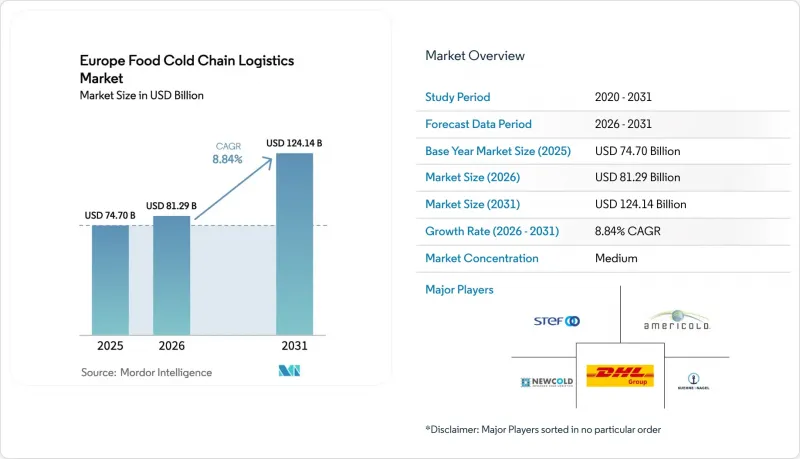
Mordor Intelligence에 의하면, 2026년 유럽의 식품 콜드체인 물류 시장 규모는 812억 9,000만 달러로 추정되고 2025년 747억 달러에서 확대해, 2031년에는 1,241억 4,000만 달러에 이를 것으로 예측됩니다.
2026-2031년 동안 연평균 성장률(CAGR) 8.84%로 성장할 것으로 전망됩니다.
본 보고서는 제품 유형별(냉동 육류·가금류, 수산물, 유제품·아이스크림, 기타), 서비스 유형별(냉장 창고, 냉장 운송, 부가가치 서비스), 온도 유형별(냉장(0-5℃),냉동(-18-0℃), 상온) 및 국가별(영국, 독일, 프랑스, 이탈리아, 기타)로 분류되어 있습니다. 시장 전망은 금액(달러) 기준으로 제시되어 있습니다.
유럽의 식품 콜드체인 물류 시장 동향 및 인사이트
유럽 전역의 옴니채널 식료품 유통 네트워크로의 전환
유럽의 식료품 소매업체들은 ‘클릭 앤 콜렉트’ 및 ‘신속 배송’ 모델을 확대하고 있으며, 단일 대형 창고 대신 도심 근처에 고밀도로 배치된 마이크로 풀필먼트 허브 클러스터를 활용하고 있습니다. 사업자 측은 이에 대응하여 냉동, 냉장, 상온 구역을 하나의 지붕 아래에 갖춘 모듈식 건물을 도입하고 있습니다. 여기에는 전력 가격 신호에 따라 냉장 부하 균형을 조정하는 첨단 에너지 관리 소프트웨어가 활용되고 있습니다. 덴마크에서의 로봇 도입은 인력을 증원하지 않고도 주문에서 출하까지의 주기를 단축하는 팔레트 처리 자동화 추세를 여실히 보여주고 있습니다. 현재의 성공 비결은 희소한 도심 부지를 확보하고, 온도 관리 준수 여부를 거의 실시간으로 확인할 수 있는 IoT(사물인터넷) 센서를 통합하는 데 있습니다. 이러한 분산형 네트워크가 성숙해짐에 따라, 제3자 물류 제공업체들은 당일 배송 시 상품의 품질을 보호하는 데이터 기반의 경로 최적화를 통해 타사와의 차별화를 꾀하고 있습니다.
EU의 ‘그린 딜’에 따른 의무화 목표가 천연 냉매 도입을 가속화하고 있습니다.
플루오르카탄(F-가스)의 단계적 감축으로 인해 창고 소유주는 지구 온난화 지수(GWP)가 높은 냉매의 사용을 중단하고, 암모니아나 CO2를 사용하는 시스템으로 재설계할 수밖에 없게 되었습니다. 초기 자본 집약도는 높지만, 재생열 회수 및 가변속 압축기가 도입되면 전력 소비량이 감소한다고 사업자들은 보고하고 있습니다. ICCEE 프로그램은 연간 118GWh의 1차 에너지 절감과 6,400만 유로의 관련 투자를 목표로 하고 있어, 업계의 노력을 여실히 보여주고 있습니다. 대기업은 그린본드 시장을 통한 자금 조달로 비용을 충당하고 있지만, 중소기업은 규제 준수 기한이 다가옴에 따라 합병 압박에 직면하고 있습니다. 천연 냉매에 경험이 풍부한 기술자가 부족하여 프로젝트 예산에 인건비 상승이 더해지지만, 한편으로는 장기적인 기술적 회복탄력성을 강화할 전문 인력 풀이 형성되고 있습니다.
유럽 전역의 트럭 운전사 부족이 운송 비용을 끌어올리고 있다.
유럽에서는 2028년까지 74만 5,000명의 트럭 운전사 부족이 예상되며, 이는 필요한 운송 능력의 17%에 해당합니다. 현재 운전사 중 25세 이하는 고작 5%에 불과하며, 국경을 넘는 노선에서는 추가적인 행정 부담이 발생하기 때문에 인력 공급 체계가 불안정해지고 있습니다. IRU의 데이터에 따르면, 이미 42만 6,000건의 인력 공백이 발생했으며, 이로 인해 임금이 상승하면서 화주들은 이전보다 몇 주 더 일찍 운송 일정을 확보해야 하는 상황에 처해 있습니다. 냉장 운송 노선에서는 전문 면허의 필요성과 더 엄격한 휴식 시간 규제로 인해 상온 운송 노선에 비해 스팟 운임의 프리미엄 폭이 확대되고 있습니다. 철도로의 모달 시프트에 대한 관심이 높아지고 있지만, 냉장 대응 화물차나 인터모달용 커넥터가 부족하여 대규모 전환이 지연되고 있으며, 도로 운송 비용은 여전히 높은 수준을 유지하고 있습니다.
부문 분석
유럽의 식품 콜드체인 물류 시장에서 냉동 육류·가금류 시장 규모는 2025년에 31.05%의 점유율에 달했으며, 증가 속도는 둔화되고 있지만 여전히 최대의 수익원입니다. 즉석식품 및 기타 부문은 식사 시간 단축에 적합한 ‘데우기만 하면 되는’ 식품을 중시하는 맞벌이 가구 수요에 힘입어 2031년까지 8.93%라는 가장 높은 연평균 성장률(CAGR)을 나타낼 전망입니다. ‘어패류’ 부문에서는 양식 생산량 확대와 소매업체의 오메가-3 건강 효능 홍보에 힘입어 수요가 견조한 추세를 보이고 있습니다. 한편, ‘유제품·아이스크림’ 부문의 주문은 정평이 나 있는 소매 프로모션에 연동된 안정적인 소비 패턴을 계속 따르고 있습니다. 과일 및 채소 부문에서는 연중 공급 전략에 따라, 기존에는 계절 한정이었던 카테고리에 콜드체인이 확산되고 있으며, 장거리 운송 중 신선도를 유지하기 위한 에틸렌 억제 향주머니의 도입이 촉진되고 있습니다.
베이커리·과자 부문에서는 급속 냉동 기술을 통해 -18℃에서 출하되어 현지에서 마무리되는 집중형 반구이 생산이 가능해짐에 따라, 일일 냉장 배송 취급량이 감소하고 있습니다. 육류 제품의 순간 가열 보존 검사 결과, 최대 5일간 상온 보관이 가능한 것으로 나타났으며, 특정 부위의 경우 향후 콜드체인에 대한 의존도가 낮아질 가능성이 시사되고 있습니다. 단백질 분리물과 기능성 지방을 배합하는 경우가 많은 식물 유래 SKU는 기존과는 다른 온도 프로파일을 나타내기 때문에 사업자에게는 다목적 보관고 내 보관 구역의 재조정이 요구되고 있습니다. 소비자의 기호가 진화함에 따라, 틈새 온도 관리에 대응할 수 있는 기동성이 높은 3PL(제3자 물류 사업자)은 융합되고 있는 제품군 전체에서 서비스 수익 기반을 확대되고 있습니다.
기타 혜택
- 엑셀 형식 시장 예측(ME) 시트
- 3개월간의 애널리스트 지원
자주 묻는 질문
목차
제1장 서론
제2장 조사 방법
제3장 주요 요약
제4장 시장 구도
제5장 시장 규모 및 성장 예측
제6장 경쟁 구도
제7장 시장 기회 및 향후 전망
KTHAccording to Mordor Intelligence, Europe food cold chain logistics market size in 2026 is estimated at USD 81.29 billion, growing from 2025 value of USD 74.70 billion with 2031 projections showing USD 124.14 billion, growing at 8.84% CAGR over 2026-2031.
This report is Segmented by Product Type (Frozen Meat & Poultry, Fish & Seafood, Dairy & Ice-Cream and More), by Service Type (Refrigerated Storage, Refrigerated Transportation and Value-Added Services), by Temperature Type (Chilled (0-5 °C), Frozen (-18-0 °C) and Ambient) and by Country (United Kingdom, Germany, France, Italy, and More). The Market Forecasts are Provided in Terms of Value (USD).
Europe Food Cold Chain Logistics Market Trends and Insights
Europe-wide Shift Toward Omni-Channel Grocery Distribution Networks
European grocers scale click-and-collect and rapid-delivery models that replace single mega-warehouses with dense clusters of micro-fulfilment hubs positioned near city centres. Operators respond by deploying modular buildings with frozen, chilled and ambient zones under one roof, supported by advanced energy-management software that balances refrigeration loads against power-price signals. Robotics adoption in Denmark illustrates the push toward automated pallet handling that compresses order-to-ship cycles without expanding headcount. Success now hinges on securing scarce urban real estate and integrating Internet-of-Things (IoT) sensors that certify temperature compliance in near real time. As these distributed networks mature, third-party logistics providers differentiate through data-driven route optimisation that protects product integrity during same-day deliveries.
Mandatory EU Green Deal Targets Accelerating Natural Refrigerant Adoption
The F-gas phasedown forces warehouse owners to retire high-GWP refrigerants and redesign systems for ammonia or CO2. Initial capital intensity is high, yet operators report lower electricity use once regenerative heat reclaim and variable-speed compressors are in place. The ICCEE programme illustrates industry commitment by targeting 118 GWh of annual primary-energy savings and EUR 64 million of related investments. Larger companies absorb the expense by refinancing on green-bond markets, while smaller firms face merger pressure as compliance deadlines approach. A scarcity of engineers experienced with natural refrigerants adds wage inflation to project budgets but also seeds a specialised labour pool that bolsters long-run technical resilience.
Continental Driver Shortage Inflating Transportation Costs
Europe faces 745,000 unfilled truck-driver slots by 2028, equal to 17% of required capacity. The talent pipeline falters as only 5% of current drivers are under 25 and cross-border routes carry extra administrative burden. IRU data notes 426,000 vacant positions already, pushing wages up and forcing shippers to book capacity weeks earlier than before. Spot-rate premiums on refrigerated lanes have widened relative to ambient lanes due to specialised licence needs and stricter rest-period rules. Modal shift to rail garners interest, yet cold-capable wagons and intermodal plugs are scarce, delaying large-scale migration and keeping road costs elevated.
Other drivers and restraints analyzed in the detailed report include:
- Rapid Capacity Additions in Iberian Peninsula Driven by Export Growth
- Surge in Demand for Ultra-Low-Temperature Storage for Plant-Based Alternatives
- High CAPEX for F-Gas Phasedown Compliance
For complete list of drivers and restraints, kindly check the Table Of Contents.
Segment Analysis
The Europe food cold chain logistics market size for Frozen Meat & Poultry reached the equivalent of 31.05% share in 2025 and remains the largest revenue contributor despite slower incremental growth. Ready Meals & Others posts the highest 8.93% CAGR to 2031, propelled by dual-income households that value heat-and-eat foods compatible with shorter mealtimes. Fish & Seafood maintains resilient demand as aquaculture output scales and retailers promote omega-3 benefits, while Dairy & Ice-cream bookings continue to follow stable consumption patterns tied to established retail promotions. In fruits and vegetables, year-round supply strategies extend cold-chain penetration into previously seasonal categories, stimulating uptake of ethylene-control sachets that preserve freshness during long-haul moves.
Flash-freezing techniques in the Bakery & Confectionery segment allow centralised par-bake production shipped at -18 °C and finished on-site, shifting volume away from daily chilled deliveries. Flash-heat preservation trials for meat products indicate shelf-stable windows of up to 5 days, hinting at future attenuation of cold-chain reliance in selected cuts. Plant-based SKUs, which often blend protein isolates with functional fats, introduce atypical thermal profiles that force operators to recalibrate storage zoning within multi-use chambers. As consumer preferences evolve, agile 3PLs able to match niche temperature regimes widen their service revenue bases across converging product groups.
Complete Report Scope:
- By Product Type
- Frozen Meat & Poultry
- Fish & Seafood
- Dairy & Ice-cream
- Fruits & Vegetables
- Bakery & Confectionery
- Ready Meals & Others
- By Service Type
- Refrigerated Storage
- Refrigerated Transportation
- Road
- Rail
- Sea
- Air
- Value-Added Services
- By Temperature Type
- Chilled (0-5 °C)
- Frozen (-18-0 °C)
- Ambient
- By Country
- United Kingdom
- Germany
- France
- Italy
- Spain
- Netherlands
- Nordics
- Poland
- Rest of Europe
List of Companies Covered in this Report:
- Lineage Logistics Holdings, LLC
- STEF SA
- Americold Logistics, LLC (AGRO Merchants Europe)
- DHL Supply Chain (Deutsche Post DHL Group)
- Kuehne + Nagel International AG
- NewCold Advanced Cold Logistics
- Constellation Cold Logistics
- DSV
- Nagel-Group
- Culina Group
- Rhenus Logistics
- ID Logistics
- Dachser SE
- Tippmann Group
- Bring Frigo (Posten Bring)
- Gist Ltd.
- DFDS Logistics
- Yusen Logistics Co., Ltd.
- Girteka Logistics
- Norfrig Logistics A/S*
Additional Benefits:
- The market estimate (ME) sheet in Excel format
- 3 months of analyst support
TABLE OF CONTENTS
1 Introduction
- 1.1 Study Assumptions & Market Definition
- 1.2 Scope of the Study
2 Research Methodology
3 Executive Summary
4 Market Landscape
- 4.1 Market Overview
- 4.2 Market Drivers
- 4.2.1 Europe-wide shift toward omni-channel grocery distribution networks (esp. click-and-collect formats)
- 4.2.2 Mandatory EU Green Deal targets accelerating adoption of natural refrigerants (NH3, CO2) in food warehouses
- 4.2.3 Rapid capacity additions in Iberian Peninsula driven by agri-food export growth to Northern Europe
- 4.2.4 Surge in demand for ultra-low-temperature storage for plant-based meat analogues
- 4.2.5 Post-Brexit customs friction boosting demand for cross-docking cold hubs near Calais & Rotterdam
- 4.3 Market Restraints
- 4.3.1 Continental driver shortage inflating refrigerated road freight spot rates
- 4.3.2 High CAPEX for F-gas phasedown compliance across legacy facilities (EU 517/2014)
- 4.3.3 Power-price volatility in Germany & Italy squeezing 3PL margins
- 4.3.4 Limited availability of Class-A refrigerated warehouse sites near Tier-1 ports (Felixstowe, Antwerp, Hamburg)
- 4.4 Value / Supply-Chain Analysis
- 4.5 Regulatory & Technological Outlook
- 4.6 Porter's Five Forces
- 4.6.1 Bargaining Power of Buyers
- 4.6.1.1 Bargaining Power of Suppliers
- 4.6.1.2 Threat of New Entrants
- 4.6.1.3 Threat of Substitutes
- 4.6.1.4 Competitive Rivalry
- 4.6.1 Bargaining Power of Buyers
5 Market Size & Growth Forecasts (Value)
- 5.1 By Product Type
- 5.1.1 Frozen Meat & Poultry
- 5.1.2 Fish & Seafood
- 5.1.3 Dairy & Ice-cream
- 5.1.4 Fruits & Vegetables
- 5.1.5 Bakery & Confectionery
- 5.1.6 Ready Meals & Others
- 5.2 By Service Type
- 5.2.1 Refrigerated Storage
- 5.2.2 Refrigerated Transportation
- 5.2.2.1 Road
- 5.2.2.2 Rail
- 5.2.2.3 Sea
- 5.2.2.4 Air
- 5.2.3 Value-Added Services
- 5.3 By Temperature Type
- 5.3.1 Chilled (0-5 °C)
- 5.3.2 Frozen (-18-0 °C)
- 5.3.3 Ambient
- 5.4 By Country
- 5.4.1 United Kingdom
- 5.4.2 Germany
- 5.4.3 France
- 5.4.4 Italy
- 5.4.5 Spain
- 5.4.6 Netherlands
- 5.4.7 Nordics
- 5.4.8 Poland
- 5.4.9 Rest of Europe
6 Competitive Landscape
- 6.1 Market Concentration
- 6.2 Strategic Moves
- 6.3 Market Share Analysis
- 6.4 Company Profiles (includes Global level Overview, Market level overview, Core Segments, Financials as available, Strategic Information, Market Rank/Share for key companies, Products & Services, and Recent Developments)
- 6.4.1 Lineage Logistics Holdings, LLC
- 6.4.2 STEF SA
- 6.4.3 Americold Logistics, LLC (AGRO Merchants Europe)
- 6.4.4 DHL Supply Chain (Deutsche Post DHL Group)
- 6.4.5 Kuehne + Nagel International AG
- 6.4.6 NewCold Advanced Cold Logistics
- 6.4.7 Constellation Cold Logistics
- 6.4.8 DSV
- 6.4.9 Nagel-Group
- 6.4.10 Culina Group
- 6.4.11 Rhenus Logistics
- 6.4.12 ID Logistics
- 6.4.13 Dachser SE
- 6.4.14 Tippmann Group
- 6.4.15 Bring Frigo (Posten Bring)
- 6.4.16 Gist Ltd.
- 6.4.17 DFDS Logistics
- 6.4.18 Yusen Logistics Co., Ltd.
- 6.4.19 Girteka Logistics
- 6.4.20 Norfrig Logistics A/S*