

|
시장보고서
상품코드
2062346
성형 회로 부품(MID) 시장 : 시장 점유율 분석, 업계 동향 및 통계, 성장 예측(2026-2031년)Molded Interconnect Device - Market Share Analysis, Industry Trends & Statistics, Growth Forecasts (2026 - 2031) |
||||||
 Mordor Intelligence
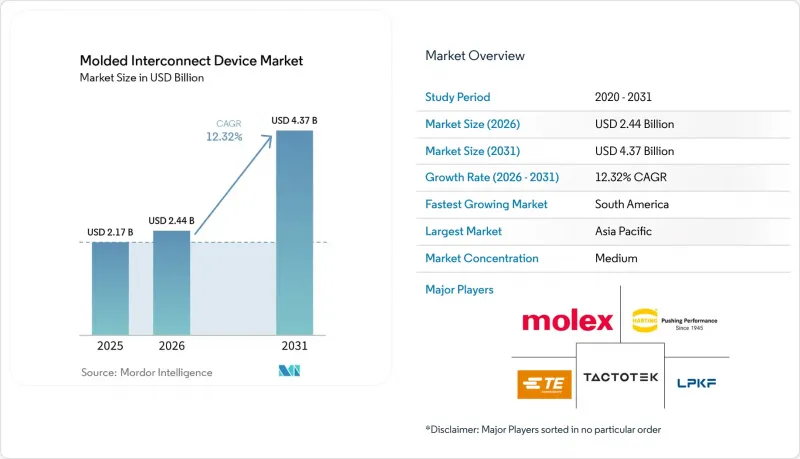
Mordor Intelligence에 의하면, 성형 회로 부품(MID) 시장 규모는 2025년 21억 7,000만 달러로 평가되었고, 2026년 24억 4,000만 달러로 추정되고, 2031년까지 43억 7,000만 달러로 확대될 전망이며, 2026-2031년 연평균 복합 성장률(CAGR)은 12.32%를 나타낼 것으로 예측됩니다.
본 보고서는 공정별(레이저 직접 스트럭처링 등), 제품 유형별(안테나 및 연결 모듈 등), 최종 이용 산업별(자동차, 소비자 가전 및 웨어러블 기기 등), 소재별(액정 폴리머, 폴리부틸렌 테레프탈레이트 등), 지역별(북미, 남미 등)로 분류되어 있습니다. 시장 전망은 금액(달러) 기준으로 제시되어 있습니다.
세계의 성형 회로 부품(MID) 시장 동향 및 인사이트
자동차 업계의 존형 E/E 아키텍처로의 전환이 3D 안테나 MID 수요를 견인하고 있습니다.
자동차 제조업체들은 수십 개의 전자 제어 장치를 지역 게이트웨이에 통합하여 차량의 배선 중량을 최대 40%까지 줄이고 있습니다. 3차원 성형 상호 연결 장치(MID)는 GPS, 휴대전화 및 V2X(Vehicle-to-Everything) 안테나를 단일 액정 폴리머 캐리어 위에 통합하여 동축 케이블을 제거하는 동시에 주파수 대역 간의 전자기 절연을 향상시킵니다. 구역별 아키텍처는 하네스의 길이를 줄이고, 안테나 모듈을 루프 라이너 뒤쪽에 설치할 수 있게 해줍니다. 이 장소는 주변 온도가 125°C에 달하는 환경이 15년 동안 지속되므로, 기계적 기능과 무선 주파수 기능을 하나의 사출 성형 부품에 통합한 성형 상호 연결 장치(MID)가 적합합니다. 콘티넨탈, 폭스바겐, BMW의 각 프로그램에서는 현재 성형 상호 연결 장치를 표준 사양으로 채택하고 있으며, 전 세계적으로 그 보급을 가속화하고 있습니다.
5G 스마트폰에서 LDS 공정의 급속한 보급
스마트폰 OEM 업체들은 리지드-플렉스나 접착층을 사용하지 않고 곡면 케이스에 mm파 안테나 어레이를 배치하기 위해 레이저 직접 스트럭처링(LDS) 기술을 점점 더 많이 도입하고 있습니다. 네오디뮴이 첨가된 레이저가 액정 고분자 내의 구리 시드 입자를 활성화시킨 후, 무전해 도금을 통해 28GHz에서 삽입 손실이 0.5 dB/cm 미만인 라인이 형성됩니다. 이 기법을 통해 부품 원가를 1.20-1.80달러 절감할 수 있을 뿐만 아니라, 단일 안테나를 구조용 리브로도 겸용할 수 있게 됩니다. 이는 인도와 동남아시아에서 플래그십 모델의 소매 가격이 600달러 미만으로 떨어지는 상황에서 매우 중요합니다. 단기적인 성장은 중국, 한국, 대만이 주도하고 있으며, 유럽에서는 콘포멀 방열기가 필요한 접이식 디자인이 그 뒤를 잇고 있습니다.
멀티샷 금형의 높은 금형 비용
회전 코어와 순차 게이트를 갖춘 패밀리 금형은 5만-15만 달러의 비용이 소요되며, 6-12주의 리드타임이 필요합니다. 연간 생산량이 1만 개 미만인 경우, 감가상각비로 인해 개당 4.00-6달러의 비용이 증가하게 되어, 항공우주 및 특수 의료 분야의 수작업 리지드-플렉스 회로와 비교했을 때 성형 회로 부품(MID)의 경쟁력이 떨어집니다. 금형 가공 임금이 시간당 75-120달러로 높은 유럽과 미국에서는 단기적인 도입 장벽이 더욱 높아집니다.
부문별 분석
레이저 직접 구조화 기술이 2025년 매출의 47.21%를 차지했으며, 스마트폰 및 자동차 안테나의 소형화에 있어 매우 중요한 역할을 하고 있음이 부각되었습니다. 이 기술을 통해 정밀하고 효율적인 설계가 가능해졌으며, 소형 고성능 디바이스에 대한 증가하는 수요에 부응하고 있습니다. 투샷 성형은 서로 다른 수지나 환경 밀봉이 필요한 틈새 시장을 충족시키며, 다양한 용도에 대한 범용성을 제공합니다. 한편, 필름 인서트 공법은 특히 자동차 및 소비자용 전자기기 업계에서 내장용 장식 패널에 널리 보급되고 있습니다. 또한, 적층식 에어로졸 제트 및 잉크젯 인쇄는 도금 공정 없이 10µm 미만의 선폭을 구현할 가능성을 지니고 있어 복잡한 설계의 기회를 제공하지만, 현재로서는 처리량이 양산 기준에 미치지 못하고 있습니다.
몰드 인터커넥트 디바이스 시장에서는 LDS 빔 스티어링 및 자동 광학 검사(AOI) 업그레이드에 대한 투자가 계속되고 있으며, 이에 따라 초기 수율이 95% 이상의 수준으로 크게 향상되었습니다. 이러한 발전 덕분에 생산 효율이 향상되고 폐기물이 줄어들고 있습니다. 한편, 적층 가공 기술은 신속한 반복 설계와 맞춤화가 단가 문제를 상쇄하는 웨어러블 기기 및 항공우주 분야의 시제품 제작 분야에서 점점 더 주목을 받고 있습니다. 프린트 헤드의 속도가 향상됨에 따라, 이러한 신기술들은 예측 기간 후반까지 몰드 인터커넥트 디바이스 시장에서 두 자릿수 점유율을 차지할 것으로 예상되며, 이는 시장에서 그 중요성이 커지고 있음을 반영합니다.
안테나 및 연결 모듈은 2025년 매출의 41.37%를 차지했으며, 모바일 기기 및 텔레매틱스 용도에 따른 높은 수요를 반영하고 있습니다. 구조용 전자 패널은 현재 소규모 시장이지만, 연평균 성장률(CAGR) 12.96%로 성장할 것으로 전망됩니다. 이러한 성장은 기존의 기계식 버튼을 대체하고, 배선 수를 줄이며, 곡면 콘솔 설계 개발을 가능하게 하는 정전용량식 스마트 서페이스의 채택 확대에 힘입은 것입니다.
조명 부품의 경우, 성형 상호 연결 장치(MID)를 활용하여 LED 어레이, 광학 시스템, 방열판을 단일 폴리카보네이트 캐리어에 통합하고 있습니다. 이번 통합을 통해 조립 시간이 50% 이상 대폭 단축되어, 제조업체에게 최적의 선택지가 되었습니다. 센서와 스위치는 특히 타이어 공기압 모니터링 시스템, 관성 측정 장치, 브러쉬리스 모터의 정류 등의 용도에서 여전히 큰 시장 점유율을 차지하고 있습니다. 이러한 용도에서 사용되는 몰드 인터커넥트 장치는 정밀한 전자 부품에 견고한 차폐 기능을 제공하여 전자기 간섭 및 습기로부터 보호함으로써 신뢰성과 수명을 향상시킵니다.
지역별 분석
아시아태평양은 279억 5,000만 달러 규모의 중국 인쇄회로기판 시장과 스마트폰 조립 제조업체들이 밀집해 있는 네트워크에 힘입어, 2025년 매출의 38.92%를 차지했습니다. 일본은 2024년 기판 매출액 중 115억 3,000만 달러를 차지했으며, 이 중 51.3%를 플렉서블 기판이 차지하고 있으며, 이비덴 등의 기업들이 레이더 모듈에 성형 상호 연결 장치를 채택하고 있습니다. 한국은 삼성일렉트로메카닉스가 다층 HDI 생산 라인을 확대함에 따라 2024년 기판 생산액이 78억 6,000만 달러를 기록하며 그 뒤를 이었습니다.
남미는 가장 빠르게 성장하는 지역이며, USMCA의 현지 조달 요건을 충족하는 전기 부품 공장에 대한 멕시코의 2025년 4분기 7억 6,645만 달러 투자에 힘입어 연평균 성장률(CAGR) 13.06%로 성장할 것으로 전망됩니다. 공급업체들은 내연기관 부품에서 전기차용 전자기기로의 전환에 따라 25억 달러 규모의 설비 갱신 비용에 직면해 있으며, 이로 인해 해당 지역에 LDS 및 투샷 성형 셀의 도입이 가속화되고 있습니다.
북미와 유럽은 각각 2025년 매출의 약 5분의 1을 차지했으며, 그 기반이 되는 것은 ISO 13485 및 AS9100 인증이 필요한 의료기기 수탁 제조와 항공우주용 센서 모듈입니다. 독일의 노동 집약적인 금형 마감 공정은 아시아에 비해 금형 비용을 40-50% 가량 상승시키고 있지만, 기능 안전 기준에 따라 사내 LDS 라인의 확충이 가속화되고 있습니다. 중동 및 아프리카은 여전히 발전 단계에 있으며, 높은 폴리머 원가에도 불구하고 긴 수명으로 이를 상쇄할 수 있는 통신 장비 및 광산 내 센서 분야에 주력하고 있습니다.
기타 혜택 :
- 엑셀 형식 시장 예측(ME) 시트
- 3개월간의 애널리스트 지원
자주 묻는 질문
목차
제1장 서론
제2장 조사 방법
제3장 주요 요약
제4장 시장 구도
제5장 시장 규모 및 성장 예측
제6장 경쟁 구도
제7장 시장 기회 및 향후 전망
AJY 26.06.26According to Mordor Intelligence, the molded interconnect device market size is projected to expand from USD 2.17 billion in 2025 and USD 2.44 billion in 2026 to USD 4.37 billion by 2031, registering a CAGR of 12.32% between 2026 and 2031.
This report is Segmented by Process (Laser Direct Structuring, and More), Product Type (Antenna and Connectivity Modules, and More), End-Use Industry (Automotive, Consumer Electronics and Wearables, and More), Material (Liquid-Crystal Polymer, Polybutylene Terephthalate, and More), and Geography (North America, South America, and More). The Market Forecasts are Provided in Terms of Value (USD).
Global Molded Interconnect Device Market Trends and Insights
Automotive shift to zonal E/E architecture driving 3-D antenna MID demand
Automakers are consolidating dozens of electronic control units into regional gateways, cutting vehicle wiring mass up to 40 %. Three-dimensional molded interconnect devices integrate GPS, cellular, and vehicle-to-everything antennas onto a single liquid-crystal-polymer carrier, eliminating coax cables and improving electromagnetic isolation between bands. Zonal architectures also shorten harness lengths, allowing antenna modules to mount behind the roof liner where ambient temperatures reach 125 °C for 15 years, a condition matched by molded interconnect devices that combine mechanical and radio-frequency functions in one injection-molded part. Continental, Volkswagen, and BMW programs now specify molded interconnect devices as standard, accelerating global pull-through.
Rapid adoption of LDS processing in 5 G smartphones
Smartphone OEMs increasingly employ laser direct structuring to place millimeter-wave antenna arrays on curved housings without rigid-flex or adhesive layers. A neodymium-doped laser activates copper-seed particles within liquid-crystal polymer, after which electroless plating forms lines with insertion loss below 0.5 dB/cm at 28 GHz. The method shaves USD 1.20-1.80 from the bill-of-materials and allows a single antenna to double as a structural rib, critical as flagship phones retail below USD 600 in India and Southeast Asia. China, South Korea, and Taiwan dominate short-term growth while Europe follows with foldable designs that need conformal radiators.
High Tooling Cost for Multi-Shot Moulds
Family molds with rotating cores and sequential gates cost USD 50,000-150,000 and require 6-12 weeks lead time. At volumes below 10,000 parts annually, amortization adds USD 4.00-6.00 per unit, rendering molded interconnect devices uncompetitive versus hand-assembled rigid-flex circuits in aerospace and specialty medical runs. Western labor rates, often USD 75-120 per hour for mold finishing, magnify near-term adoption hurdles.
Other drivers and restraints analyzed in the detailed report include:
- Miniaturization requirements in hearing aids and implantables
- EV-Battery Pack Sensors Needing 150 °C Plastics
- Limited Global Capacity for LDS Polymer Compounds
For complete list of drivers and restraints, kindly check the Table Of Contents.
Segment Analysis
Laser direct structuring commanded 47.21% of the 2025 revenue, underscoring its critical role in antenna miniaturization across smartphones and cars. This technology enables precise and efficient designs, meeting the growing demand for compact and high-performance devices. Two-shot molding fills niches requiring dissimilar resins and environmental sealing, offering versatility for various applications. Meanwhile, film-insert methods are gaining traction for decorative interior panels, particularly in the automotive and consumer electronics industries. Additive aerosol-jet and inkjet printing promise sub-10 µm lines without plating, presenting opportunities for intricate designs, although throughput currently lags behind mass-production benchmarks.
The molded interconnect device market continues to invest in LDS beam-steering and automated optical inspection upgrades, which have significantly improved first-pass yield to beyond 95%. These advancements enhance production efficiency and reduce waste. Meanwhile, additive approaches are increasingly attracting wearables and aerospace prototypes, where rapid iteration and customization outweigh unit cost concerns. As printhead speeds improve, these emerging technologies are expected to capture double-digit market share in molded interconnect devices by the late forecast window, reflecting their growing importance in the market.
Antenna and connectivity modules generated 41.37% of the 2025 revenue, reflecting the high demand driven by mobile devices and telematics applications. Structural electronics panels, although currently a smaller segment, are projected to grow at a compound annual growth rate (CAGR) of 12.96%. This growth is fueled by the increasing adoption of capacitive smart surfaces, which are replacing traditional mechanical buttons, reducing wire counts, and enabling the development of curved console designs.
Lighting components are leveraging molded interconnect devices to integrate LED arrays, optics, and heat sinks into single polycarbonate carriers. This integration has significantly reduced assembly times by more than 50%, making it a preferred choice for manufacturers. Sensors and switches continue to hold a substantial market share, particularly in applications such as tire-pressure monitoring systems, inertial measurement units, and brushless motor commutation. Molded interconnect devices in these applications provide robust shielding for delicate electronics, protecting them from electromagnetic interference and moisture, thereby enhancing their reliability and lifespan.
Geography Analysis
Asia-Pacific accounted for 38.92% of 2025 revenue, driven by China's USD 27.95 billion printed-circuit-board base and its dense network of smartphone assemblers. Japan contributed USD 11.53 billion in 2024 board revenue, with flexible substrates at 51.3%, and companies such as Ibiden applying molded interconnect devices in radar modules. South Korea followed with USD 7.86 billion in 2024 board output as Samsung Electro-Mechanics expanded its multi-layer HDI lines.
South America is the fastest-growing region, projected to grow at a 13.06% CAGR, thanks to Mexico's USD 766.45 million fourth-quarter 2025 investment in electrical-component plants that meet USMCA local-content mandates. Suppliers face a USD 2.5 billion retooling bill to upgrade from combustion-engine parts to electric-vehicle electronics, nudging regional uptake of LDS and two-shot molding cells.
North America and Europe each controlled roughly one-fifth of 2025 revenue, anchored by medical-device contract manufacturing and aerospace sensor modules that require ISO 13485 and AS9100 certification. Germany's labor-intensive mold finishing pushes tooling 40-50 % above Asia, yet functional-safety standards accelerate internal LDS line additions. The Middle East and Africa remain nascent, gravitating toward telecom and downhole sensors where long service life offsets higher polymer costs.
- Molex LLC
- TE Connectivity Ltd.
- HARTING Technology Group
- LPKF Laser & Electronics SE
- TactoTek Oy
- 2E mechatronic GmbH & Co. KG
- Phillips-Medisize LLC
- Omnetics Connector Corporation
- iwis mechatronics GmbH
- Cicor Group AG
- Carclo Technical Plastics (division of Carclo plc)
- SelectConnect Technologies LLC
- Moulded Circuits Ltd.
- Beta LAYOUT GmbH
- Amphenol ICC (Amphe-Power) Division
- Linxens Holding SAS
- Zhejiang Zhaoyi Technology Co., Ltd.
- Tritone Technologies Ltd.
- Metalis Group SA
- Advanced Interconnections Corp.
- MacDermid Alpha Electronics Solutions
- Murata Manufacturing Co., Ltd.
- Sumitomo Electric Industries, Ltd.
- Panasonic Holdings Corporation
- HELLA GmbH & Co. KGaA
Additional Benefits:
- The market estimate (ME) sheet in Excel format
- 3 months of analyst support
TABLE OF CONTENTS
1 INTRODUCTION
- 1.1 Study Assumptions and Market Definition
- 1.2 Scope of the Study
2 RESEARCH METHODOLOGY
3 EXECUTIVE SUMMARY
4 MARKET LANDSCAPE
- 4.1 Market Overview
- 4.2 Market Drivers
- 4.2.1 Automotive Shift to Zonal E/E Architecture Driving 3-D Antenna MID Demand
- 4.2.2 Rapid Adoption of LDS Processing in 5G Smartphones
- 4.2.3 Miniaturisation Requirements in Hearing Aids and Implantables
- 4.2.4 EV-Battery Pack Sensors Needing 150 °C Plastics
- 4.2.5 Next-Gen Smart-Surface HMIs in Premium Vehicles
- 4.2.6 Antenna-in-Package Integration for LEO Satellite User-Terminals
- 4.3 Market Restraints
- 4.3.1 High Tooling Cost for Multi-Shot Moulds
- 4.3.2 Limited Global Capacity for LDS Polymer Compounds
- 4.3.3 Silver Price Volatility Impacting Metallisation Chemistries
- 4.3.4 Reliability Gaps Above 180 °C for Aerospace Cabin Sensors
- 4.4 Industry Value-Chain Analysis
- 4.5 Technological Outlook
- 4.6 Regulatory Landscape
- 4.7 Impact of Macroeconomic Factors on the Market
- 4.8 Porter's Five Forces Analysis
- 4.8.1 Threat of New Entrants
- 4.8.2 Supplier Power
- 4.8.3 Buyer Power
- 4.8.4 Threat of Substitutes
- 4.8.5 Intensity of Competitive Rivalry
5 MARKET SIZE AND GROWTH FORECASTS (VALUE)
- 5.1 By Process
- 5.1.1 Laser Direct Structuring (LDS)
- 5.1.2 Two-Shot Injection Moulding
- 5.1.3 Two-Component (2K) Selective Metallisation
- 5.1.4 Film-Insert, In-Mould Electronics
- 5.1.5 Additive and Other Emerging Processes
- 5.2 By Product Type
- 5.2.1 Antenna and Connectivity Modules
- 5.2.2 Sensors and Switches
- 5.2.3 Lighting Components
- 5.2.4 Structural Electronics Panels
- 5.2.5 Other Product Type
- 5.3 By End-Use Industry
- 5.3.1 Automotive
- 5.3.2 Consumer Electronics and Wearables
- 5.3.3 Healthcare and Medical Devices
- 5.3.4 Industrial Automation
- 5.3.5 Telecommunications Infrastructure
- 5.3.6 Aerospace and Defence
- 5.3.7 Other End-Use Industry
- 5.4 By Material
- 5.4.1 Liquid-Crystal Polymer (LCP)
- 5.4.2 Polybutylene Terephthalate (PBT)
- 5.4.3 Polyamide (PA 6/6T)
- 5.4.4 Polycarbonate (PC) and Blends
- 5.4.5 Polyether Ether Ketone (PEEK)
- 5.4.6 Other Material
- 5.5 By Geography
- 5.5.1 North America
- 5.5.1.1 United States
- 5.5.1.2 Canada
- 5.5.1.3 Mexico
- 5.5.2 Europe
- 5.5.2.1 Germany
- 5.5.2.2 United Kingdom
- 5.5.2.3 France
- 5.5.2.4 Russia
- 5.5.2.5 Rest of Europe
- 5.5.3 Asia-Pacific
- 5.5.3.1 China
- 5.5.3.2 Japan
- 5.5.3.3 India
- 5.5.3.4 South Korea
- 5.5.3.5 Australia
- 5.5.3.6 Rest of Asia-Pacific
- 5.5.4 South America
- 5.5.5 Middle East and Africa
- 5.5.1 North America
6 COMPETITIVE LANDSCAPE
- 6.1 Market Concentration
- 6.2 Strategic Moves
- 6.3 Market Share Analysis
- 6.4 Company Profiles (includes Global Level Overview, Market Level Overview, Core Segments, Financials as available, Strategic Information, Market Rank/Share, Products and Services, Recent Developments)
- 6.4.1 Molex LLC
- 6.4.2 TE Connectivity Ltd.
- 6.4.3 HARTING Technology Group
- 6.4.4 LPKF Laser & Electronics SE
- 6.4.5 TactoTek Oy
- 6.4.6 2E mechatronic GmbH & Co. KG
- 6.4.7 Phillips-Medisize LLC
- 6.4.8 Omnetics Connector Corporation
- 6.4.9 iwis mechatronics GmbH
- 6.4.10 Cicor Group AG
- 6.4.11 Carclo Technical Plastics (division of Carclo plc)
- 6.4.12 SelectConnect Technologies LLC
- 6.4.13 Moulded Circuits Ltd.
- 6.4.14 Beta LAYOUT GmbH
- 6.4.15 Amphenol ICC (Amphe-Power) Division
- 6.4.16 Linxens Holding SAS
- 6.4.17 Zhejiang Zhaoyi Technology Co., Ltd.
- 6.4.18 Tritone Technologies Ltd.
- 6.4.19 Metalis Group SA
- 6.4.20 Advanced Interconnections Corp.
- 6.4.21 MacDermid Alpha Electronics Solutions
- 6.4.22 Murata Manufacturing Co., Ltd.
- 6.4.23 Sumitomo Electric Industries, Ltd.
- 6.4.24 Panasonic Holdings Corporation
- 6.4.25 HELLA GmbH & Co. KGaA
7 MARKET OPPORTUNITIES AND FUTURE OUTLOOK
- 7.1 White-Space and Unmet-Need Assessment


