

|
시장보고서
상품코드
2065501
북미의 중출력 LED 패키지 시장 : 시장 점유율 분석, 업계 동향 및 통계, 성장 예측(2026-2031년)North America Mid-Power LED Package - Market Share Analysis, Industry Trends & Statistics, Growth Forecasts (2026 - 2031) |
||||||
 Mordor Intelligence
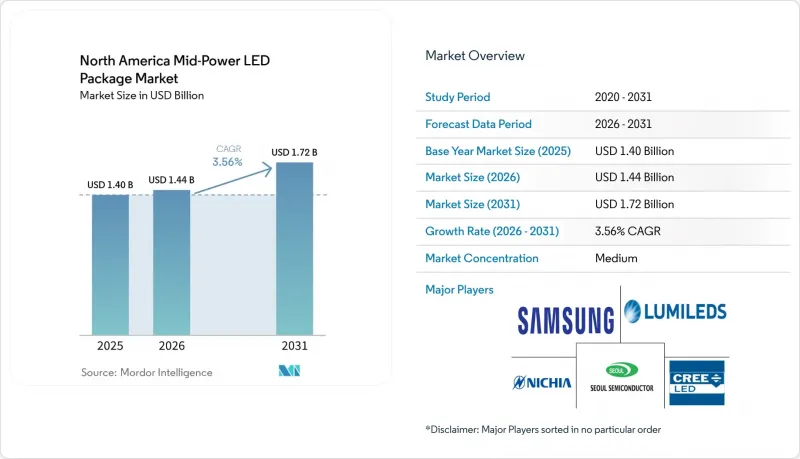
Mordor Intelligence에 의하면, 북미의 중출력 LED 패키지 시장 규모는 2025년 14억 달러로 평가되었고, 2026년 14억 4,000만 달러로 추정되고, 2031년까지 17억 2,000만 달러로 확대될 전망이며, 2026-2031년 연평균 복합 성장률(CAGR)은 3.56%를 나타낼 전망입니다.
본 보고서는 출력 범위별(0.2-0.5 W 및 0.5-1 W 미만), 패키지 구조별(2835, 3014, 3030, 기타를 포함한 SMD 및 CSP), 용도별(일반 조명, 자동차용 조명, 디스플레이 및 백라이트, 특수 및 니치 용도), 그리고 국가별(미국, 캐나다, 멕시코)로 분류되어 있습니다. 시장 전망은 금액(달러) 기준으로 제시되어 있습니다.
북미의 중출력 LED 패키지 시장 동향 및 분석
자동차용 LED 요건의 표준화
캐나다 교통부(Transport Canada)의 TSD 108 개정 제8판이 2025년 10월부터 의무화됨에 따라, 광도 및 내구성에 관한 규정이 미국 FMVSS 108과 일치하게 되었습니다. 현재 Tier 1 공급업체는 북미 대륙을 대상으로 단일 모듈 플랫폼을 설계하고 있으며, 해당 플랫폼에서는 주로 0.5W-0.8W의 중출력 패키지 어레이가 지정되어 있습니다. 이것들은 밀도가 낮은 고출력 클러스터보다 열을 더 균일하게 분산시킵니다. 2024년 NHTSA가 어댑티브 빔의 눈부심 허용 기준 완화를 거부한 것은 복잡한 광학 시스템 전체에서 균일한 휘도를 유지하기 위해 고밀도 어레이가 필요하다는 점을 더욱 강조하고 있습니다. SAE J1889 규격에서는 2025년 4월부터 가속 열 사이클 시험이 추가됨에 따라, 접합부 온도가 낮은 중출력 패키지가 유리해졌습니다. 멕시코가 2026년 2월에 발표한 자동차 전략은 매트릭스 기능 및 시퀀셜 기능의 향후 승인을 시사하고 있으며, 이에 따라 차량당 장치 수는 더욱 증가할 전망입니다. 이러한 조화로운 요인들이 맞물리면서, 신호등, DRL(주간 주행등) 및 어댑티브 시스템에 사용되는 중출력 LED에 대한 수요가 확대되고 있습니다.
에너지 절약 건축 기준의 급증
캘리포니아주의 ‘Title 24-2025’에 따르면, 2026년 1월부터 조명의 전력 밀도를 최대 15% 낮추는 한편, IECC 2024에서는 2026년에 해당 규격을 채택한 도시에서 최대 10%까지의 연속 조광 및 보다 광범위한 재실 감지가 요구되고 있습니다. 오리건주의 ‘2026년 주택 특별 건축 기준’과 뉴욕시의 ‘2025년 에너지 절약 기준’도 유사한 규정을 추가하여, 이용 빈도가 높은 공간의 경우 개보수 공사에 대한 투자 회수 기간을 최단 12-18개월로 단축하고 있습니다. 중출력 패키지는 기존의 정전류 드라이버와 원활하게 통합되므로, 시공업체는 배선을 재사용하고 가동 중단 시간을 최소화할 수 있어, 이를 통해 프로젝트 승인 절차를 신속하게 진행할 수 있습니다. 중서부 및 남동부 지역의 전력 회사들은 DLC 인증 조명 기구 1대당 30-80달러의 리베이트를 계속해서 제공하고 있으며, 해당 기구의 대부분은 2835 또는 3030 중출력 LED를 사용하고 있습니다. 전반적으로, 더 엄격해진 규정과 리베이트의 경제적 이점으로 인해 1차 전환이 정체 국면에 접어들었음에도 불구하고, 개보수 건수는 높은 수준을 유지하고 있습니다.
형광체 재료 공급망의 취약성
2025년 4월과 10월에 중국이 시행한 희토류 수출 규제로 인해 유로퓸, 테르븀, 이트륨의 수출이 허가제로 전환되었으며, 중국 이외의 현물 시장에서는 가격이 수 배로 급등했습니다. 미국의 이트륨 수입량은 8개월 동안 333톤에서 17톤으로 급감했으며, 일시적인 비축량으로는 LED 형광체 수요의 1-2분기 분량밖에 충당할 수 없습니다. 협상 결과, 1년간의 적용 유예가 합의되어 완전 시행은 2026년 11월까지 연기되었으나, 이러한 사태는 단일 공급원 리스크를 여실히 드러냈고, 각 OEM 업체들은 이중 공급망 인증 및 희토류를 포함하지 않는 형광체의 로드맵을 요구하게 되었습니다.
부문별 분석
상업용 개조 및 자동차용 신호등에 대한 수요가 맞물리면서, 2025년에는 0.5W-1W 미만 등급이 북미 중출력 LED 패키지 시장에서 61.88%의 점유율을 차지했으며, 해당 시장에서 가장 높은 점유율을 기록했습니다. 이러한 높은 점유율은 발광 효율의 꾸준한 향상을 반영한 것으로, 설계자는 더 적은 수의 다이오드로 루멘 목표를 달성할 수 있게 되었으며, 픽 앤 플레이스 공정과 드라이버의 채널 수를 줄일 수 있게 되었습니다. 다음 예측 기간으로 넘어가면, 각 OEM 업체들이 열적 신뢰성 측면에서 이 ‘최적점’에 집중함에 따라, 해당 등급은 연평균 성장률(CAGR) 3.96%로 성장하여 저와트 등급 및 1W 전후 등급을 모두 상회할 것으로 전망됩니다.
조명 기구 제조업체들은 ‘Title 24’ 및 IECC 규제가 강화됨에 따라 0.2W에서 0.5W급 제품에서 중급 제품군으로 전환했습니다. 이는 고와트수 패키지를 통해 기판의 얇은 두께 구현과 제어의 간소화가 가능하기 때문입니다. 자동차 업계의 1차 공급업체들은 SAE가 열 사이클 시험 기준을 개정하고 진동 조건 하에서의 신뢰성이 확인됨에 따라, 0.6W-0.8W의 이미터를 사용하여 DRL(주간 주행등) 및 매트릭스 어레이의 적용 범위를 확대했습니다.
기타 혜택 :
- 엑셀 형식 시장 예측(ME) 시트
- 3개월간의 애널리스트 지원
자주 묻는 질문
목차
제1장 서론
제2장 조사 방법
제3장 주요 요약
제4장 시장 구도
제5장 시장 규모 및 성장 예측
제6장 경쟁 구도
제7장 시장 기회 및 향후 전망
LSH 26.06.24According to Mordor Intelligence, the north america mid-power LED package market size is projected to expand from USD 1.40 billion in 2025 and USD 1.44 billion in 2026 to USD 1.72 billion by 2031, registering a CAGR of 3.56% between 2026 to 2031.
This report is Segmented by Power Range (0. 2-0. 5 W and 0. 5- Less Than 1 W), Package Architecture (SMD Including 2835, 3014, 3030, Others and CSP), Application (General Lighting, Automotive Lighting, Display and Backlighting, and Specialty/Niche), and Country (United States, Canada, and Mexico). The Market Forecasts are Provided in Terms of Value (USD).
North America Mid-Power LED Package Market Trends and Insights
Standardization of Automotive LED Requirements
Transport Canada TSD 108 Revision 8 became mandatory in October 2025, aligning the photometric and durability rules with U.S. FMVSS 108. Tier-1 suppliers now engineer a single module platform for the continent, and that platform predominantly specifies arrays of 0.5 W to 0.8 W mid-power packages, which spread heat more evenly than sparse high-power clusters. NHTSA's refusal in 2024 to relax adaptive-beam glare thresholds reinforces the need for high-density arrays that maintain uniform luminance across complex optics. SAE J1889 added accelerated thermal-cycling tests in April 2025, favoring lower-junction-temperature mid-power packages. Mexico's February 2026 automotive strategy signals future approvals for matrix and sequential functions, further increasing device count per vehicle. Together, the harmonized requirements expand demand for mid-power LEDs in signal, DRL, and adaptive systems.
Surge In Energy-Efficient Building Codes
California Title 24-2025 lowered lighting power densities by up to 15%, effective January 2026, while IECC 2024 calls for continuous dimming to 10% and broader occupancy sensing in cities that adopted the code in 2026. Oregon's 2026 Residential Specialty Code and New York City's 2025 Energy Conservation Code add similar controls, shortening retrofit paybacks to as little as 12-18 months in high-use spaces. Because mid-power packages integrate seamlessly with legacy constant-current drivers, contractors can reuse wiring and minimize downtime, thereby accelerating project approvals. Utilities in the Midwest and Southeast continue to offer rebates of USD 30-80 per DLC-qualified luminaire, and most of those fixtures use 2835 or 3030 mid-power LEDs. Collectively, stricter codes and rebate economics sustain high retrofit volumes despite plateauing first-wave conversions.
Supply Chain Vulnerability for Phosphor Materials
China's rare-earth export curbs in April and October 2025 placed europium, terbium, and yttrium under license, driving multi-fold price spikes in non-Chinese spot markets. U.S. yttrium imports collapsed from 333 t to 17 t within eight months, and stopgap stockpiles can cover only one to two quarters of LED phosphor demand. A negotiated one-year suspension defers full enforcement to November 2026, yet the episode spotlighted single-source risk, prompting OEMs to request dual-supply certification or non-rare-earth phosphor roadmaps.
Other drivers and restraints analyzed in the detailed report include:
- Declining Cost of Mid-Power LED Chips
- Rapid Expansion of Horticulture Lighting in Vertical Farms
- Slow Retrofit Cycle in Commercial Real Estate Segment
For complete list of drivers and restraints, kindly check the Table Of Contents.
Segment Analysis
Commercial retrofits and automotive signal lamps together propelled the 0.5 W-to-Less Than 1 W class to a 61.88% share in 2025, the highest in the North America mid-power LED package market. That weight reflects steady gains in efficacy that let designers hit lumen targets with fewer diodes, reducing pick-and-place steps and driver channel counts. Moving to the next forecast period, the same class is forecast to grow at a 3.96% CAGR, outperforming both lower-wattage and near-1 W classes as OEMs converge on this sweet spot for thermal reliability.
Fixture makers migrated from 0.2 W to 0.5 W devices toward the mid-range as Title 24 and IECC constraints tightened, as higher-wattage packages allow slimmer boards and simpler controls. Automotive Tier-1 suppliers enlarged DRL and matrix arrays with 0.6 W-to-0.8 W emitters after SAE revised thermal-cycling tests, confirming reliability under vibration.
List of Companies Covered in this Report:
- Nichia Corporation
- Lumileds Holding B.V.
- Cree LED Inc.
- Samsung Electronics Co., Ltd.
- Seoul Semiconductor Co., Ltd.
- OSRAM Opto Semiconductors GmbH
- Everlight Electronics Co., Ltd.
- LG Innotek Co., Ltd.
- Lite-On Technology Corporation
- Lextar Electronics Corporation
- NationStar Optoelectronics Co., Ltd.
- Epistar Corporation
- Bridgelux, Inc.
- MLS Co., Ltd.
- Bridgelux, Inc.
- Dominant Opto Technologies Sdn. Bhd.
- Toyoda Gosei Co., Ltd.
Additional Benefits:
- The market estimate (ME) sheet in Excel format
- 3 months of analyst support
TABLE OF CONTENTS
1 INTRODUCTION
- 1.1 Study Assumptions and Market Definition
- 1.2 Scope of the Study
2 RESEARCH METHODOLOGY
3 EXECUTIVE SUMMARY
4 MARKET LANDSCAPE
- 4.1 Market Overview
- 4.2 Market Drivers
- 4.2.1 Standardization of Automotive LED Requirements
- 4.2.2 Surge in Energy-Efficient Building Codes
- 4.2.3 Declining Cost of Mid-Power LED Chips
- 4.2.4 Rapid Expansion of Horticulture Lighting in Vertical Farms
- 4.2.5 Integration of Tunable White LEDs in Human-Centric Lighting
- 4.2.6 Expansion of Utility Rebate Programs Targeting Mid-power LED Fixtures
- 4.3 Market Restraints
- 4.3.1 Price Pressure From Low-Cost Asian Imports
- 4.3.2 Thermal Management Challenges Above 1 W Ceiling
- 4.3.3 Supply Chain Vulnerability For Phosphor Materials
- 4.3.4 Slow Retrofit Cycle in Commercial Real Estate Segment
- 4.4 Industry Value-Chain Analysis
- 4.5 Technological Outlook
- 4.6 Regulatory Landscape
- 4.7 Impact of Macroeconomic Factors on the Market
- 4.8 Porter's Five Forces Analysis
- 4.8.1 Bargaining Power of Suppliers
- 4.8.2 Bargaining Power of Buyers
- 4.8.3 Threat of New Entrants
- 4.8.4 Threat of Substitutes
- 4.8.5 Intensity of Competitive Rivalry
5 MARKET SIZE AND GROWTH FORECASTS (VALUE)
- 5.1 By Power Range
- 5.1.1 0.2-0.5 W
- 5.1.2 0.5- Less Than 1 W
- 5.2 By Package Architecture
- 5.2.1 SMD (Surface Mount Device)
- 5.2.1.1 2835
- 5.2.1.2 3014
- 5.2.1.3 3030
- 5.2.1.4 Others (3528, 3020, 5050, etc.)
- 5.2.2 CSP (Chip Scale Package)
- 5.2.1 SMD (Surface Mount Device)
- 5.3 By Application
- 5.3.1 General Lighting
- 5.3.2 Automotive Lighting
- 5.3.3 Display and Backlighting
- 5.3.4 Specialty / Niche
- 5.4 By Country
- 5.4.1 United States
- 5.4.2 Canada
- 5.4.3 Mexico
6 COMPETITIVE LANDSCAPE
- 6.1 Market Concentration
- 6.2 Strategic Moves
- 6.3 Market Share Analysis
- 6.4 Company Profiles (includes Global Level Overview, Market Level Overview, Core Segments, Financials as Available, Strategic Information, Market Rank/Share, Products and Services, Recent Developments)
- 6.4.1 Nichia Corporation
- 6.4.2 Lumileds Holding B.V.
- 6.4.3 Cree LED Inc.
- 6.4.4 Samsung Electronics Co., Ltd.
- 6.4.5 Seoul Semiconductor Co., Ltd.
- 6.4.6 OSRAM Opto Semiconductors GmbH
- 6.4.7 Everlight Electronics Co., Ltd.
- 6.4.8 LG Innotek Co., Ltd.
- 6.4.9 Lite-On Technology Corporation
- 6.4.10 Lextar Electronics Corporation
- 6.4.11 NationStar Optoelectronics Co., Ltd.
- 6.4.12 Epistar Corporation
- 6.4.13 Bridgelux, Inc.
- 6.4.14 MLS Co., Ltd.
- 6.4.15 Bridgelux, Inc.
- 6.4.16 Dominant Opto Technologies Sdn. Bhd.
- 6.4.17 Toyoda Gosei Co., Ltd.
7 MARKET OPPORTUNITIES AND FUTURE OUTLOOK
- 7.1 White-Space and Unmet-Need Assessment


