
|
시장보고서
상품코드
2073135
IT 지속가능성 인재 및 교육 플랫폼 시장 : 점유율 분석, 업계 동향과 통계, 성장 예측(2026-2031년)IT Sustainability Talent and Training Platform - Market Share Analysis, Industry Trends & Statistics, Growth Forecasts (2026 - 2031) |
||||||
 Mordor Intelligence
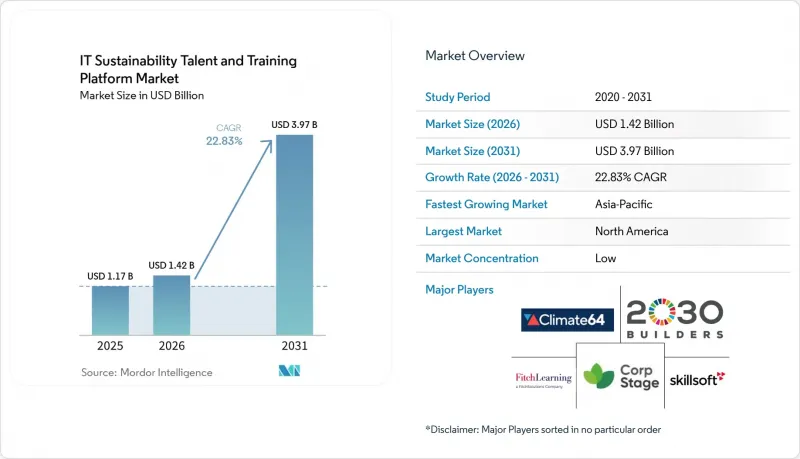
Mordor Intelligence에 의하면, IT 지속가능성 인재 및 교육 플랫폼 시장 규모는 2025년 11억 7,000만 달러에서 2026년에는 14억 2,000만 달러로 확대되어 2031년까지 39억 7,000만 달러에 이를 것으로 예상되고 있어 2026년부터 2031년까지 CAGR 22.83%로 성장할 전망입니다.
본 보고서는 구성 요소(플랫폼 및 서비스), 배포 방식(클라우드 기반, On-Premise형, 하이브리드형), 최종 사용자(IT 및 디지털 전문가, 경영진 및 리더십 팀, 인사·인재 개발 담당자 등), 학습 형태(자기 주도형 디지털 학습, 블렌디드 러닝 등), 지역별로 분류되어 있습니다. 시장 전망은 금액(달러) 기준으로 제시되어 있습니다.
전 세계 IT 지속가능성 인재 및 교육 플랫폼 시장 동향과 인사이트
ESG 및 그린 IT 역량에 대한 의무적 요건의 강화
공시 의무 강화에 따라 IT 지속가능성 인재 및 교육 플랫폼 시장에서 새로운 교육 수요가 발생하고 있습니다. 이는 보고 방식, 디지털 지속가능성 관리 및 증거 기준에 관한 실무 지식이 필요한 직원이 증가하고 있기 때문입니다. EU의 기업 지속가능성 보고 지침에 따라, 체계적인 지속가능성 공시를 작성해야 하는 기업 및 비EU 모회사의 수가 증가함에 따라, 그 결과 ESRS(환경·사회·지배구조 보고 기준) 요건 및 감사 준비와 관련된 반복 가능한 학습의 필요성이 높아지고 있습니다. 또한, ISO/IEC TS 20125-1:2026의 공표도 중요합니다. 이는 IT 팀이 교육이나 실무에서 활용할 수 있는 디지털 서비스의 에코 디자인에 관한 보다 명확한 기술적 프레임워크를 제공하기 때문입니다. 이러한 변화로 인해 기업들은 일반적인 인식 제고 모듈에 그치지 않고, IT, 데이터, 조달, 내부 감사, 지속가능성 보고 담당 직원을 위한 역할별 학습 과정으로 전환해야 할 필요에 직면해 있습니다. 따라서 IT 지속가능성 인재 및 교육 플랫폼 시장에서는 컨텐츠를 신속하게 업데이트하고, 학습 내용을 직무 역할과 연계하며, 보다 광범위한 규정 준수 업무를 지원하는 수료 기록을 저장할 수 있는 플랫폼에 대한 수요가 높아지고 있습니다. 도입 지연을 초래하지 않으면서 규제 관련 컨텐츠를 현지화할 수 있는 제공업체는 보고 일정이 더 많은 지역과 업무 기능으로 확대됨에 따라 더욱 주목을 받게 될 것입니다.
하이브리드 근무 모델의 보급에 따라 확장성이 뛰어난 디지털 교육 제공에 대한 수요가 증가하고 있습니다.
하이브리드 근무 및 분산형 근무 방식은 지속가능성 교육의 운영 모델을 혁신하고, IT 지속가능성 인재 및 교육 플랫폼 시장에 기존 대면 수업 방식에 비해 지속적인 제공상의 우위를 가져다주고 있습니다. 현재 기업들은 동일한 보고 주기 내에서 여러 국가에 흩어져 있는 IT 엔지니어, ESG 애널리스트, 조달 관리자, 경영진에게 교육을 제공해야 하기 때문에 정형화된 연례 프로그램만으로는 더 이상 실용적이지 않게 되었습니다. 자신의 속도에 맞추어 학습할 수 있는 형식, 모듈식 업데이트, 역할에 따른 학습 경로는 분산된 팀 전체에 걸쳐 신속한 도입을 지원하기 위해 조달 결정의 핵심 요소로 자리 잡게 되었습니다. 또한, IT 지속가능성 인재 및 교육 플랫폼 시장은 여러 보고 규정 및 기술 규정의 개정, 연장, 새로운 해석에 따라 교육 과정이 이를 반영해야 하는 현 상황에서도 혜택을 보고 있습니다. 따라서 구매자들은 매번 학습 구조를 재구축할 필요 없이, 지역, 직무, 규제 관련성별로 컨텐츠를 분류할 수 있는 클라우드 주도형 또는 하이브리드형 모델을 선호하는 경향이 있습니다. 이러한 추세에 따라, 전 세계에 흩어져 있는 직원을 대상으로 규모, 거버넌스 관리, 상세한 이수 현황 추적을 통합적으로 제공할 수 있는 공급업체의 입지가 강화되고 있습니다.
준법감시 이외의 교육 이니셔티브에 대한 예산 승인 제한
IT 지속가능성 인재 및 교육 플랫폼 시장은 지속가능성 역량 격차를 아직 직접적인 규정 준수나 재무적 위험 논의와 연결 짓지 않고 있는 기업들 사이에서 여전히 지출 패턴에 편차가 나타나고 있습니다. 많은 기업들은 규정 준수, 리스크 또는 혁신을 위한 예산이 아닌 재량적 교육 예산을 통해 이 분야에 자금을 계속 배정하고 있으며, 비용 우선순위가 엄격해지면 프로젝트를 연기하기 쉬워지고 있습니다. 이로 인해 직접적인 보고 압박을 받고 있는 기업들은 신속하게 조치를 취하는 반면, 당분간 규제 대상에서 제외된 기업들은 광범위한 도입을 미루는 등 양극화된 도입 양상이 나타나고 있습니다. 따라서 IT 지속가능성 인재 및 교육 플랫폼 시장은 공시 의무, 공급업체에 대한 요청, 또는 투자자의 감시를 통해 행동을 취할 수 있는 명확한 비즈니스 사례가 형성된 분야에서 더욱 탄력성을 유지하고 있습니다. 컴플라이언스를 강력하게 내세우는 벤더는 지속가능성 교육을 단순한 소프트한 문화나 의식 고취 프로그램으로 제시하는 제공업체보다 유리한 입장에 있습니다. 조달 및 보고 요건이 공급망 전반으로 확대됨에 따라, 예산 측면의 저항은 시간이 지남에 따라 완화될 전망이지만, 단기적인 수요는 여전히 구매자 그룹 간에 편차를 보일 것으로 보입니다.
부문별 분석
2025년, 플랫폼 부문은 IT 지속가능성 인재 및 교육 플랫폼 시장의 68.14% 점유율을 차지했습니다. 이는 기업이 컨텐츠, 관리, 기술 분석, 보고서 기능을 하나의 시스템에 통합한 환경을 분명히 선호하고 있음을 반영합니다. 구매자들은 누가 어떤 교육을 이수했는지, 컨텐츠가 어떤 프레임워크에 부합하는지, 그리고 해당 기록이 내부 감사 및 공시 준비에 어떻게 도움이 되는지를 보여줄 수 있는 플랫폼 아키텍처를 점점 더 요구하고 있습니다. 이러한 경향은 업무상의 이유뿐만 아니라 상업적인 이유에도 기인합니다. 왜냐하면 이사회 심사와 외부 보증 기관의 면밀한 검토를 견뎌낼 수 있는 측정 가능한 성과가 요구되는 경우, 컨텐츠만을 제공하는 서비스의 매력은 떨어지기 때문입니다. 따라서 IT 지속가능성 인재 및 교육 플랫폼 시장은 제품을 단순한 독립형 컨텐츠 라이브러리가 아닌, 보다 광범위한 거버넌스 워크플로우의 일부로 자리매김하는 벤더 쪽으로 기울고 있습니다. 이러한 경향은 표준화된 배포의 장점도 반영하고 있습니다. 대기업들은 개별적인 로컬 시스템을 강요하지 않으면서도, 여러 국가, 사업 부문, 직급 그룹에 걸쳐 작동하는 공통된 학습 계층을 원하기 때문입니다.
서비스 부문은 현재 시장 점유율 측면에서 여전히 규모가 작지만, 2026년부터 2031년까지 연평균 성장률(CAGR) 22.91%를 나타낼 것으로 예측되며, 이는 플랫폼 소유권과 거의 동등한 수준으로 도입의 깊이가 중요함을 보여줍니다. 기업은 서로 다른 보고 제도나 기술 팀에 걸쳐 지속가능성 교육을 진행할 때, 현지화된 컨텐츠, 규제 대응, 온보딩 계획 및 변경 관리에 대한 지원이 필요한 경우가 많습니다. 실제로 조직이 CSRD 준비, ISSB 준수, 내부 통제 설계, 디지털 지속가능성 역량 구축과 같은 여러 가지 요구 사항을 동시에 관리하고 있는 경우, 플랫폼만으로는 완전한 가치를 창출할 수 없습니다. 따라서 IT 지속가능성 인재 및 교육 플랫폼 시장에서는 특히 기능이나 국가에 따라 거버넌스 및 컨텐츠 요건이 상이한 다지역 진출 환경에서 소프트웨어 및 서비스에 대한 지출이 밀접하게 연계된 상태가 지속될 것으로 보입니다. 2026년 2월 Skillsoft가 발표한 차세대 Percipio 플랫폼은 주요 벤더들이 스킬 인텔리전스 및 인재 준비 상태 측정 기능을 단순한 부가 기능으로 취급하는 것이 아니라, 플랫폼 설계에 더욱 깊이 통합하고 있음을 보여줍니다. 구매자의 기대가 높아지는 가운데, 확장 가능한 아키텍처와 현지화, 통합, 측정 분야에 대한 실질적인 지원을 결합할 수 있는 공급업체는 계약 갱신율이 향상될 것으로 예측됩니다.
2025년에는 클라우드 기반 도입이 64.17%로 가장 큰 점유율을 유지하며, IT 지속가능성 인재 및 교육 플랫폼 시장의 중심적인 위치를 계속해서 차지했습니다. 이러한 우위는 전 세계적인 도입의 용이성, 컨텐츠 갱신의 신속성, 그리고 공시 기한이나 조달 수요로 인해 갑작스러운 교육 수요가 발생했을 때 조직이 이용 규모를 유연하게 확대할 수 있는 가격 모델에 기인합니다. 클라우드를 통한 제공은 기업이 사내 인프라 변경을 기다릴 필요 없이 여러 국가나 직책 그룹에 걸쳐 모듈을 신속하게 업데이트해야 할 때 특히 유용합니다. IT 지속가능성 인재 및 교육 플랫폼 시장에서는 지속가능성 학습이 더 이상 정적인 연간 과정이라기보다는 지속적으로 갱신되는 컴플라이언스 스트림과 같은 성격을 띠게 되었기 때문에 이 모델이 계속해서 지지를 받고 있습니다. 또한 구매자들은 광범위한 전 직원을 대상으로 보고서 대시보드와 수강 기록을 표준화할 수 있다는 점을 중요하게 여기며, 제공이 단일 클라우드 기반 환경에서 이루어질 경우 그 효율성은 더욱 높아집니다.
하이브리드 방식은 2026년부터 2031년까지 연평균 성장률(CAGR) 23.02%를 나타낼 것으로 예측되며, 이는 규모와 관리 간의 균형을 맞춘 현실적인 타협점을 반영하고 있습니다. 규제 대상 분야의 기업들은 여전히 클라우드 기반의 광범위한 도달 범위와 빠른 업데이트 속도를 원하고 있지만, 데이터 소재지, 접근 제한, 사내 호스팅 선호도, 그리고 업계 고유의 보안 규칙과 관련하여 더 강력한 선택지도 필요로 하고 있습니다. 이는 특히 금융 서비스, 정부 관련 기관, 그리고 여러 국가의 데이터 규제 하에서 동시에 사업을 영위하는 다국적 기업에게 중요한 과제입니다. 따라서 IT 지속가능성 인재 및 교육 플랫폼 시장은 집중형 학습 관리를 지원하면서도, 필요에 따라 사용자 데이터 및 사내 기록에 대한 보다 엄격한 관리를 유지할 수 있는 도입 모델로 전환되고 있습니다. On-Premise 배포는 제한된 이용 사례에 그칠 것으로 보이지만, 규제 변경에 맞추어 컨텐츠 업데이트, 지역별 배포, 측정 프로세스를 동기화하기 어렵기 때문에 구조적인 압박에 직면해 있습니다. 도입 과정에서 큰 마찰을 일으키지 않으면서 목적에 특화된 하이브리드 아키텍처를 제공할 수 있는 벤더는 복잡한 기업 조달 과정에서 계속해서 유리한 입지를 유지할 가능성이 높을 것입니다.
지역별 분석
2025년, 북미는 IT 지속가능성 인재 및 교육 플랫폼 시장 점유율 34.18%를 차지하며, 매출액 측면에서 가장 규모가 큰 지역 블록이 되었습니다. 이 지역은 다국적 기술 기업들이 밀집해 있고, 기업 교육 예산이 비교적 넉넉하며, 지속가능성 거버넌스, 디지털 리스크, 공시 품질에 대한 이사회 차원의 관심이 높은 등의 이점을 누리고 있습니다. 미국은 금융 서비스, 기술, 에너지 기업들이 투자자들의 압력, 기술 재교육의 필요성, 내부 보고에 대한 기대 등 복합적인 과제에 직면해 있었기 때문에 해당 지역 내 수요의 상당 부분을 차지했습니다. 캐나다에서도 상장기업과 대기업들이 기후 변화 및 ESG 공시에 대한 보다 체계적인 기대에 대비함에 따라, 기업의 지속가능성 역량 기반이 더욱 공고해지고 있습니다. 남미의 매출 규모는 여전히 작은 편이지만, 기업의 지속가능성 활동, 공급망 정보 공개에 대한 요구, 그리고 행사를 계기로 한 교육 수요가 증가함에 따라 브라질이 뚜렷한 성장 거점으로 부상하고 있습니다. 2025년 7월, 시스코(Cisco)가 세낙(Senac)과 제휴하여 벨렘에서 개최될 COP30에 앞서 500명의 IT 전문가를 양성한 사례는 대규모 기후 변화 관련 행사가 신흥 지역 시장에서 지속가능성 관련 기술에 대한 집중적인 수요의 물결을 일으킨다는 점을 보여줍니다.
유럽은 IT 지속가능성 인재 및 교육 플랫폼 시장에서 여전히 규정 준수가 가장 중요하게 여겨지는 지역입니다. 이는 공시 의무가 보다 공식적이고 가시성이 높으며, 기업의 대비 체계 구축과 보다 직접적으로 연결되어 있기 때문입니다. 독일과 영국은 보고 대상 기업의 폭넓은 기반과 성숙한 학습·개발 생태계를 모두 갖추고 있어, 이 지역에서 가장 큰 시장을 형성하고 있습니다. 조직이 거버넌스에 대한 기대와 IT, 데이터, 조달, 내부통제 등 각 기능 분야의 기술적 실행을 연계해야 하기 때문에 유럽 전역에서 수요가 특히 활발합니다. 2026년부터 2028년까지 시행되는 독일의 NABIT 이니셔티브에서는 그린 코딩, 순환형 하드웨어 전략, IT 인프라의 CO₂ 산정에 관한 개방형 교육 자료가 개발되고 있으며, 이는 디지털 지속가능성 역량이 공교육의 우선 과제로 인식되고 있음을 뒷받침하고 있습니다. 그 밖의 유럽 시장들도 각기 다른 속도로 활발하게 전개되고 있으며, 모회사 차원의 공시 의무로 인해 교육에 대한 압박이 더욱 시급해짐에 따라, 다국적 기업의 자회사들은 순수한 국내 기업들보다 더 빨리 움직이는 경향이 있습니다.
아시아태평양은 2031년까지 연평균 성장률(CAGR) 23.34%로 확대될 것으로 예측되며, IT 지속가능성 인재 및 교육 플랫폼 시장에서 가장 빠른 성장세를 보일 것으로 전망됩니다. 일본은 기업 지배구조 개혁, 기업의 디지털 전환, 그리고 기술 부문과 보고 부문을 아우르는 체계적인 디지털 학습 수요를 뒷받침하는 더욱 강력한 그린 IT 의제를 통해 전진하고 있습니다. 인도는 기업 부문이 급속히 확대되고 있으며, BRSR(비즈니스·보고·지속가능성 보고서) 프레임워크를 통해 공식적인 보고 체계가 강화되고 있는 점, 그리고 대규모 IT 서비스 기반이 존재하기 때문에 기술적 교육과 공시에 초점을 맞춘 교육에 대한 수요가 동시에 발생하고 있어, 가장 큰 시장 규모를 가진 기회를 내포하고 있습니다. 중국 역시 수출 지향형 기업들이 공급망에 대한 국제적 감시가 강화되고, 감사 가능한 지속가능성 데이터 및 스코프 3에 대한 대응에 대한 기대가 높아짐에 따라 그 중요성이 커지고 있습니다. 한국과 호주는 지속가능성 관련 컨텐츠를 보다 광범위한 전문 역량 개발 시스템에 통합할 수 있는 역량을 갖춘, 확고한 기업 대상 학습 시장으로 자리매김하고 있습니다. 중동 및 아프리카에서는 도입이 여전히 더딘 편이지만, UAE와 사우디아라비아에서는 국가 차원의 지속가능성 프로그램, 경제 다각화 계획, 그리고 대규모 국영 기업 및 금융 기관에 대한 공식적인 요건을 통해 보다 견고한 기반을 마련해 나가고 있습니다.
기타 혜택:
- 엑셀 형식 시장 예측(ME) 시트
- 3개월간의 애널리스트 지원
자주 묻는 질문
목차
제1장 서론
제2장 조사 방법
제3장 주요 요약
제4장 시장 구도
제5장 시장 규모와 성장 예측
제6장 경쟁 구도
제7장 시장 기회와 향후 전망
JHS 26.07.07According to Mordor Intelligence, the IT sustainability talent and Training Platform Market size is expected to increase from USD 1.17 billion in 2025 to USD 1.42 billion in 2026 and reach USD 3.97 billion by 2031, growing at a CAGR of 22.83% over 2026-2031.
This report is Segmented by Component (Platform, and Services), Deployment (Cloud-Based, On-Premises, and Hybrid), End User (IT and Digital Professionals, Executive and Leadership Teams, HR and Learning Professionals, and More), Learning Modality (Self-Paced Digital Learning, Blended Learning, and More), and Geography. The Market Forecasts are Provided in Terms of Value (USD).
Global IT Sustainability Talent and Training Platform Market Trends and Insights
Rising Mandatory ESG and Green IT Capability Requirements
Mandatory disclosure rules are creating a new layer of training demand within the IT Sustainability Talent and Training Platform Market, as more employees now need working knowledge of reporting methods, digital sustainability controls, and evidence standards. The EU Corporate Sustainability Reporting Directive expanded the number of companies and non-EU parent entities that must prepare structured sustainability disclosures, thereby increasing the need for repeatable learning tied to ESRS expectations and audit preparation. The publication of ISO/IEC TS 20125-1:2026 is also important because it provides digital services ecodesign with a clearer technical framework that IT teams can use in training and operational practice. These changes are pushing enterprises to move beyond generic awareness modules and toward role-based learning paths for IT, data, procurement, internal audit, and sustainability reporting staff. The IT Sustainability Talent and Training Platform Market is therefore seeing stronger demand for platforms that can refresh content quickly, map lessons to job roles, and preserve completion records that support broader compliance work. Providers that can localize regulatory content without slowing deployment are likely to gain more attention as reporting timelines extend across additional geographies and business functions.
Hybrid Work Models Increasing Demand for Scalable Digital Training Delivery
Hybrid and distributed work has changed the operating model for sustainability learning, giving the IT Sustainability Talent and Training Platform Market a durable delivery advantage over traditional classroom-led approaches. Enterprises now need to reach IT engineers, ESG analysts, procurement managers, and business leaders across many countries within the same reporting cycle, making static annual programs less practical. Self-paced delivery, modular updates, and role-specific learning paths have moved closer to the center of procurement decisions because they support faster rollout across dispersed teams. The IT Sustainability Talent and Training Platform Market is also benefiting from the fact that training now has to keep pace with amendments, extensions, and new interpretations across multiple reporting and technology rules. Buyers are therefore leaning toward cloud-led or hybrid models that can segment content by geography, function, and regulatory relevance without rebuilding the learning structure each time. This dynamic is strengthening the position of vendors that can combine scale, governance control, and detailed completion tracking across a globally distributed workforce.
Limited Budget Approval for Non-Compliance Training Initiatives
The IT Sustainability Talent and Training Platform Market still faces uneven spending patterns in enterprises that have not yet turned sustainability capability gaps into direct compliance or financial risk discussions. Many companies continue to fund this area through discretionary learning budgets rather than compliance, risk, or transformation budgets, making projects easier to defer when cost priorities tighten. This creates a two-speed adoption pattern in which companies under direct reporting pressure move ahead faster, while firms outside the immediate regulatory perimeter postpone broader rollouts. The IT Sustainability Talent and Training Platform Market, therefore, remains more resilient where disclosure obligations, supplier mandates, or investor scrutiny create a clear business case for action. Vendors with a stronger compliance message are better positioned than providers that present sustainability learning as a soft culture or awareness program. Budget resistance should ease over time as procurement and reporting requirements spread through supply chains, but near-term demand is still likely to remain uneven across buyer groups.
Other drivers and restraints analyzed in the detailed report include:
- Fast Skill Obsolescence In Cloud, AI, and Sustainable Computing Roles
- Board-Level Pressure For Measurable Sustainability Competency Building
- Fragmented Ownership Between IT, Sustainability, and Learning and Development Teams
For complete list of drivers and restraints, kindly check the Table Of Contents.
Segment Analysis
The platform segment held 68.14% of the IT Sustainability Talent and Training Platform Market share in 2025, reflecting a clear enterprise preference for integrated environments that combine content, administration, skills analytics, and reporting in one system. Buyers increasingly want a platform architecture that can show who completed which training, what framework the content addressed, and how records can support internal audit and disclosure preparation. This preference is commercial as well as operational, because content-only offerings are less attractive when buyers need measurable outputs that can withstand board review and external assurance scrutiny. The IT Sustainability Talent and Training Platform Market has therefore tilted toward vendors that can position their products within a wider governance workflow rather than as stand-alone content libraries. This lead also reflects the advantage of standardized rollout because large companies want a common learning layer that can work across multiple countries, business units, and role groups without forcing separate local systems.
The services segment remained smaller in base share, but it is projected to grow at a 22.91% CAGR from 2026 to 2031, which shows that implementation depth matters almost as much as platform ownership. Enterprises often need help with localized content, regulatory mapping, onboarding plans, and change management when they roll out sustainability learning across different reporting regimes and technical teams. In practice, the platform does not create full value on its own when organizations are managing simultaneous needs around CSRD preparation, ISSB alignment, internal control design, and digital sustainability capability building. The IT Sustainability Talent and Training Platform Market is therefore likely to keep a close link between software and service spending, especially in multi-region deployments where governance and content requirements vary by function and country. Skillsoft's next-generation Percipio Platform launch in February 2026 illustrates how larger vendors are embedding skills intelligence and workforce-readiness measurement more deeply into platform design, rather than treating those functions as add-ons. As buyer expectations rise, providers that can combine scalable architecture with practical support for localization, integration, and measurement are likely to see stronger renewal performance.
Cloud-based deployment retained the largest share at 64.17% in 2025, which kept it at the center of the IT Sustainability Talent and Training Platform Market. Its lead came from easier global rollout, faster content updates, and a pricing model that lets organizations scale usage when disclosure deadlines or procurement demands create sudden training needs. Cloud delivery is especially useful when enterprises need to update modules quickly across several countries and role groups without waiting for internal infrastructure changes. The IT Sustainability Talent and Training Platform Market continues to favor this model because sustainability learning now behaves more like a continuously updated compliance stream than a static annual course. Buyers also value the ability to standardize reporting dashboards and learner records across a broad workforce, which is more efficient when delivery sits in a single cloud-led environment.
Hybrid deployment is projected to grow at a 23.02% CAGR from 2026 to 2031, reflecting a practical compromise between scale and control. Enterprises in regulated sectors still want cloud-based reach and update speed, but they also need stronger options around data residency, access restrictions, internal hosting preferences, and sector-specific security rules. This is particularly relevant in financial services, government-linked organizations, and multinational firms operating under multiple national data rules simultaneously. The IT Sustainability Talent and Training Platform Market is therefore moving toward deployment models that can support centralized learning management while preserving tighter control over user data and internal records where needed. On-premises deployment will remain in a narrow set of use cases, but it faces structural pressure because it is harder to keep content updates, regional rollouts, and measurement processes in step with regulatory change. Vendors that can offer purpose-built hybrid architectures without adding major implementation friction are likely to remain well-positioned in complex enterprise procurements.
Complete Report Scope:
- By Component
- Platform
- Services
- By Deployment
- Cloud-Based
- On-Premises
- Hybrid
- By End User
- IT and Digital Professionals
- Sustainability and ESG Professionals
- HR and Learning Professionals
- Operations and Facilities Professionals
- Executive and Leadership Teams
- By Learning Modality
- Self-Paced Digital Learning
- Instructor-Led Virtual Learning
- Blended Learning
- Simulation-Based and Scenario-Based Learning
- By Geography
- North America
- United States
- Canada
- Mexico
- South America
- Brazil
- Argentina
- Rest of South America
- Europe
- Germany
- United Kingdom
- France
- Italy
- Spain
- Russia
- Rest of Europe
- Asia-Pacific
- China
- India
- Japan
- South Korea
- Australia
- Rest of Asia-Pacific
- Middle East and Africa
- Middle East
- United Arab Emirates
- Saudi Arabia
- Turkey
- Rest of Middle East
- Africa
- South Africa
- Egypt
- Rest of Africa
- Middle East
- North America
Geography Analysis
North America held 34.18% of the IT Sustainability Talent and Training Platform Market share in 2025, making it the largest regional block by revenue. The region benefits from a dense concentration of multinational technology companies, more mature enterprise learning budgets, and stronger board-level attention to sustainability governance, digital risk, and disclosure quality. The United States accounted for most regional demand because financial services, technology, and energy companies faced a strong mix of investor pressure, technical retraining needs, and internal reporting expectations. Canada is also building a firmer base for enterprise sustainability capability as listed issuers and large organizations prepare for more structured climate and ESG disclosure expectations. South America remained smaller in revenue, but Brazil is becoming a clearer point of traction as corporate sustainability activity, supply chain disclosure needs, and event-led training demand move higher. Cisco's July 2025 partnership with Senac to train 500 IT professionals ahead of COP30 in Belem demonstrated how large climate events can generate focused waves of demand for sustainability skills in emerging regional markets.
Europe remains the most compliance-driven regional setting in the IT Sustainability Talent and Training Platform Market because disclosure obligations are more formal, more visible, and more directly tied to enterprise readiness work. Germany and the United Kingdom are the largest country markets in the region because they combine a broad base of reporting companies with mature learning and development ecosystems. Demand across Europe is especially strong, as organizations need to connect governance expectations with technical execution across IT, data, procurement, and internal control functions. Germany's NABIT initiative, running from 2026 to 2028, is developing open educational resources on green coding, circular hardware strategies, and CO2 accounting for IT infrastructure, confirming that digital sustainability capability is becoming a recognized public education priority. Other European markets remain active at different speeds, with multinational subsidiaries often moving earlier than purely domestic firms because parent-level reporting obligations create more immediate training pressure.
Asia-Pacific is projected to expand at a 23.34% CAGR through 2031, giving it the fastest growth pace in the IT Sustainability Talent and Training Platform Market. Japan is advancing through corporate governance reform, enterprise digital transformation, and a stronger green IT agenda that supports demand for structured digital learning across technology and reporting roles. India represents the largest volume opportunity because its corporate sector is expanding quickly, its BRSR framework is increasing formal reporting discipline, and its large IT services base creates simultaneous demand for both technical and disclosure-focused training. China is also becoming more relevant as export-oriented enterprises respond to rising international scrutiny of supply chains and stronger expectations for auditable sustainability data and Scope 3 readiness. South Korea and Australia remain established enterprise learning markets with the capacity to integrate sustainability content into broader professional development systems. The Middle East and Africa are still lagging in adoption, but the UAE and Saudi Arabia are laying a firmer foundation through national sustainability programs, economic diversification plans, and formal requirements for large state-linked enterprises and financial institutions.
- Climate64
- 2030 Builders
- CorpStage
- Green Software Foundation
- Pluralsight LLC
- Skillsoft Corp.
- NIIT Learning Systems Limited
- Learning Tree International, Inc.
- Fast Lane Institute for Knowledge Transfer GmbH
- Firebrand Training Limited
- QA Limited
- CBT Nuggets, LLC
- ISACA
- The Linux Foundation
- AWS Training and Certification
- Microsoft Corporation
- IBM Corporation
- Oracle Corporation
- SAP SE
- Cisco Systems, Inc.
- Docebo Inc.
Additional Benefits:
- The market estimate (ME) sheet in Excel format
- 3 months of analyst support
TABLE OF CONTENTS
1 INTRODUCTION
- 1.1 Study Assumptions and Market Definition
- 1.2 Scope of the Study
2 RESEARCH METHODOLOGY
3 EXECUTIVE SUMMARY
4 MARKET LANDSCAPE
- 4.1 Market Overview
- 4.2 Market Drivers
- 4.2.1 Rising Mandatory ESG and Green IT Capability Requirements
- 4.2.2 Hybrid Work Models Increasing Demand for Scalable Digital Training Delivery
- 4.2.3 Fast Skill Obsolescence in Cloud, AI, and Sustainable Computing Roles
- 4.2.4 Board-Level Pressure for Measurable Sustainability Competency Building
- 4.2.5 Growing Adoption of Micro-Credentials and Role-Based Learning Paths
- 4.2.6 Under-Reported, Procurement-Led Preference for Integrated Learning and Reporting Platforms
- 4.3 Market Restraints
- 4.3.1 Limited Budget Approval for Non-Compliance Training Initiatives
- 4.3.2 Fragmented Ownership Between IT, Sustainability, and L and D Teams
- 4.3.3 Weak Internal Data Visibility on Training Impact and Skill Transfer
- 4.3.4 Under-Reported, Localization Burden for Multi-Region Regulatory Content Updates
- 4.4 Regulatory Landscape
- 4.5 Technological Outlook
- 4.6 Industry Value Chain Analysis
- 4.7 Porter's Five Forces Analysis
- 4.7.1 Bargaining Power of Buyers
- 4.7.2 Bargaining Power of Suppliers
- 4.7.3 Threat of New Entrants
- 4.7.4 Threat of Substitutes
- 4.7.5 Intensity of Competitive Rivalry
5 MARKET SIZE AND GROWTH FORECASTS (VALUE)
- 5.1 By Component
- 5.1.1 Platform
- 5.1.2 Services
- 5.2 By Deployment
- 5.2.1 Cloud-Based
- 5.2.2 On-Premises
- 5.2.3 Hybrid
- 5.3 By End User
- 5.3.1 IT and Digital Professionals
- 5.3.2 Sustainability and ESG Professionals
- 5.3.3 HR and Learning Professionals
- 5.3.4 Operations and Facilities Professionals
- 5.3.5 Executive and Leadership Teams
- 5.4 By Learning Modality
- 5.4.1 Self-Paced Digital Learning
- 5.4.2 Instructor-Led Virtual Learning
- 5.4.3 Blended Learning
- 5.4.4 Simulation-Based and Scenario-Based Learning
- 5.5 By Geography
- 5.5.1 North America
- 5.5.1.1 United States
- 5.5.1.2 Canada
- 5.5.1.3 Mexico
- 5.5.2 South America
- 5.5.2.1 Brazil
- 5.5.2.2 Argentina
- 5.5.2.3 Rest of South America
- 5.5.3 Europe
- 5.5.3.1 Germany
- 5.5.3.2 United Kingdom
- 5.5.3.3 France
- 5.5.3.4 Italy
- 5.5.3.5 Spain
- 5.5.3.6 Russia
- 5.5.3.7 Rest of Europe
- 5.5.4 Asia-Pacific
- 5.5.4.1 China
- 5.5.4.2 India
- 5.5.4.3 Japan
- 5.5.4.4 South Korea
- 5.5.4.5 Australia
- 5.5.4.6 Rest of Asia-Pacific
- 5.5.5 Middle East and Africa
- 5.5.5.1 Middle East
- 5.5.5.1.1 United Arab Emirates
- 5.5.5.1.2 Saudi Arabia
- 5.5.5.1.3 Turkey
- 5.5.5.1.4 Rest of Middle East
- 5.5.5.2 Africa
- 5.5.5.2.1 South Africa
- 5.5.5.2.2 Egypt
- 5.5.5.2.3 Rest of Africa
- 5.5.5.1 Middle East
- 5.5.1 North America
6 COMPETITIVE LANDSCAPE
- 6.1 Market Concentration
- 6.2 Strategic Moves
- 6.3 Market Share Analysis
- 6.4 Company Profiles (includes Global Level Overview, Market Level Overview, Core Segments, Financials as available, Strategic Information, Market Rank/Share, Products and Services, Recent Developments)
- 6.4.1 Climate64
- 6.4.2 2030 Builders
- 6.4.3 CorpStage
- 6.4.4 Green Software Foundation
- 6.4.5 Pluralsight LLC
- 6.4.6 Skillsoft Corp.
- 6.4.7 NIIT Learning Systems Limited
- 6.4.8 Learning Tree International, Inc.
- 6.4.9 Fast Lane Institute for Knowledge Transfer GmbH
- 6.4.10 Firebrand Training Limited
- 6.4.11 QA Limited
- 6.4.12 CBT Nuggets, LLC
- 6.4.13 ISACA
- 6.4.14 The Linux Foundation
- 6.4.15 AWS Training and Certification
- 6.4.16 Microsoft Corporation
- 6.4.17 IBM Corporation
- 6.4.18 Oracle Corporation
- 6.4.19 SAP SE
- 6.4.20 Cisco Systems, Inc.
- 6.4.21 Docebo Inc.
7 MARKET OPPORTUNITIES AND FUTURE OUTLOOK
- 7.1 White-Space and Unmet-Need Assessment