

|
시장보고서
상품코드
2100707
유럽의 IT 인재파견 : 시장 점유율 분석, 업계 동향 및 통계, 성장 예측(2026-2031년)Europe IT Staffing - Market Share Analysis, Industry Trends & Statistics, Growth Forecasts (2026 - 2031) |
||||||
 Mordor Intelligence
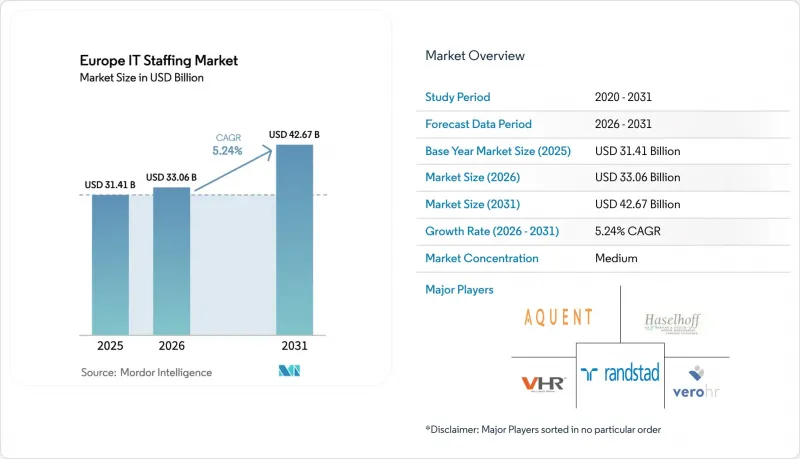
Mordor Intelligence에 의하면, 유럽의 IT 인재파견 시장 규모는 2025년 314억 1,000만 달러로 평가되었습니다. 2026년에는 330억 6,000만 달러로 확대되어 2026년부터 2031년에 걸쳐 CAGR 5.24%로 성장을 지속하여, 2031년에는 426억 7,000만 달러에 이를 것으로 예측됩니다.
본 보고서는 최종 사용자 산업(통신, 은행, 금융서비스 및 보험(BFSI), 헬스케어 및 생명과학 등), 고용 형태(계약·파견, 정규직 채용, 파견에서 정규직으로의 전환, SOW), 기술 분야(소프트웨어 개발·DevOps, 클라우드·인프라 등), 지역별로 분류되어 있습니다. 시장 전망은 금액(달러) 기준으로 제시되어 있습니다.
유럽의 IT 인재파견 시장 동향 및 인사이트
EU 기업 전반에서 디지털 전환이 급속히 확대되고 있습니다.
EU 기업들은 클라우드, AI, 그리고 고급 분석 프로그램을 사상 가장 빠른 속도로 확대하고 있으며, 이는 인재파견 업체로 향하는 단기 프로젝트 의뢰의 꾸준한 유입을 뒷받침하고 있습니다. 독일의 대형 제조업체와 프랑스의 은행은 레거시 시스템을 신속하게 현대화할 수 있는 DevOps 및 클라우드 아키텍트를 특히 찾고 있습니다. 현재 고객사들은 개발, 마이그레이션, 보안 역할을 결합한 다국적 채용 프로젝트를 발주하고 있으며, 이에 따라 공급업체들은 범유럽적 인재 풀을 구축하도록 촉진되고 있습니다. 그 결과, 평균 청구 단가의 상승과 배정 업무의 회전율 가속화가 나타나고 있으며, 이는 유럽의 IT 인재파견 시장의 장기적인 거래량 성장을 뒷받침하고 있습니다.
확대되는 ICT 기술 격차와 노동력의 고령화
유럽 기업의 절반 이상이 필요한 전문 지식을 갖춘 인재를 확보하지 못하고 있으며, 은퇴로 인한 인재 유출이 중급에서 상급 수준의 기술자 부족을 더욱 심화시키고 있습니다. 데이터 엔지니어와 사이버 보안 아키텍트의 급여 상승이 특히 두드러지며, 이로 인해 총 인건비가 상승함에 따라 기업들은 예산 범위 내에서 비용을 관리하기 위해 계약 기반의 인재 조달로 방향을 전환하고 있습니다. 이러한 뿌리 깊은 미스매치로 인해 기업들은 국경을 넘어 인재를 채용하거나 니어쇼어 인재 풀을 활용할 수 있는 전문 기업에 대한 의존도를 높이고 있으며, 이는 2030년까지 유럽의 IT 인재 파견 시장의 성장세를 유지하게 할 것입니다.
니치 기술 분야의 만성적인 인력 부족
EU 전체에서 27만 4,000명에 달하는 사이버 보안 인력 부족과, 독일에서는 종종 6개월 이상 지속되는 장기화된 채용 주기가 프로젝트 수행 능력을 제약하고 있습니다. 미션 크리티컬한 기술 세트를 확보하지 못하는 고객사는 프로젝트를 연기하거나 규모를 축소할 수밖에 없어, 벤더의 단기적인 수익 확대를 저해하고 있습니다. 이에 대응하기 위해 인재파견 기업들은 병목 현상을 완화하기 위해 재교육 아카데미나 국경을 초월한 채용 데스크에 투자하고 있지만, 공급 증가세는 여전히 수요를 따라가지 못하고 있습니다.
부문 분석
통신 업계는 5G 확산과 네트워크 가상화 프로그램을 견인력으로 삼아 2025년 유럽의 IT 인재파견 시장 점유율의 28.12%를 차지하며, 계속해서 가장 큰 지출 점유율을 유지했습니다. 의료 및 생명과학 분야는 전자건강기록(EHR) 업그레이드와 전문적인 보안 및 상호운용성 전문 지식이 필요한 원격의료의 확대를 배경으로, 추적 대상 업종 중 가장 높은 연평균 성장률(CAGR) 5.88%를 나타낼 것으로 예측됩니다. 병원들이 환자 데이터의 무결성을 위협하는 만성적인 IT 인력 부족 문제에 대처함에 따라, 의료 분야의 유럽의 IT 인재파견 시장 규모는 2031년까지 매년 확대될 전망입니다.
제조업에서는 인더스트리 4.0 생산 라인을 위한 IoT 및 자동화 엔지니어 채용이 계속되고 있는 반면, BFSI(은행 및 금융 및 보험) 기관에서는 오픈 뱅킹 시행 기한에 대응하기 위해 보안 및 핀테크 개발자를 꾸준히 채용하고 있습니다. AI를 활용한 개인화를 추구하는 소매 및 전자상거래 사업자들은 알고리즘 재학습을 위해 데이터 사이언스자와 계약을 맺고 있습니다. 스페인과 북유럽 국가들의 공공 부문 디지털 정부 프로그램이 기초 수요를 끌어올리며 다양한 고객 구성을 만들어내고 있으며, 이로 인해 유럽의 IT 인재파견 시장 전체에서 다각적인 사업을 전개하는 공급업체의 수익 전망이 강화되고 있습니다.
기타 혜택 :
- 엑셀 형식 시장 예측(ME) 시트
- 3개월간의 애널리스트 지원
자주 묻는 질문
목차
제1장 서론
제2장 조사 방법
제3장 주요 요약
제4장 시장 구도
제5장 시장 규모 및 성장 예측
제6장 경쟁 구도
제7장 시장 기회 및 향후 전망
KTH 26.08.07According to Mordor Intelligence, the Europe IT staffing market size is expected to grow from USD 31.41 billion in 2025 to USD 33.06 billion in 2026 and is forecast to reach USD 42.67 billion by 2031 at 5.24% CAGR over 2026-2031.
This report is Segmented by End-User Industry (Telecom, BFSI, Healthcare and Life-Sciences, and More), Employment Type (Contract/Temporary, Permanent Placement, and Temp-To-Perm, and Statement-Of-Work), Skill Area (Software Development and DevOps, Cloud and Infrastructure, and More), and Geography. The Market Forecasts are Provided in Terms of Value (USD).
Europe IT Staffing Market Trends and Insights
Digital-Transformation Surge Across EU Enterprises
EU companies are scaling cloud, AI, and advanced analytics programs at record pace, which is driving steady inflows of short-cycle project mandates for staffing suppliers. Large German manufacturers and French banks place premium demand on DevOps and cloud architects able to modernize legacy estates swiftly. Clients now issue multi-country requisitions that bundle development, migration, and security roles, encouraging vendors to cultivate pan-European talent benches. The outcome is rising average bill rates and faster assignment turnover, underpinning long-term volume growth in the Europe IT staffing market.
Widening ICT Skills Gap and Ageing Workforce
More than half of European businesses cannot secure the expertise they require, and retirement-driven attrition is widening the shortage for mid-to-senior technologists. Salary inflation is most acute for data engineers and cybersecurity architects, sending total labor costs upward and steering enterprises toward contract sourcing to stay within budgets. This persistent mismatch increases client reliance on specialist firms that can recruit across borders or tap near-shore talent pools, sustaining momentum in the Europe IT staffing market through 2030.
Persistent Talent Shortages in Niche Skills
The cybersecurity workforce gap of 274,000 professionals across the EU and prolonged search cycles, often six months or more in Germany, are constraining delivery capacity. Clients unable to secure mission-critical skillsets delay or down-scale projects, tempering near-term revenue upside for vendors. In response, staffing firms are investing in re-skilling academies and cross-border recruitment desks to alleviate bottlenecks, but supply growth remains slower than demand.
Other drivers and restraints analyzed in the detailed report include:
- Proliferation of Remote and Hybrid-Work Staffing Models
- Growing Adoption of MSP / RPO Outsourcing Frameworks
- Volatile Macro Conditions Curbing Discretionary IT Hiring
For complete list of drivers and restraints, kindly check the Table Of Contents.
Segment Analysis
Telecom retained the largest slice of spending, accounting for 28.12% of Europe IT staffing market share in 2025, anchored by 5G roll-outs and network virtualization programs. Healthcare and Life Sciences is projected to log a 5.88% CAGR, the fastest among tracked verticals, on the back of electronic health record upgrades and telemedicine scale-ups that demand specialized security and interoperability expertise. The Europe IT staffing market size for healthcare engagements is set to widen every year through 2031 as hospitals address chronic IT vacancies that jeopardize patient data integrity.
Manufacturing continues to procure IoT and automation engineers for Industry 4.0 lines, while BFSI institutions keep security and fintech developers in steady rotation to meet open-banking deadlines. Retail and e-commerce operators, pursuing AI-driven personalization, contract data scientists for algorithm re-training. Public-sector digital-government programs in Spain and the Nordics add to baseline demand, producing a broad client mix that strengthens revenue visibility for diversified providers across the Europe IT staffing market.
Complete Report Scope:
- By End-user Industry
- Telecom
- BFSI
- Healthcare and Life-Sciences
- Manufacturing and Industry 4.0
- Retail and e-Commerce
- Other End-user Industries
- By Employment Type
- Contract/Temporary
- Permanent Placement
- Temp-to-Perm
- Statement-of-Work (SOW) / Project-Based
- By Skill Area
- Software Development and DevOps
- Cloud and Infrastructure
- Data, AI and Analytics
- Cyber-security
- Emerging Tech (IoT/AR-VR/Blockchain)
- By Country
- United Kingdom
- Germany
- France
- Spain
- Italy
- Rest of Europe
List of Companies Covered in this Report:
- Adecco Group AG
- Randstad N.V.
- ManpowerGroup Inc.
- Hays plc
- Robert Half Inc.
- PageGroup plc
- Allegis Group LLC
- Akkodis SAS
- Capgemini SE (Sogeti Staffing)
- Alten S.A.
- Harvey Nash Group Ltd
- Experis (ManpowerGroup)
- AQUENT LLC
- Vero HR Ltd.
- Haselhoff Groep B.V.
- VHR Consulting Ltd.
- Pertemps Ltd
- Tiger Recruitment Ltd
- MAS Recruiting Inc.
- Chronos Consulting Ltd
- Morgan Hunt UK Ltd
- Computer Futures (SThree plc)
- Modis Ltd (Akkodis)
Additional Benefits:
- The market estimate (ME) sheet in Excel format
- 3 months of analyst support
TABLE OF CONTENTS
1 INTRODUCTION
- 1.1 Study Assumptions and Market Definition
- 1.2 Scope of the Study
2 RESEARCH METHODOLOGY
3 EXECUTIVE SUMMARY
4 MARKET LANDSCAPE
- 4.1 Market Overview
- 4.2 Market Drivers
- 4.2.1 Digital-transformation surge across EU enterprises
- 4.2.2 Widening ICT skills gap and ageing workforce
- 4.2.3 Proliferation of remote and hybrid-work staffing models
- 4.2.4 Growing adoption of MSP / RPO outsourcing frameworks
- 4.2.5 EU AI-Act compliance spurring demand for AI-ethics talent
- 4.2.6 CSRD-driven need for "green-software" engineers
- 4.3 Market Restraints
- 4.3.1 Persistent talent shortages in niche skills (e.g., SAP/DevOps)
- 4.3.2 Volatile macro conditions curbing discretionary IT hiring
- 4.3.3 Stricter labour-leasing rules (e.g., Germany AUG reforms)
- 4.3.4 Rise of direct-sourcing and freelancer platforms
- 4.4 Regulatory Landscape
- 4.5 Technological Outlook
- 4.6 Porter's Five Forces Analysis
- 4.6.1 Bargaining Power of Suppliers
- 4.6.2 Bargaining Power of Buyers/Consumers
- 4.6.3 Threat of New Entrants
- 4.6.4 Threat of Substitute Products
- 4.6.5 Intensity of Competitive Rivalry
5 MARKET SIZE AND GROWTH FORECASTS (VALUE)
- 5.1 By End-user Industry
- 5.1.1 Telecom
- 5.1.2 BFSI
- 5.1.3 Healthcare and Life-Sciences
- 5.1.4 Manufacturing and Industry 4.0
- 5.1.5 Retail and e-Commerce
- 5.1.6 Other End-user Industries
- 5.2 By Employment Type
- 5.2.1 Contract/Temporary
- 5.2.2 Permanent Placement
- 5.2.3 Temp-to-Perm
- 5.2.4 Statement-of-Work (SOW) / Project-Based
- 5.3 By Skill Area
- 5.3.1 Software Development and DevOps
- 5.3.2 Cloud and Infrastructure
- 5.3.3 Data, AI and Analytics
- 5.3.4 Cyber-security
- 5.3.5 Emerging Tech (IoT/AR-VR/Blockchain)
- 5.4 By Country
- 5.4.1 United Kingdom
- 5.4.2 Germany
- 5.4.3 France
- 5.4.4 Spain
- 5.4.5 Italy
- 5.4.6 Rest of Europe
6 COMPETITIVE LANDSCAPE
- 6.1 Market Concentration
- 6.2 Strategic Moves
- 6.3 Market Share Analysis
- 6.4 Company Profiles (includes Global level Overview, Market level overview, Core Segments, Financials as available, Strategic Information, Market Rank/Share, Products and Services, Recent Developments)
- 6.4.1 Adecco Group AG
- 6.4.2 Randstad N.V.
- 6.4.3 ManpowerGroup Inc.
- 6.4.4 Hays plc
- 6.4.5 Robert Half Inc.
- 6.4.6 PageGroup plc
- 6.4.7 Allegis Group LLC
- 6.4.8 Akkodis SAS
- 6.4.9 Capgemini SE (Sogeti Staffing)
- 6.4.10 Alten S.A.
- 6.4.11 Harvey Nash Group Ltd
- 6.4.12 Experis (ManpowerGroup)
- 6.4.13 AQUENT LLC
- 6.4.14 Vero HR Ltd.
- 6.4.15 Haselhoff Groep B.V.
- 6.4.16 VHR Consulting Ltd.
- 6.4.17 Pertemps Ltd
- 6.4.18 Tiger Recruitment Ltd
- 6.4.19 MAS Recruiting Inc.
- 6.4.20 Chronos Consulting Ltd
- 6.4.21 Morgan Hunt UK Ltd
- 6.4.22 Computer Futures (SThree plc)
- 6.4.23 Modis Ltd (Akkodis)
7 MARKET OPPORTUNITIES AND FUTURE OUTLOOK
- 7.1 White-space and Unmet-Need Assessment


