
|
시장보고서
상품코드
2124283
IT 인재파견 시장 : 시장 점유율 분석, 업계 동향 및 통계, 성장 예측(2026-2031년)IT Staffing - Market Share Analysis, Industry Trends & Statistics, Growth Forecasts (2026 - 2031) |
||||||
 Mordor Intelligence
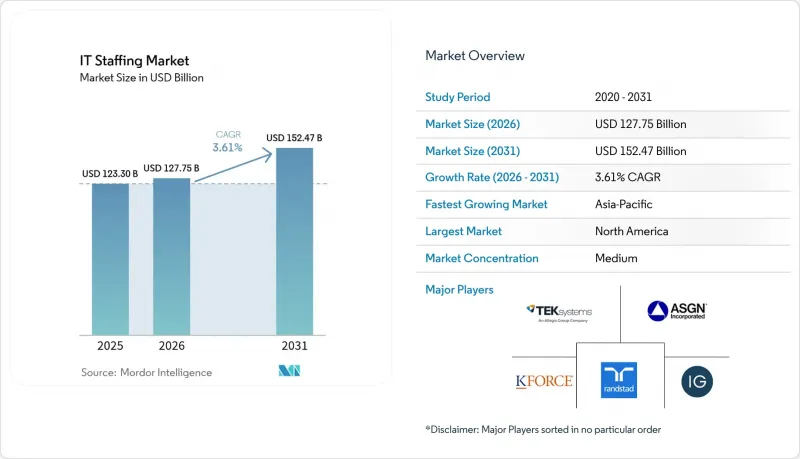
Mordor Intelligence에 의하면, IT 인재파견 시장 규모는 2025년 1,233억 달러로 평가되었고, 2026년에는 1,277억 5,000만 달러로 추정되고, 2026-2031년 CAGR 3.61%로 성장을 지속할 전망이며, 2031년에는 1,524억 7,000만 달러에 이를 것으로 예측됩니다.
본 보고서는 스킬 세트별(소프트웨어 개발자, 테스터·QA 엔지니어, 시스템 분석가, 기술 지원 담당자, 네트워크·보안 전문가, 기타), 최종 사용자 산업별(통신, 은행, 금융서비스 및 보험(BFSI), 기타), 인재 파견 서비스 유형별(계약형 인재 파견, 기타), 기업 규모별(대기업·중소기업), 지역별로 분류되어 있습니다. 시장 예측은 금액(달러) 기준으로 제시되어 있습니다.
세계의 IT 인재 파견 시장 동향 및 인사이트
AI, 클라우드, IoT를 중심으로 한 디지털 전환(DX) 프로젝트 도입 가속화
현재 전 세계 기술 관련 구인 정보의 14%가 AI 또는 머신러닝 기술을 요구하고 있으며, 이는 전년 동기 9%에서 증가한 수치입니다. 클라우드 전환에는 전문적인 DevOps 엔지니어나 보안 아키텍트가 요구되고 있으며, 2030년까지 1,395억 8,000만 달러에 달할 것으로 예측되는 엣지 컴퓨팅 투자에는 인프라와 IoT를 모두 겸비한 인재가 필요합니다. NTT DATA가 20만 명의 직원을 대상으로 생성형 AI 교육을 실시하는 프로그램은 현재 진행 중인 기술 재교육의 규모를 더욱 부각시키고 있습니다. 따라서 AI 알고리즘, 클라우드 리소스, 디바이스 네트워크를 연결하는 학제간 프로젝트 팀이 IT 인재 파견 시장의 지속적인 확장을 주도하고 있습니다.
분산형 인재을 필요로 하는 원격 및 하이브리드 근무 모델의 확대
Dell Technologies 직원의 65%가 공식적인 유연 근무 형태를 이용하고 있으며, 이는 장소에 구애받지 않는 채용이 정착되고 있음을 보여줍니다. 고용주는 더 광범위한 인재 풀에 접근할 수 있게 되지만, 국경을 넘는 규정 준수 대응과 커지는 임금 격차 시정에 대한 기대에 대처해야 합니다. 맨파워그룹(ManpowerGroup)의 2025년 전망에 따르면, 41%의 기업이 인재 증원을 계획하고 있으며, 기술직이 수요 순위 1위를 차지하고 있습니다. 경쟁 입찰은 이제 대륙을 넘어 이루어지고 있으며, 보상 수준이 상승함에 따라 인재 소개 회사는 급여 이외의 요소를 포함한 인재 유지 전략을 강화할 수밖에 없게 되었습니다.
니치 기술 분야의 지속적인 세계 기술 인재 부족
해결되지 않은 디지털 기술 격차는 2034년까지 세계 경제에 막대한 손실을 초래할 것으로 추정되며, 양자 기술, 고도화된 AI, 제로 트러스트 보안 분야의 전문 지식에 대한 구조적인 공급 제약이 두드러지고 있습니다. 대학은 커리큘럼을 제때 업데이트하지 못하고 있어, 신입 졸업생들이 이러한 특수 분야에 진출하기까지 수년 단위의 시차가 발생하고 있습니다. 이러한 인재 부족으로 인해 보상 패키지가 상승하고 프로젝트 일정이 장기화됨에 따라, 기업들은 단기적인 ROI를 압박하는 집중적인 기술 재교육 이니셔티브에 자금을 투입할 수밖에 없는 상황에 처해 있습니다.
부문 분석
2025년, 소프트웨어 개발자는 IT 인재 파견 시장의 37.05%를 차지했으며, 이는 정착된 애플리케이션 현대화 프로젝트를 반영합니다. 생성형 AI 엔지니어는 2031년까지 연평균 성장률(CAGR) 11.75%를 나타낼 것으로 예측되며, 이는 프롬프트 설계, 모델 감사, LLM 미세 조정에 대한 수요 증가를 뒷받침합니다. 엣지 클라우드 파이프라인이 확대됨에 따라, 데이터 및 AI 엔지니어링 분야의 IT 인재 파견 시장 규모는 급격히 확대될 것으로 예측됩니다. 급여 수준은 하이브리드 AI 개발 전문 지식을 제공할 때 공급업체가 요구할 수 있는 프리미엄 가격을 보여줍니다.
기존의 테스터와 QA 담당자는 자동화라는 역풍에 직면해 있으며, 많은 전문가들이 AI를 활용한 검증 도구로 전환하고 있습니다. 시스템 분석가는 통합 아키텍처로 무게중심을 옮기고 있으며, 네트워크 전문가는 AI 기반 위협 모니터링에 대한 역량 강화를 도모하고 있습니다. 신기술(양자 개발, 블록체인 아키텍처, IoT 기기 보안)은 IT 인재 파견 시장에서 전체적으로 아직 규모는 작지만, 급속히 확대되고 있는 부문입니다.
BFSI(은행 및 금융 및 보험) 부문은 오픈 뱅킹 규정 준수 및 핀테크 플랫폼 업그레이드를 원동력으로 삼아, 2025년에도 24.15%의 점유율을 차지하며 최대 도입 부문으로 자리매김했습니다. 의료 분야는 전자의무기록 현대화 및 AI를 활용한 진단에 힘입어 연평균 성장률(CAGR) 10.25%로 가장 빠르게 성장하는 산업으로 부상하고 있습니다. 원격의료 및 환자 데이터 상호운용성에 관한 표준이 정착됨에 따라, 의료 프로젝트용 IT 인재 파견 시장 규모는 확대될 것으로 예측됩니다.
제조업에서는 IoT 및 예측 유지보수 인재가 필요한 스마트 팩토리 도입이 우선시되고 있습니다. 소매업 및 전자상거래 산업에서는 옴니채널 확충이 계속되고 있는 반면, 공공기관에서는 사이버 보안 및 시민 서비스의 디지털화를 위한 예산이 확보되고 있습니다. ‘기타’ 범주에는 에너지, 자동차, 스마트 시티 프로그램이 포함되어 있으며, 각 분야는 고유한 기술 조합을 필요로 하여 IT 인재 파견 시장에 다양한 인재 공급원을 제공합니다.
지역별 분석
북미는 탄탄한 기술 생태계, 막대한 디지털 예산, 엄격한 보안 요건에 힘입어 2025년에도 44.05%의 점유율을 유지했습니다. 비자 정책의 지속적인 변화와 임금 상승으로 인재 확보가 어려워지면서, 캐나다와 라틴아메리카로의 니어쇼어링이 증가하고 있습니다. 미국은 실리콘밸리의 소프트웨어 프로젝트와 월스트리트의 클라우드 개편으로 수요를 견인하고 있는 반면, 캐나다는 토론토와 몬트리올에 비용 경쟁력이 있는 허브를 제공합니다.
아시아태평양은 인도의 IT 서비스 사업 확대, 일본의 기술 재교육 이니셔티브, 싱가포르의 지역 본부 유치에 힘입어 연평균 성장률(CAGR) 8.15%를 기록하며 가장 빠르게 성장하는 지역입니다. 다국적 기업들이 조달처를 다각화한 결과, 해당 지역의 매니지드 서비스 연간 계약액은 2024년에 32% 증가했습니다. 중국의 플랫폼 사업 회복과 한국의 반도체 연구개발(R&D)도 전문 인재 수요를 더욱 끌어올리고 있습니다.
유럽에서는 동유럽 거점이 단순한 비용 차익 거래에서 틈새 전문센터로 진화하고 있음에도 불구하고, 독일과 영국에서는 안정적인 수요가 나타나고 있습니다. GDPR(EU 개인정보보호규정)(일반 데이터 보호 규정) 준수에 따라 사이버 보안 도입률은 높은 수준을 유지하고 있습니다. 중동 및 아프리카는 뒤처져 있지만 꾸준한 성장을 기록하고 있으며, 사우디아라비아의 스마트 시티 프로젝트와 남아프리카공화국의 영어권 서비스 허브가 주목할 만한 수요 거점으로 부상하고 있습니다. 이러한 시장에서 환율 조정 후의 임금 격차가 전 세계 IT 인재 파견 시장공급업체 이익률 전략을 형성하고 있습니다.
기타 혜택
- 엑셀 형식 시장 예측(ME) 시트
- 3개월간의 애널리스트 지원
자주 묻는 질문
목차
제1장 서론
제2장 조사 방법
제3장 주요 요약
제4장 시장 인사이트
제5장 시장 세분화
제6장 경쟁 구도
제7장 시장 기회 및 향후 전망
AJY 26.09.11According to Mordor Intelligence, the IT staffing market size is expected to grow from USD 123.30 billion in 2025 to USD 127.75 billion in 2026 and is forecast to reach USD 152.47 billion by 2031 at 3.61% CAGR over 2026-2031.

This report is Segmented by Skill Set (Software Developer, Testers and QA Engineers, Systems Analyst, Technical Support Professionals, Networking and Security Experts, and More), End-User Industry (Telecom, BFSI, and More), Staffing Service Type (Contract Staffing, and More), Enterprise Size (Large Enterprises, and SMEs), and Geography. The Market Forecasts are Provided in Terms of Value (USD).
Global IT Staffing Market Trends and Insights
Accelerated Adoption of AI-, Cloud- and IoT-Centric Digital-Transformation Projects
Fourteen percent of global tech job postings now demand AI or machine-learning skills, up from 9% a year earlier . Cloud migrations call for specialized DevOps engineers and security architects, while edge-computing investments that are projected to reach USD 139.58 billion by 2030 require blended infrastructure-plus-IoT talent. NTT DATA's program to train 200,000 employees in generative AI further underscores the scale of reskilling underway . Interdisciplinary project teams that connect AI algorithms, cloud resources, and device networks are therefore driving sustained expansion in the IT staffing market.
Expansion of Remote and Hybrid Work Models Requiring Distributed Talent
Sixty-five percent of Dell Technologies personnel use formal flexibility arrangements, signaling lasting normalization of location-agnostic hiring. Employers gain access to broader talent pools, yet must navigate cross-border compliance and rising pay parity expectations. ManpowerGroup's 2025 outlook shows 41% of firms plan to add headcount, with technology roles topping demand charts. Competitive bidding now spans continents, increasing compensation levels and compelling agencies to enhance retention packages that extend beyond salary.
Persistent Global Skill Shortages in Niche Technologies
It is estimates that unresolved digital-skills gaps could cost the global economy by 2034, underscoring structural supply constraints for quantum, advanced AI, and zero-trust security expertise. Universities have not kept curriculum pace, creating multiyear lags before new graduates enter these specializations. The scarcity elevates compensation packages and lengthens project timelines, compelling enterprises to bankroll intensive reskilling initiatives that erode near-term ROI.
Other drivers and restraints analyzed in the detailed report include:
- Surging Demand for Cyber-Resilience Staff Driven by Cyber-Insurance Mandates
- Digital-Transformation Budget Rebound Post-Pandemic Fuels Staff-Augmentation Demand
- Wage Inflation Compressing MSP Bill-Rate Margins
For complete list of drivers and restraints, kindly check the Table Of Contents.
Segment Analysis
Software developers accounted for 37.05% of IT staffing market share in 2025, reflecting entrenched application modernization projects. Generative-AI engineers are projected to register a 11.75% CAGR through 2031, underscoring growing demand for prompt design, model auditing, and LLM fine-tuning. The IT staffing market size for data and AI engineering is projected to escalate sharply as edge-cloud pipelines scale. Salary corridors signal premium pricing that providers can command when supplying hybrid AI-development expertise.
Traditional testers and QA roles face automation headwinds, pushing many professionals toward AI-enabled verification tools. Systems analysts are pivoting to integration architecture, and network specialists are upskilling in AI-driven threat monitoring. Emerging skills-quantum development, blockchain architecture, and IoT device security-collectively remain a small but rapidly expanding slice of the IT staffing market.
BFSI remained the largest adopter with 24.15% share in 2025, driven by open-banking compliance and fintech platform upgrades. Healthcare emerges as the fastest-growing vertical at 10.25% CAGR, propelled by electronic-health-record modernization and AI-assisted diagnostics. The IT staffing market size for healthcare projects is expected to widen as telemedicine and patient-data interoperability standards take hold.
Manufacturing prioritizes smart-factory deployments requiring IoT and predictive-maintenance talent. Retail and e-commerce continue omnichannel build-outs, while public sector agencies earmark cybersecurity and citizen-service digitization budgets. Energy, automotive, and smart-city programs fill the "Other Industries" category, each demanding bespoke skill combinations and feeding diverse pipelines for the IT staffing market.
Complete Report Scope:
- By Skill Set
- Software Developers
- Testers and QA Engineers
- Systems Analysts / Business Analysts
- Technical Support Professionals
- Networking and Security Experts
- Data and AI Engineers
- Other Skill Sets
- By End-User Industry
- Telecom
- Banking, Financial Services and Insurance (BFSI)
- Healthcare and Life Sciences
- Manufacturing
- Retail and e-Commerce
- Government and Public Sector
- Other Industries
- By Staffing Service Type
- Temporary / Contract Staffing
- Permanent Placement
- Statement-of-Work (SOW) / Project-based
- Managed Service Provider (MSP) / Outsourced Staffing
- By Enterprise Size
- Large Enterprises
- Small and Medium Enterprises
- By Geography
- North America
- United States
- Canada
- Mexico
- South America
- Brazil
- Argentina
- Colombia
- Rest of South America
- Europe
- Germany
- United Kingdom
- France
- Italy
- Spain
- Russia
- Netherlands
- Rest of Europe
- Asia-Pacific
- China
- Japan
- South Korea
- India
- Australia
- Singapore
- Rest of Asia-Pacific
- Middle East and Africa
- Middle East
- Saudi Arabia
- United Arab Emirates
- Rest of Middle East
- Africa
- South Africa
- Egypt
- Rest of Africa
- Middle East
- North America
Geography Analysis
North America retained 44.05% share in 2025, supported by deep tech ecosystems, large digital budgets, and rigorous security mandates. Continuous visa policy shifts and wage escalation challenge talent availability, prompting more near-shoring to Canada and Latin America. The United States leads demand due to Silicon Valley software projects and Wall Street cloud overhauls, while Canada provides cost-advantaged hubs in Toronto and Montreal.
Asia-Pacific is the fastest-growing region at an 8.15% CAGR, buoyed by India's IT services scale-up, Japanese reskilling initiatives, and Singapore's regional headquarters attraction. Managed-services annual contract value in the region rose 32% in 2024 as multinationals diversified sourcing. China's platform rebound and Korea's semiconductor R&D add further pull on specialist headcount.
Europe posts stable demand in Germany and the United Kingdom, even as Eastern European destinations evolve from pure cost-arbitrage to niche specialist centers. GDPR compliance maintains high cybersecurity uptake. Middle East and Africa trail but register steady growth; Saudi Arabia's smart-city projects and South Africa's English-language service hubs are notable demand pockets. Currency-adjusted wage differentials across these markets shape provider margin strategies within the global IT staffing market.
- TEKsystems Inc. (Allegis Group Holdings Inc.)
- ASGN Incorporated
- Insight Global LLC
- Randstad N.V.
- Kforce Inc.
- Artech Information Systems LLC
- Consulting Solutions International Inc.
- MATRIX Resources Inc.
- NTT DATA Corporation
- Beacon Hill Staffing Group LLC
- Experis IT (ManpowerGroup Global Inc.)
- Akkodis (Adecco Group AG)
- Kelly Services Inc.
- Motion Recruitment Partners LLC
- Robert Half International Inc.
- Genesis10 Inc.
- Collabera LLC
- PERSOL Holdings Co., Ltd.
- Aquent LLC
- CGI Inc.
Additional Benefits:
- The market estimate (ME) sheet in Excel format
- 3 months of analyst support
TABLE OF CONTENTS
1 INTRODUCTION
- 1.1 Study Assumptions and Market Definition
- 1.2 Scope of the Study
2 RESEARCH METHODOLOGY
3 EXECUTIVE SUMMARY
4 MARKET INSIGHTS
- 4.1 Market Overview
- 4.2 Market Drivers
- 4.2.1 Accelerated adoption of AI-, Cloud- and IoT-centric digital-transformation projects
- 4.2.2 Expansion of remote and hybrid work models requiring distributed talent
- 4.2.3 Surging demand for cyber-resilience staff driven by cyber-insurance mandates
- 4.2.4 Digital-transformation budget rebound post-pandemic fuels staff-augmentation demand
- 4.2.5 Generative-AI supervision roles (prompt engineers, model auditors) emerge
- 4.2.6 Vendor consolidation among Global-2000 clients boosts MSP-led volume deals
- 4.3 Market Restraints
- 4.3.1 Persistent global skill shortages in niche technologies
- 4.3.2 Wage inflation compressing MSP bill-rate margins
- 4.3.3 AI-based self-service hiring platforms disintermediate agencies
- 4.3.4 Tightening data-sovereignty laws restrict cross-border staff deployment
- 4.4 Value Chain Analysis
- 4.5 Regulatory Landscape
- 4.6 Technological Outlook
- 4.7 Porterss Five Forces
- 4.7.1 Bargaining Power of Suppliers
- 4.7.2 Bargaining Power of Buyers
- 4.7.3 Threat of New Entrants
- 4.7.4 Threat of Substitutes
- 4.7.5 Competitive Rivalry
- 4.8 Industry Ecosystem Analysis
- 4.9 Key Use Cases and Case Studies
- 4.10 Assessment of Macroeconomic Trends
- 4.11 Investment Analysis
5 MARKET SEGMENTATION
- 5.1 By Skill Set
- 5.1.1 Software Developers
- 5.1.2 Testers and QA Engineers
- 5.1.3 Systems Analysts / Business Analysts
- 5.1.4 Technical Support Professionals
- 5.1.5 Networking and Security Experts
- 5.1.6 Data and AI Engineers
- 5.1.7 Other Skill Sets
- 5.2 By End-User Industry
- 5.2.1 Telecom
- 5.2.2 Banking, Financial Services and Insurance (BFSI)
- 5.2.3 Healthcare and Life Sciences
- 5.2.4 Manufacturing
- 5.2.5 Retail and e-Commerce
- 5.2.6 Government and Public Sector
- 5.2.7 Other Industries
- 5.3 By Staffing Service Type
- 5.3.1 Temporary / Contract Staffing
- 5.3.2 Permanent Placement
- 5.3.3 Statement-of-Work (SOW) / Project-based
- 5.3.4 Managed Service Provider (MSP) / Outsourced Staffing
- 5.4 By Enterprise Size
- 5.4.1 Large Enterprises
- 5.4.2 Small and Medium Enterprises
- 5.5 By Geography
- 5.5.1 North America
- 5.5.1.1 United States
- 5.5.1.2 Canada
- 5.5.1.3 Mexico
- 5.5.2 South America
- 5.5.2.1 Brazil
- 5.5.2.2 Argentina
- 5.5.2.3 Colombia
- 5.5.2.4 Rest of South America
- 5.5.3 Europe
- 5.5.3.1 Germany
- 5.5.3.2 United Kingdom
- 5.5.3.3 France
- 5.5.3.4 Italy
- 5.5.3.5 Spain
- 5.5.3.6 Russia
- 5.5.3.7 Netherlands
- 5.5.3.8 Rest of Europe
- 5.5.4 Asia-Pacific
- 5.5.4.1 China
- 5.5.4.2 Japan
- 5.5.4.3 South Korea
- 5.5.4.4 India
- 5.5.4.5 Australia
- 5.5.4.6 Singapore
- 5.5.4.7 Rest of Asia-Pacific
- 5.5.5 Middle East and Africa
- 5.5.5.1 Middle East
- 5.5.5.1.1 Saudi Arabia
- 5.5.5.1.2 United Arab Emirates
- 5.5.5.1.3 Rest of Middle East
- 5.5.5.2 Africa
- 5.5.5.2.1 South Africa
- 5.5.5.2.2 Egypt
- 5.5.5.2.3 Rest of Africa
- 5.5.5.1 Middle East
- 5.5.1 North America
6 Competitive Landscape
- 6.1 Market Concentration
- 6.2 Strategic Moves
- 6.3 Market Share Analysis
- 6.4 Company Profiles (includes Global level Overview, Market level overview, Core Segments, Financials as available, Strategic Information, Market Rank/Share for key companies, Products and Services, and Recent Developments)
- 6.4.1 TEKsystems Inc. (Allegis Group Holdings Inc.)
- 6.4.2 ASGN Incorporated
- 6.4.3 Insight Global LLC
- 6.4.4 Randstad N.V.
- 6.4.5 Kforce Inc.
- 6.4.6 Artech Information Systems LLC
- 6.4.7 Consulting Solutions International Inc.
- 6.4.8 MATRIX Resources Inc.
- 6.4.9 NTT DATA Corporation
- 6.4.10 Beacon Hill Staffing Group LLC
- 6.4.11 Experis IT (ManpowerGroup Global Inc.)
- 6.4.12 Akkodis (Adecco Group AG)
- 6.4.13 Kelly Services Inc.
- 6.4.14 Motion Recruitment Partners LLC
- 6.4.15 Robert Half International Inc.
- 6.4.16 Genesis10 Inc.
- 6.4.17 Collabera LLC
- 6.4.18 PERSOL Holdings Co., Ltd.
- 6.4.19 Aquent LLC
- 6.4.20 CGI Inc.
7 MARKET OPPORTUNITIES AND FUTURE OUTLOOK
- 7.1 White-space and Unmet-Need Assessment