
|
시장보고서
상품코드
2116899
인재 채용 소프트웨어 시장 : 점유율 분석, 업계 동향과 통계, 성장 예측(2026-2031년)Talent Acquisition Software - Market Share Analysis, Industry Trends & Statistics, Growth Forecasts (2026 - 2031) |
||||||
 Mordor Intelligence
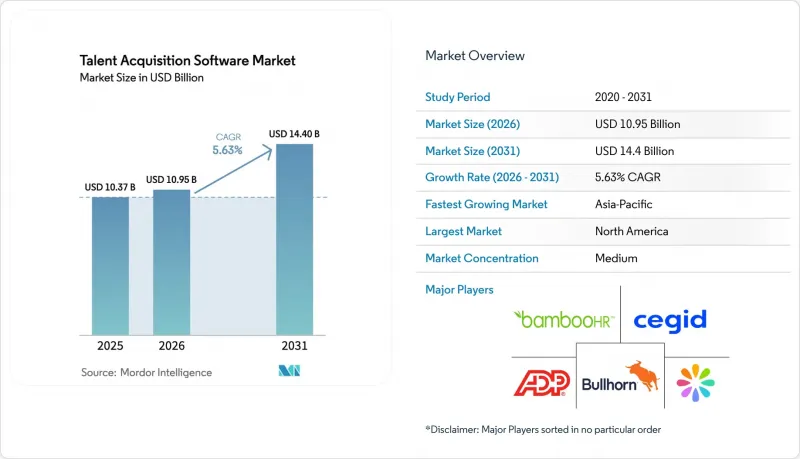
Mordor Intelligence에 의하면, 인재 채용 소프트웨어 시장 규모는 2025년에 103억 7,000만 달러로 평가되었고 2026년 109억 5,000만 달러에서 2031년까지 144억 달러에 이를 것으로 예측되며, 예측 기간(2026-2031년) CAGR은 5.63%를 나타낼 전망입니다.
본 보고서는 배포 모델(On-Premise, 클라우드), 구성 요소(지원자 추적 시스템, 리크루팅 마케팅 스위트 등), 기업 규모(대기업, 중소기업),최종 이용 산업(제조, 의료, 은행, 금융서비스 및 보험(BFSI), 교육, 호텔·관광, IT 및 통신 등) 및 지역별로 분류되어 있습니다. 시장 예측은 금액(달러) 기준으로 제시되어 있습니다.
세계 인재 채용 소프트웨어 시장 동향 및 인사이트
HR 테크 스택의 클라우드 전환이 플랫폼 통합을 가속화
클라우드 네이티브 HR 아키텍처로 전환하는 조직들은 비용과 성능 양면에서 두 자릿수의 이점을 보고하고 있습니다. 실시간 데이터 통합을 통해 기존의 사일로화가 해소되고, 채용 분석이 향상되며, 전사적인 인재에 대한 인사이트이 가능해집니다. 구현 주기 단축과 유연한 확장성 덕분에 클라우드 도입은 특히 대규모 채용 시 매력적입니다. API 우선 설계 덕분에 고용주는 전문적인 소싱, 평가 또는 신원 조회 모듈을 통합된 워크플로우에 통합할 수 있으며, 인재 채용 소프트웨어 시장은 보다 광범위한 HR 디지털 전환의 초석으로서의 입지를 강화하고 있습니다.
AI를 활용한 후보자 매칭이 채용 품질의 지표를 혁신
현재 머신러닝 엔진은 이력서, 평가 결과, 행동 신호를 분석하여 키워드 검색보다 더 높은 정확도로 최적의 후보자 프로파일을 추출하고 있습니다. 주요 플랫폼은 2024년에 수십만 건의 채용 공고를 처리하며 채용 담당자의 처리 능력을 50% 이상 향상시켰습니다. 규제 당국의 감시가 강화되는 가운데, 설명 가능한 AI 대시보드와 편향성 감사는 필수 기능으로 자리 잡았습니다. 뚜렷한 효율성이 실현되고 있음에도 불구하고, 대기업 10곳 중 9곳 가까이가 채용 사이트에서 AI를 활용한 개인화 기능을 아직 도입하지 않고 있습니다. 바로 이러한 도입 격차가 성장 기회를 지속적으로 뒷받침하고 있습니다.
데이터 개인정보 보호 규정 준수 비용이 도입의 장벽이 되고 있다.
규제 요건이 강화됨에 따라 고용주는 동의 관리, 정보 유출 방지, 그리고 후보자 데이터 거버넌스에 투자해야 할 의무가 있습니다. 일부 다국적 기업은 기존 워크플로우를 개선하고 국경을 넘는 데이터 전송을 관리하기 위해 수백만 달러 규모의 예산을 배정하고 있습니다. 이러한 지출은 구매 결정을 지연시키고 기능 혁신에 대한 자금 배분을 저해하여, 인재 채용 소프트웨어 시장에 단기적인 압박을 가하고 있습니다.
부문 분석
클라우드 도입과 관련된 인재 채용 소프트웨어 시장 규모는 2025년에 73억 5,000만 달러를 돌파하며, 구독형 서비스에 대한 고객의 뚜렷한 선호도를 여실히 보여주었습니다. 향후 연평균 성장률(CAGR) 6.62%가 예상되는 클라우드 서비스는 2031년까지 더 큰 시장 점유율을 확보할 전망입니다. On-Premise 도입은 규제가 엄격한 산업 분야에서 여전히 남아 있지만, 보안 인증 및 주권 클라우드(sovereign cloud) 옵션이 늘어남에 따라 꾸준히 감소하는 추세입니다. 하이브리드 모델은 특히 금융 서비스 및 의료 분야에서 기밀 데이터를 단계적으로 이전하는 조직에게 중간 경유지로서의 역할을 수행하고 있습니다. 싱가포르, 브리티시컬럼비아주, 그리고 미국의 특정 주에서 시행되는 정부 지원 프로그램은 클라우드로의 전환을 더욱 가속화하여 인재 채용 소프트웨어 시장에 직접적인 혜택을 가져다주고 있습니다.
클라우드 전환은 레거시 아키텍처로는 실현할 수 없는 AI 기능과 지속적인 업데이트를 동시에 가능하게 합니다. 따라서 각 벤더는 고급 분석 기능, 대화형 AI 봇, 스킬 그래프 기술을 표준 클라우드 기능으로 패키지화하고 있습니다. 그 결과, 구매 기업은 자본 지출 부담 없이 채용의 질을 측정 가능한 수준으로 향상시킬 수 있습니다. 이러한 이점은 SaaS(Software-as-a-Service) 방식의 제공으로 향하는 장기적인 추세를 강화하며, 클라우드 선도 기업과 뒤처진 On-Premise 기존 기업 간의 격차를 더욱 벌리고 있습니다.
지원자 추적 시스템은 2025년 매출의 37.25%라는 최대 점유율을 차지하며, 엔터프라이즈 및 미드마켓 부문 전반에 걸친 핵심 워크플로우 계층으로 자리 잡고 있습니다. 그러나 채용 마케팅, 후보자 관계 관리, 온보딩 각 모듈이 통합됨에 따라 구매자들은 단일 공급업체로부터 통합 제품군을 조달하는 경향이 강해지고 있습니다. 이러한 변화에 따라 채용 마케팅 기능은 연평균 성장률(CAGR) 6.45%를 나타낼 것으로 예측되며, 잠재적인재 풀을 육성하는 후보자 관계 관리 모듈이 그 뒤를 잇고 있습니다. 또한, 복잡한 세계 확장은 전문적인 인사이트력을 필요로 하기 때문에 서비스, 도입 및 최적화 컨설팅 분야도 견조한 성장세를 보이고 있습니다.
제품군 간의 통합은 단일 화면 대시보드, 통합 분석 기능, 그리고 벤더 관리에 드는 간접비 절감을 원하는 채용 담당자들 수요에 의해 형성되고 있습니다. 최신 ATS 제품에는 과거에는 별도의 라이선스가 필요했던 이력서 분석, 면접 일정 관리, 예측 분석 기능이 번들로 제공되어 총 소유 비용(TCO)이 절감되고, 인재 채용 소프트웨어 시장의 통합이 진행되고 있습니다.
지역별 분석
북미는 2025년 지출의 34.05%를 차지하고 있으며, 이는 SaaS의 높은 보급률과 성숙한 통합 생태계를 반영합니다. 미국 기업들은 AI의 설명 가능성 및 지원자 경험 지표를 중시하는 반면, 캐나다의 구매자들은 이중 언어 워크플로우와 국경을 초월한 인재 조달을 우선시하고 있습니다. 멕시코에서 제조업이 확대됨에 따라 숙련된 기술직과 엔지니어링 직종 모두를 지원하는 확장성이 뛰어난 채용 시스템에 대한 수요가 증가하고 있습니다.
아시아태평양은 2024년 인도의 세 자릿수 구인 증가와 중국의 기술 분야 채용 급증에 힘입어 2031년까지 6.18%라는 가장 높은 연평균 성장률(CAGR)을 나타낼 전망입니다. 싱가포르, 말레이시아, 태국에서는 정부가 HR 테크 도입 지원 프로그램을 시행하고 있으며, 다국어 지원은 여전히 핵심 요건으로 남아 있습니다. 다양한 노동법과 데이터 거주 요건으로 인해 공급업체들은 유연한 호스팅 및 규정 준수 옵션을 유지하도록 장려받고 있으며, 이는 해당 지역의 인재 채용 소프트웨어 시장 전체를 견인하고 있습니다.
유럽에서는 GDPR(EU 개인정보보호규정)과 관련된 시스템 업그레이드 및 단일 시장 내 국경을 초월한 채용이 성장 동력이 되어 지속적인 성장이 예상됩니다. 독일과 영국은 계속해서 기업 내 도입을 주도하고 있는 반면, 프랑스와 스페인은 다국어 지원 능력과 EU 내 인재 이동에 중점을 두고 있습니다. 곧 시행될 EU AI법으로 인해 투명성이 높은 알고리즘 및 편향 완화에 관한 보고에 대한 수요가 시급한 과제가 되고 있으며, 이는 제품 로드맵을 더욱 구체화하고 있습니다.
라틴아메리카, 중동 및 아프리카는 경제 다각화와 외국인 투자가 기업의 디지털화를 촉진함에 따라 새로운 수요가 성장하는 지역으로 부상하고 있습니다. 브라질의 기술 생태계와 걸프협력회의(GCC)의 공공 부문 현대화 프로젝트는 새로운 조달 동향을 상징하고 있습니다. 경량화된 도입 환경과 지역 언어 지원을 제공하는 벤더들은 이러한 지역에서 인재 채용 소프트웨어 시장 점유율을 점진적으로 확대해 나갈 것으로 기대됩니다.
기타 혜택:
- 엑셀 형식 시장 예측(ME) 시트
- 3개월간의 애널리스트 지원
자주 묻는 질문
목차
제1장 서론
제2장 조사 방법
제3장 주요 요약
제4장 시장 구도
제5장 시장 규모와 성장 예측
제6장 경쟁 구도
제7장 시장 기회와 향후 전망
JHS 26.09.03According to Mordor Intelligence, the talent acquisition software market size was valued at USD 10.37 billion in 2025 and estimated to grow from USD 10.95 billion in 2026 to reach USD 14.4 billion by 2031, at a CAGR of 5.63% during the forecast period (2026-2031).

This report is Segmented by Deployment Model (On-Premises, and Cloud), Component (Applicant Tracking System, Recruitment Marketing Suite, and More), Enterprise Size (Large Enterprises, and Small and Medium Enterprises), End-Use Industry (Manufacturing, Healthcare, BFSI, Education, Hospitality, IT and Telecom, and More), and Geography. The Market Forecasts are Provided in Terms of Value (USD).
Global Talent Acquisition Software Market Trends and Insights
Cloud Migration of HR Tech Stacks Accelerates Platform Consolidation
Organizations shifting to cloud-native HR architectures report double-digit cost and performance benefits. Real-time data integration collapses historical silos, improving hiring analytics and enabling enterprise-wide workforce insights. Faster implementation cycles and elastic scalability make cloud deployments especially attractive for high-volume recruiting. API-first designs let employers plug specialized sourcing, assessment, or background-check modules into unified workflows, positioning the talent acquisition software market as the cornerstone of broader HR digital transformation.
AI-Powered Candidate Matching Transforms Quality-of-Hire Metrics
Machine-learning engines now parse resumes, assessments, and behavioral signals to surface best-fit profiles with greater precision than keyword searches. Leading platforms processed hundreds of thousands of requisitions in 2024, boosting recruiter capacity by more than half. Explainable-AI dashboards and bias audits have become must-have features amid heightened regulatory scrutiny. Despite clear efficiency gains, nearly nine in ten large employers have yet to deploy AI-driven personalization on career sites-an adoption gap that continues to fuel growth opportunities
Data-Privacy Compliance Costs Create Implementation Barriers
Heightened regulatory requirements obligate employers to invest in consent management, breach safeguards, and candidate data governance. Some multinationals now allocate multimillion-dollar budgets for remediation of legacy workflows and cross-border data-transfer controls. These expenditures slow purchase decisions and divert funds away from feature innovation, placing short-term pressure on the talent acquisition software market.
Other drivers and restraints analyzed in the detailed report include:
- Hyper-Personalised Candidate Experience Becomes Competitive Differentiator
- Rising Contingent Workforce Penetration Expands Platform Scope
- Legacy HRIS Integration Hurdles Constrain Adoption Velocity
For complete list of drivers and restraints, kindly check the Table Of Contents.
Segment Analysis
The talent acquisition software market size tied to cloud deployments eclipsed USD 7.35 billion in 2025, underscoring a decisive customer preference for subscription-based delivery. With a future 6.62% CAGR, cloud offerings are poised to capture even greater share by 2031. On-premises installations persist in highly regulated verticals but face steady attrition as security certifications and sovereign-cloud options multiply. Hybrid models serve as interim waypoints for organizations migrating sensitive data in phases, especially in financial services and healthcare. Government funding programs in Singapore, British Columbia, and selected U.S. states further hasten cloud transitions, directly benefiting the talent acquisition software market.
Cloud migration simultaneously unlocks AI capabilities and continuous updates that legacy architectures cannot match. Vendors therefore package advanced analytics, conversational AI bots, and skills-graph technology as standard cloud features. In turn, buyers gain measurable quality-of-hire improvements without capital-expense burdens. These advantages reinforce the long-term gravitational pull toward software-as-a-service delivery, widening the gap between cloud leaders and lagging on-premises incumbents.
Applicant tracking systems accounted for the largest 37.25% slice of 2025 revenue, making them the anchoring workflow layer across enterprise and mid-market segments. Yet as recruitment marketing, candidate relationship management, and onboarding modules converge, buyers increasingly source integrated suites from a single provider. This shift propels recruitment marketing functionality to a projected 6.45% CAGR, closely followed by candidate relationship modules that nurture passive talent pools. Services, implementation, and optimization consulting also record healthy growth because complex global rollouts require specialized expertise.
Cross-suite convergence is shaped by recruiter demand for single-pane dashboards, unified analytics, and lower vendor-management overhead. Modern ATS products bundle resume parsing, interview scheduling, and predictive analytics that once required separate licenses, compressing total cost of ownership and driving consolidation in the talent acquisition software market.
Complete Report Scope:
- By Deployment Model
- On-premises Solutions
- Cloud-based Solutions
- By Component
- Applicant Tracking System
- Candidate Relationship Management
- Recruitment Marketing Suite
- Services and Support
- By Enterprise Size
- Large Enterprises
- Small and Medium Enterprises
- By End-use Industry
- Manufacturing
- Healthcare
- BFSI
- Education
- Hospitality
- IT and Telecom
- Retail and E-commerce
- Other End-use Industries
- By Region
- North America
- United States
- Canada
- Mexico
- South America
- Brazil
- Argentina
- Colombia
- Rest of South America
- Europe
- Germany
- United Kingdom
- France
- Russia
- Spain
- Rest of Europe
- Asia Pacific
- China
- India
- Japan
- Australia
- Rest of Asia Pacific
- Middle East
- United Arab Emirates
- Saudi Arabia
- Turkey
- Rest of Middle East
- Africa
- South Africa
- Nigeria
- Kenya
- Rest of Africa
- North America
Geography Analysis
North America captured 34.05% of 2025 spending, reflecting deep SaaS penetration and mature integration ecosystems. U.S. organizations emphasize AI explainability and candidate-experience metrics, whereas Canadian buyers prioritize bilingual workflows and cross-border talent sourcing. Mexico's expanding manufacturing footprint increases the appetite for scalable recruitment systems that support both skilled trades and engineering roles.
Asia Pacific posts the strongest 6.18% CAGR to 2031, underpinned by India's triple-digit job-offer growth in 2024 and China's technology-sector hiring surges. Government programs in Singapore, Malaysia, and Thailand subsidize HR tech adoption, and multi-language localization remains a core requirement. Diverse labor laws and data-residency mandates encourage vendors to maintain flexible hosting and compliance options, lifting the overall talent acquisition software market in the region.
Europe shows durable growth, propelled by GDPR-linked upgrades and cross-border hiring within the single market. Germany and the United Kingdom continue to lead enterprise adoption, while France and Spain focus on multilingual capability and EU talent mobility. The forthcoming EU AI Act adds urgency to demand for transparent algorithms and bias-mitigation reporting, further shaping product roadmaps.
Latin America, the Middle East, and Africa represent emerging demand corridors as economic diversification and foreign investment fuel enterprise digitization. Brazil's tech ecosystem and Gulf Cooperation Council public-sector modernization projects exemplify new procurement momentum. Vendors that offer light-footprint deployments and regional language support stand to capture incremental talent acquisition software market share in these geographies.
- ADP LLC
- Applicant Tracking System Inc. (Trakstar)
- Bamboo HR LLC
- Bullhorn Inc.
- Cegid Group SA
- ClearCompany HRM Inc.
- Cornerstone OnDemand Inc.
- Greenhouse Software Inc.
- HireVue Inc.
- iCIMS Inc.
- IBM Corporation
- Jobvite Inc.
- Learning Technologies Group PLC
- Lever Inc.
- Oracle Corporation
- PeopleFluent Inc.
- Recruit Holdings Co. Ltd.
- SAP SE
- SmartRecruiters Inc.
- Workday Inc.
- Zoho Corporation Pvt. Ltd.
Additional Benefits:
- The market estimate (ME) sheet in Excel format
- 3 months of analyst support
TABLE OF CONTENTS
1 INTRODUCTION
- 1.1 Study Assumptions and Market Definition
- 1.2 Scope of the Study
2 RESEARCH METHODOLOGY
3 EXECUTIVE SUMMARY
4 MARKET LANDSCAPE
- 4.1 Market Overview
- 4.2 Market Drivers
- 4.2.1 Cloud-migration of HR tech stacks
- 4.2.2 AI-powered candidate matching improving quality-of-hire
- 4.2.3 Hyper-personalised candidate experience expectations
- 4.2.4 Rising contingent workforce penetration
- 4.2.5 Talent analytics adoption for DEI scorecards
- 4.2.6 Government incentives for digital hiring platforms
- 4.3 Market Restraints
- 4.3.1 Data-privacy compliance costs (GDPR, CPRA)
- 4.3.2 Legacy HRIS integration hurdles
- 4.3.3 Economic downturn hiring freezes
- 4.3.4 Algorithmic-bias litigation risk
- 4.4 Industry Ecosystem Analysis
- 4.5 Regulatory Landscape
- 4.6 Technological Outlook
- 4.7 Impact of Macroeconomic Factors
- 4.8 Porter's Five Forces Analysis
- 4.8.1 Threat of New Entrants
- 4.8.2 Bargaining Power of Buyers
- 4.8.3 Bargaining Power of Suppliers
- 4.8.4 Threat of Substitutes
- 4.8.5 Intensity of Competitive Rivalry
5 MARKET SIZE AND GROWTH FORECASTS (VALUE)
- 5.1 By Deployment Model
- 5.1.1 On-premises Solutions
- 5.1.2 Cloud-based Solutions
- 5.2 By Component
- 5.2.1 Applicant Tracking System
- 5.2.2 Candidate Relationship Management
- 5.2.3 Recruitment Marketing Suite
- 5.2.4 Services and Support
- 5.3 By Enterprise Size
- 5.3.1 Large Enterprises
- 5.3.2 Small and Medium Enterprises
- 5.4 By End-use Industry
- 5.4.1 Manufacturing
- 5.4.2 Healthcare
- 5.4.3 BFSI
- 5.4.4 Education
- 5.4.5 Hospitality
- 5.4.6 IT and Telecom
- 5.4.7 Retail and E-commerce
- 5.4.8 Other End-use Industries
- 5.5 By Region
- 5.5.1 North America
- 5.5.1.1 United States
- 5.5.1.2 Canada
- 5.5.1.3 Mexico
- 5.5.2 South America
- 5.5.2.1 Brazil
- 5.5.2.2 Argentina
- 5.5.2.3 Colombia
- 5.5.2.4 Rest of South America
- 5.5.3 Europe
- 5.5.3.1 Germany
- 5.5.3.2 United Kingdom
- 5.5.3.3 France
- 5.5.3.4 Russia
- 5.5.3.5 Spain
- 5.5.3.6 Rest of Europe
- 5.5.4 Asia Pacific
- 5.5.4.1 China
- 5.5.4.2 India
- 5.5.4.3 Japan
- 5.5.4.4 Australia
- 5.5.4.5 Rest of Asia Pacific
- 5.5.5 Middle East
- 5.5.5.1 United Arab Emirates
- 5.5.5.2 Saudi Arabia
- 5.5.5.3 Turkey
- 5.5.5.4 Rest of Middle East
- 5.5.6 Africa
- 5.5.6.1 South Africa
- 5.5.6.2 Nigeria
- 5.5.6.3 Kenya
- 5.5.6.4 Rest of Africa
- 5.5.1 North America
6 COMPETITIVE LANDSCAPE
- 6.1 Market Concentration
- 6.2 Strategic Moves
- 6.3 Market Share Analysis
- 6.4 Company Profiles (includes Global level Overview, Market level overview, Core Segments, Financials as available, Strategic Information, Market Rank/Share for key companies, Products and Services, and Recent Developments)
- 6.4.1 ADP LLC
- 6.4.2 Applicant Tracking System Inc. (Trakstar)
- 6.4.3 Bamboo HR LLC
- 6.4.4 Bullhorn Inc.
- 6.4.5 Cegid Group SA
- 6.4.6 ClearCompany HRM Inc.
- 6.4.7 Cornerstone OnDemand Inc.
- 6.4.8 Greenhouse Software Inc.
- 6.4.9 HireVue Inc.
- 6.4.10 iCIMS Inc.
- 6.4.11 IBM Corporation
- 6.4.12 Jobvite Inc.
- 6.4.13 Learning Technologies Group PLC
- 6.4.14 Lever Inc.
- 6.4.15 Oracle Corporation
- 6.4.16 PeopleFluent Inc.
- 6.4.17 Recruit Holdings Co. Ltd.
- 6.4.18 SAP SE
- 6.4.19 SmartRecruiters Inc.
- 6.4.20 Workday Inc.
- 6.4.21 Zoho Corporation Pvt. Ltd.
7 MARKET OPPORTUNITIES AND FUTURE OUTLOOK
- 7.1 White-Space and Unmet-Need Assessment