
|
시장보고서
상품코드
2073260
태국의 디지털 워크플레이스 시장 점유율 분석, 업계 동향과 통계, 성장 예측(2026-2031년)Thailand Digital Workplace - Market Share Analysis, Industry Trends & Statistics, Growth Forecasts (2026 - 2031) |
||||||
 Mordor Intelligence
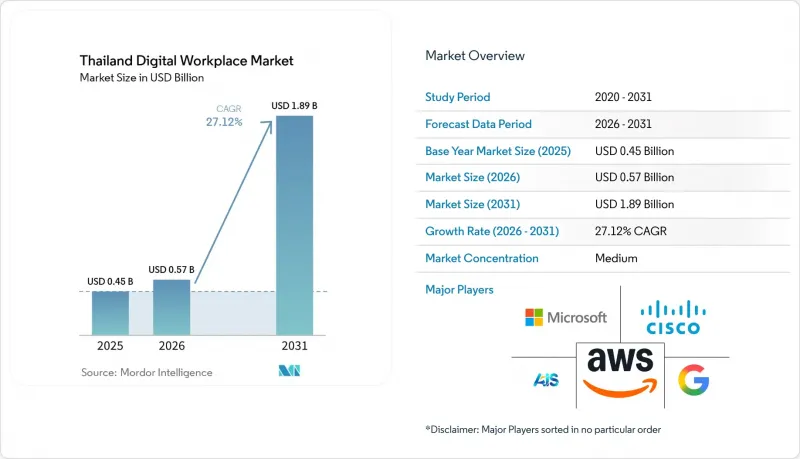
Mordor Intelligence에 의하면, 태국 디지털 워크플레이스 시장 규모는 2025년에 4억 5,000만 달러로 평가되었고 2026년 5억 7,000만 달러에서 2031년까지 18억 9,000만 달러에 이를 것으로 예측되며, 예측 기간(2026-2031년) CAGR은 27.12%를 나타낼 전망입니다.
본 보고서는 구성 요소(솔루션 및 서비스), 도입 형태(클라우드, On-Premise, 하이브리드), 조직 규모(대기업 및 중소기업), 최종 사용자 산업(IT 및 통신, 은행, 금융서비스 및 보험(BFSI), 의료, 제조, 소매, 정부·공공 부문, 에너지 및 유틸리티 등)별로 분류되어 있습니다. 시장 전망은 금액(달러) 기준으로 제시되어 있습니다.
태국 디지털 워크플레이스 시장 동향과 인사이트
태국 기업에서 하이브리드 근무 방식의 표준화가 진전되고 있습니다.
태국의 하이브리드 근무 방식은 일시적인 조치라는 범위를 넘어 많은 조직에서 정식 인력 정책의 일부로 자리 잡았으며, 이는 태국 디지털 워크플레이스 시장에서 뚜렷한 구매 동인으로 작용하고 있습니다. 2025년 태국의 고용주 702곳을 대상으로 실시된 조사에 따르면, 대기업에서 파트타임 정규직의 비율은 20%에서 42%로, 계약직 파트타임 직원의 비율은 19%에서 28%로 증가했으며, 이는 유연한 근무 형태가 노동 시장에 정착되고 있음을 보여줍니다. 이러한 변화로 인해 고용주는 더 이상 비공식적인 도구에 의존할 수 없게 되었으며, 사무실이나 원격 근무 환경을 불문하고 커뮤니케이션, 기기 관리, 업무 흐름의 연속성을 지원하는 통합 플랫폼이 필요해졌습니다. 마이크로소프트의 ‘Work Trend Index 2025”에 따르면, 태국 기업의 68%가 이미 비즈니스 프로세스 자동화를 위해 AI 에이전트 도입을 시작했으며, 이로 인해 워크플레이스 플랫폼은 단순한 기본 커뮤니케이션 계층이라기보다는 운영 계층에 가까운 위치를 차지하게 되었습니다. 또한 캐스카트 테크놀로지사의 보고서에 따르면, 2025년에는 태국의 기술 전문가 중 31%가 “주 2일은 출근, 주 3일은 재택근무”라는 근무 형태를 선호한다고 응답했으며, 이는 거점 간 안정적인 디지털 워크플레이스 인프라의 필요성을 뒷받침하는 것입니다.
방콕에 본사를 둔 기업의 ‘클라우드 우선”와 같은 워크플레이스의 갱신 주기
방콕의 기업 기반은 클라우드 전환과 밀접하게 연계된 워크플레이스 갱신 주기를 거치고 있으며, 이것이 태국의 디지털 워크플레이스 시장에서 수요를 견인하고 있습니다. Amazon Web Services(AWS)와 Google Cloud가 일본 내 클라우드 용량 제공을 시작하고, Microsoft가 인프라 투자를 발표함에 따라, 기업의 워크로드에서 발생하는 지연이나 로컬 데이터 처리에 대한 기존의 우려는 완화되었습니다. 크룬실리 은행은 AWS를 활용한 생성형 AI 도입을 통해 클라우드 전환 일정을 50% 이상 앞당겼습니다. 이는 워크플레이스의 현대화가 핵심 인프라의 변경 이후가 아니라, 그와 동시에 진행되고 있음을 보여줍니다. Google Cloud는 자사 플랫폼으로 전환하는 태국의 조직들이 예기치 못한 가동 중단 시간을 50% 이상 줄이고, 기술 비용을 평균 20% 이상 절감할 수 있다고 밝혔습니다. 이는 재무 부서 입장에서 플랫폼의 보다 광범위한 개편을 추진하는 직접적인 근거가 됩니다. 그 결과, 초기 클라우드 전환을 완료한 많은 기업들은 현재 구식 협업 도구, 엔드포인트 도구, 가상 데스크톱 도구를 보다 통합된 플랫폼으로 대체하는 단계에 있습니다.
PDPA로 인한 보안 심사 지연
태국의 PDPA(개인정보보호법)에 따라, 업무용 도구가 직원의 감시 데이터, 근태 기록, 통신 로그 또는 분석 결과를 처리하는 경우, 플랫폼 도입이 계속 지연되고 있습니다. 고용주는 각종 직원 데이터를 수집 및 이용의 법적 근거와 대조해야 하며, 이로 인해 본격적인 도입을 진행하기 전에 법적 및 운영상의 검토 작업이 추가됩니다. 2025년 1월에 발표된 ROPA(개인정보보호법) 적용 제외에 관한 공지는 중소기업에 일정한 구제책을 제공했지만, 조직이 AI가 탑재된 업무 도구를 평가할 때 부서 간에 걸쳐 규정 준수 점검을 수행해야 하는 광범위한 필요성을 없앤 것은 아닙니다. “PDPA 마스터플랜 2024-2027”는 태국이 규제 완화 단계로 넘어가는 것이 아니라, 여전히 데이터 보호 체계를 지속적으로 강화하고 있음을 보여줍니다. 이로 인해 태국의 디지털 워크플레이스 시장에서 도입 속도에 편차가 발생하게 되며, 구매자들은 광범위한 제품군 도입보다는 소규모의 포인트 솔루션을 선택하는 경향이 더욱 강해질 가능성이 있습니다.
부문별 분석
2025년, 솔루션은 태국 디지털 워크플레이스 시장의 72.43%를 차지하고 있으며, 이는 기업들이 독립형 서비스 제공보다 소프트웨어 정의 워크플레이스 아키텍처에 더 많은 예산을 할당하고 있음을 보여줍니다. 이 리드는 하이브리드 근무 환경 전반에 적용 가능한 통합형 커뮤니케이션, 엔드포인트, 워크플로우 및 직원 경험 플랫폼으로의 전환을 반영하고 있습니다. 솔루션 분야에서는 통합 커뮤니케이션 및 협업 도구의 보급이 가장 빠르게 진행되고 있습니다. 이는 기업들이 음성, 메시징, 회의와 같은 개별 제품들을 더 적은 수의 환경으로 통합하려고 하기 때문입니다. 로컬 클라우드의 용량 확대가 이러한 변화를 뒷받침하고 있으며, 이는 툴스택이 파편화된 상태로 유지되던 주된 원인이 해소되었기 때문입니다. 금융 서비스 업계에서는 카시콘 비즈니스 테크놀로지 그룹이 화웨이와 공동으로 고가용성 데이터센터 네트워킹을 도입한 사례가, 금융 기관들이 클라우드 기반 데스크톱 및 비즈니스 연속성 모델에 필요한 인프라를 구축하고 있음을 보여주고 있습니다.
서비스 분야는 여전히 규모가 작지만, 태국의 디지털 워크플레이스 산업이 초기 도입 단계에서 전환, 변경 관리, 규정 준수 대응, 최적화 단계로 나아가면서 그 역할은 확대되고 있습니다. 구매자들은 워크플레이스 플랫폼을 레거시 용도, 보안 프레임워크, 비즈니스 프로세스 규칙과 연동하기 위한 지원이 필요한 경우가 많기 때문에 전문 서비스에 대한 수요가 증가하고 있습니다. 액센츄어, IBM, 위프로, TCS, 인포시스 등 대형 시스템 통합 기업들은 업무가 단순히 도구 도입에 그치지 않고 운영 모델의 재설계까지 미치고 있기 때문에 이 부문을 중심으로 사업을 전개하고 있습니다. 또한, 워크플로우 자동화 및 지식 관리 도구의 중요성도 점점 더 높아지고 있습니다. 이는 이미 핵심 협업 플랫폼을 도입한 조직이 팀 간의 업무 흐름과 정보 접근성을 개선하고자 하기 때문입니다. 동시에, 태국의 디지털 워크플레이스 업계에서는 전체 제품군을 교체할 필요 없이 제조, 인사, 서비스 업무 분야의 특정 워크플로우 과제를 해결할 수 있는 특화형 솔루션에 대한 수요가 여전히 존재하고 있습니다.
2025년, 태국의 디지털 워크플레이스 시장에서 클라우드는 69.27%의 점유율을 차지하는 주요 도입 모델이며, 해당 시장의 클라우드 규모는 2031년까지 연평균 성장률(CAGR) 21.99%로 확대될 것으로 전망됩니다. 이 입지는 현지 하이퍼스케일 인프라 덕분에 태국 기업들이 현지 호스팅 옵션을 활용하면서도 세계적 수준의 클라우드 성능을 이용할 수 있게 됨에 따라 더욱 공고해졌습니다. Google Cloud의 방콕 리전에는 3개의 가용성 영역이 있으며, TalayLink 해저 케이블과의 통합을 통해 동남아시아 전역에서 저지연 협업 및 가상 데스크톱 워크로드를 지원합니다. 아마존 웹 서비스(Amazon Web Services) 역시 장기적인 인프라 구축의 일환으로 “AWS 아시아태평양(태국) 리전”를 개설했습니다. 이를 통해 기업은 업무용 용도과 데이터를 호스팅하기 위한 또 하나의 현지 옵션을 확보하게 됩니다. 이러한 움직임은 기업들이 인프라 기반을 현대화해 나가는 과정에서 구식 하이브리드형이나 On-Premise형 협업 도구가 재조명되면서, 보다 광범위한 업데이트 주기를 뒷받침하는 것입니다.
On-Premise 배포는 규제가 엄격한 환경에서 여전히 중요합니다. 이러한 환경에서 조직은 클라우드 기반 워크플레이스으로 더욱 전환하기 전에, 특정 인사, 통신 또는 모니터링 데이터에 대해 보다 엄격한 관리를 시행하고자 합니다. 하이브리드 아키텍처가 여전히 중요하게 여겨지는 이유는 기업이 기밀성이 높은 관리 지점을 사내 시스템에 남겨두면서도 분석, 협업, 워크플로우 도구를 클라우드에서 실행할 수 있기 때문입니다. 이러한 경향은 제조업이나 유틸리티 분야에서 두드러지게 나타납니다. 이러한 업계에서는 현장 업무나 사업 연속성에 대한 요구 사항이 완전한 클라우드 전환과 반드시 일치하지는 않기 때문입니다. 국내 클라우드 옵션 역시 일부 구매자의 의사 결정에 영향을 미치고 있습니다. 이는 현지에서 관리되는 인프라 덕분에 공공 부문 및 정부 관련 고객들의 망설임을 줄일 수 있기 때문입니다. 그 결과, 클라우드가 명백히 주도적인 위치를 차지하고 있음에도 불구하고, 태국의 디지털 워크플레이스 시장에서의 도입 여부는 여전히 보안 체계, 운영상의 복잡성, 그리고 내부 변화의 속도에 따라 좌우되고 있습니다.
기타 혜택:
- 엑셀 형식 시장 예측(ME) 시트
- 3개월간의 애널리스트 지원
목차
제1장 서론
제2장 조사 방법
제3장 주요 요약
제4장 시장 구도
제5장 시장 규모와 성장 예측
제6장 경쟁 구도
제7장 시장 기회와 향후 전망
JHSAccording to Mordor Intelligence, the thailand digital workplace market size was valued at USD 0.45 billion in 2025 and estimated to grow from USD 0.57 billion in 2026 to reach USD 1.89 billion by 2031, at a CAGR of 27.12% during the forecast period (2026-2031).
This report is Segmented by Component (Solutions, and Services), Deployment Mode (Cloud, On-Premises, and Hybrid), Organization Size (Large Enterprises, and Small and Medium-Sized Enterprises), End-User Industry (IT and Telecommunications, BFSI, Healthcare, Manufacturing, Retail, Government and Public Sector, Energy and Utilities, and More). The Market Forecasts are Provided in Terms of Value (USD).
Thailand Digital Workplace Market Trends and Insights
Rising Hybrid Work Standardization In Thai Enterprises
Hybrid work in Thailand has moved beyond a temporary arrangement and has become part of formal workforce policy in many organizations, which is creating a clear buying trigger for the Thailand digital workplace market. A 2025 survey of 702 Thai employers found that part-time permanent roles in large organizations rose from 20% to 42%, while contract part-time roles increased from 19% to 28%, which shows that flexible work structures are becoming embedded in the labor market. This shift means employers can no longer depend on informal tool use and now need unified platforms that support communication, device control, and workflow continuity across office and remote settings. Microsoft's Work Trend Index 2025 reported that 68% of Thai organizations had already started implementing AI agents to automate business processes, which places the workplace platform closer to an operating layer than a basic communication layer. Cathcart Technology also reported that 31% of Thai technology professionals preferred a 2-day onsite and 3-day remote pattern in 2025, which reinforces the need for stable digital workspace infrastructure across locations.
Cloud-First Workplace Refresh Cycles In Bangkok-Focused Enterprises
Bangkok's enterprise base is moving through a workplace refresh cycle that is closely tied to cloud migration, and this is strengthening demand in the Thailand digital workplace market. The launch of in-country cloud capacity by Amazon Web Services and Google Cloud, together with Microsoft's announced infrastructure investment, has reduced earlier concerns around latency and local data handling for enterprise workloads. Krungsri accelerated its cloud migration timeline by more than 50% through generative AI work with AWS, which shows that workplace modernization is now happening alongside core infrastructure change rather than after it. Google Cloud stated that Thai organizations migrating to its platform can cut unplanned downtime by over 50% and optimize technology spending by over 20% on average, which gives finance teams a direct case for broader platform renewal. As a result, many companies that have completed an initial cloud move are now in position to replace older collaboration, endpoint, and virtual desktop tools with more integrated platforms.
PDPA-Driven Security Review Delays
Thailand's PDPA continues to slow platform procurement when workplace tools handle employee monitoring data, attendance records, communication logs, or analytics outputs. Employers need to map each type of employee data to a lawful basis for collection and use, which adds legal and operational review work before a full deployment can proceed. Notifications on ROPA exemptions issued in January 2025 gave smaller firms some relief, but they did not remove the broader need for cross-functional compliance checks when organizations assess AI-enabled workplace tools. The PDPA Master Plan 2024-2027 signals that Thailand is still tightening its data protection framework rather than moving into a lighter enforcement phase. This keeps deployment speed uneven across the Thailand digital workplace market and can push buyers toward smaller point solutions instead of broad suite rollouts.
Other drivers and restraints analyzed in the detailed report include:
- Public Sector Digitization And Thailand 4.0 Programs
- AI-Ready Collaboration And Employee Experience Demand
- Fragmented Legacy Application Estates
For complete list of drivers and restraints, kindly check the Table Of Contents.
Segment Analysis
Solutions held 72.43% of the Thailand digital workplace market in 2025, which shows that enterprises are putting more of their budgets into software-defined workplace architecture than into stand-alone service delivery. This lead reflects the shift toward integrated communication, endpoint, workflow, and employee experience platforms that can be deployed across hybrid work settings. Unified communication and collaboration tools are moving fastest within the solutions-based because companies are trying to consolidate separate voice, messaging, and meeting products into fewer environments. Local cloud capacity has supported this change because it removes a major reason for keeping fragmented tool stacks in place. In financial services, the Kasikorn Business-Technology Group's deployment of high-availability data center networking with Huawei shows how institutions are building the underlying backbone needed for cloud-delivered desktop and workforce continuity models.
The services segment remains smaller, but its role is growing as the Thailand digital workplace industry moves from initial adoption into migration, change management, compliance readiness, and optimization work. Professional services demand is rising because buyers often need help linking workplace platforms to legacy applications, security frameworks, and business process rules. Large integrators such as Accenture, IBM, Wipro, TCS, and Infosys are positioned around this layer because the work now reaches beyond tool deployment and into operating model redesign. Workflow automation and knowledge management tools are also moving up the priority list because organizations that have already deployed core collaboration platforms are now trying to improve process flow and information access across teams. At the same time, the Thailand digital workplace industry still leaves room for focused solutions that address specific workflow gaps in manufacturing, HR, or service operations without requiring a full suite replacement.
Cloud was the leading deployment model in the Thailand digital workplace market in 2025 with a 69.27% share, and the cloud in the Thailand digital workplace market size is projected to grow at a 21.99% CAGR through 2031. This position has become stronger because local hyperscale infrastructure now gives Thai enterprises access to global-grade cloud performance with local hosting options. Google Cloud's Bangkok region includes three availability zones and integration with the TalayLink subsea cable, which supports low-latency collaboration and virtual desktop workloads across Southeast Asia. Amazon Web Services also launched the AWS Asia Pacific (Thailand) Region as part of a long-term infrastructure commitment, which gives enterprises another local path for hosting workplace applications and data. These moves support a broader replacement cycle in which older hybrid or on-premises collaboration tools are being reconsidered as companies modernize their infrastructure base.
On-premises deployment still matters in regulated settings where organizations want stricter control over selected HR, communications, or monitoring data before they move further into cloud-based workplace operations. Hybrid architecture remains relevant because it lets companies keep sensitive control points on internal systems while running analytics, collaboration, and workflow tools in the cloud. This pattern is visible in manufacturing and utilities where shop-floor operations and operational continuity needs do not always line up with a full cloud-only move. Domestic cloud options are also shaping some buyer decisions because locally governed infrastructure can reduce hesitation in public sector and state-adjacent accounts. As a result, cloud leads clearly, but deployment choice in the Thailand digital workplace market is still influenced by security posture, operating complexity, and the pace of internal change.
Complete Report Scope:
- By Component
- Solutions
- Unified Communication and Collaboration
- Unified Endpoint Management
- Enterprise Mobility and Management
- Employee Experience Platforms and Intranet
- Workflow Automation and Knowledge Management
- Virtual Desktop Infrastructure and Cloud PC
- Services
- Solutions
- Deployment Mode
- Cloud
- On-Premises
- Hybrid
- Organization Size
- Large Enterprises
- Small and Medium-Sized Enterprises
- End-User Industry
- IT and Telecommunications
- BFSI
- Healthcare
- Manufacturing
- Retail
- Government and Public Sector
- Education
- Energy and Utilities
- Legal and Professional Services
- Other End-User Industries
List of Companies Covered in this Report:
- Microsoft Corporation
- Google LLC
- Cisco Systems, Inc.
- Amazon Web Services, Inc.
- Cloud HM Company Limited
- AIS Business
- True Corporation Public Company Limited
- Broadcom Inc.
- Citrix Systems, Inc.
- Nutanix, Inc.
- Dell Technologies Inc.
- Hewlett Packard Enterprise Company
- Zoom Video Communications, Inc.
- RingCentral, Inc.
- 8x8, Inc.
- NEC Corporation
- Fujitsu Limited
- Accenture PLC
- Tata Consultancy Services Limited
- Infosys Limited
- Wipro Limited
- DXC Technology Company
- IBM Corporation
- SAP SE
- Oracle Corporation
- ServiceNow, Inc.
Additional Benefits:
- The market estimate (ME) sheet in Excel format
- 3 months of analyst support
TABLE OF CONTENTS
1 INTRODUCTION
- 1.1 Study Assumptions and Market Definition
- 1.2 Scope of the Study
2 RESEARCH METHODOLOGY
3 EXECUTIVE SUMMARY
4 MARKET LANDSCAPE
- 4.1 Market Overview
- 4.2 Market Drivers
- 4.2.1 Rising Hybrid Work Standardization in Thai Enterprises
- 4.2.2 Cloud-First Workplace Refresh Cycles in Bangkok-Focused Enterprises
- 4.2.3 Public Sector Digitization and Thailand 4.0 Programs
- 4.2.4 AI-Ready Collaboration and Employee Experience Demand
- 4.2.5 Cross-Platform Migration Pressure From Legacy Messaging and Endpoint Tools
- 4.2.6 Sector-Specific Compliance and Auditability Requirements
- 4.3 Market Restraints
- 4.3.1 PDPA-Driven Security Review Delays
- 4.3.2 Fragmented Legacy Application Estates
- 4.3.3 SME Budget Sensitivity for Multi-Tool Suites
- 4.3.4 Shortage of Workplace Modernization Skills and Change Managers
- 4.4 Impact of Macroeconomic Factors on the Market
- 4.5 Industry Value Chain Analysis
- 4.6 Regulatory Landscape
- 4.7 Technological Outlook
- 4.8 Porter's Five Forces Analysis
- 4.8.1 Threat of New Entrants
- 4.8.2 Bargaining Power of Buyers
- 4.8.3 Bargaining Power of Suppliers
- 4.8.4 Threat of Substitutes
- 4.8.5 Competitive Rivalry
5 MARKET SIZE AND GROWTH FORECASTS (VALUE)
- 5.1 By Component
- 5.1.1 Solutions
- 5.1.1.1 Unified Communication and Collaboration
- 5.1.1.2 Unified Endpoint Management
- 5.1.1.3 Enterprise Mobility and Management
- 5.1.1.4 Employee Experience Platforms and Intranet
- 5.1.1.5 Workflow Automation and Knowledge Management
- 5.1.1.6 Virtual Desktop Infrastructure and Cloud PC
- 5.1.2 Services
- 5.1.1 Solutions
- 5.2 Deployment Mode
- 5.2.1 Cloud
- 5.2.2 On-Premises
- 5.2.3 Hybrid
- 5.3 Organization Size
- 5.3.1 Large Enterprises
- 5.3.2 Small and Medium-Sized Enterprises
- 5.4 End-User Industry
- 5.4.1 IT and Telecommunications
- 5.4.2 BFSI
- 5.4.3 Healthcare
- 5.4.4 Manufacturing
- 5.4.5 Retail
- 5.4.6 Government and Public Sector
- 5.4.7 Education
- 5.4.8 Energy and Utilities
- 5.4.9 Legal and Professional Services
- 5.4.10 Other End-User Industries
6 COMPETITIVE LANDSCAPE
- 6.1 Market Concentration
- 6.2 Strategic Moves
- 6.3 Market Share Analysis
- 6.4 Company Profiles (includes Global Level Overview, Market Level Overview, Core Segments, Financials as available, Strategic Information, Market Rank/Share, Products and Services, Recent Developments)
- 6.4.1 Microsoft Corporation
- 6.4.2 Google LLC
- 6.4.3 Cisco Systems, Inc.
- 6.4.4 Amazon Web Services, Inc.
- 6.4.5 Cloud HM Company Limited
- 6.4.6 AIS Business
- 6.4.7 True Corporation Public Company Limited
- 6.4.8 Broadcom Inc.
- 6.4.9 Citrix Systems, Inc.
- 6.4.10 Nutanix, Inc.
- 6.4.11 Dell Technologies Inc.
- 6.4.12 Hewlett Packard Enterprise Company
- 6.4.13 Zoom Video Communications, Inc.
- 6.4.14 RingCentral, Inc.
- 6.4.15 8x8, Inc.
- 6.4.16 NEC Corporation
- 6.4.17 Fujitsu Limited
- 6.4.18 Accenture PLC
- 6.4.19 Tata Consultancy Services Limited
- 6.4.20 Infosys Limited
- 6.4.21 Wipro Limited
- 6.4.22 DXC Technology Company
- 6.4.23 IBM Corporation
- 6.4.24 SAP SE
- 6.4.25 Oracle Corporation
- 6.4.26 ServiceNow, Inc.
7 MARKET OPPORTUNITIES AND FUTURE OUTLOOK
- 7.1 White-Space and Unmet-Need Assessment