|
시장보고서
상품코드
2073267
아시아태평양의 디지털 워크플레이스 : 시장 점유율 분석, 업계 동향 및 통계, 성장 예측(2026-2031년)Asia-Pacific Digital Workplace - Market Share Analysis, Industry Trends & Statistics, Growth Forecasts (2026 - 2031) |
||||||
 Mordor Intelligence
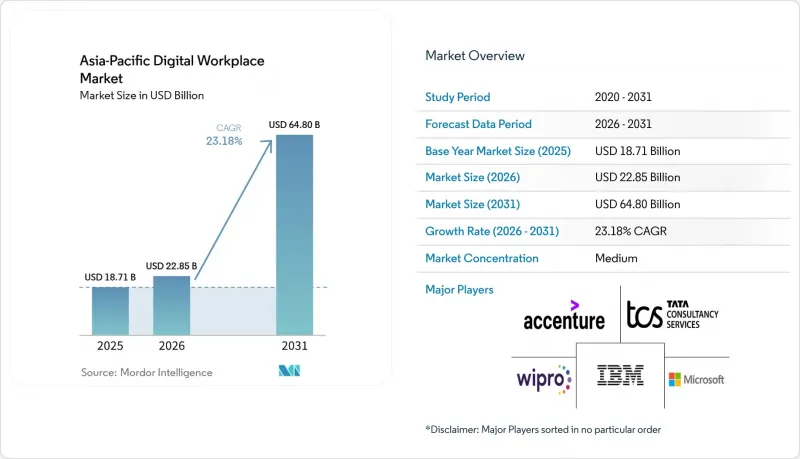
Mordor Intelligence에 의하면, 아시아태평양의 디지털 워크플레이스 시장 규모는 2025년 187억 1,000만 달러로 평가되었습니다. 2026년에는 228억 5,000만 달러로 확대되어 2026년부터 2031년에 걸쳐 CAGR 23.18%로 성장을 지속하여, 2031년에는 648억 달러에 이를 것으로 예측됩니다.
본 보고서는 구성 요소(솔루션 및 서비스), 도입 형태(클라우드, On-Premise 등), 조직 규모(대기업 및 중소기업), 최종 사용자 산업 분야(IT 및 통신, 의료, 제조, 소매, 정부·공공 부문, 교육 등) 및 지역별로 분류되어 있습니다. 시장 전망은 금액(달러) 기준으로 제시되어 있습니다.
아시아태평양의 디지털 워크플레이스 시장 동향 및 인사이트
대기업에서의 하이브리드 근무 방식의 정착
하이브리드 근무 방식은 일시적인 조치의 범위를 넘어, 현재 해당 지역의 대기업에서 장기적인 업무 공간 설계를 형성하고 있습니다. 이에 따라 아시아태평양의 디지털 워크플레이스 시장은 호황을 누리고 있습니다. 그 배경에는 기업이 사무실이나 원격 환경을 불문하고 일관된 협업, 기기 관리, 워크플로우 접근성 및 직원 지원을 필요로 하고 있다는 점이 있습니다. 기업의 요구는 화상 회의나 메시징에 그치지 않고, 지식, 승인, 서비스 요청, 팀 간 협력을 하나로 묶어주는 ‘"접속 계층"에 대한 수요가 증가하는 추세이기 때문에 수요 패턴은 더 이상 이에 국한되지 않게 되었습니다. 마이크로소프트는 '2026년 업무 동향 지수'에서 기업들이 AI를 활용한 업무를 중심으로 운영 모델을 재구축하고 있다고 밝히며, 분산된 팀과 워크플로우 간의 협력을 지원하는 디지털 도구의 필요성을 강조하고 있습니다. 이러한 동향은 아시아태평양의 디지털 워크플레이스 시장에 있어 중요합니다. 왜냐하면, 사무실 출근을 의무화하고 있는 기업이라 하더라도 직원들이 물리적 업무와 디지털 업무 사이를 원활하게 오갈 수 있어야 한다는 점이 여전히 요구되고 있기 때문입니다. 그 결과, 단일 운영 환경 내에서 커뮤니케이션, 지식 접근, 워크플로우의 연속성을 지원할 수 있는 플랫폼에 대한 투자가 계속해서 이루어지고 있습니다.
클라우드 호스팅형 직원 경험 스택으로의 전환
기업들이 정기적인 업그레이드 주기를 통해 제공되는 것이 아니라 지속적으로 업데이트되는 디지털 워크플레이스 플랫폼을 점점 더 선호함에 따라, 클라우드 도입이 가속화되고 있습니다. 이로 인해 AI 기능, 정책 변경, 보안 제어가 SaaS 기반 환경을 통해 보다 효율적으로 제공됨에 따라, 아시아태평양의 디지털 워크플레이스 시장이 강화되고 있습니다. 마이크로소프트는 2026년 6월, 인포시스, TCS, 위프로가 공동으로 6개월도 채 되지 않는 기간 동안 30만 명 이상의 직원을 대상으로 Microsoft 365 Copilot을 도입했다고 보고했습니다. 이는 비즈니스상의 이점이 명확하다면, 대기업들이 클라우드 기반 업무용 소프트웨어를 얼마나 신속하게 표준화하고 있는지를 보여줍니다. 이러한 도입 속도는 소프트웨어 도입 현황뿐만 아니라 업무 환경의 생산성, 거버넌스, AI 접근과 관련된 클라우드 서비스에 대한 신뢰도 반영하고 있기 때문에 중요한 의미를 지닙니다. 아시아태평양의 디지털 워크플레이스 시장은 규제 대상인 많은 구매자들이 클라우드를 관리상의 타협이 아닌, 더 신속한 도입과 관리 간소화로 이어지는 현실적인 수단으로 인식하게 되었습니다는 사실에 힘입어 성장하고 있습니다. 이에 따라 클라우드에서 호스팅되는 직원 경험 스택은 대기업과 신흥 중견 기업 모두에서 플랫폼 선정의 핵심 요소로 자리 잡고 있습니다.
구식 ID, 기기, 용도의 난립
많은 기업이 여전히 신원, 기기, 용도 각 계층이 연동되지 않은 상태로 운영되고 있기 때문에 레거시 시스템의 확산은 업무 환경 혁신의 큰 걸림돌이 되고 있습니다. 이로 인해 아시아태평양의 디지털 워크플레이스 시장은 위축되고 있습니다. 왜냐하면, 도입 기업은 새로운 업무 환경 플랫폼의 가치를 충분히 실현하기 전에, 기반이 되는 기술 환경을 정비하는 데 주력해야 하는 경우가 많기 때문입니다. IBM은 2026년 6월, ServiceNow와의 제휴 확대가 특히 레거시 용도의 현대화와 기업 데이터 정비를 목표로 하고 있다고 발표했습니다. 이는 인프라의 정리 및 정돈이 AI나 업무 환경의 대규모 도입에 있어 여전히 현실적인 장벽으로 남아 있음을 시사합니다. 이 문제는 단순히 기술적인 문제만은 아닙니다. 시스템의 무분별한 확장은 정책 표준화를 지연시키고, 지원 부담을 가중시키며, 팀이나 국가를 초월한 사용자 경험의 일관성을 해치기 때문입니다. HCLTech가 2026년 1월에 Team Global Express와 진행한 프로젝트에서도, 보다 광범위한 서비스 혁신을 추진하기 전에 멀티 벤더 환경을 통합할 필요성이 부각되었습니다. 더 많은 조직이 이러한 복잡성을 완화할 때까지는 아시아태평양의 디지털 워크플레이스 시장이 도입 주기의 지연과 도입 성과에 대한 편차를 계속해서 겪게 될 것입니다.
부문별 분석
2025년, 솔루션은 아시아태평양의 디지털 워크플레이스 시장의 68.26%를 차지했습니다. 이는 소프트웨어 플랫폼이 구매자가 업무 환경을 현대화하는 데 있어 여전히 핵심적인 기반임을 보여줍니다. 이러한 우위는 기업들이 개별적인 포인트 제품이 아닌, 단일 아키텍처 내에서 커뮤니케이션, 워크플로우 자동화, 지식 접근 및 직원 지원을 관리하는 통합 도구를 선호하는 경향을 반영합니다. 아시아태평양의 디지털 워크플레이스 시장에서 솔루션에 대한 수요는 통합 커뮤니케이션, 직원 경험 플랫폼, 워크플로우 자동화, 인트라넷 기능, 그리고 일상적인 생산성과 체계적인 서비스 제공을 모두 지원하는 지식 관리 영역에 집중되어 있습니다. 사용자가 컨텍스트를 전환하지 않고도 작업 간을 이동할 수 있게 됨으로써 워크플레이스 플랫폼의 가치가 높아지기 때문에 구매자들은 이러한 기능들이 하나의 통합된 시스템으로 작동하기를 점점 더 요구하고 있습니다. 따라서, 특히 여러 사업 부문이나 국가에 걸쳐 운영 모델을 표준화하고 있는 기업들에서 이 솔루션 카테고리는 아시아태평양의 디지털 워크플레이스 시장에서 여전히 가장 큰 비중을 차지하고 있습니다.
또한, 디지털 워크플레이스 프로그램이 엔드포인트 제어, 워크플로우 라우팅, AI 기반 지원까지 확대됨에 따라 솔루션 구성도 다양해지고 있습니다. 분산된 팀을 대상으로 안전한 액세스, 정책의 일관성, 관리 간소화를 원하는 고객들 사이에서 가상 데스크톱 인프라(VDI)와 클라우드 PC 도구가 다시 주목받고 있습니다. 기업들이 디바이스, ID, 용도를 서로 분리된 상태로 병행 관리하는 것이 아니라 유기적으로 연계하여 운영하기를 요구함에 따라, 통합 엔드포인트 관리는 협업 및 워크플로우 플랫폼과 점점 더 밀접하게 연계되고 있습니다. 아시아태평양의 디지털 워크플레이스 시장에서 서비스 분야의 규모는 여전히 작지만, 도입 규모, 통합 요구 사항 및 변경 관리 요건이 복잡해지면서 사내 팀만으로는 대응하기 어려운 경우, 그 중요성은 변함없습니다. HCLTech가 2026년 1월에 Team Global Express사와 체결한 계약은 단일 관리형 업무 환경 계약을 활용함으로써 공급업체 통합, 지원 간소화, 그리고 대규모 조직 전반에 걸쳐 보다 통일된 운영 환경을 구축할 수 있음을 보여줍니다.
2025년, 클라우드는 아시아태평양의 디지털 워크플레이스 시장의 64.83%를 차지했으며, 2031년까지 연평균 성장률(CAGR) 23.72%로 확대될 것으로 전망됩니다. 이는 클라우드가 대부분의 새로운 업무 환경 도입에서 표준적인 선택지가 되고 있음을 뒷받침합니다. 그 주된 이유는 클라우드 환경이라면 On-Premise 모델이 일반적으로 지원할 수 있는 범위보다 더 신속하게 AI 기능 도입, 정책 변경, 협업 기능 개선을 실현할 수 있기 때문입니다. 아시아태평양의 디지털 워크플레이스 시장에서 이것이 중요한 이유는 사용자의 행동, 거버넌스 규정, AI 활용 사례가 변화함에 따라 업무 환경 도구도 지속적으로 발전해야 하기 때문입니다. 또한, 클라우드 도입을 통해 벤더는 현지에서 긴 업그레이드 주기를 거치지 않고도 대규모 사용자 기반 전체에 걸쳐 제품의 성능을 유지하고 새로운 기능을 제공할 수 있는 보다 직접적인 수단을 확보할 수 있습니다. 이러한 이점은 운영 성숙도가 각기 다른 여러 국가에서 디지털 직원 경험 프로그램을 확대하려는 기업이 있는 지역에서 특히 중요합니다.
클라우드 표준화의 속도는 기업의 동향에서도 엿볼 수 있습니다. 마이크로소프트는 2026년 6월, 인포시스, TCS, 위프로가 공동으로 6개월도 채 되지 않는 기간 동안 30만 명 이상의 직원에게 Microsoft 365 Copilot을 도입했다고 보고했습니다. 이는 기업 수요와 플랫폼의 준비 상태가 맞아떨어졌을 때, 클라우드 기반 업무 환경 도구가 얼마나 신속하게 도입될 수 있는지를 보여줍니다. On-Premise 구축은 데이터 취급 규정이 여전히 엄격하고 내부 통제 요건의 변경이 어려운 정부 기관이나 규제가 엄격한 일부 업계에서 여전히 그 중요성을 유지하고 있습니다. 따라서 하이브리드 전개는 아시아태평양의 디지털 워크플레이스 시장에서 특히 일부 로컬 워크로드를 유지하면서 단계적으로 현대화를 추진하고 있는 대기업에게 계속해서 전환 모델로서의 역할을 수행하고 있습니다.
기타 혜택 :
- 엑셀 형식 시장 예측(ME) 시트
- 3개월간의 애널리스트 지원
자주 묻는 질문
목차
제1장 서론
제2장 조사 방법
제3장 주요 요약
제4장 시장 구도
제5장 시장 규모 및 성장 예측
제6장 경쟁 구도
제7장 시장 기회 및 향후 전망
KTH 26.07.07According to Mordor Intelligence, the asia-Pacific digital workplace market size is expected to grow from USD 18.71 billion in 2025 to USD 22.85 billion in 2026 and is forecast to reach USD 64.8 billion by 2031 at 23.18% CAGR over 2026-2031.
This report is Segmented by Component (Solutions, and Services), Deployment Mode (Cloud, On-Premises, and More), Organization Size (Large Enterprises, and Small and Medium-Sized Enterprises), End-User Industry (IT and Telecommunications, Healthcare, Manufacturing, Retail, Government and Public Sector, Education, and More), and Geography. The Market Forecasts are Provided in Terms of Value (USD).
Asia-Pacific Digital Workplace Market Trends and Insights
Hybrid Work Permanence Across Large Enterprises
Hybrid work has moved beyond a temporary policy and now shapes long-term workplace design across large organizations in the region. This is keeping the Asia-Pacific digital workplace market active because enterprises need consistent collaboration, device management, workflow access, and employee support across office and remote settings. The demand pattern is no longer limited to video meetings or messaging, because companies increasingly want a connected layer that links knowledge, approvals, service requests, and team coordination. Microsoft stated in its 2026 Work Trend Index that firms are rebuilding their operating models around AI-enabled work, underscoring the need for digital tools that support coordination across distributed teams and workflows. This trend is important for the Asia-Pacific digital workplace market because firms with fixed office attendance still need employees to move between physical and digital tasks without friction. As a result, spending remains focused on platforms that can support communication, knowledge access, and workflow continuity in a single operating environment.
Shift To Cloud-Hosted Employee Experience Stacks
Cloud deployment is gaining ground as enterprises increasingly seek digital workplace platforms that are continuously updated rather than delivered through periodic upgrade cycles. This is strengthening the Asia-Pacific digital workplace market because AI functionality, policy changes, and security controls are now delivered more efficiently through SaaS-native environments. Microsoft reported in June 2026 that Infosys, TCS, and Wipro together scaled Microsoft 365 Copilot to more than 300,000 employees in under six months, demonstrating how quickly large organizations are standardizing on cloud-based workplace software when the business case is clear. That pace of rollout matters because it reflects not only software adoption, but also confidence in cloud delivery for workplace productivity, governance, and AI access. The Asia-Pacific digital workplace market is also supported by the fact that many regulated buyers now see cloud as a practical route to faster deployment and simpler administration rather than a compromise on control. This makes cloud-hosted employee experience stacks central to platform selection across both large enterprises and emerging mid-market buyers.
Legacy Identity, Device, and Application Sprawl
Legacy sprawl remains a major brake on workplace transformation because many enterprises still operate with disconnected identity, device, and application layers. This weakens the Asia-Pacific digital workplace market because buyers often need to address the underlying technology estate before they can fully realize the value of new workplace platforms. IBM said in June 2026 that its expanded work with ServiceNow is specifically targeting legacy application modernization and enterprise data readiness, indicating that foundational cleanup remains a real barrier to scaled AI and workplace deployment. The problem is not only technical, because sprawl also slows policy standardization, increases support effort, and makes user experience less consistent across teams and countries. HCLTech's January 2026 engagement with Team Global Express also highlighted the need to consolidate a multi-vendor environment before broader service transformation could move ahead. Until more organizations reduce this complexity, the Asia-Pacific digital workplace market will continue to face slower implementation cycles and uneven adoption outcomes.
Other drivers and restraints analyzed in the detailed report include:
- Security-First Workspace Consolidation
- AI-Enabled Workflow Orchestration and Knowledge Access
- Integration Debt Across Collaboration and Workflow Tools
For complete list of drivers and restraints, kindly check the Table Of Contents.
Segment Analysis
Solutions captured 68.26% of the Asia-Pacific digital workplace market in 2025, which shows that software platforms remain the primary layer through which buyers are modernizing workplace environments. This dominance reflects the enterprise's preference for integrated tools that manage communication, workflow automation, knowledge access, and employee support within a single architecture rather than through separate point products. In the Asia-Pacific digital workplace market, solution demand centers on unified communications, employee experience platforms, workflow automation, intranet capabilities, and knowledge management layers that support both daily productivity and structured service delivery. Buyers increasingly want these capabilities to work as a single, connected system because the value of a workplace platform rises when users can move between tasks without switching context. That is why the solutions category continues to hold the largest weight in the Asia-Pacific digital workplace market, especially in enterprises that are standardizing operating models across multiple business units and countries.
The solutions mix is also broadening, as digital workplace programs now touch endpoint control, workflow routing, and AI-assisted support. Virtual desktop infrastructure and cloud PC tools are drawing renewed attention where clients want secure access, policy consistency, and simpler management for distributed teams. Unified endpoint management is increasingly linked to collaboration and workflow platforms, as enterprises seek device, identity, and application controls to work together rather than in parallel silos. The services side of the Asia-Pacific digital workplace market remains smaller, but it remains important when deployment scale, integration needs, and change management requirements become too complex for internal teams to handle alone. HCLTech's January 2026 engagement with Team Global Express shows how a single managed workplace scope can be used to consolidate vendors, simplify support, and create a more unified operating environment across a large organization
Cloud held 64.83% of the Asia-Pacific digital workplace market in 2025 and is projected to expand at a 23.72% CAGR through 2031, confirming that cloud has become the default route for most new workplace deployments. The main reason is that cloud environments allow enterprises to introduce AI features, policy changes, and collaboration improvements faster than on-premises models can typically support. In the Asia-Pacific digital workplace market, this matters because workplace tools must evolve continuously as user behavior, governance rules, and AI use cases change. Cloud deployment also gives vendors a more direct way to maintain product performance and deliver new functionality across large user bases without long local upgrade cycles. These advantages are especially relevant in regions where firms are trying to scale digital employee experience programs across multiple countries with different operational maturity levels.
The pace of cloud standardization is visible in enterprise behavior. Microsoft reported in June 2026 that Infosys, TCS, and Wipro together expanded Microsoft 365 Copilot to more than 300,000 employees in under six months, demonstrating how quickly cloud-based workplace tools can be rolled out when enterprise demand aligns with platform readiness. On-premises deployment still has relevance in parts of government and highly regulated industries where data-handling rules remain strict and internal control requirements are harder to change. Hybrid deployment, therefore, continues to function as a transition model in the Asia-Pacific digital workplace market, especially for large enterprises that are modernizing gradually while keeping some local workloads in place.
Complete Report Scope:
- By Component
- Solutions
- Unified Communication and Collaboration
- Unified Endpoint Management
- Enterprise Mobility and Management
- Employee Experience Platforms and Intranet
- Workflow Automation and Knowledge Management
- Virtual Desktop Infrastructure and Cloud PC
- Services
- Solutions
- By Deployment Mode
- Cloud
- On-Premises
- Hybrid
- By Organization Size
- Large Enterprises
- Small and Medium-sized Enterprises
- By End-User Industry
- IT and Telecommunications
- BFSI
- Healthcare
- Manufacturing
- Retail
- Government and Public Sector
- Education
- Energy and Utilities
- Legal and Professional Services
- Other End-User Industries
- By Geography
- China
- Japan
- India
- South Korea
- Australia and New Zealand
- Southeast Asia
- Rest of Asia-Pacific
List of Companies Covered in this Report:
- IBM Corporation
- Microsoft Corporation
- Accenture PLC
- Tata Consultancy Services Limited
- Wipro Limited
- Cognizant Technology Solutions Corporation
- HCL Technologies Limited
- NTT DATA Group Corporation
- Infosys Limited
- DXC Technology Company
- Fujitsu Limited
- Hewlett Packard Enterprise Company
- Capgemini SE
- Kyndryl Holdings, Inc.
- Unisys Corporation
- Citrix Systems, Inc.
- Atlassian Corporation
- Salesforce, Inc.
- ServiceNow, Inc.
- Kissflow Inc.
- Simpplr Inc.
Additional Benefits:
- The market estimate (ME) sheet in Excel format
- 3 months of analyst support
TABLE OF CONTENTS
1 INTRODUCTION
- 1.1 Study Assumptions and Market Definition
- 1.2 Scope of the Study
2 RESEARCH METHODOLOGY
3 EXECUTIVE SUMMARY
4 MARKET LANDSCAPE
- 4.1 Market Overview
- 4.2 Impact of Macroeconomic Factors on the Market
- 4.3 Market Drivers
- 4.3.1 Hybrid Work Permanence Across Large Enterprises
- 4.3.2 Shift to Cloud-Hosted Employee Experience Stacks
- 4.3.3 Security-First Workspace Consolidation
- 4.3.4 AI-Enabled Workflow Orchestration and Knowledge Access
- 4.3.5 Frontline Worker Digitization in Asset-Intensive Industries
- 4.3.6 Outcome-Based Procurement for Digital Employee Experience
- 4.4 Market Restraints
- 4.4.1 Legacy Identity, Device, and Application Sprawl
- 4.4.2 Integration Debt Across Collaboration and Workflow Tools
- 4.4.3 Skills Gaps in DEX Administration and Adoption Governance
- 4.4.4 Privacy, Sovereignty, and Cross-Border Data Concerns
- 4.5 Industry Value Chain Analysis
- 4.6 Regulatory Landscape
- 4.7 Technological Outlook
- 4.8 Porter's Five Forces Analysis
- 4.8.1 Bargaining Power of Buyers
- 4.8.2 Bargaining Power of Suppliers
- 4.8.3 Threat of New Entrants
- 4.8.4 Threat of Substitutes
- 4.8.5 Intensity of Competitive Rivalry
5 MARKET SIZE AND GROWTH FORECASTS (VALUE)
- 5.1 By Component
- 5.1.1 Solutions
- 5.1.1.1 Unified Communication and Collaboration
- 5.1.1.2 Unified Endpoint Management
- 5.1.1.3 Enterprise Mobility and Management
- 5.1.1.4 Employee Experience Platforms and Intranet
- 5.1.1.5 Workflow Automation and Knowledge Management
- 5.1.1.6 Virtual Desktop Infrastructure and Cloud PC
- 5.1.2 Services
- 5.1.1 Solutions
- 5.2 By Deployment Mode
- 5.2.1 Cloud
- 5.2.2 On-Premises
- 5.2.3 Hybrid
- 5.3 By Organization Size
- 5.3.1 Large Enterprises
- 5.3.2 Small and Medium-sized Enterprises
- 5.4 By End-User Industry
- 5.4.1 IT and Telecommunications
- 5.4.2 BFSI
- 5.4.3 Healthcare
- 5.4.4 Manufacturing
- 5.4.5 Retail
- 5.4.6 Government and Public Sector
- 5.4.7 Education
- 5.4.8 Energy and Utilities
- 5.4.9 Legal and Professional Services
- 5.4.10 Other End-User Industries
- 5.5 By Geography
- 5.5.1 China
- 5.5.2 Japan
- 5.5.3 India
- 5.5.4 South Korea
- 5.5.5 Australia and New Zealand
- 5.5.6 Southeast Asia
- 5.5.7 Rest of Asia-Pacific
6 COMPETITIVE LANDSCAPE
- 6.1 Market Concentration
- 6.2 Strategic Moves
- 6.3 Market Share Analysis
- 6.4 Company Profiles (includes Global Level Overview, Market Level Overview, Core Segments, Financials as available, Strategic Information, Market Rank/Share, Products and Services, Recent Developments)
- 6.4.1 IBM Corporation
- 6.4.2 Microsoft Corporation
- 6.4.3 Accenture PLC
- 6.4.4 Tata Consultancy Services Limited
- 6.4.5 Wipro Limited
- 6.4.6 Cognizant Technology Solutions Corporation
- 6.4.7 HCL Technologies Limited
- 6.4.8 NTT DATA Group Corporation
- 6.4.9 Infosys Limited
- 6.4.10 DXC Technology Company
- 6.4.11 Fujitsu Limited
- 6.4.12 Hewlett Packard Enterprise Company
- 6.4.13 Capgemini SE
- 6.4.14 Kyndryl Holdings, Inc.
- 6.4.15 Unisys Corporation
- 6.4.16 Citrix Systems, Inc.
- 6.4.17 Atlassian Corporation
- 6.4.18 Salesforce, Inc.
- 6.4.19 ServiceNow, Inc.
- 6.4.20 Kissflow Inc.
- 6.4.21 Simpplr Inc.
7 MARKET OPPORTUNITIES AND FUTURE OUTLOOK
- 7.1 White-Space and Unmet-Need Assessment