

|
시장보고서
상품코드
2098541
AI 가속기 메모리 시장 : 점유율 분석, 업계 동향 및 통계, 성장 예측(2026-2031년)AI Accelerator Memory - Market Share Analysis, Industry Trends & Statistics, Growth Forecasts (2026 - 2031) |
||||||
 Mordor Intelligence
Mordor Intelligence에 의하면, AI 가속기 메모리 시장 규모는 2025년 382억 9,000만 달러에서 2026년에는 537억 4,000만 달러로 확대되어 2026년부터 2031년까지 CAGR 25.27%로 성장을 지속하여, 2031년에는 1,657억 9,000만 달러에 이를 것으로 예측됩니다.
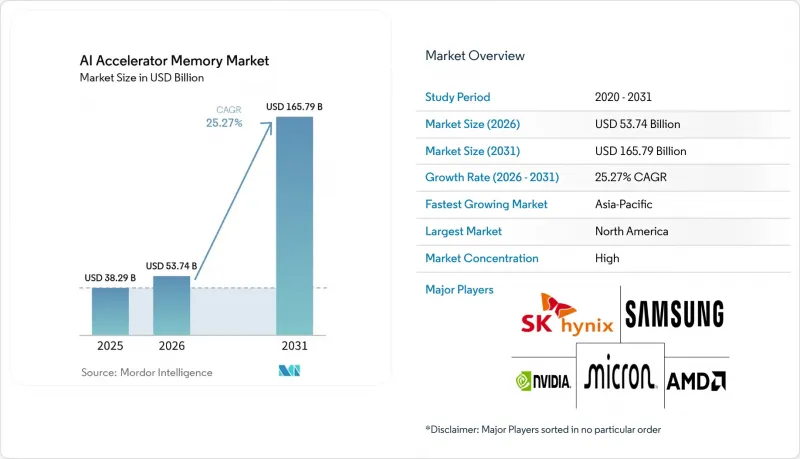
본 보고서는 메모리 아키텍처(HBM 등), 가속기 플랫폼(데이터센터용 GPU 가속기 등), HBM 세대(HBM2 및 HBM2E 등), HBM 스택 높이(최대 4단 등), HBM 스택당 용량(최대 8 GB 등), 배포 플랫폼(하이퍼스케일 클라우드 및 AI 팩토리 등), 그리고 지역별로 분류되어 있습니다. 시장 전망은 금액(달러) 기준으로 제시되어 있습니다.
전 세계 AI 가속기 메모리 시장 동향 및 인사이트
AI 가속기에서의 HBM3E 및 HBM4 채택 확대
AI 가속기 메모리 시장은 HBM 각 세대의 업그레이드 혜택을 받고 있습니다. 이는 고성능화에 따라 제조 공정의 복잡화와 판매 가격 상승이 수반되기 때문입니다. SK하이닉스는 자사의 HBM3E가 핀당 최대 9.6Gbps, 대역폭 1.23 TB/s 이상을 달성했다고 발표했으며, 이는 현재의 AI 가속기가 더욱 고밀도이자 고속의 메모리 구성으로 지속적으로 전환되고 있는 이유를 뒷받침합니다. Samsung Electronics는 2026년 2월, 1c DRAM 공정과 4nm 로직 기반 다이를 활용한 HBM4의 양산을 시작했다고 발표하며, 시장이 이미 다음 인증 주기로 전환되기 시작했음을 시사했습니다. 엔비디아는 2026년 6월, 삼성, SK하이닉스, 마이크론 각사가 자사의 베라 루빈(Vera Rubin) 플랫폼 인증을 획득하고 생산을 시작했음을 확인했습니다. 이를 통해 공급업체의 준비 상황에 대한 불확실성이 완화되고, 차세대 가속기의 양산을 위한 공급 기반이 확대될 것입니다. 따라서 AI 가속기 메모리 시장이 확대되고 있는 것은 단위 수요가 증가하고 있을 뿐만 아니라, HBM4 및 HBM4E로의 전환이 있을 때마다 수익 성장이 더 정교하고 비용이 많이 드는 제조 공정으로 이어지기 때문이기도 합니다.
AI 훈련 및 추론에서의 연산 밀도 상승
AI 가속기 메모리 시장은 훈련과 추론 모두에서 칩 1개당 필요한 메모리 용량과 대역폭이 꾸준히 증가하고 있는 점에 힘입어 성장하고 있습니다. 구글은 2026년 4월, 칩 1개당 288GB의 HBM과 8,601GB/s를 갖춘 TPU 8i를 발표함과 동시에 온칩 SRAM을 3배인 384MB로 증설하여, 단일 제품 주기 내에서 메모리 집약도가 얼마나 높아졌는지를 입증했습니다. NVIDIA의 Vera Rubin 플랫폼은 가속기당 576GB의 HBM4 구성을 채택함으로써 이러한 추세를 더욱 가속화했습니다. 이는 장문맥 모델과 대규모 워킹 세트가 여전히 최소 메모리 요구 사항을 계속 높이고 있음을 보여줍니다. JEDEC의 LPDDR6 로드맵 역시 엣지 시스템조차 메모리 내 처리(PIM) 지원을 포함한 더 진보된 메모리 기능으로 전환되고 있음을 보여주며, 이는 데이터 마이그레이션을 줄이고 로컬 추론의 효율을 높이려는 광범위한 압력을 반영합니다. AI 가속기의 메모리 시장에서 이는 모델 효율이 향상되더라도 가속기당 메모리 용량이 증가하고 있음을 의미합니다. 컨텍스트 윈도우의 장기화와 추론 파이프라인의 복잡화로 인해 추가적인 대역폭과 용량이 계속해서 소모되기 때문입니다.
패키지 수준에서의 엄격한 열 설계 및 수율 제약
AI 가속기 메모리 시장은 중대한 기술적 제약에 직면해 있습니다. 층 수가 증가하고 로직 다이가 베이스 구조에 통합됨에 따라 열 관리가 더욱 어려워지고 있습니다. 삼성의 HBM4 양산 개시 및 업계 내 스택 높이 증가 추세는 메모리 벤더들이 인증 및 신뢰성 한계 내에서 고밀도화를 도모하고 있음을 보여줍니다. 상용화는 세대가 거듭될수록 정의된 열 및 성능 임계값을 충족하는 데 달려 있기 때문에 JEDEC 규격은 여전히 중요합니다. 마이크론과 마벨은 모두 데이터 마이그레이션량과 인터페이스 전력 소비를 줄이기 위한 메모리 아키텍처 변경을 강조하고 있으며, 이는 이 과제가 단순한 공급량 부족에 그치지 않고 패키지 수준의 실현 가능성까지 미치고 있음을 뒷받침합니다. 따라서 새로운 적층 높이와 새로운 로직 공정의 조합으로 인해 수율이 상용화 목표치에 미치지 못할 경우, 인공지능(AI) 가속기 메모리 시장은 예상보다 완만한 양산 확대에 직면할 위험을 계속해서 안고 있습니다.
부문 분석
2025년 AI 가속기 메모리 시장에서 메모리 아키텍처별 점유율의 92.48%를 HBM이 차지하고 있으며, 이는 주요 AI 가속기가 여전히 매우 높은 대역폭과 고밀도 온패키지 메모리에 의존하고 있음을 뒷받침합니다. 구글의 Ironwood TPU는 칩당 7,370 GB/s의 HBM3E를 8스택 탑재하고 있으며, 후속 모델인 TPU 8i에서는 칩당 288 GB로 성능을 8,601 GB/s까지 향상시켰습니다. 이는 HBM이 최첨단 시스템에서 여전히 기본 설계 옵션으로 남아 있는 이유를 보여줍니다. GDDR은 시스템 설계자가 여전히 성능과 통합 비용의 균형을 고려하고 있는 저비용 추론용 GPU 및 워크스테이션용 카드에서 그 역할을 유지했습니다. 또한 DDR은 하이브리드 AI 서버에서 CPU에 연결된 기능, 특히 가속기가 광범위한 엔터프라이즈용 컴퓨팅 인프라와 함께 도입되는 경우에도 여전히 중요한 역할을 수행하고 있습니다. AI 가속기 메모리 시장에서 HBM과 기타 아키텍처 구성 간에 나타나는 이러한 큰 격차는 현재의 데이터센터 AI가 대역폭을 대량으로 소비하는 가속기 패키지에 얼마나 크게 의존하고 있는지를 반영합니다.
LPDDR은 가장 빠르게 성장하는 하위 부문으로, 2026년부터 2031년까지 연평균 성장률(CAGR) 26.27%로 성장을 지속하고, 있으며, 이는 다음 수요의 물결이 최대 규모의 데이터센터 도입을 넘어 확산되고 있음을 보여줍니다. JEDEC는 LPDDR6 로드맵에 '프로세싱 인 메모리(PIM)' 지원을 추가하여 LPDDR의 적용 범위를 데이터센터 및 엣지 이용 사례로 확대할 것이라고 발표했습니다. 이는 로컬 추론과 저전력을 필요로 하는 AI 시스템에서 저전력 메모리의 역할이 더욱 확대될 것임을 시사합니다. 삼성의 LPDDR6 프로그램은 AI 엣지 시스템, AI PC, 데이터센터 및 자동차용 플랫폼을 대상으로 하고 있으며, 이는 각 공급업체들이 LPDDR을 단순한 모바일용 부품이 아닌 AI 메모리의 성장 분야로 포지셔닝하고 있음을 뒷받침합니다. 또한 마이크론은 LPDDR의 대역폭을 엣지 AI의 토큰 생성 속도와 직접 연결 지어, 하이퍼스케일 클라우드 이외의 분야에서도 메모리 처리량이 성능을 직접 좌우하는 요소임을 보여주었습니다. 따라서 AI 가속기 메모리 시장은 데이터센터용 HBM 코어와 급성장 중인 엣지용 LPDDR 계층으로 양분되고 있으며, 각 아키텍처는 서로 다른 도입 모델에 대응하고 있습니다.
2025년, 데이터센터용 GPU 가속기는 AI 가속기 메모리 시장 규모의 73.58%를 차지하고, 이는 주류 훈련 및 추론용 GPU 플랫폼의 도입 실적과 할당 비중이 높음을 반영합니다. NVIDIA의 H100, H200 및 Blackwell 제품군은 GPU 플랫폼을 대규모 AI 도입의 중심에 계속 두었으나, AMD는 차기 사이클의 MI455X 등의 플랫폼을 통해 HBM 공급에서 중요한 2차 고객 경로로서의 지위를 유지했습니다. AI SoC, NPU 및 APU는 모바일, 자동차, 임베디드 AI 분야에서 계속해서 활용되었으나, 단위당 메모리 가치는 대규모 데이터센터용 가속기보다 낮은 수준에 머물렀습니다. FPGA 기반 가속기는 적응성과 결정론적 응답 시간이 여전히 중요한, 지연 시간에 민감한 워크로드에서 여전히 중요한 역할을 수행했습니다. 이로 인해 다른 플랫폼 유형이 수요 기반을 확대했음에도 불구하고, AI 가속기 메모리 시장은 GPU 주도형 인프라에 의해 지탱되는 상태가 지속되었습니다.
맞춤형 AI ASIC 및 XPU는 2031년까지 연평균 성장률(CAGR) 26.46%를 나타낼 것으로 예측되며, AI 가속기 메모리 시장에서 가장 빠르게 성장하는 플랫폼 부문이 될 전망입니다. 브로드컴은 2026년 2월, 자사의 3.5D XDSiP 아키텍처를 채택하고 여러 HBM 스택을 지원하는 최초의 2nm 맞춤형 컴퓨팅 SoC 출하를 시작했다고 발표했습니다. 이는 맞춤형 실리콘이 더욱 조기에, 그리고 신속하게 첨단 이종 패키징으로 전환되고 있음을 보여줍니다. AWS Trainium, Google TPU 8, Meta MTIA 500의 사례에서 볼 수 있듯이, 하이퍼스케일러 기업들은 표준 GPU 템플릿을 그대로 채택하기보다는 워크로드별 대역폭 및 지연 시간 목표에 기반하여 메모리 요구 사항을 설계하는 경향이 강해지고 있습니다. Marvell의 맞춤형 HBM 컴퓨팅 아키텍처 역시 XPU당 HBM 스택 수를 늘리면서 인터페이스 전력 소비를 줄이고 있으며, 이를 통해 맞춤형 메모리 인터페이스가 맞춤형 가속기의 경쟁력 있는 설계 요소로 자리 잡고 있습니다. 이러한 변화가 진행됨에 따라, AI 가속기 메모리 시장에서는 이전 GPU가 주류를 이루던 시기에 비해 인증 프로세스 및 제품별 HBM 구성의 다양성이 더욱 확대될 것입니다.
지역별 분석
2025년, 북미는 AI 가속기 메모리 시장의 48.12%를 차지하며 지역별 수요의 중심지로서의 위상을 유지했습니다. 이 지역의 우위는 메모리 제조 능력 그 자체라기보다는 하이퍼스케일 기업의 집중, 맞춤형 실리콘 프로그램, 그리고 대규모 AI 서버 도입에 기인합니다. 2026년 2월, 아마존이 루이지애나주에 120억 달러를 투자하기로 결정한 것은 이 지역의 하드웨어 수요를 지속적으로 형성하고 있는 단일 프로젝트에 대한 투자 규모를 보여주는 사례였습니다. 또한 구글도 2026년에 TPU 로드맵을 확대하며, 메모리 집약형 가속기의 주요 초기 도입 지역으로서 북미의 역할을 강화했습니다. 캐나다는 데이터센터에 유리한 전력 공급 조건을 통해 지역 성장을 뒷받침한 반면, 멕시코는 미래 AI 인프라 구축을 위한 니어쇼어 거점으로서 주목을 받았습니다.
아시아태평양은 2031년까지 연평균 성장률(CAGR) 26.19%를 나타낼 것으로 예측되며, AI 가속기 메모리 시장에서 가장 빠르게 성장하는 지역이 될 전망입니다. 이 지역은 첨단 HBM 제조 거점인 동시에 AI 인프라 수요의 새로운 중심지로서 이중의 역할을 수행하고 있습니다. 한국은 SK하이닉스와 삼성의 팹 네트워크를 통해 중심적인 지위를 유지하고 있는 반면, 마이크론의 히로시마 거점은 광범위한 태평양 지역 공급망에서 중요한 생산 거점으로 자리 잡았습니다. 2026년 2월에 승인된 SK하이닉스의 21조 6,100억 원(약 160억 달러) 규모의 용인 클러스터 계획은 이 지역이 미래 메모리 생산 능력에 얼마나 막대한 투자를 하고 있는지를 보여줍니다. 일본은 첨단 패키징 기술을 제공하고 있으며, 인도 및 동남아시아는 AI 클라우드의 확대, AI PC의 보급, 그리고 현지 추론 시스템 도입을 통해 수요를 지속적으로 확대되고 있습니다.
유럽, 남미, 중동 및 아프리카는 현재 점유율 기준으로는 여전히 소규모이지만, 각각 인공지능(AI) 가속기 메모리 시장에 전략적인 수요를 창출했습니다. 독일과 영국이 유럽 내 AI 서버 도입을 주도한 반면, ‘프랑스 2030’과 같은 공공 이니셔티브는 국내 연산 능력 강화를 지속적으로 지원했습니다. 또한, EU AI법으로 인해 규정 준수 및 데이터 관리가 기업의 AI 워크로드 호스팅 위치에 영향을 미치게 되면서, 해당 지역의 인프라 계획이 더욱 촉진되었습니다. 중동 및 아프리카에서는 수출 체계와 국경을 초월한 기술 협정에 힘입어, 사우디아라비아와 UAE의 국가 주도형 AI 클러스터 조달을 통해 그 중요성이 높아졌습니다. 남미는 여전히 도입 주기의 초기 단계에 있지만, 브라질과 칠레는 향후 지역 AI 인프라 확장을 위한 기반 구축을 지속하고 있습니다.
기타 혜택:
- 엑셀 형식 시장 예측(ME) 시트
- 3개월간의 애널리스트 지원
자주 묻는 질문
목차
제1장 서론
제2장 조사 방법
제3장 주요 요약
제4장 시장 구도
제5장 시장 규모와 성장 예측
제6장 경쟁 구도
제7장 시장 기회와 향후 전망
JHS 26.08.07According to Mordor Intelligence, the AI accelerator memory market size is expected to grow from USD 38.29 billion in 2025 to USD 53.74 billion in 2026 and is forecast to reach USD 165.79 billion by 2031 at 25.27% CAGR over 2026-2031.
This report is Segmented by Memory Architecture (HBM, and More), Accelerator Platform (Data Center GPU Accelerators, and More), HBM Generation (HBM2 and HBM2E, and More), HBM Stack Height (Up To 4-High, and More), HBM Capacity Per Stack (Up To 8 GB, and More), Deployment Platform (Hyperscale Cloud and AI Factories, and More), and Geography. The Market Forecasts are Provided in Terms of Value (USD).
Global AI Accelerator Memory Market Trends and Insights
Growing Adoption of HBM3E and HBM4 in AI Accelerators
The AI accelerator memory market is benefiting from each HBM generation upgrade because higher performance now comes with greater process complexity and higher selling prices. SK hynix stated that its HBM3E reached up to 9.6 Gbps per pin and more than 1.23 TB/s of bandwidth, underscoring why current AI accelerators continue to move toward denser, faster memory configurations. Samsung said in February 2026 that it had begun mass production of HBM4 using a 1c DRAM process and a 4 nm logic base die, signaling that the market had already begun shifting to the next qualification cycle. NVIDIA confirmed in June 2026 that Samsung, SK hynix, and Micron had all qualified and entered production for its Vera Rubin platform, reducing uncertainty around vendor readiness and widening the supply base for the next accelerator ramp. The AI accelerator memory market, therefore, moves higher not only because unit demand is rising, but also because each transition to HBM4 and HBM4E ties revenue growth to a more demanding and more expensive manufacturing path.
Rising AI Training and Inference Compute Density
The AI accelerator memory market is also being pushed by the steady rise in memory capacity and bandwidth required per chip for both training and inference. Google introduced TPU 8i in April 2026 with 288 GB of HBM and 8,601 GB/s per chip, while also tripling on-chip SRAM to 384 MB, demonstrating how memory intensity has risen in one product cycle. NVIDIA's Vera Rubin platform extended that direction with a 576 GB HBM4 configuration per accelerator, indicating that long-context models and larger working sets are still pushing minimum memory requirements upward. JEDEC's LPDDR6 roadmap also showed that even edge systems are moving toward richer memory functions, including processing-in-memory support, which reflects broader pressure to reduce data movement and improve local inference efficiency. In the AI accelerator memory market, this means memory content per accelerator is rising even when model efficiency improves, because longer context windows and more complex inference pipelines continue to consume additional bandwidth and capacity.
High Package-Level Thermal and Yield Constraints
The AI accelerator memory market faces a significant technical constraint; thermal management becomes more difficult as layer counts rise and logic dies are integrated into the base structure. Samsung's HBM4 ramp and the industry's move to higher stack heights show that memory vendors are trying to increase density while staying within qualification and reliability limits. JEDEC standards remain important because commercialization depends on meeting defined thermal and performance thresholds across successive generations. Micron and Marvell both highlighted memory architecture changes aimed at reducing data movement and interface power, confirming that the issue is not limited to raw supply volume but extends to package-level feasibility. This keeps the artificial intelligence (AI) accelerator memory market vulnerable to slower-than-expected ramps whenever new stack heights or new logic-process combinations push yields below commercial targets.
Other drivers and restraints analyzed in the detailed report include:
- Expansion of Hyperscale Data Center AI Fleets
- Higher Bandwidth Demand Per Watt in Advanced GPUs and ASICs
- Limited Qualified Supply Base for Advanced HBM
For complete list of drivers and restraints, kindly check the Table Of Contents.
Segment Analysis
HBM held 92.48% of the AI accelerator memory market share by memory architecture in 2025, which confirms that leading AI accelerators still depend on very high bandwidth and dense on-package memory. Google's Ironwood TPU deployed 8 stacks of HBM3E at 7,370 GB/s per chip, and the later TPU 8i lifted performance to 8,601 GB/s with 288 GB per chip, which shows why HBM stayed the default design choice for frontier systems. GDDR kept a role in lower-cost inference GPUs and workstation cards, where system designers still balance performance against integration cost. DDR also remained relevant for CPU-attached functions in hybrid AI servers, especially when accelerators are deployed alongside broader enterprise compute infrastructure. In the AI accelerator memory market, this wide gap between HBM and the rest of the architecture mix reflects how strongly current data center AI depends on bandwidth-intensive accelerator packages.
LPDDR is the fastest-growing sub-segment, with a 26.27% CAGR from 2026 to 2031, indicating that the next wave of demand is broadening beyond the largest data center deployments. JEDEC said its LPDDR6 roadmap adds processing-in-memory support and extends LPDDR into data centers and edge use cases, suggesting a wider role for low-power memory in AI systems that need local inference and lower energy draw. Samsung's LPDDR6 program targets AI edge systems, AI PCs, data centers, and automotive platforms, confirming that suppliers are treating LPDDR as an AI memory growth area rather than just a mobile component. Micron also linked LPDDR bandwidth directly to token-generation speed in edge AI, making memory throughput a direct performance lever outside the hyperscale cloud. The AI accelerator memory market is therefore splitting into a data center HBM core and a fast-growing edge LPDDR layer, with each architecture serving a distinct deployment model.
Data Center GPU Accelerators captured 73.58% of the AI accelerator memory market size in 2025, reflecting the installed base and allocation strength of mainstream training and inference GPU platforms. NVIDIA's H100, H200, and Blackwell families kept GPU platforms at the center of large-scale AI deployments, while AMD remained a meaningful secondary customer route for HBM supply through platforms such as MI455X in the next cycle. AI SoCs, NPUs, and APUs continued to serve mobile, automotive, and embedded AI, but their memory value per unit remained lower than that of large data center accelerators. FPGA-based accelerators still mattered in latency-sensitive workloads where adaptability and deterministic response times remained important. This left the AI accelerator memory market anchored by GPU-led infrastructure, even as other platform types widened the demand base.
Custom AI ASICs and XPUs are projected to grow at 26.46% CAGR through 2031, making them the fastest-growing platform segment in the AI accelerator memory market. Broadcom said in February 2026 that it began shipping the first 2 nm custom compute SoC on its 3.5D XDSiP architecture, with support for multiple HBM stacks, demonstrating how custom silicon is moving into advanced heterogeneous packaging earlier and faster. AWS Trainium, Google TPU 8, and Meta MTIA 500 indicate that hyperscalers are increasingly designing their memory needs around workload-specific bandwidth and latency targets rather than accepting a standard GPU template. Marvell's custom HBM compute architecture also supports more HBM stacks per XPU with lower interface power, which makes tailored memory interfaces a competitive design feature for custom accelerators. As that shift continues, the AI accelerator memory market will see a broader mix of qualification paths and product-specific HBM configurations than it did in the prior GPU-dominated cycle.
Complete Report Scope:
- By Memory Architecture
- High Bandwidth Memory (HBM)
- Graphics Double Data Rate Memory
- Low-Power Double Data Rate Memory
- Double Data Rate Memory
- Other Specialized Accelerator Memory
- By Accelerator Platform
- Data Center GPU Accelerators
- Custom AI ASICs and XPUs
- AI SoCs, NPUs, and APUs
- FPGA-Based Accelerators
- Data Processing Units, SmartNICs, and Networking Accelerators
- Other Accelerator Platforms
- By HBM Generation
- HBM2 and HBM2E
- HBM3
- HBM3E
- HBM4
- HBM4E and Next-Generation HBM
- By HBM Stack Height
- Up to 4-High
- 8-High
- 12-High
- 16-High
- Above 16-High
- By HBM Capacity per Stack
- Up to 8 GB
- 8 GB to 16 GB
- 16 GB to 24 GB
- 24 GB to 36 GB
- Above 36 GB
- By Deployment Platform
- Hyperscale Cloud and AI Factories
- Enterprise and On-Premise Data Centers
- High-Performance Computing and Research Systems
- Networking and Telecommunications Infrastructure
- Edge AI and Industrial Systems
- AI Workstations and AI PCs
- Automotive AI and Autonomous Systems
- By Geography
- North America
- United States
- Canada
- Mexico
- Europe
- Germany
- United Kingdom
- France
- Italy
- Rest of Europe
- Asia-Pacific
- China
- Japan
- South Korea
- India
- Southeast Asia
- Rest of Asia-Pacific
- South America
- Middle East and Africa
- North America
Geography Analysis
North America held 48.12% of the AI accelerator memory market in 2025, maintaining its position as the leading regional demand center. The region's lead came from the concentration of hyperscale buyers, custom silicon programs, and large AI server deployments rather than from memory manufacturing capacity alone. Amazon's February 2026 decision to invest USD 12 billion in Louisiana showed the scale of single-project commitments that continue to shape regional hardware demand. Google also expanded its TPU roadmap in 2026, reinforcing North America's role as the primary early-deployment zone for memory-intensive accelerators. Canada supported regional growth through favorable power conditions for data centers, while Mexico gained attention as a nearshore infrastructure corridor for future AI buildouts.
Asia-Pacific is projected to grow at 26.19% CAGR through 2031, making it the fastest-growing region in the AI accelerator memory market. The region plays a dual role as both the manufacturing base for advanced HBM and a rising center of demand for AI infrastructure. South Korea remained central through the fab networks of SK hynix and Samsung, while Micron's Hiroshima site added an important production node in the broader Pacific supply chain. SK hynix's KRW 21.61 trillion (approximately USD 16 billion) Yongin cluster approval in February 2026 showed how heavily the region is investing in future memory output. Japan contributed advanced packaging capabilities, and India and Southeast Asia continued to build demand through AI cloud expansion, AI PC adoption, and local inference deployments.
Europe, South America, the Middle East, and Africa remained smaller in current share, but each added strategic demand for the artificial intelligence (AI) accelerator memory market. Germany and the United Kingdom led European AI server deployments, while public initiatives such as France 2030 continued supporting domestic compute capacity. The EU AI Act also encouraged more local infrastructure planning because compliance and data control now influence where enterprise AI workloads are hosted. The Middle East and Africa gained importance through sovereign AI cluster procurement in Saudi Arabia and the UAE, supported by export frameworks and cross-border technology agreements. South America remained earlier in its cycle, but Brazil and Chile continued laying the groundwork for future regional AI infrastructure expansion.
- SK hynix Inc.
- Samsung Electronics Co., Ltd.
- Micron Technology, Inc.
- NVIDIA Corporation
- Advanced Micro Devices, Inc.
- Intel Corporation
- Taiwan Semiconductor Manufacturing Company Limited
- ASML Holding N.V.
- Applied Materials, Inc.
- Lam Research Corporation
- KLA Corporation
- Tokyo Electron Limited
- Amkor Technology, Inc.
- ASE Technology Holding Co., Ltd.
- JCET Group Co., Ltd.
- Powertech Technology Inc.
- Tongfu Microelectronics Co., Ltd.
- Marvell Technology, Inc.
- Synopsys, Inc.
- Cadence Design Systems, Inc.
Additional Benefits:
- The market estimate (ME) sheet in Excel format
- 3 months of analyst support
TABLE OF CONTENTS
1 INTRODUCTION
- 1.1 Study Assumptions and Market Definition
- 1.2 Scope of the Study
2 RESEARCH METHODOLOGY
3 EXECUTIVE SUMMARY
4 MARKET LANDSCAPE
- 4.1 Market Overview
- 4.2 Market Drivers
- 4.2.1 Growing Adoption of HBM3E and HBM4 in AI Accelerators
- 4.2.2 Rising AI Training and Inference Compute Density
- 4.2.3 Expansion of Hyperscale Data Center AI Fleets
- 4.2.4 Higher Bandwidth Demand per Watt in Advanced GPUs and ASICs
- 4.2.5 Supply Reallocation Toward High-Margin AI Memory SKUs
- 4.2.6 Rising Adoption of Chiplet-Based AI Architectures
- 4.3 Market Restraints
- 4.3.1 High Package-Level Thermal and Yield Constraints
- 4.3.2 Limited Qualified Supply Base for Advanced HBM
- 4.3.3 Heavy Dependence on Advanced Packaging Capacity
- 4.3.4 Export Controls and Supply Chain Localization Friction
- 4.4 Industry Value Chain Analysis
- 4.5 Regulatory Landscape
- 4.6 Technological Outlook
- 4.7 Impact of Macroeconomic Factors on the Market
- 4.8 Porter's Five Forces Analysis
- 4.8.1 Bargaining Power of Suppliers
- 4.8.2 Bargaining Power of Buyers
- 4.8.3 Threat of New Entrants
- 4.8.4 Threat of Substitutes
- 4.8.5 Intensity of Competitive Rivalry
5 MARKET SIZE AND GROWTH FORECASTS (VALUE)
- 5.1 By Memory Architecture
- 5.1.1 High Bandwidth Memory (HBM)
- 5.1.2 Graphics Double Data Rate Memory
- 5.1.3 Low-Power Double Data Rate Memory
- 5.1.4 Double Data Rate Memory
- 5.1.5 Other Specialized Accelerator Memory
- 5.2 By Accelerator Platform
- 5.2.1 Data Center GPU Accelerators
- 5.2.2 Custom AI ASICs and XPUs
- 5.2.3 AI SoCs, NPUs, and APUs
- 5.2.4 FPGA-Based Accelerators
- 5.2.5 Data Processing Units, SmartNICs, and Networking Accelerators
- 5.2.6 Other Accelerator Platforms
- 5.3 By HBM Generation
- 5.3.1 HBM2 and HBM2E
- 5.3.2 HBM3
- 5.3.3 HBM3E
- 5.3.4 HBM4
- 5.3.5 HBM4E and Next-Generation HBM
- 5.4 By HBM Stack Height
- 5.4.1 Up to 4-High
- 5.4.2 8-High
- 5.4.3 12-High
- 5.4.4 16-High
- 5.4.5 Above 16-High
- 5.5 By HBM Capacity per Stack
- 5.5.1 Up to 8 GB
- 5.5.2 8 GB to 16 GB
- 5.5.3 16 GB to 24 GB
- 5.5.4 24 GB to 36 GB
- 5.5.5 Above 36 GB
- 5.6 By Deployment Platform
- 5.6.1 Hyperscale Cloud and AI Factories
- 5.6.2 Enterprise and On-Premise Data Centers
- 5.6.3 High-Performance Computing and Research Systems
- 5.6.4 Networking and Telecommunications Infrastructure
- 5.6.5 Edge AI and Industrial Systems
- 5.6.6 AI Workstations and AI PCs
- 5.6.7 Automotive AI and Autonomous Systems
- 5.7 By Geography
- 5.7.1 North America
- 5.7.1.1 United States
- 5.7.1.2 Canada
- 5.7.1.3 Mexico
- 5.7.2 Europe
- 5.7.2.1 Germany
- 5.7.2.2 United Kingdom
- 5.7.2.3 France
- 5.7.2.4 Italy
- 5.7.2.5 Rest of Europe
- 5.7.3 Asia-Pacific
- 5.7.3.1 China
- 5.7.3.2 Japan
- 5.7.3.3 South Korea
- 5.7.3.4 India
- 5.7.3.5 Southeast Asia
- 5.7.3.6 Rest of Asia-Pacific
- 5.7.4 South America
- 5.7.5 Middle East and Africa
- 5.7.1 North America
6 COMPETITIVE LANDSCAPE
- 6.1 Market Concentration
- 6.2 Strategic Moves
- 6.3 Market Positioning Analysis
- 6.4 Company Profiles (includes Global Level Overview, Market Level Overview, Core Segments, Financials as available, Strategic Information, Market Rank/Share, Products and Services, Recent Developments)
- 6.4.1 SK hynix Inc.
- 6.4.2 Samsung Electronics Co., Ltd.
- 6.4.3 Micron Technology, Inc.
- 6.4.4 NVIDIA Corporation
- 6.4.5 Advanced Micro Devices, Inc.
- 6.4.6 Intel Corporation
- 6.4.7 Taiwan Semiconductor Manufacturing Company Limited
- 6.4.8 ASML Holding N.V.
- 6.4.9 Applied Materials, Inc.
- 6.4.10 Lam Research Corporation
- 6.4.11 KLA Corporation
- 6.4.12 Tokyo Electron Limited
- 6.4.13 Amkor Technology, Inc.
- 6.4.14 ASE Technology Holding Co., Ltd.
- 6.4.15 JCET Group Co., Ltd.
- 6.4.16 Powertech Technology Inc.
- 6.4.17 Tongfu Microelectronics Co., Ltd.
- 6.4.18 Marvell Technology, Inc.
- 6.4.19 Synopsys, Inc.
- 6.4.20 Cadence Design Systems, Inc.
7 MARKET OPPORTUNITIES AND FUTURE OUTLOOK
- 7.1 White-Space and Unmet-Need Assessment


