

|
시장보고서
상품코드
2098553
고속 LPDDR5X DRAM : 시장 점유율 분석, 업계 동향과 통계, 성장 예측(2026-2031년)High-Speed LPDDR5X DRAM - Market Share Analysis, Industry Trends & Statistics, Growth Forecasts (2026 - 2031) |
||||||
 Mordor Intelligence
Mordor Intelligence에 의하면, 고속 LPDDR5X DRAM 시장 규모는 2025년 87억 3,000만 달러에서 2026년에는 109억 2,000만 달러로 확대되고, 2031년까지 143억 3,000만 달러에 이를 것으로 예측되며, 2026-2031년 CAGR 5.59%를 기록할 전망입니다.
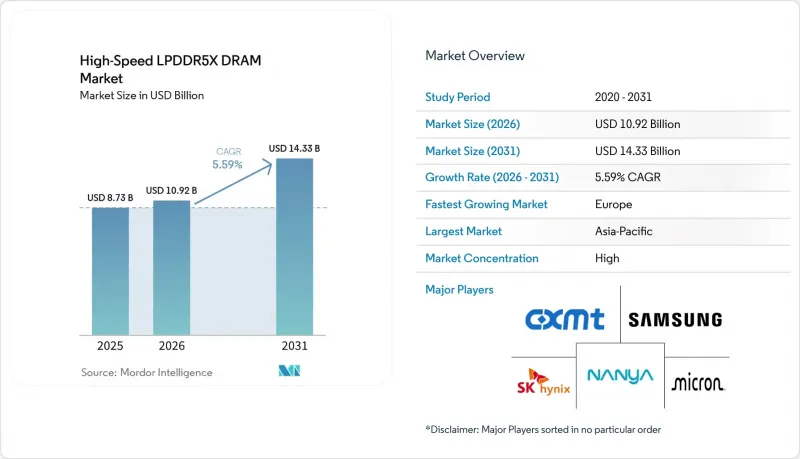
본 보고서는 속도 등급(핀당 7,500 Mb/s, 8,533 Mb/s, 9,600 Mb/s 및 10,667/10,700 Mb/s), 다이 밀도(8 GB, 12 GB, 16GB, 24GB, 32 GB 및 그 이상), 최종 기기(스마트폰, 태블릿, 초슬림 경량 노트북/AI PC, 크롬북, 차량용 IVI, ADAS, 중앙 처리 장치 및 기타), 그리고 지역별로 분류되어 있습니다. 시장 전망은 금액(달러) 기준으로 제시되어 있습니다.
세계 고속 LPDDR5X DRAM 시장 동향 및 인사이트
GenAI 탑재 플래그십 스마트폰의 메모리 탑재량 확대
온디바이스 AI는 기존 스마트폰 교체 주기가 예상했던 것보다 빠른 속도로 스마트폰 메모리 선정에 영향을 미치고 있습니다. 마이크론은 2025년 6월, 1Y 공정을 기반으로 한 10.7 Gbps LPDDR5X가 Llama 2의 쿼리 응답 시간을 30%, 번역 결과를 50% 이상, 추천 엔진의 성능을 25% 향상시켰습니다고 발표했습니다. 이를 통해 대역폭이 모바일 기기의 AI 성능 향상과 직접적으로 연결되어 있음을 보여주었습니다. 또한 마이크론은 이러한 샘플이 16GB 패키지로 공급되고 있으며, 2026년 플래그십 스마트폰용으로는 8GB에서 32GB의 용량 범위가 계획되어 있다고 밝혔습니다. 이는 AI 지원 스마트폰의 메모리 구성이 강화되는 추세와 부합합니다. 삼성의 초슬림형 LPDDR5X 패키지는 내열성과 두께 제약을 해결하여, 더욱 얇은 스마트폰 설계에서 고밀도 메모리의 상용화를 가능하게 하고 있습니다. 이로 인해 고속 LPDDR5X 동적 랜덤 액세스 메모리(DRAM) 시장은 AI 지원 플래그십 스마트폰의 출시와 밀접하게 연계된 상태를 유지하고 있습니다. 이는 기기 제조업체들이 기기 내 추론을 지원하기 위해 대용량과 고속 데이터 전송 속도를 모두 필요로 하기 때문입니다.
8533 지원 프리미엄 SoC의 표준화
핀당 8,533 Mb/s급은 프리미엄 LPDDR5X 도입에 있어 가장 안정적인 성능 지점으로 자리 잡고 있습니다. JEDEC의 LPDDR5X 사양서는 컨트롤러 검증 및 동작 매개변수에 관한 공통된 프레임워크를 확립하여, 보다 광범위한 생태계가 이 등급에 부합할 수 있도록 지원하고 있습니다. 그 후, CXMT는 LPDDR5X 제품의 양산을 확인했으며, 8,533 Mbps, 9,600 Mbps, 10,667 Mbps 각 변형에 대한 지속적인 진전을 발표했습니다. 이는 핵심 프리미엄 등급에서 주류 제품공급 체계가 개선되고 있음을 보여줍니다. 이는 고속 LPDDR5X DRAM 시장에서 중요한 의미를 지닙니다. 널리 수용된 속도 등급은 인증 절차의 장벽을 낮추고, 더 많은 디바이스 프로그램이 공통된 기반 위에서 양산으로 전환될 수 있도록 하기 때문입니다. 또한, 규모 확대를 주도하는 등급과 프리미엄 차별화 및 새로운 노드로의 전환으로 이어지는 고속 빈(bin) 사이에 더 명확한 경계선을 그을 수 있게 됩니다.
공급업체 집중 및 할당 리스크
고속 LPDDR5X DRAM 시장공급은 여전히 극소수의 선도 제조업체에 집중되어 있습니다. 삼성, SK하이닉스, 마이크론이 최첨단 LPDDR5X 제품을 계속 주도하고 있으며, CXMT는 여전히 네 번째 신뢰할 수 있는 공급원으로서의 입지를 다져가고 있습니다. SK하이닉스가 서버용 SOCAMM2를 출시한 것은 LPDDR5X 다이가 스마트폰 이외의 고부가가치 포맷으로도 확대되기 시작했음을 보여주며, 이로 인해 시장 전체의 할당 관리가 더욱 엄격해질 가능성이 있습니다. CXMT의 IPO 투자설명서에는 기술 업그레이드를 위한 투자 계획이 제시되었으나, 경쟁사들의 추격 과정이 완료된 것이 아니라 여전히 진행 중이라는 점도 확인되었습니다. 따라서 플래그십 스마트폰 수요, AI PC 수요, 그리고 AI 서버용 패키징 수요가 동시에 증가할 때마다 고속 LPDDR5X DRAM 시장은 공급 조정 압력을 받게 될 것입니다.
부문 분석
2025년, 핀당 8,533 Mb/s 등급은 고속 LPDDR5X DRAM 시장 점유율의 61.29%를 차지하며, 프리미엄 디바이스 프로그램에서 주요 양산 등급이 되었습니다. 이러한 위상은 주요 시스템 온 칩(SoC) 로드맵 전반에 걸친 장기적인 검증 기간을 반영한 것입니다. LPDDR5X의 확장으로 인해 메모리 컨트롤러 개발 팀은 이 속도 등급에 맞추어 최적화를 진행할 시간을 확보할 수 있었기 때문입니다. 고속 LPDDR5X DRAM 시장에서 이러한 성숙도는 중요한 의미를 지닙니다. 대규모 플래그십 제품이나 상위 등급의 생산량을 널리 수용되고 있는 단일 등급으로 전환할 때의 위험을 줄여주기 때문입니다. OEM 및 공급업체들이 더 고성능의 AI 지원 기기로의 광범위한 전환에 발맞추어 더 빠른 규격을 표준화해 나감에 따라, 기존의 7,500 Mb/s 등급 시장 점유율은 축소되는 추세입니다. CXMT가 8,533 Mbps로 양산을 시작한 것도, 상업적으로 가장 중요한 비중을 차지하는 이 등급에서공급 옵션 폭을 넓히는 데 기여할 것입니다.
핀당 10,667/10,700 Mb/s 부문은 2031년까지 연평균 성장률(CAGR) 6.39%를 나타낼 것으로 예측되며, 고속 LPDDR5X DRAM 시장에서 가장 빠르게 성장하는 속도 등급이 될 것입니다. 마이크론은 2025년 6월, 자사의 1Y 공정을 기반으로 한 LPDDR5X가 10.7 Gbps로 작동하며, 7.5Gbps의 1B 세대에 비해 43%의 속도 향상을 실현한다고 발표함과 동시에, 2026년 플래그십 스마트폰을 타겟으로 하고 있다고 밝혔습니다. 삼성 역시 AI 용도에 최적화된 10.7 Gbps LPDDR5X 제품을 개발 중이며, 주요 공급업체들이 동시에 속도 범위의 상한선을 끌어올리고 있음을 보여줍니다. 9,600 Mb/s 대역은 속도, 검증, 시스템 수준의 안정성 간의 균형이 필요한 노트북용 모듈 및 자동차용 메모리 프로그램을 지원하기 때문에 여전히 핵심적인 역할을 수행하고 있습니다. 이로 인해 고속 LPDDR5X DRAM 시장 내에는 계층 구조가 형성되어 있습니다. 8,533 Mb/s가 시장 확대를 주도하고, 9,600 Mb/s가 폭넓은 플랫폼의 유연성을 뒷받침하며, 10,667/10,700 Mb/s가 차기 프리미엄 업그레이드 주기를 포착하는 형태를 띠고 있습니다.
지역별 분석
2025년, 아시아태평양은 고속 LPDDR5X DRAM 시장의 81.21%를 차지할 것으로 예상되며, 이는 해당 지역 내 메모리 제조, 디바이스 조립 및 최종 제품에 대한 수요가 고도로 집중되어 있음을 반영합니다. 한국은 여전히 주요 생산 거점이며, 삼성과 SK하이닉스가 모바일, 컴퓨팅, 자동차 이용 사례에 걸친 첨단 LPDDR5X 로드맵의 상당 부분을 주도하고 있습니다. 중국은 주요 스마트폰 제조 거점이자 CXMT의 LPDDR5X 사업 확장을 위한 핵심 시장으로서, 수요 및 공급 양면에서 이 지역의 기반을 강화하고 있습니다. CXMT의 IPO 투자설명서에 따르면, 이 회사는 샤오미, OPPO, vivo, Transsion 등을 포함한 중국 내 스마트폰용 LPDDR 고객 기반을 확대하고 있으며, 중국 내 현지 조달의 중요성이 높아지고 있음을 여실히 보여주고 있습니다. 대만과 일본은 패키징, 전자기기 제조 및 고신뢰성 용도를 통해 시장을 뒷받침하고 있는 반면, 인도와 동남아시아에서는 스마트폰 조립 대수 증가와 LPDDR5X 탑재 모델로의 단계적 전환이 지속적으로 진행되고 있습니다.
유럽은 2031년까지 연평균 성장률(CAGR) 6.37%를 나타낼 것으로 예측되며, 고속 LPDDR5X DRAM 시장에서 가장 두드러진 성장을 보일 것으로 전망됩니다. 가장 강력한 성장 동력은 소프트웨어 정의 차량(SDV) 프로그램과 중앙 집중식 차량 컴퓨팅으로, 이 분야에서는 저전력 메모리가 엄격한 신뢰성 및 안전성 요건을 충족해야 합니다. NXP의 S32N7 플랫폼은 자동차 컴퓨팅 아키텍처가 더 높은 LPDDR5X 탑재 요건에 부합하는 도메인 처리 및 중앙 처리 모델로 전환되고 있음을 보여줍니다. 또한 유럽에서는 기업 및 교육 기관을 중심으로 AI PC 도입이 진행되고 있으며, 이는 LPDDR5X를 탑재한 노트북 설계 및 관련 모듈 형식에 대한 수요를 뒷받침하고 있습니다.
북미는 AI PC 플랫폼의 동향, 하이퍼스케일 컴퓨팅 수요, 그리고 해당 지역 내 대규모 DRAM 제조업체로서 마이크론의 입지가 맞물려, 고속 LPDDR5X 동적 랜덤 액세스 메모리(DRAM) 시장에서 여전히 전략적으로 중요한 지역으로 남아 있습니다. 마이크론의 현재 LPDDR5X 부품 및 LPCAMM2 모듀얼 포트폴리오를 통해, 해당 지역의 시스템 제조업체들은 모바일 및 노트북용 양쪽 폼 팩터를 모두 활용할 수 있게 되었습니다. SK하이닉스의 NVIDIA ‘Vera-Rubin’ 플랫폼용 SOCAMM2 프로그램은 AI 서버 도입에 있어 LPDDR5X의 새로운 수요 거점으로서 북미의 역할을 더욱 부각시키고 있습니다. 남미, 중동 및 아프리카, 오세아니아를 포함한 세계 기타 지역은 여전히 매출 규모가 비교적 작고, 현지 수요가 수입 디바이스나 비용 중심의 제품군에 치우쳐 있기 때문에 LPDDR5X의 채택은 완만한 속도로 진행될 것으로 보입니다.
기타 혜택:
- 엑셀 형식 시장 예측(ME) 시트
- 3개월간의 애널리스트 지원
자주 묻는 질문
목차
제1장 서론
제2장 조사 방법
제3장 주요 요약
제4장 시장 구도
제5장 시장 규모와 성장 예측
제6장 경쟁 구도
제7장 시장 기회와 향후 전망
KTH 26.08.06According to Mordor Intelligence, the high-speed LPDDR5X DRAM market size is expected to increase from USD 8.73 billion in 2025 to USD 10.92 billion in 2026 and reach USD 14.33 billion by 2031, growing at a CAGR of 5.59% over 2026-2031.
This report is Segmented by Speed Grade (7, 500 Mb/S Per Pin, 8, 533 Mb/S Per Pin, 9, 600 Mb/S Per Pin, and 10, 667 / 10, 700 Mb/S Per Pin), Die Density (8 GB, 12 GB, 16 GB, 24 GB, 32 GB, and More), End Device (Smartphones, Tablets, Thin-And-Light Notebooks / AI PCs, Chromebooks, Automotive IVI, ADAS, and Central Compute, and More), and Geography. The Market Forecasts are Provided in Terms of Value (USD).
Global High-Speed LPDDR5X DRAM Market Trends and Insights
GenAI Flagship Smartphone Memory Content Expansion
On-device AI is changing smartphone memory decisions faster than earlier handset upgrade cycles had assumed. Micron said in June 2025 that its 1Y-based LPDDR5X at 10.7 Gbps improved Llama 2 query response time by 30%, translation results by more than 50%, and recommendation engine performance by 25%, which tied bandwidth directly to visible AI performance gains in mobile devices. Micron also said those samples were being supplied in 16 GB packages, with an 8 GB to 32 GB capacity range planned for 2026 flagship smartphones, which aligns with the move toward richer memory configurations in AI-ready phones. Samsung's ultra-thin LPDDR5X package addresses heat resistance and thickness constraints, enabling practical use of higher memory density in slimmer phone designs. This keeps the high-speed LPDDR5X dynamic random-access memory (DRAM) market closely tied to flagship AI phone launches, as device makers now need both higher capacity and faster data rates to support on-device inference.
8533-Ready Premium SoC Standardization
The 8,533 Mb/s per pin class has become the most stable performance point for premium LPDDR5X deployments. JEDEC's LPDDR5X documentation established a common framework for controller validation and operating parameters, helping the broader ecosystem align around this grade. CXMT later confirmed mass production of LPDDR5X products and publicly showed continued progress across 8,533 Mbps, 9,600 Mbps, and 10,667 Mbps variants, which indicates that mainstream supply depth at the core premium grade is improving. This matters in the high-speed LPDDR5X DRAM market because a widely accepted speed grade lowers qualification friction and lets more device programs move to volume production on a common footing. It also creates a clearer boundary between the grade that drives scale and the faster bins that remain tied to premium differentiation and newer node transitions.
Supplier Concentration and Allocation Risk
Supply in the high-speed LPDDR5X DRAM market remains concentrated around a very small group of advanced manufacturers. Samsung, SK hynix, and Micron continue to lead the most advanced LPDDR5X products, while CXMT is still building its position as a fourth credible source. SK hynix's server-focused SOCAMM2 launch shows that LPDDR5X dies are now being directed into additional high-value formats beyond smartphones, which can tighten allocation discipline across the market. CXMT's IPO prospectus showed a planned investment path for technology upgrades, but it also confirmed that the competitive catch-up process is still underway rather than complete. That leaves the high-speed LPDDR5X DRAM market exposed to allocation pressure whenever flagship phone demand, AI PC demand, and AI server packaging demand rise at the same time.
Other drivers and restraints analyzed in the detailed report include:
- LPDDR4X Production Drawdown Accelerating Migration
- AI PC and Chromebook Low-Power Memory Uptake
- Memory BOM Inflation for Price-Sensitive Devices
For complete list of drivers and restraints, kindly check the Table Of Contents.
Segment Analysis
The 8,533 Mb/s per pin tier held 61.29% of the high-speed LPDDR5X DRAM market share in 2025, making it the primary volume grade for premium device programs. That position reflects a long validation window across leading system-on-chip roadmaps, because the LPDDR5X extension gave memory controller teams time to optimize around this speed class. In the high-speed LPDDR5X DRAM market, that maturity matters because it lowers the risk of moving large flagship and upper-tier volumes onto a single widely accepted grade. The earlier 7,500 Mb/s tier has been giving way as OEMs and suppliers standardize on higher speeds, consistent with the broader shift toward more capable AI-ready devices. CXMT's move into mass production at 8,533 Mbps also broadens supply options at the grade that carries the largest commercial weight.
The 10,667/10,700 Mb/s per pin segment is projected to grow at a 6.39% CAGR through 2031, making it the fastest-rising speed class in the high-speed LPDDR5X DRAM market. Micron said in June 2025 that its 1Y-based LPDDR5X operates at 10.7 Gbps and delivers a 43% speed increase over the 7.5 Gbps 1B generation, while also targeting 2026 flagship smartphones. Samsung also developed a 10.7 Gbps LPDDR5X product optimized for AI applications, demonstrating that leading suppliers are pushing the upper end of the speed range in parallel. The 9,600 Mb/s tier keeps a strong middle role, because it supports notebook modules and automotive memory programs that need a balance of speed, validation, and system-level stability. This creates a layered structure inside the high-speed LPDDR5X DRAM market, where 8,533 Mb/s drives scale, 9,600 Mb/s supports broader platform flexibility, and 10,667/10,700 Mb/s captures the next premium upgrade cycle.
Complete Report Scope:
- By Speed Grade
- 7,500 Mb/s per pin
- 8,533 Mb/s per pin
- 9,600 Mb/s per pin
- 10,667 / 10,700 Mb/s per pin
- By Die Density
- 8 GB
- 12 GB
- 16 GB
- 24 GB
- 32 GB
- 64 GB and Above
- By End Device
- Smartphones
- Tablets
- Thin-and-Light Notebooks / AI PCs
- Chromebooks
- Automotive IVI, ADAS and Central Compute
- Embedded / Edge AI Devices and AR/VR
- By Geography
- North America
- Europe
- Asia-Pacific
- China
- Japan
- South Korea
- Taiwan
- Rest of Asia-Pacific
- Rest of the World
Geography Analysis
Asia-Pacific accounted for 81.21% of the high-speed LPDDR5X DRAM market in 2025, reflecting the region's deep concentration of memory manufacturing, device assembly, and end-product demand. South Korea remains the leading production center, with Samsung and SK hynix driving much of the advanced LPDDR5X roadmap across mobile, computing, and automotive use cases. China reinforces the region on both the demand and supply sides, as it is a major smartphone manufacturing base and the home market for CXMT's LPDDR5X expansion. CXMT's IPO prospectus said the company had established a growing domestic smartphone LPDDR customer base, including Xiaomi, OPPO, vivo, and Transsion, underscoring the growing relevance of local sourcing in China. Taiwan and Japan add support through packaging, electronics manufacturing, and high-reliability applications, while India and Southeast Asia continue to absorb rising smartphone assembly volumes and a gradual move toward LPDDR5X-enabled models.
Europe is projected to grow at a 6.37% CAGR through 2031, making it the fastest-growing region in the high-speed LPDDR5X DRAM market. The strongest support comes from software-defined vehicle programs and centralized vehicle compute, where low-power memory must meet strict reliability and safety requirements. NXP's S32N7 platform demonstrates how automotive compute architectures are moving toward domain- and central-processing models that align with higher LPDDR5X content requirements. Europe also benefits from AI PC adoption in enterprise and education purchases, which supports demand for LPDDR5X notebook designs and related module formats.
North America remains a strategically important part of the high-speed LPDDR5X dynamic random access memory (DRAM) market because it combines AI PC platform activity, hyperscale compute demand, and Micron's position as the region's large-scale DRAM producer. Micron's current LPDDR5X component and LPCAMM2 module portfolio gives system makers in the region access to both mobile and notebook-oriented form factors. SK hynix's SOCAMM2 program for NVIDIA's Vera-Rubin platform further underlines North America's role as an emerging demand center for LPDDR5X in AI server deployments. The Rest of the World, including South America, the Middle East, Africa, and Oceania, remains a smaller revenue pool, where LPDDR5X adoption is likely to remain gradual because local demand still leans toward imported devices and cost-sensitive product tiers.
- Samsung Electronics Co., Ltd.
- SK hynix Inc.
- Micron Technology, Inc.
- ChangXin Memory Technologies Group Co., Ltd.
- Nanya Technology Corporation
- BIWIN Storage Technology Co., Ltd.
- ADATA Technology Co., Ltd.
- Innodisk Corporation
- Apacer Technology Inc.
- Framework Computer Inc.
- Memorysolution GmbH
- Jet One Technology Co., Ltd.
Additional Benefits:
- The market estimate (ME) sheet in Excel format
- 3 months of analyst support
TABLE OF CONTENTS
1 INTRODUCTION
- 1.1 Study Assumptions and Market Definition
- 1.2 Scope of the Study
2 RESEARCH METHODOLOGY
3 EXECUTIVE SUMMARY
4 MARKET LANDSCAPE
- 4.1 Market Overview
- 4.2 Market Drivers
- 4.2.1 GenAI Flagship Smartphone Memory Content Expansion
- 4.2.2 8533-Ready Premium SoC Standardization
- 4.2.3 LPDDR4X Production Drawdown Accelerating Migration
- 4.2.4 AI PC and Chromebook Low-Power Memory Uptake
- 4.2.5 Automotive Centralized Compute and Safety-Grade LPDDR Adoption
- 4.2.6 Thin-Package Thermal Gains Enabling Higher Capacities
- 4.3 Market Restraints
- 4.3.1 Supplier Concentration and Allocation Risk
- 4.3.2 Mid-Tier Processor Compatibility Gaps
- 4.3.3 High-Speed Signal and Thermal Validation Burden
- 4.3.4 Memory BOM Inflation for Price-Sensitive Devices
- 4.4 Industry Supply Chain Analysis
- 4.5 Industry Value Chain Analysis
- 4.6 Regulatory Landscape
- 4.7 Technological Outlook
- 4.8 Impact of Macroeconomic Factors
- 4.9 Porter's Five Forces Analysis
- 4.9.1 Bargaining Power of Suppliers
- 4.9.2 Bargaining Power of Buyers
- 4.9.3 Threat of New Entrants
- 4.9.4 Threat of Substitutes
- 4.9.5 Intensity of Competitive Rivalry
5 MARKET SIZE AND GROWTH FORECASTS (VALUE)
- 5.1 By Speed Grade
- 5.1.1 7,500 Mb/s per pin
- 5.1.2 8,533 Mb/s per pin
- 5.1.3 9,600 Mb/s per pin
- 5.1.4 10,667 / 10,700 Mb/s per pin
- 5.2 By Die Density
- 5.2.1 8 GB
- 5.2.2 12 GB
- 5.2.3 16 GB
- 5.2.4 24 GB
- 5.2.5 32 GB
- 5.2.6 64 GB and Above
- 5.3 By End Device
- 5.3.1 Smartphones
- 5.3.2 Tablets
- 5.3.3 Thin-and-Light Notebooks / AI PCs
- 5.3.4 Chromebooks
- 5.3.5 Automotive IVI, ADAS and Central Compute
- 5.3.6 Embedded / Edge AI Devices and AR/VR
- 5.4 By Geography
- 5.4.1 North America
- 5.4.2 Europe
- 5.4.3 Asia-Pacific
- 5.4.3.1 China
- 5.4.3.2 Japan
- 5.4.3.3 South Korea
- 5.4.3.4 Taiwan
- 5.4.3.5 Rest of Asia-Pacific
- 5.4.4 Rest of the World
6 COMPETITIVE LANDSCAPE
- 6.1 Market Concentration
- 6.2 Strategic Moves
- 6.3 Market Share Analysis
- 6.4 Company Profiles (includes Global Level Overview, Market Level Overview, Core Segments, Financials as available, Strategic Information, Market Rank/Share, Products and Services, Recent Developments)
- 6.4.1 Samsung Electronics Co., Ltd.
- 6.4.2 SK hynix Inc.
- 6.4.3 Micron Technology, Inc.
- 6.4.4 ChangXin Memory Technologies Group Co., Ltd.
- 6.4.5 Nanya Technology Corporation
- 6.4.6 BIWIN Storage Technology Co., Ltd.
- 6.4.7 ADATA Technology Co., Ltd.
- 6.4.8 Innodisk Corporation
- 6.4.9 Apacer Technology Inc.
- 6.4.10 Framework Computer Inc.
- 6.4.11 Memorysolution GmbH
- 6.4.12 Jet One Technology Co., Ltd.
7 MARKET OPPORTUNITIES AND FUTURE OUTLOOK
- 7.1 White-Space and Unmet-Need Assessment


