

|
시장보고서
상품코드
2072556
독일의 NOR 플래시 : 시장 점유율 분석, 업계 동향 및 통계, 성장 예측(2026-2031년)Germany NOR Flash - Market Share Analysis, Industry Trends & Statistics, Growth Forecasts (2026 - 2031) |
||||||
 Mordor Intelligence
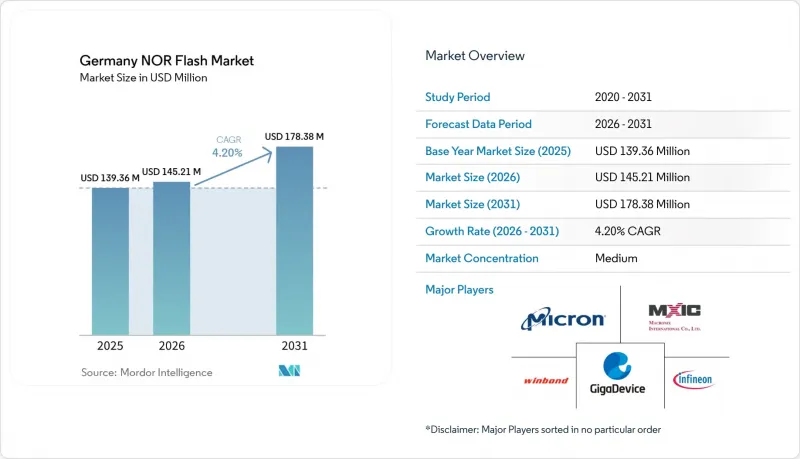
Mordor Intelligence에 의하면, 독일의 NOR 플래시 시장 규모는 2025년 1억 3,936만 달러로 평가되었습니다. 2026년에는 1억 4,521만 달러로 확대되어 2031년까지 1억 7,838만 달러에 이를 것으로 예상되고 2026년부터 2031년에 걸쳐 CAGR 4.20%로 성장할 전망입니다.
본 보고서는 NOR 플래시의 유형(직렬, 병렬), 인터페이스(SPI 싱글/듀얼 등), 용량(2메가비트 이하 등), 전압(3V급 등), 최종 사용자용도(소비자용 전자기기, 통신, 기타), 공정 기술 노드(65nm, 45nm, 55nm, 기타), 패키지 유형(WLCSP/CSP, 기타)별로 분류되어 있습니다. 시장 전망은 금액(달러) 및 수량(단위)으로 제시되어 있습니다.
독일의 NOR 플래시 시장 동향 및 분석
펌웨어를 광범위하게 사용하는 ADAS 및 도메인 컨트롤러가 자동차용 NOR 플래시 수요를 가속화하고 있습니다.
독일의 OEM 및 1차 공급업체들은 분산형 전자 제어 장치에서 도메인 및 구역 아키텍처로의 전환을 추진하고 있으며, 이러한 변화로 인해 각 차량 플랫폼에서 사용되는 외부 코드 저장소의 용량이 증가하고 있습니다. 빠른 부팅, 인플레이스 실행, 그리고 신뢰성 높은 펌웨어 저장 장치는 안전성이 극히 중요한 자동차 시스템에서 여전히 핵심적인 역할을 수행하고 있기 때문에 독일의 NOR 플래시 메모리 시장은 이러한 전환의 혜택을 누리고 있습니다. 인피니온은 자사의 자동차용 메모리 제품군을 ADAS 및 자율주행용 도메인 컨트롤러 설계에 직접 적용하고 있습니다. 이러한 설계에서는 시스템 전체의 초기화에 앞서, 신속한 부팅과 신뢰성 높은 펌웨어에 대한 접근이 요구됩니다. 이러한 설계 방식에 따라 인증 공급업체의 수가 제한되기 때문에 메모리 가격이 전반적으로 하락하더라도 인증 공급업체는 가격을 유지하기가 더 쉬워집니다. 독일의 차량 아키텍처에서 연산 기능이 통합됨에 따라 각 컨트롤러 내의 펌웨어 밀도가 지속적으로 높아지고 있으며, 이는 자동차용 등급의 NOR 부품에 대한 수요 기반을 구조적으로 공고히 하고 있습니다.
독일 생산 거점에서 고속 기동형 IoT 엣지 디바이스에 쿼드 및 옥탈 SPI 채택
독일의 공장 자동화 분야에서는 센서 네트워크, 게이트웨이, 프로그래머블 컨트롤러의 경우, 기동 지연이 생산 중단으로 직결되기 때문에 더 고속의 직렬 인터페이스 도입이 확대되고 있습니다. 독일의 NOR 플래시 메모리 시장은 이러한 변화의 혜택을 누리고 있습니다. 산업용 엣지 기기에서 표준 SPI 및 듀얼 I/O 디바이스가 더 높은 대역폭을 가진 쿼드 SPI 및 옥탈 솔루션으로 점차 대체되고 있기 때문입니다. 윈본드의 W35T 옥탈 NOR는 200 MHz DDR에서 400 MB/s의 연속 읽기 처리량을 지원하며, 인스턴트 온(Instant-On) 작동이 필요한 산업용 공장 자동화 및 IoT 시스템을 대상으로 합니다. GigaDevice사도 GD25NX xSPI 시리즈를 통해 이러한 전환을 추진했습니다. 이 시리즈는 1.8V 코어와 1.2V I/O 설계를 결합함으로써, 제약이 엄격한 에지 노드에서 외부 전원 회로에 대한 요구 사항을 완화하고 있습니다. 독일의 기계 제조업체들이 중복 부트 코드 저장 및 가동 중단 위험 감소를 추진함에 따라, 옥탈 및 xSPI의 도입은 틈새 시장용 업그레이드에서 실용적인 시스템 요구 사항으로 전환되고 있습니다.
256 Mb를 초과하는 NAND와의 비용 차이로 인해 고밀도 소비자용 제품의 채택이 제한되고 있습니다.
부문별 분석
2025년에는 시리얼 NOR 플래시가 매출의 61.1%를 차지했는데, 이러한 우위는 독일의 각 OEM 업체들이 소형 제어 장치 및 산업용 엣지 설계를 위해 핀 수가 적은 메모리를 얼마나 강력하게 선호하고 있는지를 보여줍니다. 독일의 NOR 플래시 메모리 시장에서도 시리얼 NOR 플래시는 2031년까지 연평균 성장률(CAGR) 5.2%를 나타낼 것으로 예측되며, 시장 전체의 성장률을 상회하는 속도를 유지할 전망입니다. 이러한 강점은 소형 기판 레이아웃과의 호환성, 낮은 전력 소비, 그리고 자동차 및 산업용 제어 모듈에의 손쉬운 통합에서 비롯됩니다. 병렬 NOR 플래시는 병렬 버스 MCU 아키텍처를 중심으로 구축되었으며, 긴 가동 기간 동안 재설계되는 일이 거의 없는 구형 통신 시스템이나 산업용 시스템에서 여전히 중요한 역할을 수행하고 있습니다.
독일의 NOR 플래시 메모리 업계는 여전히 기존 설비의 교체 주기의 영향을 받고 있으며, 새로운 프로젝트가 다른 곳으로 이전되더라도 레거시 장비에 대한 병렬 방식 수요를 유지하는 요인이 되고 있습니다. 윈본드와 기가디바이스는 기본적인 직렬 아키텍처의 구성을 변경하지 않고도 읽기 대역폭을 향상시키는 옥탈 및 xSPI 변형을 통해 직렬 분야의 발전을 주도해 왔습니다. 이러한 표준 직렬 인터페이스에서 더 빠른 직렬 인터페이스로의 내부적 전환에 힘입어, 직렬 NOR는 기존 도입 규모를 넘어 더욱 탄력을 받고 있습니다. 또한, 다른 자동차용 및 파워 반도체 제품에서도 동일한 성숙한 공정 노드가 점점 더 널리 사용되고 있으므로, 공급업체는 해당 노드의 생산 능력을 신중하게 관리해야 합니다.
2025년에는 쿼드 SPI가 인터페이스 매출의 50.4%를 차지했으며, 이는 독일의 1차 공급업체에서 널리 사용되고 있는 MCU 및 SoC 제품군과의 폭넓은 호환성을 반영한 것입니다. 인터페이스 중 가장 빠른 성장세를 보이고 있는 것은 옥탈 및 xSPI이며, 컨트롤러의 대역폭 수요가 지속적으로 증가함에 따라 2031년까지 연평균 성장률(CAGR) 5.6%로 성장할 것으로 전망됩니다. 독일의 NOR 플래시 메모리 시장에서 이러한 변화는 메모리 아키텍처를 전면적으로 변경하지 않으면서도 더 빠른 코드 로딩이 필요한 멀티도메인 차량용 컨트롤러 및 산업용 엣지 디바이스와 밀접한 관련이 있습니다. 또한, JEDEC xSPI 규격을 준수함으로써 공급업체와 OEM이 익숙한 개발 프로세스를 통해 8라인 디바이스로 전환할 수 있도록 지원하며, 이는 전환 위험을 줄이는 데에도 기여합니다.
따라서 독일의 NOR 플래시 메모리 업계는 시리얼 부문을 포기하는 대신, 그 범위 내에서 변화를 추진하고 있습니다. 인피니온의 ‘SEMPER X1 LPDDR 플래시’는 그 적용 범위가 어디까지 확장될 수 있는지를 보여주고 있으며, 고속 데이터 액세스와 가동 중지 시간 최소화가 필요한 차세대 소프트웨어 정의 차량 아키텍처를 위해 설계된 대역폭을 갖추고 있습니다. 마크로닉스 역시 xSPI를 중시하는 메모리 제품군과 자동차용 안전성 전략을 통해 이러한 방향성에 발맞추고 있으며, 이는 인터페이스 로드맵에 대해 공급업체들 간에 폭넓은 합의가 형성되었음을 보여줍니다. 실제 결과로 볼 때, 쿼드 SPI가 현재의 양산 표준으로 남아 있는 반면, 옥탈 및 xSPI가 새로운 설계 채택의 향방을 점점 더 결정짓고 있습니다.
2025년에는 16-32메가비트 용량대가 매출의 29.5%를 차지하며, 독일의 NOR 플래시 메모리 시장에서 가장 큰 용량대가 되었습니다. 이러한 위치는 바디 제어 모듈, 파워트레인 컨트롤러, 산업용 엣지 게이트웨이 등의 용도와의 적합성을 반영한 것으로, 이러한 분야에서는 펌웨어 이미지가 여전히 이 범위 내에 머물러 있기 때문입니다. 128메가비트 대역은 도메인 컨트롤러, 디지털 콕핏 시스템 및 고성능 팩토리 게이트웨이에서 과거에는 별도의 모듈에 분산되어 있던 소프트웨어 부하가 통합됨에 따라, 2031년까지 연평균 성장률(CAGR) 5.7%로 성장할 것으로 전망됩니다. 이러한 밀도 변화는 코드량의 전반적인 증가, 보안 업데이트 단계, 그리고 다양한 기능을 갖춘 임베디드 시스템의 보급에 따른 것입니다.
256메가비트 이상의 카테고리도, 순수한 비용 효율성보다는 ‘현장 실행’ 성능이나 인증 기준이 중시되는 시스템에서 그 입지를 넓혀가고 있습니다. 저밀도 티어는 수명이 긴 산업용 계측 기기나 비교적 단순한 IoT 엔드포인트에 계속해서 활용되고 있으며, 성장률은 소폭에 그치더라도 상업적으로 중요한 위치를 차지하고 있습니다. 독일의 NOR 플래시 메모리 시장에서 32메가비트급 제품의 중요성은 여전히 높습니다. 이는 현재의 자동차 및 산업용 생산 프로그램에서 해당 등급이 큰 점유율을 차지하고 있기 때문입니다. 동시에, 연결된 기기가 보안이 강화된 펌웨어 이미지, 업데이트 스테이징, 그리고 더 긴 소프트웨어 지원 기간을 위해 더 많은 용량을 필요로 하게 됨에 따라, 대용량 제품의 실용성도 높아지고 있습니다.
기타 혜택 :
- 엑셀 형식 시장 예측(ME) 시트
- 3개월간의 애널리스트 지원
자주 묻는 질문
목차
제1장 서론
제2장 조사 방법
제3장 주요 요약
제4장 시장 구도
제5장 시장 규모 및 성장 예측
제6장 경쟁 구도
제7장 시장 기회 및 향후 전망
KTH 26.07.03According to Mordor Intelligence, the germany NOR flash market size is expected to increase from USD 139.36 million in 2025 to USD 145.21 million in 2026 and reach USD 178.38 million by 2031, growing at a CAGR of 4.20% over 2026-2031.
This report is Segmented by NOR Flash Type (Serial, and Parallel), Interface (SPI Single/Dual, and More), Density (2 Megabit and Less, and More), Voltage (3V Class, and More), End-User Application (Consumer Electronics, Communication, and More), Process Technology Node (65 Nm, 45 Nm, 55 Nm, and More), Packaging Type (WLCSP/CSP, and More). The Market Forecasts are Provided in Terms of Value (USD) and Volume (Units).
Germany NOR Flash Market Trends and Insights
Firmware-Intensive ADAS And Domain Controllers Accelerating Automotive-Grade NOR Demand
Germany's OEM and Tier-1 base is moving from distributed electronic control units toward domain- and zonal-architecture approaches, and that shift increases the amount of external code storage used on each vehicle platform. The Germany NOR flash memory market benefits from this transition because fast boot, execute-in-place operation, and dependable firmware storage remain central to safety-critical automotive systems. Infineon positions its automotive memory portfolio directly into ADAS and autonomous domain controller designs, where rapid startup and dependable firmware access are required before wider system initialization. This design pattern narrows the pool of qualified suppliers, helping certified vendors defend pricing even when broader memory pricing softens. As German vehicle architectures consolidate compute functions, firmware density continues to rise within each controller, which supports a structurally firmer demand base for automotive-grade NOR parts.
Quad And Octal SPI Adoption For Fast-Boot IoT Edge Devices Across German Manufacturing Hubs
Germany's factory automation base is adopting faster serial interfaces because boot delays translate directly into production interruptions in sensor networks, gateways, and programmable controllers. The German NOR flash memory market is gaining from this shift as standard SPI and dual I/O devices give way to higher-bandwidth quad SPI and octal solutions in industrial edge equipment. Winbond's W35T octal NOR supports 400 MB/s continuous read throughput at 200 MHz DDR and is positioned for industrial factory automation and IoT systems that need instant-on behavior. GigaDevice also moved this transition forward with its GD25NX xSPI line, which combined a 1.8 V core and 1.2 V I/O design to reduce the external power circuitry requirements in constrained edge nodes. As German machine builders push for redundant boot-code storage and lower downtime risk, octal and xSPI adoption is moving from a niche upgrade to a practical system requirement.
Cost premium over NAND above 256 Mb limiting high-density consumer adoption
Other drivers and restraints analyzed in the detailed report include:
- Constellation-Scale LEO Satellites Requiring Radiation-Hardened NOR Flash Devices
- Bundesregierung Mikroelektronik Funding Driving 55 Nm And 40 Nm On-Shore Production For NOR Self-Sufficiency
- Scaling ceilings beyond 45 nm steering German OEM roadmaps toward MRAM/ReRAM substitutes
For complete list of drivers and restraints, kindly check the Table Of Contents.
Segment Analysis
Serial NOR flash held 61.1% of revenue in 2025, and that lead shows how strongly German OEMs prefer low pin-count memory for compact control units and industrial edge designs. In the German NOR flash memory market, serial NOR flash is also expected to grow at a 5.2% CAGR through 2031, which keeps it ahead of overall market growth. This strength comes from compatibility with smaller board layouts, lower power draw, and easier integration into automotive and industrial control modules. Parallel NOR flash still matters in older telecommunications and industrial systems that were built around parallel-bus MCU architectures and are rarely redesigned during long operating lives.
The German NOR flash memory industry is still influenced by installed-base replacement cycles, and that helps sustain parallel demand in legacy equipment even as new programs move elsewhere. Winbond and GigaDevice have both pushed the serial category forward through octal and xSPI variants that raise read bandwidth without changing the basic serial architecture path. That internal migration from standard serial interfaces to faster serial interfaces gives serial NOR an extra layer of momentum beyond its installed base. It also means suppliers must manage node capacity carefully because the same mature process nodes are increasingly used across other automotive and power semiconductor products.
Quad SPI accounted for 50.4% of interface revenue in 2025, reflecting its broad compatibility with the MCU and SoC families widely used by German Tier-1 suppliers. The fastest interface growth comes from octal and xSPI, projected to grow at a 5.6% CAGR through 2031 as controller bandwidth needs continue to rise. In the German NOR flash memory market, this change is tied to multi-domain vehicle controllers and industrial edge devices that need faster code loading without a full memory architecture change. JEDEC xSPI compliance also reduces migration risk by helping suppliers and OEMs move toward 8-line devices with a familiar development path.
The German NOR flash memory industry is therefore shifting inside the serial category rather than abandoning it. Infineon's SEMPER X1 LPDDR flash shows how far that path can go, with bandwidth designed for next-generation software-defined vehicle architectures that require rapid data access and minimal downtime. Macronix has also aligned with this direction through its xSPI-oriented memory family and automotive safety positioning, indicating broad vendor agreement on the interface roadmap. The practical outcome is that quad SPI remains the current volume standard, while octal and xSPI increasingly define where new design wins are heading.
The 16-32 megabit tier accounted for 29.5% of revenue in 2025, making it the largest density bracket in the German NOR flash memory market. That position reflects its fit with body control modules, powertrain controllers, and industrial edge gateways, where firmware images still sit comfortably within that range. The 128 megabit tier is projected to grow at a 5.7% CAGR through 2031 as domain controllers, digital cockpit systems, and more capable factory gateways combine software loads that were once spread across separate modules. This density shift follows the broader rise in code volume, secure update staging, and feature-rich embedded systems.
The 256 megabit and above categories are also gaining traction in systems where execute-in-place performance and certification standards matter more than raw cost efficiency. Lower-density tiers continue to serve long-life industrial instrumentation and simpler IoT endpoints, making them commercially relevant even if growth is modest. The German NOR flash memory market for the 32 megabit tier remains important because it accounts for a large share of current automotive and industrial production programs. At the same time, larger densities are becoming more practical as connected devices require more room for secure firmware images, update staging, and longer software support windows.
Complete Report Scope:
- By Type (Value and Volume)
- Serial NOR Flash
- Parallel NOR Flash
- By Interface (Value)
- SPI Single / Dual
- Quad SPI
- Octal and xSPI
- By Density (Value)
- 2 Megabit and Less
- More than 2 to 4 Megabit
- More than 4 to 8 Megabit
- More than 8 to 16 Megabit
- More than 16 to 32 Megabit
- More than 32 to 64 Megabit
- More than 64 to 128 Megabit
- More than 128 to 256 Megabit
- More than 256 Megabit
- By Voltage (Value)
- 3 V Class
- 1.8 V Class
- Wide-Voltage (1.65 V - 3.6 V)
- Other Sub-1.8 V Classes (1.2 V, 2.5 V, 5 V)
- By End-User Application (Value and Volume)
- Consumer Electronics
- Communication
- Automotive
- Industrial
- Other Applications
- By Process Technology Node (Value)
- 90 nm and More
- 65 nm
- 55 nm (including 58 nm)
- 45 nm
- 28 nm and Below
- By Packaging Type (Value)
- WLCSP / CSP
- QFN / SOIC
- BGA / FBGA
- Other Packages
List of Companies Covered in this Report:
- Winbond Electronics Corporation
- Macronix International Co. Ltd.
- GigaDevice Semiconductor Inc.
- Infineon Technologies AG
- Micron Technology Inc.
- Integrated Silicon Solution Inc.
- Microchip Technology Inc.
- Renesas Electronics Corporation
- Elite Semiconductor Microelectronics Technology Inc.
- Samsung Electronics Co. Ltd.
- Alliance Memory Inc.
- Zbit Semiconductor Inc.
- Puya Semiconductor Co. Ltd.
- Etron Technology Inc.
- XTX Technology Limited
- Jiangsu Ruichip Electronic Co. Ltd.
- Pujing Memory Co. Ltd.
- AMIC Technology Corp.
- Tower Semiconductor Ltd.
Additional Benefits:
- The market estimate (ME) sheet in Excel format
- 3 months of analyst support
TABLE OF CONTENTS
1 INTRODUCTION
- 1.1 Study Assumptions and Market Definition
- 1.2 Scope of the Study
2 RESEARCH METHODOLOGY
3 EXECUTIVE SUMMARY
4 MARKET LANDSCAPE
- 4.1 Market Overview
- 4.2 Market Drivers
- 4.2.1 Firmware-Intensive ADAS and Domain Controllers Accelerating Automotive-Grade NOR Demand
- 4.2.2 Quad and Octal SPI Adoption for Fast-Boot IoT Edge Devices across German Manufacturing Hubs
- 4.2.3 Constellation-Scale LEO Satellites Requiring Radiation-Hardened NOR Flash Devices
- 4.2.4 Bundesregierung "Mikroelektronik" Funding Driving 55 nm and 40 nm On-Shore Production for NOR Self-Sufficiency
- 4.2.5 Secure Boot and OTA-Update Mandates in Industrie 4.0 Factories
- 4.2.6 Low-Power 1.8 V Serial NOR Enabling Wearable and Point-of-Care Healthcare Electronics
- 4.3 Market Restraints
- 4.3.1 Cost Premium over NAND above 256 Mb Limiting High-Density Consumer Adoption
- 4.3.2 Scaling Ceilings beyond 45 nm Steering German OEM Roadmaps toward MRAM and ReRAM Substitutes
- 4.3.3 Foundry Concentration in Taiwan Exposing Supply-Chain Disruption Risk for German Tier-1s
- 4.3.4 ASP Compression from Expanding Chinese Capacity Impacting Vendor Margins in Europe
- 4.4 Industry Value Chain Analysis
- 4.5 Impact of Macroeconomic Factors on the Market
- 4.6 Regulatory and Technological Outlook
- 4.7 Porter's Five Forces Analysis
- 4.7.1 Bargaining Power of Suppliers
- 4.7.2 Bargaining Power of Buyers
- 4.7.3 Threat of New Entrants
- 4.7.4 Threat of Substitute Products
- 4.7.5 Intensity of Competitive Rivalry
- 4.8 Pricing Analysis
- 4.9 Investment Analysis
5 MARKET SIZE AND GROWTH FORECASTS (VALUE AND VOLUME)
- 5.1 By Type (Value and Volume)
- 5.1.1 Serial NOR Flash
- 5.1.2 Parallel NOR Flash
- 5.2 By Interface (Value)
- 5.2.1 SPI Single / Dual
- 5.2.2 Quad SPI
- 5.2.3 Octal and xSPI
- 5.3 By Density (Value)
- 5.3.1 2 Megabit and Less
- 5.3.2 More than 2 to 4 Megabit
- 5.3.3 More than 4 to 8 Megabit
- 5.3.4 More than 8 to 16 Megabit
- 5.3.5 More than 16 to 32 Megabit
- 5.3.6 More than 32 to 64 Megabit
- 5.3.7 More than 64 to 128 Megabit
- 5.3.8 More than 128 to 256 Megabit
- 5.3.9 More than 256 Megabit
- 5.4 By Voltage (Value)
- 5.4.1 3 V Class
- 5.4.2 1.8 V Class
- 5.4.3 Wide-Voltage (1.65 V - 3.6 V)
- 5.4.4 Other Sub-1.8 V Classes (1.2 V, 2.5 V, 5 V)
- 5.5 By End-User Application (Value and Volume)
- 5.5.1 Consumer Electronics
- 5.5.2 Communication
- 5.5.3 Automotive
- 5.5.4 Industrial
- 5.5.5 Other Applications
- 5.6 By Process Technology Node (Value)
- 5.6.1 90 nm and More
- 5.6.2 65 nm
- 5.6.3 55 nm (including 58 nm)
- 5.6.4 45 nm
- 5.6.5 28 nm and Below
- 5.7 By Packaging Type (Value)
- 5.7.1 WLCSP / CSP
- 5.7.2 QFN / SOIC
- 5.7.3 BGA / FBGA
- 5.7.4 Other Packages
6 COMPETITIVE LANDSCAPE
- 6.1 Market Concentration
- 6.2 Strategic Moves
- 6.3 Market Share Analysis
- 6.4 Company Profiles (includes Global Level Overview, Market Level Overview, Core Segments, Financials as available, Strategic Information, Market Rank/Share, Products and Services, Recent Developments)
- 6.4.1 Winbond Electronics Corporation
- 6.4.2 Macronix International Co. Ltd.
- 6.4.3 GigaDevice Semiconductor Inc.
- 6.4.4 Infineon Technologies AG
- 6.4.5 Micron Technology Inc.
- 6.4.6 Integrated Silicon Solution Inc.
- 6.4.7 Microchip Technology Inc.
- 6.4.8 Renesas Electronics Corporation
- 6.4.9 Elite Semiconductor Microelectronics Technology Inc.
- 6.4.10 Samsung Electronics Co. Ltd.
- 6.4.11 Alliance Memory Inc.
- 6.4.12 Zbit Semiconductor Inc.
- 6.4.13 Puya Semiconductor Co. Ltd.
- 6.4.14 Etron Technology Inc.
- 6.4.15 XTX Technology Limited
- 6.4.16 Jiangsu Ruichip Electronic Co. Ltd.
- 6.4.17 Pujing Memory Co. Ltd.
- 6.4.18 AMIC Technology Corp.
- 6.4.19 Tower Semiconductor Ltd.
7 MARKET OPPORTUNITIES AND FUTURE OUTLOOK
- 7.1 White-Space and Unmet Need Analysis


